


06 Aug UPSC Alert: Lok Sabha Passes Taxation Bill Allowing MDR on UPI Transactions
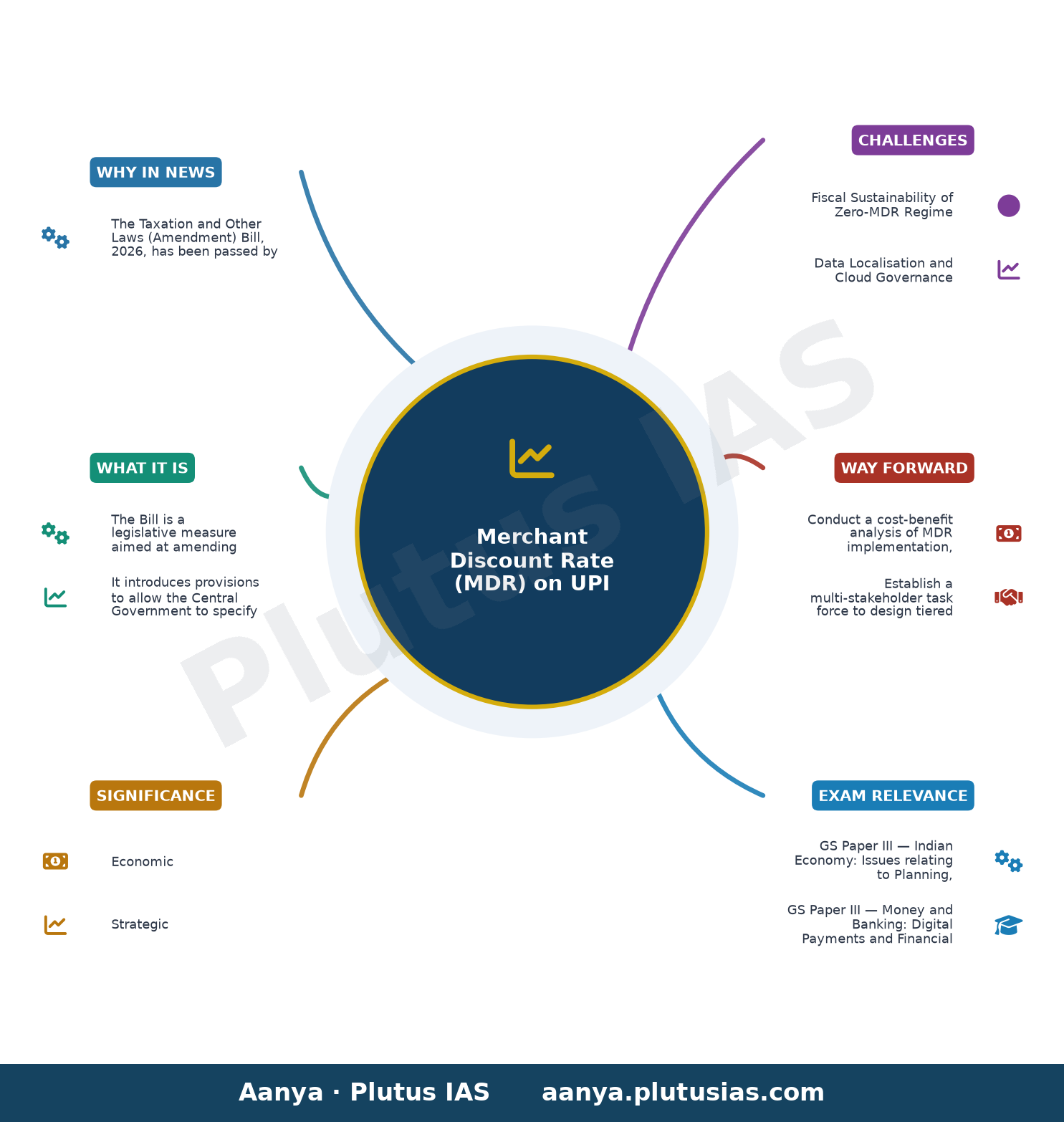
✎ The Taxation and Other Laws (Amendment) Bill, 2026, empowers the Central Government to specify which transactions remain free of charges, to generate revenue for payment system providers while supporting domestic electronics…
Subject Relevance — Where This Topic Fits
- GS Paper III — Indian Economy: Issues relating to Planning, Mobilization of Resources, Growth, Development and Employment | GS Paper III — Money and Banking: Digital Payments and Financial Inclusion | GS Paper III — Liberalisation of the Economy: Foreign Direct Investment and Foreign Portfolio Investment
- Prelims: Merchant Discount Rate (MDR), UPI (Unified Payments Interface), Payment and Settlement Systems Act, 2007, Foreign Portfolio Investors (FPI), Electronic Manufacturing Clusters (EMC), Customs-bonded warehouses, Data localisation, Zero-MDR regime
- Essay: The role of digital public infrastructure in India’s economic transformation: Opportunities and challenges, Balancing fiscal incentives with consumer protection in the digital economy
Quick Revision: The Taxation and Other Laws (Amendment) Bill, 2026, empowers the Central Government to specify which transactions remain free of charges, to generate revenue for payment system providers while supporting domestic electronics manufacturing.
Why is this in the news?
The Taxation and Other Laws (Amendment) Bill, 2026, has been passed by the Lok Sabha, introducing significant amendments to the Payment and Settlement Systems Act, 2007, and the Income Tax Act, 1961. This legislative move is aimed at generating revenue for payment system providers while supporting domestic electronic manufacturing and attracting foreign capital, particularly in data centre operations and electronics production.
Background
- The zero-MDR regime for UPI and RuPay transactions was introduced in 2020 to promote digital payments and financial inclusion, with the objective of reducing the cost burden on merchants and consumers.
- The Reserve Bank of India (RBI) and the Government of India have historically subsidised the cost of digital transactions to incentivise adoption, particularly among small merchants and in rural areas.
- The Payment and Settlement Systems Act, 2007, originally framed to regulate payment systems, has been amended multiple times to align with the evolving digital payments landscape, including the introduction of UPI in 2016.
- India’s electronics manufacturing sector has been a focus area for the Government, with initiatives such as the Production-Linked Incentive (PLI) scheme for large-scale electronics manufacturing and the Scheme for Promotion of Manufacturing of Electronic Components and Semiconductors (SPECS).
- The proposed amendments also address the relocation of fund managers to India, a move aligned with the Government’s broader strategy to position India as a global financial services hub.
- The Bill replaces an ordinance issued on June 5, 2026, which provided income-tax exemptions for foreign portfolio investors (FPIs) investing in government securities, indicating a broader trend of fiscal concessions to attract foreign capital.
What is the Taxation and Other Laws (Amendment) Bill, 2026?
- The Bill is a legislative measure aimed at amending multiple laws, including the Income Tax Act, 1961, and the Payment and Settlement Systems Act, 2007, to promote foreign investment, support domestic electronics manufacturing, and provide regulatory clarity for foreign cloud service providers.
- It introduces provisions to allow the Central Government to specify electronic payment modes or transactions that may be subject to Merchant Discount Rate (MDR), thereby reversing the zero-MDR regime for UPI and RuPay transactions above a specified threshold.
- The Bill extends the income-tax exemption for foreign companies engaged in contract manufacturing of electronic goods in India until FY 2040-41, with a focus on specified electronic products such as mobile phones, laptops, servers, and their components.
- The legislation provides ‘process certainty’ to make it easier for overseas cloud companies to use data centres, thereby facilitating data localisation and reducing compliance burdens.
- The Bill delinks the Payment and Settlement Systems Act from the Income Tax Act, providing a separate legal framework for regulating payment systems and digital transactions.
- It replaces an ordinance issued on June 5, 2026, which granted income-tax exemptions to foreign portfolio investors (FPIs) investing in government securities, indicating a broader trend of fiscal concessions to attract foreign capital.
- The Bill also seeks to facilitate the relocation of fund managers to India by reducing the conditions that such funds must meet to avoid their global income becoming taxable in India.
Key Features
| Feature | Significance |
|---|---|
| Merchant Discount Rate (MDR) provision for UPI transactions | Enables levying of charges on UPI payments above ₹2,000, reversing the zero-MDR regime to incentivise payment infrastructure providers and reduce fiscal burden on exchequer. |
| Delinking Payment and Settlement Systems Act, 2007 from Income Tax Act | Provides legal autonomy to regulate payment systems independently, enhancing policy flexibility for digital payment ecosystem. |
| 15-year income tax exemption for foreign electronics manufacturers | Encourages long-term investment in domestic electronics manufacturing, aligning with ‘Make in India’ and ‘Atmanirbhar Bharat’ objectives. |
| Extension of income tax exemption for contract manufacturers until FY2040-41 | Supports sustained growth in electronics supply chain by ensuring fiscal incentives for global manufacturers operating in India. |
| Simplification of regulatory framework for foreign cloud service providers | Reduces compliance burden for global data centre operators, facilitating India’s integration into global digital infrastructure. |
| Income-tax exemption for foreign portfolio investors in government securities | Boosts foreign capital inflows by removing tax barriers, enhancing liquidity in debt markets. |
Why it Matters
Economic
- Facilitates higher foreign direct investment (FDI) in electronics manufacturing, reducing import dependency and improving trade balance.
- Introduces revenue-neutral fiscal measures to sustain digital payment infrastructure, balancing consumer convenience with provider sustainability.
- Enhances India’s position as a global electronics manufacturing hub, aligning with global supply chain diversification trends.
- Strengthens capital market integration by exempting foreign portfolio investors from tax on government securities, improving market depth.
Strategic
- Supports ‘Atmanirbhar Bharat’ by incentivising domestic electronics production, reducing reliance on imports for critical components.
- Enhances data localisation compliance for foreign cloud providers, ensuring strategic control over digital infrastructure and data sovereignty.
- Promotes financial inclusion by sustaining UPI ecosystem while introducing calibrated user charges to prevent over-reliance on subsidies.
Policy & Governance
- Provides legal clarity and process certainty for overseas investors, reducing regulatory arbitrage and improving ease of doing business.
- Aligns taxation policies with global best practices for electronics manufacturing and digital services, enhancing India’s competitiveness.
- Introduces flexibility in payment system regulations, allowing adaptive policy responses to technological and market changes.
Challenges
1. Fiscal Sustainability of Zero-MDR Regime
- Zero-MDR policy imposed fiscal burden on exchequer, estimated at ₹1,500–2,000 crore annually, necessitating revenue-neutral alternatives.
- Proposed MDR on high-value UPI transactions may disproportionately affect small merchants and low-income users, risking exclusion.
- Lack of empirical data on consumer price elasticity of demand for digital payments complicates optimal pricing of MDR.
UPSC Link: GS3: Fiscal Policy
2. Data Localisation and Cloud Governance
- Foreign cloud providers face compliance challenges due to overlapping data localisation norms, raising concerns over operational efficiency.
- Risk of regulatory fragmentation if state-level data policies diverge from central provisions, creating compliance burdens for businesses.
- Potential conflict between data localisation and global data flow requirements under trade agreements (e.g., RCEP).
UPSC Link: GS3: IT & Cyber Security
3. Electronics Manufacturing Supply Chain Gaps
- Dependence on imported components (e.g., semiconductors) limits value addition in India’s electronics sector, constraining export competitiveness.
- Skill shortages in high-tech manufacturing and R&D hinder long-term growth in electronics sector despite fiscal incentives.
- Infrastructure bottlenecks (e.g., customs clearance, logistics) increase operational costs for bonded warehouse-based manufacturers.
UPSC Link: GS3: Industrial Policy
4. Tax Arbitrage and Compliance Complexity
- Differential tax treatment for foreign portfolio investors may create arbitrage opportunities, complicating capital market regulation.
- Global Minimum Tax (Pillar Two) implementation could reduce attractiveness of India’s tax exemptions for foreign investors.
- Complexity in determining tax residency for fund managers relocated to India may lead to disputes with foreign tax authorities.
UPSC Link: GS3: Taxation
5. Digital Payment Ecosystem Fragmentation
- Interoperability issues between UPI and other payment systems (e.g., cards, wallets) may reduce efficiency gains from MDR reforms.
- Risk of monopolistic practices by dominant payment aggregators, necessitating regulatory oversight to ensure fair competition.
- Cybersecurity threats in high-value digital transactions require robust fraud detection and consumer protection mechanisms.
UPSC Link: GS3: Digital Economy
Challenges — UPSC Perspective
| Issue | Concern |
|---|---|
| Revenue Neutrality of MDR | Ensuring MDR does not become a regressive tax, disproportionately impacting small merchants and low-income users. |
| Data Sovereignty vs. Global Compliance | Balancing India’s data localisation requirements with international data flow obligations under trade agreements. |
| Supply Chain Dependence on Imports | Reducing reliance on imported components to enhance value addition and export competitiveness in electronics. |
| Tax Incentive Efficacy | Evaluating whether 15-year tax exemptions are sufficient to offset higher operational costs in India compared to other manufacturing hubs. |
| Regulatory Arbitrage in Cloud Services | Preventing foreign cloud providers from exploiting regulatory gaps to avoid compliance with Indian data laws. |
| Digital Payment Monopolies | Mitigating risks of anti-competitive practices by dominant payment aggregators in the UPI ecosystem. |
Way Forward
- Conduct a cost-benefit analysis of MDR implementation, including impact on small merchants and consumer adoption rates.
- Establish a multi-stakeholder task force to design tiered MDR structures, ensuring equity across transaction sizes and user segments.
- Strengthen customs infrastructure and bonded warehouse facilities to reduce supply chain bottlenecks for electronics manufacturers.
- Develop a national skill development programme for high-tech manufacturing to address talent shortages in electronics and cloud services.
- Enhance cybersecurity frameworks for digital payments, including real-time fraud detection and consumer grievance redressal mechanisms.
- Align data localisation policies with global standards to avoid trade disputes while ensuring strategic data control.
- Monitor the efficacy of tax exemptions for foreign investors, adjusting policies to maintain competitiveness amid global tax reforms.
- Promote interoperability between UPI and other payment systems to enhance ecosystem efficiency and reduce fragmentation.
UPSC Value Addition
Keywords for Mains Answer-Writing
Taxation and Other Laws (Amendment) Bill 2026 · Merchant Discount Rate (MDR) on UPI transactions · Payment and Settlement Systems Act, 2007 · Zero-MDR regime · Foreign Portfolio Investors (FPIs) · Electronic manufacturing in India · Data localisation and cloud service providers · Income-tax exemptions for foreign companies · Customs-bonded warehouses for electronic components · Process certainty in taxation
Constitutional & Policy Linkages
- Article 265: Taxation must be within legislative competence and not violate constitutional provisions.
- Article 14: Ensuring MDR does not discriminate arbitrarily against certain user segments or payment modes.
- Article 19(1)(g): Balancing regulatory measures with the right to carry on business in digital payment services.
Concept Flow
Government identifies fiscal strain from zero-MDR regime → Proposes MDR on high-value UPI transactions → Lok Sabha passes Taxation and Other Laws (Amendment) Bill → Legal framework delinks Payment Systems Act from Income Tax Act → MDR notification empowers RBI to regulate charges → Impact on small merchants and consumer adoption assessed → Policy adjustments for equity and efficiency → Long-term effects on digital payment ecosystem and electronics manufacturing evaluated.
Prelims Practice Questions
Q1. Consider the following statements regarding the Taxation and Other Laws (Amendment) Bill, 2026:
1. The Bill seeks to delink the Payment and Settlement Systems Act, 2007 from the Income Tax Act.
2. It proposes to extend the income-tax exemption for foreign companies engaged in electronic manufacturing until FY 2040-41.
3. The Bill introduces a provision for levying Merchant Discount Rate (MDR) on all UPI transactions uniformly.
How many of the above statements are correct?
- Only one
- Only two
- All three
- None
Answer: Only two — Statement 1 is correct as the Bill delinks the Payment and Settlement Systems Act from the Income Tax Act. Statement 2 is correct as it extends the exemption for foreign companies in electronic manufacturing until FY 2040-41. Statement 3 is incorrect because the Bill empowers the government to specify transactions that must remain free of charges, not all UPI transactions uniformly.
Q2. Assertion (A): The Taxation and Other Laws (Amendment) Bill, 2026 aims to promote foreign capital inflow into India.
Reason (R): The Bill provides income-tax exemptions to foreign portfolio investors and facilitates the relocation of fund managers to India.
Options:
A. Both A and R are true, and R is the correct explanation of A.
B. Both A and R are true, but R is not the correct explanation of A.
C. A is true, but R is false.
D. A is false, but R is true.
- A
- B
- C
- D
Answer: A — Both Assertion (A) and Reason (R) are true. The Bill indeed aims to promote foreign capital inflow by providing tax exemptions and facilitating fund manager relocation. However, while R supports A, it is not the sole or primary explanation for A, as other provisions (e.g., MDR flexibility) also contribute to the goal.
Q3. Match the following provisions of the Taxation and Other Laws (Amendment) Bill, 2026 with their respective objectives:
Column I (Provision)
1. Delinking Payment and Settlement Systems Act from Income Tax Act
2. Extending income-tax exemption for foreign companies in electronic manufacturing
3. Empowering government to specify zero-MDR transactions
4. Simplifying regulatory framework for foreign cloud service providers
Column II (Objective)
A. Promote electronic manufacturing
B. Provide process certainty for overseas cloud companies
C. Delink regulatory frameworks
D. Allow flexibility in MDR for UPI transactions
Options:
1. 1-C, 2-A, 3-D, 4-B
2. 1-A, 2-B, 3-C, 4-D
3. 1-D, 2-C, 3-A, 4-B
4. 1-B, 2-D, 3-C, 4-A
- 1
- 2
- 3
- 4
Answer: 1 — The correct match is: 1-C (delinking frameworks), 2-A (promote electronic manufacturing), 3-D (flexibility in MDR), 4-B (simplify regulatory framework for cloud providers).
Mains Practice Question
✍ The Taxation and Other Laws (Amendment) Bill, 2026 introduces significant changes to the regulatory framework governing electronic payments, foreign investments, and domestic manufacturing. Critically analyse the implications of these amendments for India’s digital economy, foreign investment inflows, and the electronics manufacturing ecosystem. Also, examine the constitutional and policy challenges that may arise from the introduction of Merchant Discount Rate (MDR) on UPI transactions. (15 Marks)
Approach: MODEL-ANSWER SKELETON:
**Introduction (2 marks):**
– Briefly contextualise the Taxation and Other Laws (Amendment) Bill, 2026 as a legislative instrument aimed at promoting foreign capital, supporting domestic electronics manufacturing, and introducing flexibility in digital payment regulations.
**Body (10 marks):**
**Part 1: Implications for Digital Economy (4 marks)**
– Discuss the delinking of the Payment and Settlement Systems Act, 2007 from the Income Tax Act and its impact on regulatory clarity and process certainty for digital payment systems.
– Analyse the proposed flexibility in MDR for UPI transactions, including the potential for selective imposition of charges (e.g., above Rs 2,000) and its impact on user behaviour, financial inclusion, and the digital payments ecosystem.
– Reference the RBI Governor’s stance on the need for cost-sharing in digital transactions and the balance between affordability and sustainability of payment infrastructure.
**Part 2: Foreign Investment Inflows (3 marks)**
– Examine the income-tax exemptions for Foreign Portfolio Investors (FPIs) and fund managers, and their role in attracting global capital to India’s financial markets.
– Discuss the reduction in compliance conditions for fund managers relocating to India and its potential to enhance India’s position as a global financial hub.
– Highlight the significance of the ordinance’s replacement by the Bill in providing legal certainty to investors.
**Part 3: Electronics Manufacturing Ecosystem (3 marks)**
– Analyse the extension of income-tax exemptions for foreign companies engaged in electronic manufacturing until FY 2040-41, with a focus on specified products (mobile phones, laptops, servers, etc.).
– Discuss the 15-year tax exemption for foreign companies storing electronic components in customs-bonded warehouses and its role in strengthening supply chain resilience.
– Evaluate the impact of these measures on India’s goal of achieving self-reliance in electronics manufacturing (e.g., ‘Make in India’ initiative).
**Part 4: Constitutional and Policy Challenges (3 marks)**
– Critically examine the constitutional validity of empowering the government to specify zero-MDR transactions, including concerns over executive overreach and the potential for arbitrary decision-making.
– Discuss the policy challenges of introducing MDR on UPI transactions, such as the risk of discouraging digital payments, exacerbating the digital divide, and undermining the ‘less-cash’ economy vision.
– Reference the balance between revenue generation for payment system providers and the need to maintain affordability for end-users.
**Conclusion (3 marks):**
– Summarise the key takeaways from the amendments, including their potential to boost foreign investment, strengthen domestic manufacturing, and introduce flexibility in digital payments.
– Highlight the need for careful implementation of MDR provisions to avoid unintended consequences for India’s digital economy and financial inclusion goals.
– Conclude with a balanced view on whether the amendments strike the right balance between economic growth and equitable access to digital infrastructure.
Source: Times of India
Generated by AanyaAi for educational purpose.

- यूएन महासभा में भारत के विदेश मंत्री जयशंकर के उच्चस्तरीय दौरे का महत्व - September 21, 2026
- मध्य प्रदेश: हाईकोर्ट ने बलात्कार मामले में आरोपी को डीएनए सबूत के आधार पर किया दोषमुक्त - September 21, 2026
- MP High Court Acquits Rape Convict Due to Negative DNA Evidence - September 21, 2026

No Comments