


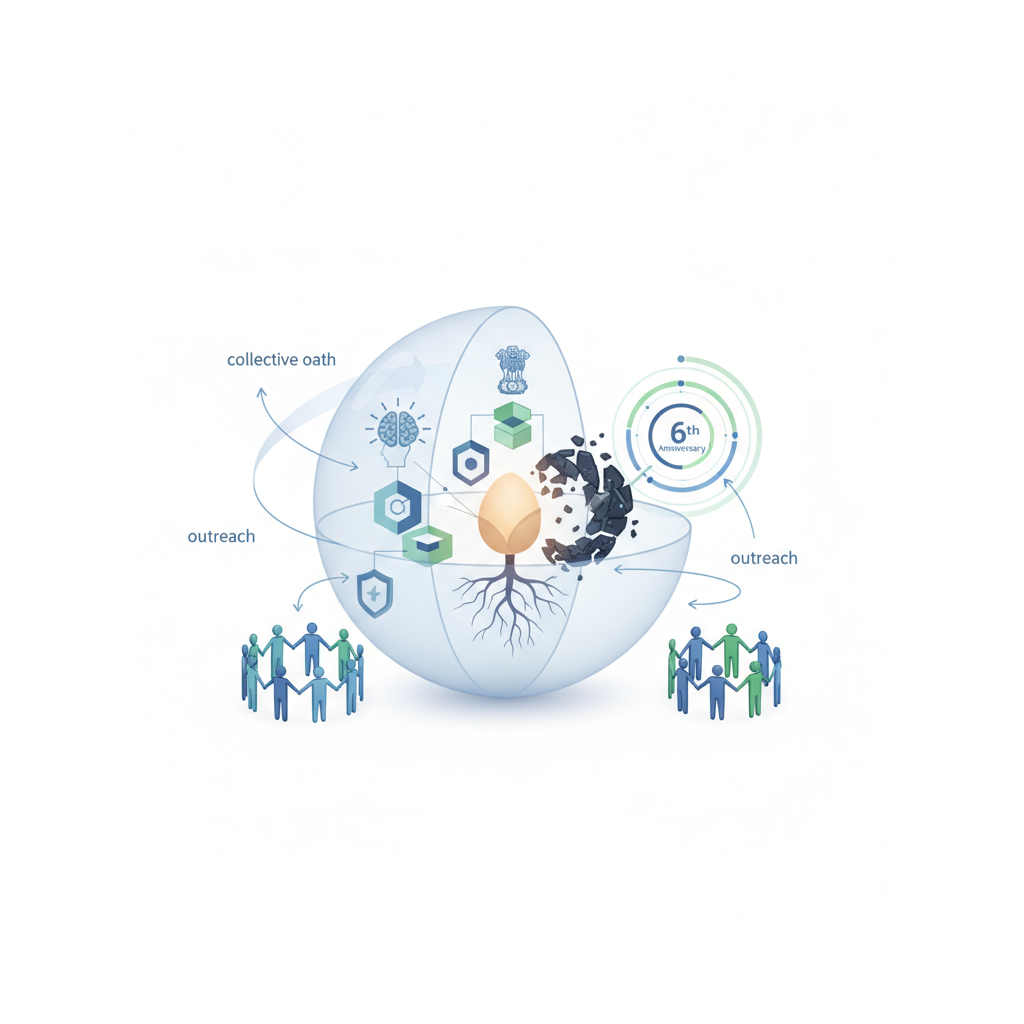
04 Sep UPSC Alert: National Oath Against Drug Abuse Under Nasha Mukt Bharat Abhiyaan 2026
✎ NMBA is India’s flagship demand-reduction initiative under the NAPDDR, integrating prevention, treatment, rehabilitation, and community participation to combat substance abuse, with the 14446 helpline and e-pledge portal serving…
Subject Relevance — Where This Topic Fits
- GS Paper II — Governance, Government Policies and Interventions for Development in various sectors and Issues arising out of their Design and Implementation | GS Paper III — Challenges to Development — Social Sector / Health / Human Resource
- Prelims: Nasha-Mukt Bharat Abhiyaan (NMBA), National Action Plan for Drug Demand Reduction (NAPDDR), Social Justice and Empowerment Ministry, 14446 Helpline, Nasha-Mukti Mitra, Demand Reduction Strategy
- Essay: Public health as a determinant of national development, The role of community participation in social welfare initiatives
Quick Revision: NMBA is India’s flagship demand-reduction initiative under the NAPDDR, integrating prevention, treatment, rehabilitation, and community participation to combat substance abuse, with the 14446 helpline and e-pledge portal serving as key operational tools.
Why is this in the news?
The Union Ministry of Social Justice and Empowerment marked the sixth anniversary of the Nasha-Mukt Bharat Abhiyaan (NMBA) by launching a nationwide collective oath against substance abuse, aiming to galvanise 10 crore citizens through direct and digital participation. High-level coordination meetings were held to strategise outreach to educational institutions, government offices, public sector undertakings, and civil society organisations, underscoring the campaign’s institutionalised approach to demand reduction.
Background
- The NMBA was launched on 15 August 2020 by the Ministry of Social Justice and Empowerment to address the rising menace of substance abuse in India.
- The campaign operates under the National Action Plan for Drug Demand Reduction (NAPDDR), a comprehensive, evidence-based strategy to reduce drug demand through prevention, treatment, rehabilitation, and aftercare.
- A National Survey on Extent and Pattern of Substance Use in India (2019) provided the empirical foundation for policy formulation and targeted interventions.
- The NAPDDR integrates multi-sectoral coordination across health, education, law enforcement, and rural development ministries to ensure holistic demand reduction.
- NMBA leverages digital platforms, including the e-pledge portal and the ‘Nasha-Mukti Mitra’ registration system, to expand reach and foster volunteer participation.
- The 14446 helpline serves as a critical intervention point for information dissemination, counselling, and referral services for individuals and families affected by substance abuse.
What is the Nasha-Mukt Bharat Abhiyaan (NMBA)?
- Launched on 15 August 2020 under the aegis of the Ministry of Social Justice and Empowerment, NMBA is a multi-pronged, demand-side intervention to reduce substance abuse in India.
- The campaign is anchored in the National Action Plan for Drug Demand Reduction (NAPDDR), which outlines strategies for prevention, treatment, rehabilitation, and aftercare within a rights-based framework.
- NMBA adopts a life-cycle approach, targeting vulnerable populations such as adolescents, youth, women, and marginalised communities through awareness campaigns, skill-building, and community mobilisation.
- The initiative employs a 360-degree communication strategy, utilising mass media, digital platforms, and grassroots outreach to disseminate information on the harms of substance abuse and available support mechanisms.
- A core component of NMBA is the ‘Nasha-Mukti Mitra’ programme, which encourages citizens to register as volunteers to support prevention efforts, provide peer counselling, and facilitate access to treatment services.
- The 14446 helpline functions as a 24×7 resource for individuals seeking help, offering counselling, guidance on de-addiction centres, and legal information related to substance abuse.
- NMBA’s e-pledge portal enables citizens to take a public oath against substance abuse, fostering a collective commitment to a drug-free society and enhancing social accountability.
- The campaign’s outreach metrics indicate engagement with over 34.56 crore citizens, including 13.71 crore youth and 10.65 crore women, demonstrating its scale and inclusivity.
Key Features
| Feature | Significance |
|---|---|
| National Oath (E-Pledge) under Nasha Mukt Bharat Abhiyaan (NMBA) | Institutionalises public commitment against substance abuse through a structured, scalable digital platform, ensuring mass participation and measurable engagement. |
| Multi-Stakeholder Coordination Mechanism | Integrates central ministries, state departments, PSUs, educational institutions, and civil society to align efforts under a unified national strategy. |
| First National Survey on Drug Use (2019) | Provides empirical data on prevalence, patterns, and socio-demographic correlates of substance abuse, enabling evidence-based policy formulation. |
| NMBA E-Pledge Portal (nashamukt.dosje.gov.in/epledge) | Facilitates voluntary registration, tracking of pledges, and dissemination of awareness content, enhancing reach and accountability. |
| National Helpline (14446) for De-addiction Support | Offers confidential counselling, referral services, and crisis intervention, reducing barriers to seeking help. |
Why it Matters
Public Health and Social Welfare
- NMBA aligns with WHO’s global strategy on drug prevention, positioning India’s response within an internationally recognised framework.
- Early intervention through community engagement mitigates long-term health, economic, and criminal consequences of substance abuse.
- Focus on youth (13.71 crore participants) and women (10.65 crore) addresses high-risk demographic segments with tailored awareness campaigns.
Governance and Institutional Capacity
- Centralised nodal agency (Ministry of Social Justice and Empowerment) ensures coherence in policy implementation across diverse sectors.
- Evidence-based approach (National Survey) strengthens policy credibility and resource allocation efficiency.
- Digital integration (E-Pledge, Helpline) enhances transparency, scalability, and real-time monitoring of outreach efforts.
Legal and Policy Framework
- NMBA operates under the National Action Plan for Drug Demand Reduction (NAPDDR), a statutory framework for demand-side interventions.
- Collaboration with law enforcement (Police, CAPFs) and judicial systems ensures a balanced approach integrating prevention, treatment, and enforcement.
Community Participation and Behavioural Change
- Mass oath-taking fosters collective responsibility, reducing stigma and normalisation of substance use in social settings.
- Volunteer mobilisation (Nasha Mukti Mitras) creates grassroots networks for sustained awareness and peer support.
Challenges
1. Geographical and Demographic Disparities in Outreach
- Urban-rural divide in access to awareness campaigns and helpline services may leave marginalised communities underserved.
- Language barriers and digital illiteracy limit participation in E-Pledge and online modules, particularly in tribal and remote areas.
UPSC Link: GS-II: Social Sector/GS-III: Health
2. Stigma and Underreporting of Substance Abuse
- Cultural and social taboos discourage individuals from seeking help or disclosing use, skewing prevalence data.
- Fear of legal consequences (e.g., for possession) deters users from accessing treatment or helpline services.
UPSC Link: GS-II: Social Justice/GS-IV: Ethics
3. Resource Constraints in Treatment and Rehabilitation
- Limited capacity of de-addiction centres and trained professionals exacerbates treatment gaps, especially in high-burden states.
- Inadequate funding for aftercare and reintegration programmes undermines long-term recovery outcomes.
UPSC Link: GS-II: Health/GS-III: Security
4. Cross-Border Drug Trafficking and Supply-Side Challenges
- India’s geographical position as a transit route for global drug trafficking complicates domestic prevention efforts.
- Weak border surveillance and porous borders facilitate smuggling, necessitating multi-agency coordination.
UPSC Link: GS-III: Security/GS-II: Governance
5. Sustainability of Community Engagement
- Short-term campaigns risk losing momentum without continuous reinforcement and local ownership.
- Volunteer burnout and attrition in grassroots initiatives may dilute impact over time.
UPSC Link: GS-IV: Ethics/GS-II: Social Sector
Challenges — UPSC Perspective
| Issue | Concern |
|---|---|
| Low awareness in tribal and remote areas | Limited reach of digital campaigns and language barriers hinder participation. |
| Stigma associated with seeking help | Underreporting of cases and reluctance to utilise helpline services. |
| Insufficient de-addiction infrastructure | Treatment gaps disproportionately affect economically weaker sections. |
| Cross-border drug trafficking | Supply-side pressures undermine demand-reduction efforts. |
| Volunteer fatigue in grassroots initiatives | Sustainability of community-led awareness programmes. |
Government Initiatives — Must-Memorise for Prelims
- Nasha Mukt Bharat Abhiyaan (NMBA)
- National Action Plan for Drug Demand Reduction (NAPDDR)
- Nasha Mukti Mitras (Volunteer Registration Portal)
Way Forward
- Strengthen multi-lingual and offline awareness modules to bridge the digital divide in rural and tribal regions.
- Expand the network of de-addiction centres and integrate telemedicine for remote counselling and treatment.
- Enhance inter-ministerial coordination with law enforcement, health, and education sectors to create a seamless referral system.
- Launch targeted campaigns in high-prevalence states using local influencers and community leaders to reduce stigma.
- Establish a centralised dashboard for real-time monitoring of outreach, helpline utilisation, and treatment outcomes.
- Incorporate substance abuse prevention into school curricula with age-appropriate modules and teacher training.
- Promote public-private partnerships to fund aftercare programmes and vocational training for recovered individuals.
- Conduct periodic national surveys to update prevalence data and evaluate the impact of NMBA interventions.
UPSC Value Addition
Keywords for Mains Answer-Writing
Nasha Mukti Bharat Abhiyaan (NMBA) · National Action Plan for Drug Demand Reduction (NAPDDR) · Substance Abuse Prevention · Community Awareness · Public Health Policy · Social Justice and Empowerment Ministry · National Survey on Drug Use · Rehabilitation and Aftercare · Youth Engagement · Preventive Healthcare · Multi-Stakeholder Coordination · Evidence-Based Policy · National Helpline 14446 · Nasha-Mukti Mitras · Drug Demand Reduction Strategies
Concept Flow
Substance abuse prevalence → National Survey (2019) → Evidence-based policy (NAPDDR) → NMBA Launch (2020) → NMBA → Multi-stakeholder coordination → E-Pledge, Helpline, Awareness Campaigns → Mass participation (34.56 crore) → Public commitment (Oath) → Behavioural change → Reduced demand → Lower health and social costs → Stigma and underreporting → Treatment gaps → Need for de-addiction infrastructure and aftercare → Cross-border trafficking → Supply-side challenge → Enforcement and border management coordination → Volunteer mobilisation → Grassroots engagement → Sustainable community-led prevention → Policy evaluation → Data-driven adjustments → Long-term impact on public health and governance
Prelims Practice Questions
Q1. Consider the following statements regarding the Nasha Mukti Bharat Abhiyaan (NMBA):
1. It was launched by the Ministry of Social Justice and Empowerment on 15 August 2020.
2. The campaign aims to reach over 10 crore citizens through direct and online participation.
3. The National Helpline for substance abuse prevention under NMBA is 14446.
4. The campaign exclusively targets urban youth and excludes rural populations.
How many of the above statements are correct?
- Only one
- Only two
- Only three
- All four
Answer: Only three — Statements 1, 2, and 3 are correct. Statement 4 is incorrect as the campaign targets both urban and rural populations, including all segments of society.
Q2. Assertion (A): The Nasha Mukti Bharat Abhiyaan (NMBA) employs a multi-stakeholder approach involving ministries, educational institutions, and voluntary organizations.
Reason (R): The campaign’s success depends on coordinated efforts across government and non-government sectors to address substance abuse comprehensively.
In the context of the above two statements, which one of the following is correct?
- Both A and R are true, and R is the correct explanation of A.
- Both A and R are true, but R is not the correct explanation of A.
- A is true, but R is false.
- A is false, but R is true.
Answer: Both A and R are true, and R is the correct explanation of A. — Both Assertion (A) and Reason (R) are true, and Reason (R) correctly explains Assertion (A). The NMBA’s multi-stakeholder approach is a deliberate strategy to ensure comprehensive coverage and effectiveness.
Q3. Match the following initiatives under the National Action Plan for Drug Demand Reduction (NAPDDR) with their respective objectives:
Column I (Initiative) | Column II (Objective)
——————————————–|——————————————–
A. Nasha Mukti Bharat Abhiyaan (NMBA) | 1. Community-based rehabilitation and aftercare
B. National Helpline (14446) | 2. Prevention through awareness and education
C. Nasha-Mukti Mitras | 3. Immediate support and counseling for substance abuse
D. National Survey on Drug Use | 4. Data-driven policy formulation and assessment
- A-2, B-3, C-1, D-4; A-3, B-2, C-1, D-4; A-2, B-1, C-3, D-4; A-4, B-3, C-2, D-1
- answer_string_to_match_with_key_above
- explain_pairwise
- format_match
Answer: ? — A. NMBA focuses on prevention through awareness and education. B. The National Helpline provides immediate support and counseling. C. Nasha-Mukti Mitras are volunteers engaged in community-based rehabilitation. D. The National Survey on Drug Use is used for data-driven policy formulation.
Mains Practice Question
✍ The Nasha Mukti Bharat Abhiyaan (NMBA) represents a paradigm shift in India’s approach to substance abuse prevention by integrating preventive healthcare with community engagement and multi-stakeholder coordination. Critically examine the institutional framework, policy instruments, and challenges associated with the NMBA in achieving its objectives. Also, assess the role of the National Action Plan for Drug Demand Reduction (NAPDDR) in providing a strategic direction to these efforts. (15 Marks)
Approach: MODEL-ANSWER SKELETON:
1. **Institutional Framework of NMBA**
– Nodal Ministry: Ministry of Social Justice and Empowerment (MoSJE) as the coordinating authority.
– Key Institutions: Involvement of Ministries (Health, Education, Railways, Defence, etc.), State Governments, NGOs, and community organizations.
– Role of District-Level Committees: Local governance and implementation through district magistrates and district drug demand reduction committees.
2. **Policy Instruments and Strategies**
– **Preventive Measures**: Mass awareness campaigns, school and college engagement, and digital platforms (e.g., NMBA e-pledge and Nasha-Mukti Mitras).
– **Intervention Mechanisms**: National Helpline (14446) for immediate support, treatment, and rehabilitation services.
– **Data-Driven Approach**: National Survey on Drug Use (first of its kind) to inform policy and assess trends.
– **Legal and Institutional Backing**: Alignment with the National Action Plan for Drug Demand Reduction (NAPDDR) under the Narcotic Drugs and Psychotropic Substances (NDPS) Act, 1985.
3. **Challenges in Implementation**
– **Geographical and Socio-Cultural Diversity**: Varied prevalence and acceptance of substance abuse across regions (e.g., Northeast vs. urban metros).
– **Stigma and Social Barriers**: Persistent stigma associated with seeking help for substance abuse, particularly among women and marginalized groups.
– **Resource Constraints**: Limited infrastructure for rehabilitation and aftercare in rural and remote areas.
– **Monitoring and Evaluation**: Ensuring real-time data collection and feedback loops for continuous improvement.
4. **Role of NAPDDR in Strategic Direction**
– **Comprehensive Framework**: NAPDDR provides a 5-pillar strategy—prevention, awareness, treatment, rehabilitation, and aftercare—under the NDPS Act.
– **Evidence-Based Policy**: Data from the National Survey informs targeted interventions and resource allocation.
– **Multi-Sectoral Coordination**: NAPDDR mandates collaboration between central ministries, state governments, and civil society to address demand and supply-side factors.
– **Legal and Institutional Synergy**: Strengthening of the Narcotics Control Bureau (NCB) and state-level drug control authorities to enforce NDPS provisions.
5. **Critical Assessment and Way Forward**
– **Strengths**: NMBA’s focus on youth engagement, digital tools, and community participation is commendable. The integration of preventive healthcare with social justice aligns with global best practices (e.g., WHO’s mhGAP).
– **Weaknesses**: Over-reliance on awareness campaigns without sufficient investment in treatment infrastructure. The National Helpline’s reach and effectiveness need periodic audits.
– **Opportunities**: Leveraging technology (AI, telemedicine) for personalized interventions and expanding the role of Nasha-Mukti Mitras as community leaders.
– **Threats**: Emerging challenges like the rise of synthetic drugs, cross-border trafficking, and the normalization of substance use in digital spaces (e.g., online drug markets).
6. **Conclusion**
– NMBA and NAPDDR represent a holistic and progressive approach to substance abuse prevention in India. However, sustained political will, increased funding, and robust implementation mechanisms are essential for translating policy into impact. The success of these initiatives will depend on their ability to adapt to evolving drug use patterns and societal attitudes.
Source: PIB (Press Information Bureau)
Generated by AanyaAi for educational purpose.
Related guides on our sites
- Current affairs for upsc 2026
- Best PSIR optional coaching for upsc
- Best sociology optional coaching for upsc
- Which is best sociology optional coaching for upsc

- इसरो ने जीएसएलवी-एफ17 द्वारा पृथ्वी अवलोकन उपग्रह ईओएस-05 का सफल प्रक्षेपण किया - September 4, 2026
- ISRO’s EOS-05 Launch: GSLV-F17 Boosts India’s Earth Observation Capabilities - September 4, 2026
- सीएआरए की पुणे वर्कशॉप: विशेष ज़रूरतों वाले बच्चों के गोद लेने में क्षेत्रीय सहयोग बढ़ा - September 4, 2026

No Comments