


05 Aug UPSC Alert: Nationwide Survey Finds Zero Manual Scavengers in 2024-25
✎ The Prohibition of Employment as Manual Scavengers and their Rehabilitation Act, 2013, and the NAMASTE scheme together aim to eliminate manual scavenging through identification, rehabilitation, mechanisation, and skill…
Subject Relevance — Where This Topic Fits
- GS Paper II — Social Justice and Welfare | GS Paper III — Employment and Skill Development | GS Paper IV — Human Dignity and Constitutional Values
- Prelims: Manual Scavenging (Prohibition) Act, 2013, National Action for Mechanised Sanitation Ecosystem (NAMASTE), National Commission for Safai Karamcharis (NCSK), Swachh Bharat Mission (SBM), Seventh Schedule of the Constitution, Sustainable Development Goals (SDG 6), Pradhan Mantri Swachhata Mission
- Essay: The moral imperative of eradicating manual scavenging in 21st century India, Technology, dignity, and social justice: The triad of sanitation reform
Quick Revision: The Prohibition of Employment as Manual Scavengers and their Rehabilitation Act, 2013, and the NAMASTE scheme together aim to eliminate manual scavenging through identification, rehabilitation, mechanisation, and skill development, while ensuring the dignity and safety of sanitation workers.
Why is this in the news?
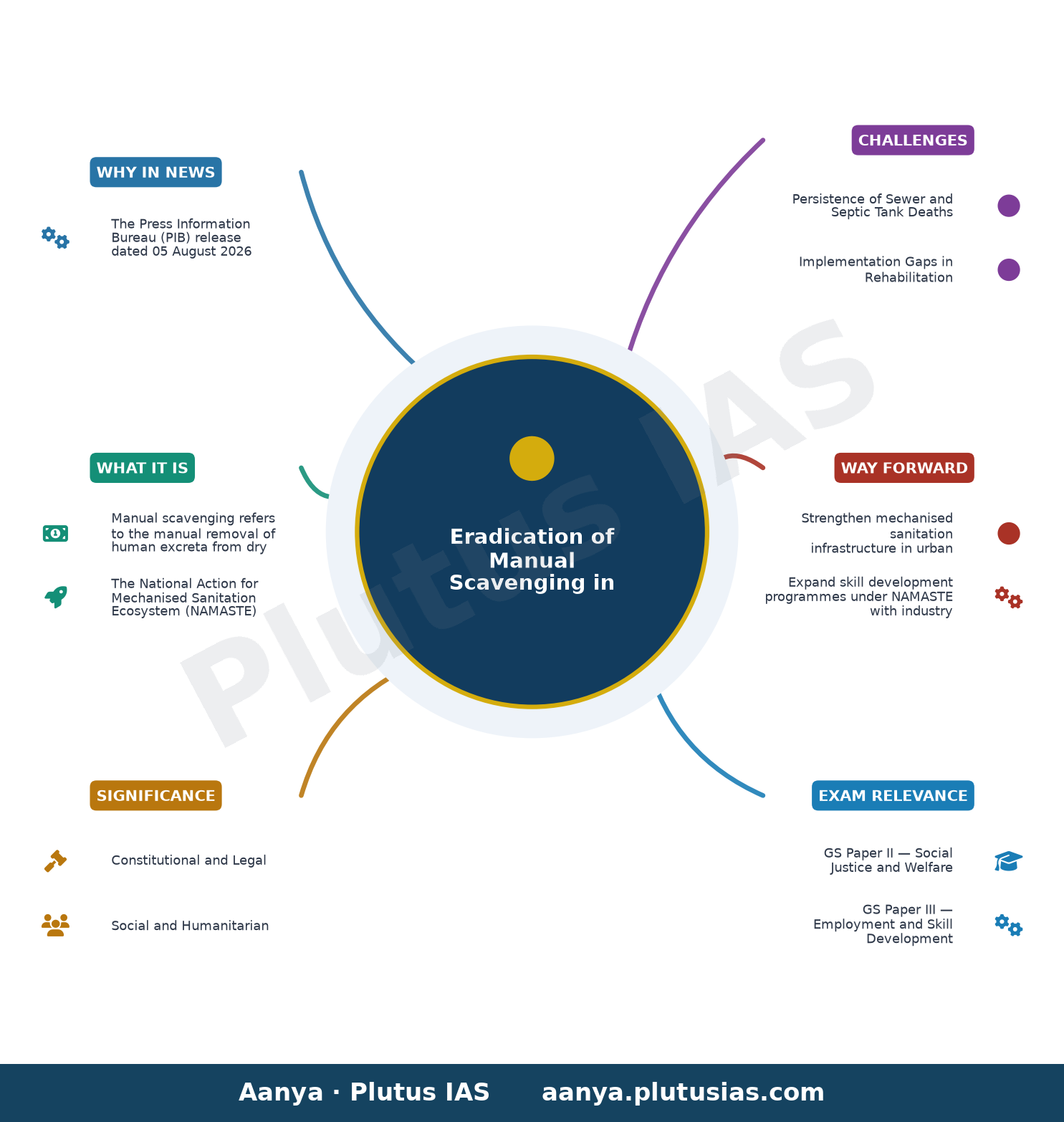
The Press Information Bureau (PIB) release dated 05 August 2026 announced that a nationwide survey conducted during 2024–25 found no individuals engaged in manual scavenging across any district in India. The announcement underscores the effectiveness of rehabilitation measures, financial assistance, and skill development initiatives, while also highlighting persistent challenges such as hazardous sewer and septic tank cleaning deaths.
Background
- Manual scavenging is a dehumanising practice rooted in caste-based occupational hierarchy, historically linked to the ‘Dalit’ communities in India.
- The Prohibition of Employment as Manual Scavengers and their Rehabilitation Act, 2013, mandates the identification, rehabilitation, and compensation of manual scavengers, along with the provision of alternative livelihoods.
- The Swachh Bharat Mission (SBM) and its subsequent phases have prioritised mechanised sanitation and the elimination of manual scavenging as key objectives.
- The National Commission for Safai Karamcharis (NCSK) has been instrumental in monitoring the implementation of laws and policies aimed at safeguarding the rights of sanitation workers.
- The Constitution of India, through the Seventh Schedule, assigns sanitation as a state subject, necessitating coordinated action between the Centre and States for effective implementation.
What is Manual Scavenging and the NAMASTE Scheme?
- Manual scavenging refers to the manual removal of human excreta from dry latrines, sewers, or septic tanks, a practice that violates fundamental rights to dignity, health, and equality under Articles 14, 15, 17, and 21 of the Constitution.
- The National Action for Mechanised Sanitation Ecosystem (NAMASTE) scheme, launched in July 2023, is a central sector scheme aimed at eliminating manual scavenging by providing mechanised sanitation solutions, financial assistance, and skill development to identified manual scavengers.
- NAMASTE integrates the erstwhile ‘Self-Employment Scheme for Rehabilitation of Manual Scavengers’ (SRMS) and focuses on four pillars: identification of manual scavengers, mechanised sanitation solutions, skill development, and financial support for alternative livelihoods.
- Under NAMASTE, identified manual scavengers receive a one-time cash assistance of ₹40,000, skill development training, and capital subsidies for self-employment ventures.
- The scheme also promotes mechanised cleaning of sewers and septic tanks to reduce the risk of hazardous manual cleaning, aligning with the objectives of the Swachh Bharat Mission.
- The National Commission for Safai Karamcharis (NCSK) monitors the implementation of laws and policies, conducts surveys, and recommends measures to improve the welfare of sanitation workers.
Key Features
| Feature | Significance |
|---|---|
| National Survey 2024-25 (No manual scavengers identified) | Demonstrates progress toward constitutional goal of Article 21 (Right to Dignity) and Article 47 (Duty of State to improve public health). |
| Financial Rehabilitation (₹40,000 lump-sum OTCS) | Provides immediate economic security to identified manual scavengers, addressing vulnerability and poverty. |
| Skill Development Training (5,632 beneficiaries, 2023-26) | Enables transition from hazardous manual labour to sustainable livelihoods, aligning with SDG 8 (Decent Work and Economic Growth). |
| Capital Subsidy for Self-Employment (483 beneficiaries) | Facilitates entrepreneurship among former manual scavengers, reducing dependency on exploitative labour. |
| FIRs in Sewer/Septic Tank Cleaning (123 cases, 2023-26) | Highlights persistent enforcement gaps despite legislative bans, necessitating stricter compliance under Prohibition of Employment as Manual Scavengers and their Rehabilitation Act, 2013. |
Why it Matters
Constitutional and Legal
- Reaffirms the State’s obligation under Article 47 to prohibit hazardous manual labour and improve public health standards.
- Validates the effectiveness of the Prohibition of Employment as Manual Scavengers and their Rehabilitation Act, 2013, in reducing manual scavenging cases.
- Highlights the role of the National Commission for Safai Karamcharis (NCSK) in monitoring enforcement and reporting deaths in sewer cleaning.
Social and Humanitarian
- Achievement of near-eradication of manual scavenging represents a milestone in social justice and dignity for marginalised communities.
- Financial and skill-based rehabilitation addresses structural inequities faced by historically oppressed groups (e.g., Scheduled Castes).
- Reduction in manual scavenging deaths (though sewer deaths persist) indicates improved safety for sanitation workers.
Economic and Developmental
- Transition from manual scavenging to skilled labour contributes to India’s demographic dividend by enhancing employability.
- Government expenditure on rehabilitation programmes (₹40,000 OTCS, training, subsidies) demonstrates investment in human capital development.
- Aligns with Sustainable Development Goals (SDG 1, 8, and 10) by reducing poverty and promoting inclusive growth.
Administrative and Governance
- Centralised data collection and rehabilitation efforts under NAMASTE (National Mechanised Sanitation Ecosystem) streamline policy implementation.
- State-level coordination remains critical, as sanitation is a State subject under the Seventh Schedule of the Constitution.
- Enforcement of bans on manual scavenging requires inter-departmental collaboration between local bodies, labour departments, and social justice ministries.
Challenges
1. Persistence of Sewer and Septic Tank Deaths
- Despite bans, 182 deaths occurred in sewer/septic tank cleaning (2023-26), indicating systemic failures in enforcement and mechanisation.
- Lack of centralised data on violators (as sanitation is a State subject) hampers accountability and policy correction.
- Mechanised cleaning infrastructure remains inadequate in many urban and rural areas, forcing manual intervention.
UPSC Link: GS2: Governance, GS3: Employment, GS4: Human Values
2. Implementation Gaps in Rehabilitation
- Only 5,632 beneficiaries received skill training (2023-26), a fraction of the 58,098 identified manual scavengers, suggesting slow progress.
- Capital subsidy utilisation (483 beneficiaries) remains low, indicating bureaucratic hurdles or lack of awareness among target groups.
- Long-term sustainability of livelihoods post-rehabilitation requires monitoring and market linkages.
UPSC Link: GS2: Welfare Schemes, GS3: Skill Development
3. Inter-State Disparities in Enforcement
- Manual scavenging persists in states with weaker governance (e.g., Uttar Pradesh, Bihar), despite national bans.
- Variations in rehabilitation funding and training infrastructure across states lead to uneven outcomes.
- Lack of uniform data collection mechanisms obscures true prevalence of manual scavenging.
UPSC Link: GS2: Federalism, GS3: Social Sector
4. Social Stigma and Caste-Based Exclusion
- Historical caste-based occupation of manual scavenging continues to stigmatise beneficiaries, hindering reintegration into society.
- Low participation of women in rehabilitation programmes reflects deep-rooted gender biases in sanitation work.
- Cultural resistance to mechanised cleaning in some communities delays adoption of safer alternatives.
UPSC Link: GS1: Social Issues, GS4: Human Values
5. Financial Constraints in Scaling Rehabilitation
- ₹40,000 OTCS and training costs impose fiscal burden on exchequer, requiring prioritisation within limited budgets.
- Dependence on central schemes (NAMASTE) for rehabilitation may not address localised economic needs.
- Private sector participation in skill development remains limited, reducing employment opportunities.
UPSC Link: GS3: Economic Development, GS2: Budgetary Allocations
Challenges — UPSC Perspective
| Issue | Concern |
|---|---|
| Sewer Deaths (182, 2023-26) | Persistent manual intervention in hazardous cleaning despite legal bans. |
| Low Skill Training Utilisation (5,632/58,098) | Inadequate coverage of rehabilitation programmes for identified beneficiaries. |
| State-Level Enforcement Gaps | Variations in implementation of manual scavenging bans across states. |
| Social Stigma and Caste Bias | Barriers to reintegration and adoption of mechanised cleaning due to entrenched discrimination. |
| Fiscal Constraints in Rehabilitation | Limited resources for scaling skill development and financial assistance programmes. |
Government Initiatives — Must-Memorise for Prelims
- Prohibition of Employment as Manual Scavengers and their Rehabilitation Act, 2013
- National Commission for Safai Karamcharis (NCSK) monitoring mechanism
- National Mechanised Sanitation Ecosystem (NAMASTE) Scheme (launched July 2023)
Way Forward
- Strengthen mechanised sanitation infrastructure in urban and rural areas to eliminate manual intervention in hazardous cleaning.
- Expand skill development programmes under NAMASTE with industry partnerships to enhance employability of beneficiaries.
- Establish a centralised digital dashboard for real-time tracking of manual scavenging cases and rehabilitation progress across states.
- Mandate annual third-party audits of sewer and septic tank cleaning operations to ensure compliance with safety protocols.
- Launch targeted awareness campaigns to combat social stigma and caste-based exclusion among manual scavengers.
- Increase fiscal allocation for rehabilitation programmes, with a focus on women and marginalised groups.
- Enforce stricter penalties for violators under the 2013 Act, including blacklisting of non-compliant agencies.
- Integrate NAMASTE with existing welfare schemes (e.g., PMKVY, DAY-NULM) to create seamless livelihood pathways.
UPSC Value Addition
Keywords for Mains Answer-Writing
Manual scavenging abolition · Prohibition of Employment as Manual Scavengers and their Rehabilitation Act, 2013 · National Safai Karamchari Commission (NCSK) · NAMASTE Scheme · Sewer and septic tank deaths · Constitutional provisions on sanitation · Social justice and empowerment · Skill development and rehabilitation · Mechanised sanitation ecosystem · Article 47 (Directive Principles of State Policy)
Concept Flow
Manual scavenging → Constitutional prohibition (Article 47) → Legal framework (2013 Act) → National surveys (2013, 2018, 2024-25) → Identification of beneficiaries → Financial rehabilitation (₹40,000 OTCS) → Skill development and entrepreneurship → Mechanised sanitation adoption → Social reintegration and dignity restoration → Sustainable eradication of manual scavenging.
Prelims Practice Questions
Q1. Consider the following statements regarding the Prohibition of Employment as Manual Scavengers and their Rehabilitation Act, 2013:
1. The Act prohibits the employment of manual scavengers and the construction of insanitary latrines.
2. The Act mandates the identification and rehabilitation of manual scavengers with financial assistance.
3. The Act is implemented by the Ministry of Housing and Urban Affairs.
4. The Act provides for the constitution of a National Commission for Safai Karamcharis (NCSK).
How many of the above statements are correct?
- Only one
- Only two
- Only three
- All four
Answer: Only three — Statements 1, 2, and 4 are correct. Statement 3 is incorrect as the Act is implemented by the Ministry of Social Justice and Empowerment, not the Ministry of Housing and Urban Affairs.
Q2. Assertion (A): The National Safai Karamchari Commission (NCSK) is a statutory body tasked with monitoring the implementation of the Prohibition of Employment as Manual Scavengers and their Rehabilitation Act, 2013.
Reason (R): The NCSK was constituted under Article 324 of the Constitution of India to oversee the welfare of safai karamcharis.
Select the correct code:
A. Both A and R are true, and R is the correct explanation of A.
B. Both A and R are true, but R is NOT the correct explanation of A.
C. A is true, but R is false.
D. A is false, but R is true.
- A
- B
- C
- D
Answer: C — Assertion (A) is true as the NCSK is indeed a statutory body monitoring the Act. Reason (R) is false because the NCSK was not constituted under Article 324 but under the Prohibition of Employment as Manual Scavengers and their Rehabilitation Act, 2013.
Q3. Match the following initiatives with their respective objectives:
Column I (Initiative) | Column II (Objective)
— | —
1. NAMASTE Scheme | A. Providing financial assistance to identified manual scavengers
2. Prohibition of Employment as Manual Scavengers Act, 2013 | B. Mechanised sanitation and rehabilitation of manual scavengers
3. One-time cash assistance (OTCA) | C. Prohibition of manual scavenging and construction of insanitary latrines
4. National Safai Karamchari Commission (NCSK) | D. Monitoring the welfare and rehabilitation of safai karamcharis
Choose the correct match:
A. 1-B, 2-C, 3-A, 4-D
B. 1-C, 2-B, 3-A, 4-D
C. 1-A, 2-B, 3-C, 4-D
D. 1-D, 2-C, 3-B, 4-A
- A
- B
- C
- D
Answer: A — The correct matches are: 1-B (NAMASTE Scheme aims at mechanised sanitation and rehabilitation), 2-C (The Act prohibits manual scavenging and construction of insanitary latrines), 3-A (OTCA provides financial assistance to identified manual scavengers), 4-D (NCSK monitors welfare and rehabilitation).
Mains Practice Question
✍ The Government of India has reiterated its commitment to the complete eradication of manual scavenging through the NAMASTE Scheme and other rehabilitation measures. In this context, critically examine the legal, institutional, and socio-economic dimensions of manual scavenging abolition in India. Also, assess the effectiveness of the Prohibition of Employment as Manual Scavengers and their Rehabilitation Act, 2013, in addressing the issue. (15 Marks)
Approach: MODEL-ANSWER SKELETON:
1. **Legal Framework**:
– Prohibition of Employment as Manual Scavengers and their Rehabilitation Act, 2013: Key provisions (Sections 3, 4, 5, 7, 8, 9, 10, 11), definition of manual scavenging, prohibition of employment, and rehabilitation measures.
– Constitutional basis: Article 47 (Directive Principles of State Policy) mandates the state to improve public health and prohibit hazardous occupations.
– Role of the National Safai Karamchari Commission (NCSK): Statutory body under the Act, monitoring implementation, and recommending measures.
2. **Institutional Mechanisms**:
– NAMASTE Scheme: National Action for Mechanised Sanitation Ecosystem, launched in 2022, aims at providing safety gear, mechanised equipment, and rehabilitation to safai karamcharis.
– State-level mechanisms: Role of state governments in implementing the Act and NAMASTE, coordination with local bodies.
– Judicial interventions: Landmark judgments (e.g., Safai Karamchari Andolan vs. Union of India, 2014) directing the government to implement the Act effectively.
3. **Socio-Economic Dimensions**:
– Caste-based exploitation: Manual scavenging is deeply linked to caste, particularly the Dalit community, perpetuating social exclusion and economic deprivation.
– Economic rehabilitation: One-time cash assistance (₹40,000), skill development training (5,632 beneficiaries in 2023-26), and capital subsidies (483 beneficiaries) as part of NAMASTE.
– Challenges: Persistence of manual scavenging in informal sectors, lack of awareness, and inadequate enforcement of the Act.
4. **Effectiveness of the Act**:
– Achievements: No manual scavengers identified in the 2024-25 nationwide survey, financial assistance provided to 58,098 identified manual scavengers, and 123 FIRs registered for hazardous sewer cleaning.
– Limitations: Continued deaths in sewer and septic tank cleaning (182 deaths from Jan 2023 to Jun 2026), lack of data on violations due to sanitation being a state subject, and slow pace of rehabilitation.
– Way forward: Strengthening NCSK, ensuring mechanised sanitation across all urban local bodies, and addressing socio-economic barriers through targeted welfare programs.
5. **Conclusion**:
– The Act and NAMASTE Scheme represent significant steps toward eradication, but challenges remain in enforcement, awareness, and socio-economic rehabilitation. A multi-dimensional approach involving legal, institutional, and socio-economic measures is essential for sustainable abolition.
Source: PIB (Press Information Bureau)
Generated by AanyaAi for educational purpose.

- तमिलनाडु के लिए क्या है ‘एल नीनो’ और उत्तर-पूर्वी मानसून का खतरा? - September 23, 2026
- El Nino & Northeast Monsoon: Impact on Tamil Nadu for UPSC 2026 - September 23, 2026
- हिमाचल में डिजिटल भुगतान क्रांति: बिलासपुर अव्वल, महिलाओं की भागीदारी 93% तक पहुंची - September 23, 2026

No Comments