


02 Aug UPSC Alert: No Manual Scavengers Found in India’s Latest Survey Under MS Act 2013
✎ The Prohibition of Employment as Manual Scavengers and their Rehabilitation (PEMSR) Act, 2013, prohibits manual scavenging, regulates unsanitary latrines, and mandates rehabilitation, while the NAMASTE Scheme and SBM-U 2.0…
Subject Relevance — Where This Topic Fits
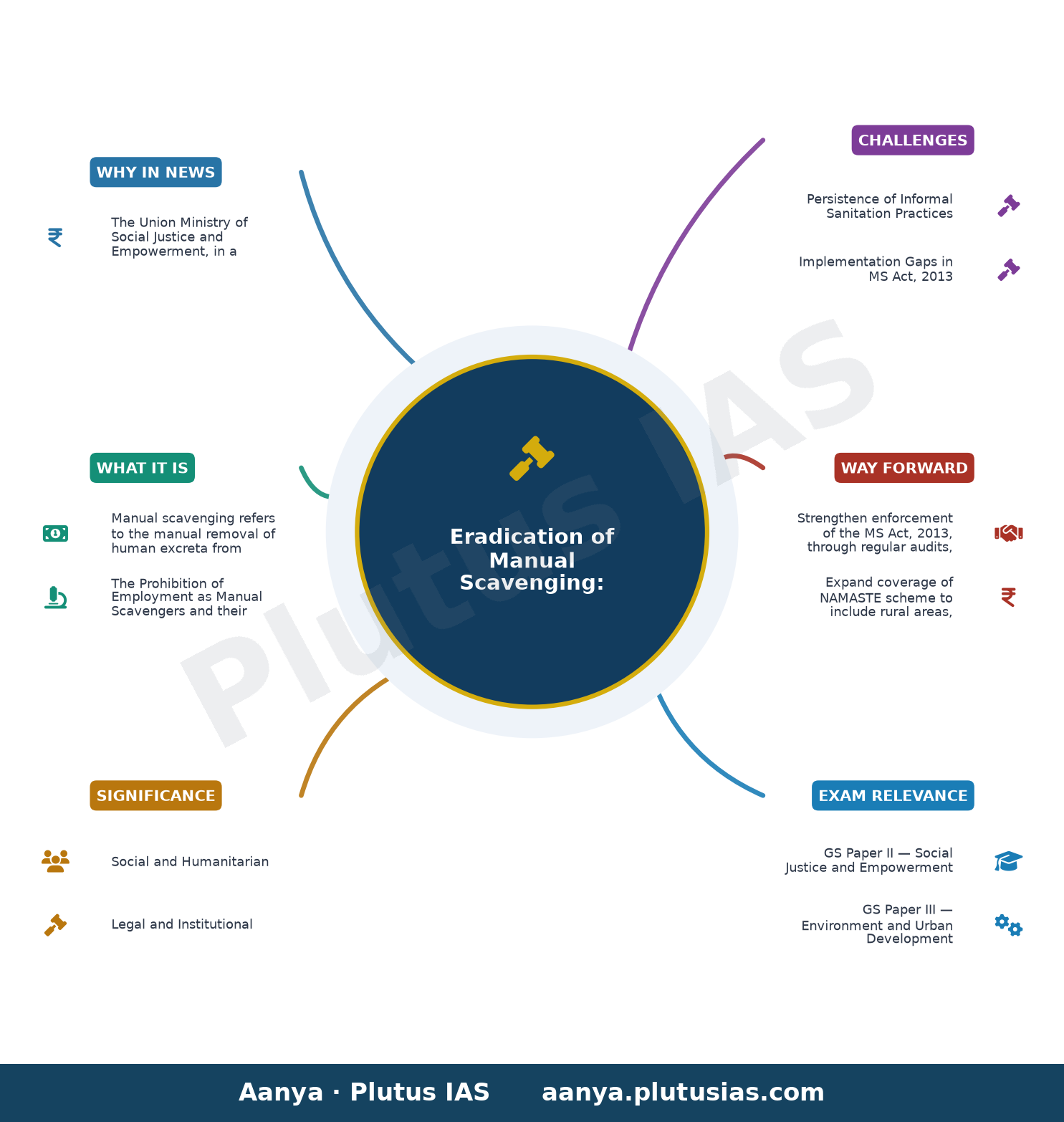
- GS Paper II — Social Justice and Empowerment | GS Paper III — Environment and Urban Development | GS Paper IV — Ethics and Governance
- Prelims: Manual Scavenging Prohibition Act, 2013, NAMASTE Scheme, Swachh Bharat Mission-Urban 2.0, Sewer and Septic Tank Workers (SSTWs), Personal Protective Equipment (PPE), Emergency Response Sanitation Units (ERSUs), Unsaniitary Latrines, Mechanised Sanitation Ecosystem
- Essay: The moral imperative of dignity in labour: Eradicating manual scavenging in India, Technology, policy, and societal transformation: The case of sanitation workers in India
Quick Revision: The Prohibition of Employment as Manual Scavengers and their Rehabilitation (PEMSR) Act, 2013, prohibits manual scavenging, regulates unsanitary latrines, and mandates rehabilitation, while the NAMASTE Scheme and SBM-U 2.0 promote mechanisation and safety for sewer and septic tank workers.
Why is this in the news?
The Union Ministry of Social Justice and Empowerment, in a written response to the Rajya Sabha on 2 August 2026, stated that a pan-India survey conducted under the provisions of the Prohibition of Employment as Manual Scavengers and their Rehabilitation (PEMSR) Act, 2013, found no manual scavengers in any district. This assertion, while indicative of progress, must be contextualised within the broader legal, institutional, and welfare frameworks designed to eliminate manual scavenging and ensure the safety and dignity of sewer and septic tank workers.
Background
- The practice of manual scavenging, defined as the manual removal of human excreta from unsanitary latrines, dry latrines, or sewers, has been a persistent social evil in India despite constitutional and statutory prohibitions.
- The PEMSR Act, 2013, was enacted to prohibit the employment of manual scavengers, regulate the construction and maintenance of unsanitary latrines, and provide for the rehabilitation of manual scavengers.
- The Act mandates the identification and rehabilitation of manual scavengers, the provision of alternative livelihoods, and the enforcement of safety measures for sewer and septic tank workers.
- The National Action for Mechanised Sanitation Ecosystem (NAMASTE) Scheme, launched in 2023-24, aims to mechanise sanitation work, provide safety gear, and ensure the welfare of sewer and septic tank workers.
- The Swachh Bharat Mission-Urban 2.0 (SBM-U 2.0), launched on 1 October 2021, includes Used Water Management (UWM) as a key component to promote mechanised cleaning of sewers and septic tanks.
- Despite legal and policy measures, ground-level implementation challenges persist, including the persistence of unsafe sanitation practices, inadequate enforcement, and socio-economic vulnerabilities of sanitation workers.
What is Manual Scavenging and the Legal Framework to Eradicate It?
- Manual scavenging refers to the manual removal of human excreta from unsanitary latrines, dry latrines, or sewers, often performed by marginalised communities, particularly Dalits, in violation of their fundamental right to dignity and equality.
- The Prohibition of Employment as Manual Scavengers and their Rehabilitation (PEMSR) Act, 2013, is the primary legal instrument to prohibit manual scavenging, regulate the construction and maintenance of unsanitary latrines, and provide for the rehabilitation of manual scavengers.
- Key provisions of the PEMSR Act include: prohibition of employment of manual scavengers, regulation of the construction and maintenance of unsanitary latrines, and the establishment of a National Commission for Safai Karamcharis to monitor implementation.
- The Act mandates the identification and rehabilitation of manual scavengers, the provision of alternative livelihoods, and the enforcement of safety measures for sewer and septic tank workers.
- The Act also criminalises the employment of manual scavengers and prescribes penalties for violations, including imprisonment and fines.
- Despite the legal framework, manual scavenging persists due to socio-economic vulnerabilities, inadequate enforcement, and the continued existence of unsanitary latrines in rural and urban areas.
- The Act also aligns with constitutional provisions, including Articles 14 (Right to Equality), 17 (Abolition of Untouchability), and 21 (Right to Life and Personal Liberty), which guarantee dignity, equality, and the right to a safe and healthy environment.
Key Features
| Feature | Significance |
|---|---|
| Manual Scavengers and their Rehabilitation (Prohibition) Act, 2013 (MS Act, 2013) | Prohibits manual scavenging, mandates rehabilitation of identified manual scavengers, and penalizes employment in hazardous sanitation work. |
| National Action for Mechanised Sanitation Ecosystem (NAMASTE) Scheme | Aims at mechanisation of sanitation work, safety of sewer and septic tank workers, and their welfare through skill development, PPE, and capital subsidies. |
| Swachh Bharat Mission-Urban 2.0 (SBM-U 2.0) | Focuses on mechanised cleaning of sewers and septic tanks, eliminating manual entry into hazardous sanitation systems. |
| Identification of 89,915 Sewer and Septic Tank Workers | Systematic mapping of workers engaged in hazardous sanitation roles for targeted welfare and safety interventions. |
| Emergency Response Sanitation Units (ERSUs) | Provides rapid response teams equipped with safety gear and machinery to address sanitation emergencies without manual intervention. |
Why it Matters
Social and Humanitarian
- The absence of manual scavengers in recent surveys reflects progress in eradicating a dehumanising practice that violates dignity and fundamental rights.
- The MS Act, 2013, and NAMASTE scheme prioritise the welfare of marginalised sanitation workers, aligning with constitutional guarantees of equality and dignity under Article 14 and Article 21.
- Mechanisation reduces occupational hazards, thereby lowering mortality and morbidity among sanitation workers, who are predominantly from Scheduled Castes and economically weaker sections.
Legal and Institutional
- The MS Act, 2013, provides a robust legal framework to prohibit manual scavenging and enforce penalties, ensuring accountability of stakeholders including local authorities and private contractors.
- NAMASTE scheme operationalises the MS Act by integrating legal compliance with welfare measures, creating a multi-layered institutional response.
- SBM-U 2.0 reinforces legal and policy commitments by mandating mechanised sanitation infrastructure, reducing reliance on manual labour in hazardous conditions.
Economic and Productivity
- Mechanisation of sanitation work enhances operational efficiency, reduces downtime due to health-related absenteeism, and lowers long-term healthcare costs for workers.
- Investment in safety equipment, training, and capital subsidies under NAMASTE creates employment opportunities in allied sectors such as manufacturing of sanitation machinery and PPE.
Public Health and Environmental
- Elimination of manual scavenging reduces exposure to toxic gases and biological hazards, thereby mitigating public health risks in urban and peri-urban areas.
- Mechanised sanitation systems improve wastewater management, reducing pollution of water bodies and soil, which is critical for sustainable urban development.
Challenges
1. Persistence of Informal Sanitation Practices
- Despite legal prohibitions, informal manual scavenging persists in rural and semi-urban areas due to lack of mechanised alternatives and socio-economic vulnerabilities.
- Workers often revert to manual scavenging due to lack of alternative livelihoods, inadequate awareness of welfare schemes, or coercion by employers.
UPSC Link: GS2: Vulnerable Sections
2. Implementation Gaps in MS Act, 2013
- Inadequate enforcement of the MS Act, 2013, particularly in states with weak local governance, leads to continued manual scavenging in violation of the law.
- Lack of regular surveys and monitoring mechanisms to identify and rehabilitate manual scavengers, despite statutory obligations.
UPSC Link: GS2: Government Policies
3. Socio-Economic Vulnerabilities of Sanitation Workers
- Sanitation workers, especially those in informal sectors, face systemic discrimination, low wages, and lack of social security, exacerbating their vulnerability.
- Limited access to education and skill development programmes restricts their upward mobility and perpetuates intergenerational poverty.
UPSC Link: GS1: Social Empowerment
4. Technological and Infrastructure Deficits
- Inadequate investment in mechanised sanitation infrastructure, particularly in smaller towns and rural areas, undermines the objectives of NAMASTE and SBM-U 2.0.
- Dependence on outdated and hazardous sanitation systems in older urban areas increases the risk of manual intervention despite legal prohibitions.
UPSC Link: GS3: Infrastructure
5. Awareness and Stigma
- Stigma associated with sanitation work discourages workers from availing welfare schemes or reporting violations, perpetuating exploitative labour practices.
- Lack of awareness among workers about their rights and entitlements under the MS Act, 2013, and NAMASTE scheme limits the reach of welfare measures.
UPSC Link: GS2: Social Justice
Challenges — UPSC Perspective
| Issue | Concern |
|---|---|
| Legal Compliance | Inadequate enforcement of the MS Act, 2013, leading to continued manual scavenging in some regions. |
| Socio-Economic Barriers | Workers lack alternative livelihoods, trapping them in hazardous sanitation work despite legal prohibitions. |
| Infrastructure Gaps | Mechanised sanitation systems are absent in many urban and rural areas, forcing reliance on manual labour. |
| Awareness Deficits | Workers are unaware of their rights and welfare schemes, reducing the efficacy of government interventions. |
| Stigma and Discrimination | Social stigma discourages workers from seeking redressal or availing welfare measures. |
| Monitoring and Surveys | Inadequate periodic surveys to identify and rehabilitate manual scavengers, despite statutory requirements. |
Government Initiatives — Must-Memorise for Prelims
- National Action for Mechanised Sanitation Ecosystem (NAMASTE) Scheme
- Swachh Bharat Mission-Urban 2.0 (SBM-U 2.0)
Way Forward
- Strengthen enforcement of the MS Act, 2013, through regular audits, penalties for violations, and mandatory mechanisation of sanitation work in all urban local bodies.
- Expand coverage of NAMASTE scheme to include rural areas, with targeted interventions for informal sanitation workers and migrant labourers.
- Enhance awareness campaigns to educate sanitation workers about their rights, entitlements, and welfare schemes, leveraging local NGOs and community leaders.
- Invest in mechanised sanitation infrastructure, particularly in smaller towns and heritage cities, to eliminate reliance on manual labour.
- Provide skill development and alternative livelihood programmes for sanitation workers, focusing on sectors such as plumbing, waste management, and machinery operation.
- Establish grievance redressal mechanisms with dedicated helplines and fast-track courts to address violations of the MS Act, 2013.
- Promote public-private partnerships to scale up the deployment of sanitation machinery and emergency response units (ERSUs).
- Integrate sanitation worker welfare into broader urban development policies, ensuring their representation in planning and implementation.
UPSC Value Addition
Keywords for Mains Answer-Writing
Manual Scavenging Prohibition Act 2013 · NAMASTE Scheme · Sewer and Septic Tank Workers · Mechanised Sanitation Ecosystem · Social Justice and Empowerment Ministry · Manual Scavengers Act 2013 survey findings · Urban Sanitation Policy · Sustainable Development Goal 6 · Constitutional Provisions for Manual Scavenging · Judicial Pronouncements on Manual Scavenging
Constitutional & Policy Linkages
- Article 14: Equality before law and equal protection of laws
- Article 21: Right to life and personal liberty, including dignity
- Article 46: Promotion of educational and economic interests of weaker sections
- Article 47: Duty of the State to improve public health
Concept Flow
Manual scavenging → Prohibition under MS Act, 2013 → Identification of workers under NAMASTE → Mechanisation of sanitation work → Reduction in manual labour → Improved safety and dignity of workers → Enhanced public health and environmental sustainability
Prelims Practice Questions
Q1. Consider the following statements regarding the ‘Manual Scavengers and their Rehabilitation (MS) Act, 2013’:
1. The Act prohibits the employment of manual scavengers for hazardous cleaning of sewers and septic tanks.
2. The Act mandates the identification and rehabilitation of manual scavengers.
3. The Act empowers the District Magistrate to conduct surveys for manual scavengers.
4. The Act provides for the provision of safety equipment and training to sewer and septic tank workers.
How many of the above statements are correct?
- Only one
- Only two
- Only three
- All four
Answer: All four — Statements 1, 2, and 3 are correct as per the MS Act, 2013. Statement 4, while a desirable provision, is not explicitly mandated by the Act itself but is addressed through schemes like NAMASTE.
Q2. Assertion (A): The National Action for Mechanised Sanitation Ecosystem (NAMASTE) Scheme aims to eliminate manual scavenging by promoting mechanised cleaning of sewers and septic tanks.
Reason (R): The scheme provides capital subsidies for sanitation machinery, personal protective equipment (PPE), and health insurance to sewer and septic tank workers.
In the context of the above two statements, which one of the following is correct?
- Both A and R are true, and R is the correct explanation of A
- Both A and R are true, but R is not the correct explanation of A
- A is true, but R is false
- A is false, but R is true
Answer: A is true, but R is false — Assertion (A) is true as NAMASTE promotes mechanised cleaning to eliminate manual scavenging. Reason (R) is also true but does not directly explain the assertion, as it focuses on welfare measures rather than the core objective of eliminating manual scavenging.
Q3. Match the following initiatives with their respective objectives:
Column I (Initiative) | Column II (Objective)
— | —
A. Manual Scavengers Act, 2013 | 1. Provision of safety equipment and training to sewer workers
B. NAMASTE Scheme | 2. Elimination of manual scavenging and rehabilitation of workers
C. Swachh Bharat Mission-Urban 2.0 | 3. Mechanisation of sewer and septic tank cleaning
D. Employment of Manual Scavengers and Construction of Dry Latrines (Prohibition) Act, 1993 | 4. Prohibition of manual scavenging and dry latrine construction
Choose the correct match:
- A-2, B-1, C-3, D-4
- A-4, B-3, C-1, D-2
- A-2, B-3, C-1, D-4
- A-4, B-1, C-3, D-2
Answer: A-4, B-1, C-3, D-2 — A matches with 2 (MS Act, 2013 aims to eliminate manual scavenging and rehabilitate workers), B matches with 3 (NAMASTE promotes mechanisation), C matches with 1 (SBM-U 2.0 includes safety measures for workers), and D matches with 4 (1993 Act prohibits manual scavenging and dry latrines).
Mains Practice Question
✍ The Government of India has reiterated its commitment to eliminate manual scavenging through legal and welfare measures. In this context, critically examine the effectiveness of the Manual Scavengers and their Rehabilitation (MS) Act, 2013, and the National Action for Mechanised Sanitation Ecosystem (NAMASTE) Scheme in achieving this objective. Also, analyse the role of judicial pronouncements and constitutional provisions in addressing the issue of manual scavenging. (15 Marks)
Approach: MODEL-ANSWER SKELETON:
1. **Introduction (2 Marks)**
– Define manual scavenging and its socio-legal dimensions.
– Briefly state the objectives of the MS Act, 2013 and NAMASTE Scheme.
2. **Provisions of the MS Act, 2013 (3 Marks)**
– Prohibition of employment of manual scavengers (Section 3).
– Prohibition of construction and maintenance of dry latrines (Section 4).
– Rehabilitation measures: cash assistance, skill development, and alternative livelihoods (Section 7).
– Survey and identification of manual scavengers (Section 6).
– Role of District Magistrates and local authorities.
3. **NAMASTE Scheme: Objectives and Components (3 Marks)**
– Launched in 2023-24 to promote mechanised sanitation.
– Identification of 89,915 sewer and septic tank workers.
– Components: PPE kits, safety training, capital subsidies for machinery, health insurance, and Emergency Response Sanitation Units (ERSUs).
– Focus on reducing human entry into sewers.
4. **Judicial Pronouncements and Constitutional Provisions (3 Marks)**
– **Constitutional Provisions**: Article 21 (Right to Life and Dignity), Article 17 (Abolition of Untouchability), and Directive Principles of State Policy (Articles 38, 39, 41, 42, 46, 47).
– **Judicial Pronouncements**:
– *Safai Karamchari Andolan v. Union of India* (2014): Directions for rehabilitation and compensation.
– *Balram Singh v. Union of India* (2022): Emphasised the need for mechanisation and strict enforcement.
– *State of Gujarat v. Hon’ble High Court of Gujarat* (2016): Highlighted the role of state governments in enforcement.
5. **Effectiveness and Challenges (3 Marks)**
– **Strengths**: Legal prohibition, welfare schemes, and judicial activism.
– **Challenges**: Persistent ground-level manual scavenging due to lack of mechanisation, social stigma, and weak enforcement.
– **Data**: Recent survey findings (no manual scavengers found) vs. ground realities (underreporting, informal sector).
6. **Conclusion (1 Mark)**
– Summarise the need for a multi-pronged approach: legal, technological, and social.
– Emphasise the role of state governments, civil society, and international commitments (SDG 6).
Source: PIB (Press Information Bureau)
Generated by AanyaAi for educational purpose.

- RoDTEP योजना को 31 दिसंबर 2026 तक बढ़ाया गया: निर्यातकों को मिलेगा लाभ - October 2, 2026
- ISRO Launches Free GIS Online Course for UPSC & PCS Aspirants - October 2, 2026
- ओडिशा के SAMS पोर्टल को मिला SKOCH प्लेटिनम अवार्ड 2026 - October 2, 2026

No Comments