


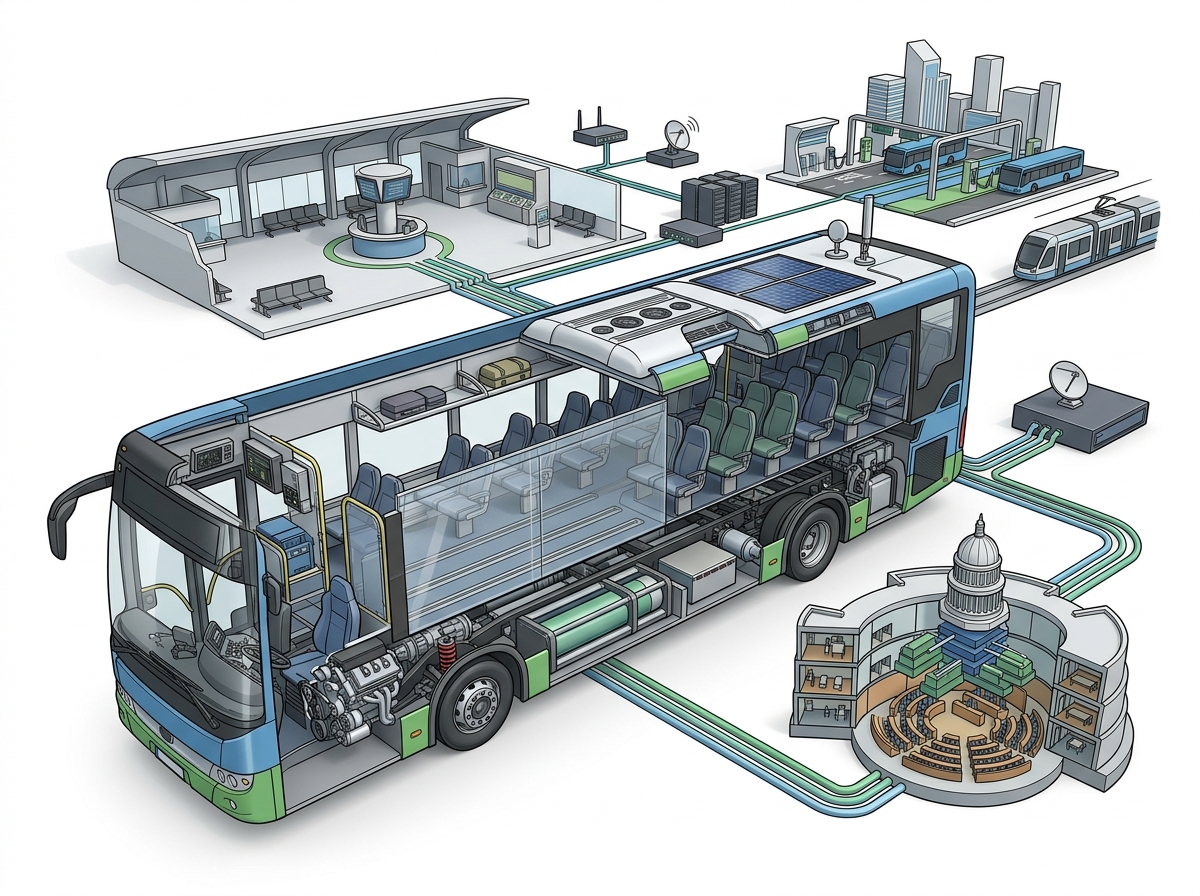
11 Aug UPSC Alert: Parliamentary Panel’s 392nd Report on Next-Gen Bus Mobility
✎ The 392nd Report of the Parliamentary Standing Committee proposes a National Bus Digital Grid for real-time tracking, unified booking, and predictive analytics to modernise India’s bus transport sector.
Subject Relevance — Where This Topic Fits
- GS Paper II — Governance, Constitution and Polity (Parliamentary Committees) | GS Paper III — Infrastructure (Transport Sector), Science and Technology (Digital Public Infrastructure) | GS Paper III — Environment and Disaster Management (Sustainable Mobility)
- Prelims: Parliamentary Standing Committee, Public-Private Partnership (PPP), National Bus Digital Grid, Fleet Transition Compact, All-India Passenger Permit, Bus Terminal Authority, Fastag, C-VIGIL, MP Local Area Development Scheme (MPLADS), End-of-Life Framework for Electric Buses
- Essay: Role of Parliamentary Committees in Policy Formulation and Oversight, Sustainable Urban Mobility: Balancing Efficiency, Equity and Environmental Goals
Quick Revision: The 392nd Report of the Parliamentary Standing Committee proposes a National Bus Digital Grid for real-time tracking, unified booking, and predictive analytics to modernise India’s bus transport sector.
Why is this in the news?
The Rajya Sabha Department-related Parliamentary Standing Committee on Transport, Tourism and Culture, chaired by Member of Parliament Shri Sanjay Kumar Jha, presented its 392nd report titled ‘Enabling Inclusive, Digital and Sustainable Bus Transport: Policy, Regulation and Public-Private Partnership for Next-Generation Mobility’ on 11 August 2026. The report, adopted on 6 August 2026, offers comprehensive recommendations on modernising India’s bus transport ecosystem through regulatory reforms, digital integration, safety enhancements, and sustainable transition strategies.
Background
- India’s urban bus transport sector operates under a fragmented regulatory framework with overlapping jurisdictions between central and state authorities, leading to inefficiencies in service delivery and infrastructure development.
- The National Urban Transport Policy (2006) and subsequent guidelines (e.g., National Urban Transport Mission) have emphasised sustainable mobility but implementation gaps persist due to inadequate institutional mechanisms and digital integration.
- Public-Private Partnership (PPP) models in bus operations (e.g., HAM, OPEX) have seen limited success in tier-II and tier-III cities, necessitating a structured policy framework for scalability.
- The Electric Mobility Promotion Scheme (EMPS) and FAME-II schemes aim to accelerate the adoption of electric buses, but challenges such as charging infrastructure, battery recycling, and fleet transition timelines remain unresolved.
- The COVID-19 pandemic disrupted public transport ridership, accelerating the need for digital ticketing, contactless payments, and real-time tracking systems to restore user confidence.
- Safety concerns, particularly for women commuters, have prompted demands for gender-inclusive transport policies, including women-operated services and enhanced surveillance systems.
What is the 392nd Report of the Parliamentary Standing Committee on Transport, Tourism and Culture?
- The report is a comprehensive policy document submitted by the Rajya Sabha’s Department-related Standing Committee on Transport, Tourism and Culture, focusing on the structural and operational reforms required to modernise India’s bus transport sector.
- It addresses critical gaps in regulatory coherence, digital infrastructure, safety standards, and sustainability, proposing a phased transition to next-generation mobility solutions.
- The report is structured around six thematic pillars: (1) All-India Passenger Permit System, (2) National Bus Terminal Authority, (3) National Bus Digital Grid, (4) Operator-Centric Safety Framework, (5) Fleet Transition Compact.
- It advocates for a shift from state-centric permit regimes to a unified, electronically monitored national permit system, ensuring seamless interstate operations and reduced regulatory friction.
- The report recommends the establishment of a dedicated National Bus Terminal Authority, modelled after the Airport Authority of India, to standardise terminal operations, ownership, and accessibility frameworks.
- A National Bus Digital Grid is proposed to integrate real-time tracking, unified booking platforms, and crowd-sourced safety ratings, leveraging GIS-based analytics for predictive maintenance and risk mapping.
- Safety reforms include mandatory fire-safety audits, retrofitting of older fleets, and the implementation of emergency warning systems, with operator safety ratings tied to permit renewals.
- The report emphasises the phased transition to electric buses through a ‘Fleet Transition Compact’ model, involving registered scrapping facilities, bulk procurement, and regional manufacturing clusters.
Key Features
| Feature | Significance |
|---|---|
| All-India Passenger Permit (Replacement of Tourist Permit) | Standardises inter-state bus operations by replacing state-specific permits with a unified, electronically monitored permit system, reducing regulatory fragmentation and facilitating seamless travel across jurisdictions. |
| National Bus Terminal Authority (Modelled on Airport Authority) | Decouples terminal ownership from bus operations to ensure non-discriminatory access, uniform standards, and integrated infrastructure planning under a dedicated statutory body. |
| National Bus Digital Grid | Creates an interoperable, real-time digital ecosystem for bus services, integrating tracking, booking, ratings, and citizen grievance redressal to enhance transparency, efficiency, and user experience. |
| Operator-Centric Safety Framework | Institutionalises automated fitness testing, mandatory safety audits, and public safety ratings to ensure compliance with life-safety standards across the bus fleet, including retrofitting measures for sleeper and school buses. |
| Fleet Transition Compact for Electrification | Accelerates the adoption of electric buses through bulk procurement, phased rollout, and end-of-life management frameworks, supported by regional manufacturing and charging infrastructure clusters. |
Why it Matters
Economic Efficiency
- Reduces transaction costs and regulatory delays by standardising permits and terminal operations, enhancing the viability of inter-state bus services.
- Lowers operational expenses through bulk procurement of buses and economies of scale in maintenance and charging infrastructure.
- Boosts tourism and regional connectivity by ensuring reliable, high-quality bus services with real-time tracking and safety compliance.
Technological Modernisation
- Integrates digital governance tools (GIS, IoT, AI-driven analytics) to create a transparent, accountable, and user-centric mobility ecosystem.
- Enables data-driven policy formulation through centralised monitoring of fleet performance, safety metrics, and service quality.
- Facilitates public-private partnerships by providing a standardised digital platform for operations, payments, and grievance redressal.
Social Inclusion and Gender Equity
- Promotes women-led bus services and employment opportunities, including targeted training and hiring programmes for female drivers and staff.
- Standardises accessibility features (e.g., toilets in buses) and implements alert systems to enhance safety for women passengers.
- Ensures equitable service delivery across regions, including underserved areas, through uniform terminal access and route planning.
Environmental Sustainability
- Accelerates the transition to electric buses through structured procurement, scrappage incentives, and regional manufacturing hubs.
- Reduces vehicular emissions and noise pollution by mandating retrofitting of safety and environmental compliance features in existing fleets.
- Encourages the adoption of cleaner technologies through end-of-life frameworks for batteries and vehicles, minimising e-waste.
Challenges
1. Regulatory Fragmentation
- Divergent state-level regulations for permits, safety standards, and terminal operations hinder seamless inter-state bus services.
- Lack of a unified digital framework complicates monitoring, enforcement, and data sharing across jurisdictions.
UPSC Link: GS-II: Federalism and Cooperative Federalism
2. Technological Integration Gaps
- Limited interoperability between state-owned and private bus operators’ digital systems impedes real-time tracking and integrated booking.
- Inadequate infrastructure for electric vehicle charging, particularly in rural and remote areas, delays fleet electrification.
UPSC Link: GS-III: Science and Technology
3. Safety and Compliance Deficits
- Inconsistent enforcement of fitness testing and safety audits leads to poor maintenance and higher accident risks.
- Absence of standardised safety ratings for operators discourages accountability and transparency in service delivery.
UPSC Link: GS-II: Governance and Accountability
4. Financial and Operational Constraints
- High capital costs for procuring electric buses and setting up charging infrastructure strain public and private sector budgets.
- Limited access to credit and incentives for small and medium-sized operators hinders their participation in modernisation programmes.
UPSC Link: GS-III: Infrastructure and Investment Models
5. Gender-Specific Barriers
- Cultural and systemic biases limit women’s participation in bus operations, including training, hiring, and retention.
- Inadequate safety measures in buses and terminals discourage women from using public transport services.
UPSC Link: GS-I: Social Empowerment
Challenges — UPSC Perspective
| Issue | Concern |
|---|---|
| Permit and Regulation Variability | Inconsistent state-level rules create administrative hurdles and operational inefficiencies. |
| Digital Divide in Monitoring Systems | Lack of standardised digital tools across states impedes real-time tracking and data sharing. |
| Safety Audit Deficiencies | Irregular enforcement of fitness tests and retrofitting norms compromises passenger safety. |
| Electric Vehicle Infrastructure Gaps | Insufficient charging stations and grid capacity delay the transition to clean energy buses. |
| Workforce Gender Imbalance | Underrepresentation of women in bus operations due to systemic barriers and safety concerns. |
| Financial Sustainability of Operators | High costs of modernisation and electrification threaten the viability of small operators. |
Way Forward
- Constitute the National Bus Terminal Authority within one year, modelled on the Airport Authority of India, to standardise terminal operations and access.
- Notify interoperability standards for the National Bus Digital Grid within six months, ensuring seamless integration of tracking, booking, and grievance redressal systems.
- Launch a phased programme for women-led bus services, including training, hiring, and safety audits, within six months.
- Develop a time-bound plan for bulk procurement of electric buses, supported by regional manufacturing and charging infrastructure clusters, within one year.
- Establish automated fitness testing stations in all districts within six months, with mandatory safety audits for all buses during permit renewal.
- Create a GIS-based risk mapping tool to identify high-risk routes and prioritise safety interventions, including retrofitting measures.
- Formulate a national code for bus terminals within one year, incorporating accessibility standards and grievance redressal mechanisms.
- Collaborate with insurance regulators to streamline claim processes for injured passengers, reducing disputes and improving service reliability.
UPSC Value Addition
Keywords for Mains Answer-Writing
Parliamentary Standing Committee on Transport, Tourism and Culture · Inclusive, Digital and Sustainable Bus Transport · All-India Passenger Permit · National Bus Terminal Authority · National Bus Digital Grid · Operator-centric Safety · Fleet Transition Compact · Women-operated Bus Services · Public-Private Partnership in Mobility · Electronic Monitoring of Vehicles · Geospatial Tracking of Buses · End-of-Life Framework for Electric Buses · Standardisation of Bus Stops · Interoperability Standards in Transport · Road Safety and Fire Prevention in Buses
Constitutional & Policy Linkages
- Article 246: Distribution of Legislative Powers (Concurrent List – Transport and Communication)
- Article 262: Adjudication of disputes relating to inter-state rivers and transport
Concept Flow
Fragmented state-level regulations → Inefficient inter-state bus services → Standardisation of permits and terminals → National Bus Terminal Authority and unified permits → Lack of digital integration → Poor monitoring and user experience → National Bus Digital Grid → Real-time tracking, integrated booking, and citizen grievance redressal → Safety compliance deficits → Higher accident risks → Operator-centric safety framework → Automated testing, retrofitting, and public safety ratings → High carbon emissions and pollution → Delayed electrification → Fleet Transition Compact → Bulk procurement of electric buses and regional manufacturing hubs → Gender inequity in transport sector → Limited women’s participation → Women-led bus services programme → Training, hiring, and safety audits
Prelims Practice Questions
Q1. Consider the following statements regarding the Parliamentary Standing Committee on Transport, Tourism and Culture:
1. The Committee is a permanent body constituted under the Rules of Procedure and Conduct of Business in the Council of States.
2. The Committee presented its 392nd Report on “Inclusive, Digital and Sustainable Bus Transport” on 11 August 2026.
3. The Report recommends the establishment of a National Bus Terminal Authority modeled on the Airports Authority of India.
How many of the above statements are correct?
- Only one
- Only two
- All
- None
Answer: All — Statements 1 and 3 are correct. Statement 2 is incorrect as the Report was presented on 11 August 2026, but the Committee’s 392nd Report pertains to the subject mentioned.
Q2. Assertion (A): The Parliamentary Standing Committee on Transport, Tourism and Culture recommends the replacement of the All-India Tourist Permit with an All-India Passenger Permit.
Reason (R): The All-India Passenger Permit is proposed to be issued by the state of first registration with clearly defined rights and enforced through electronic means.
In the context of the above two statements, which one of the following is correct?
- Both A and R are true and R is the correct explanation of A
- Both A and R are true but R is not the correct explanation of A
- A is true but R is false
- A is false but R is true
Answer: Both A and R are true and R is the correct explanation of A — Both Assertion (A) and Reason (R) are true. The Reason (R) correctly explains the Assertion (A) as the Report explicitly recommends the replacement of the All-India Tourist Permit with an All-India Passenger Permit for clarity and enforcement.
Mains Practice Question
✍ The Parliamentary Standing Committee on Transport, Tourism and Culture has recommended a paradigm shift towards ‘Inclusive, Digital and Sustainable Bus Transport’ in its 392nd Report. Critically examine the key recommendations of the Report with reference to the constitutional and institutional frameworks governing transport policy in India. Also, analyse how these recommendations align with the principles of cooperative federalism and sustainable development. (15 Marks)
Approach: MODEL-ANSWER SKELETON:
1. **Introduction (2 marks)**:
– Context: Role of Parliamentary Standing Committees in policy oversight (Article 248, Rules of Procedure of Rajya Sabha).
– Objective of the Report: Transition to inclusive, digital, and sustainable bus transport.
2. **Key Recommendations and Constitutional/Institutional Framework (5 marks)**:
– **All-India Passenger Permit**: Constitutional basis in Entry 31 of List I (Union List) and Entry 20 of List III (Concurrent List); aligns with Article 256 (obligation of States to ensure compliance with Union laws).
– **National Bus Terminal Authority**: Modelled on the Airports Authority of India (AAI) under the Airports Authority of India Act, 1994; highlights the need for a unified regulatory framework under Entry 24 of List I (Union List).
– **National Bus Digital Grid**: Interoperability standards under Entry 24 of List I; leverages the Digital India initiative and the National Digital Communications Policy, 2018.
– **Operator-centric Safety**: Compliance with the Motor Vehicles Act, 1988 (Entry 23 of List II, State List) and the Central Motor Vehicles Rules, 1989.
– **Fleet Transition Compact**: Aligns with the Faster Adoption and Manufacturing of Hybrid and Electric Vehicles (FAME) Scheme, 2015 under Entry 34 of List I.
3. **Cooperative Federalism (4 marks)**:
– **Collaborative Governance**: Recommendations on electronic monitoring, geospatial tracking, and standardisation of bus stops require Centre-State coordination under Article 263 (Inter-State Council) and Article 252 (delegation of powers to States).
– **Role of States**: States retain jurisdiction over intra-state transport (Entry 20 of List III), but the Report advocates for uniformity in enforcement and data sharing.
– **Public-Private Partnership (PPP)**: The Report emphasizes PPP models (e.g., Build-Operate-Transfer) under the National PPP Policy, 2011, and the Model Concession Agreement, 2017.
4. **Sustainable Development (3 marks)**:
– **Environmental Sustainability**: Transition to electric buses (FAME Scheme) and end-of-life frameworks for batteries align with the National Electric Mobility Mission Plan, 2020 and the Solid Waste Management Rules, 2016.
– **Social Inclusion**: Recommendations on women-operated bus services and standardisation of bus bodies (e.g., toilets) reflect the principles of the Rights of Persons with Disabilities Act, 2016 and the National Policy for Women, 2016.
– **Economic Viability**: Digital integration (e.g., live tracking, unified booking) enhances efficiency and reduces carbon footprint, aligning with the Sustainable Development Goals (SDG 11: Sustainable Cities and Communities).
5. **Conclusion (1 mark)**:
– The recommendations, if implemented, would modernize India’s bus transport sector while balancing federalism, sustainability, and digital transformation. However, challenges such as data privacy (under the Personal Data Protection Bill, 2019), inter-state coordination, and funding mechanisms need to be addressed.
Source: PIB (Press Information Bureau)
Generated by AanyaAi for educational purpose.

- यूएस-चीन एआई हॉटलाइन: क्यों शी जिनपिंग-ट्रम्प शिखर वार्ता में टैरिफ से आगे बढ़ा ‘सुपर इंटेलिजेंस’ का मुद्दा - September 26, 2026
- US-China AI Hotline: Xi-Trump Summit’s Game-Changing AI Dialogue Explained - September 26, 2026
- आईसीएआर द्वारा स्वच्छता अभियान: गणेश विसर्जन से पर्यावरण संरक्षण तक - September 26, 2026

No Comments