


07 Aug UPSC Alert: PLI Scheme Boosts Bulk Drug Production & Cuts Import Dependency
✎ The PLI Scheme for Bulk Drugs incentivizes domestic production of 41 identified APIs/KSMs/DIs with financial subsidies linked to incremental sales, reducing India’s import dependence and strengthening pharmaceutical self-reliance…
Subject Relevance — Where This Topic Fits
- GS Paper II — Government Policies and Interventions for Development in various sectors | GS Paper III — Indian Economy and Issues Relating to Planning, Mobilization of Resources, Growth, Development and Employment | GS Paper III — Issues Relating to Intellectual Property Rights (IPR) and Patents in the Pharmaceutical Sector
- Prelims: Production-Linked Incentive (PLI) Scheme, Active Pharmaceutical Ingredients (APIs), Key Starting Materials (KSM), Drug Intermediates (DI), Atmanirbhar Bharat, Pharmaceutical Policy 2020, FDI in Pharmaceutical Sector, Import Substitution, Make in India
- Essay: The Role of Government Schemes in Achieving Self-Reliance in Strategic Sectors, Balancing Innovation and Accessibility in India’s Pharmaceutical Industry
Quick Revision: The PLI Scheme for Bulk Drugs incentivizes domestic production of 41 identified APIs/KSMs/DIs with financial subsidies linked to incremental sales, reducing India’s import dependence and strengthening pharmaceutical self-reliance under Atmanirbhar Bharat.
Why is this in the news?
On 7 August 2026, the Department of Pharmaceuticals under the Ministry of Chemicals and Fertilizers, Government of India, announced the approval of 48 projects under the Production-Linked Incentive (PLI) Scheme for Bulk Drugs, aimed at boosting domestic production of Key Starting Materials (KSM), Drug Intermediates (DI), and Active Pharmaceutical Ingredients (APIs). This initiative is part of India’s broader strategy to reduce import dependence, enhance self-reliance in critical pharmaceutical inputs, and strengthen the pharmaceutical manufacturing ecosystem under the Atmanirbhar Bharat initiative.
Background
- India is the world’s third-largest pharmaceutical market by volume and ranks 14th in terms of value, with a significant share of global generic medicine production.
- The domestic pharmaceutical industry contributes approximately 20% of global generic drug exports, yet India remains heavily dependent on imports for critical APIs, KSMs, and DIs, particularly from China, which supplies over 70% of India’s API requirements.
- The COVID-19 pandemic exposed vulnerabilities in global supply chains, prompting the Government of India to prioritize domestic production of essential pharmaceutical inputs to ensure supply chain resilience.
What is the Production-Linked Incentive (PLI) Scheme for Bulk Drugs?
- The PLI Scheme for Bulk Drugs is a financial incentive mechanism introduced by the Government of India to promote domestic manufacturing of Key Starting Materials (KSMs), Drug Intermediates (DIs), and Active Pharmaceutical Ingredients (APIs).
- The scheme provides financial incentives to eligible manufacturers based on their incremental sales of domestically produced bulk drugs, with incentives ranging from 5% to 20% of sales for a period of up to 6 years.
- The total outlay for the scheme is ₹6,940 crore, with ₹87.70 crore already utilized in the distribution of incentives to approved applicants as of March 2026.
- As of August 2026, 48 projects have been approved, with a committed investment of ₹4,329.95 crore and an actual investment of ₹5,070.45 crore, indicating strong industry participation and confidence in the scheme.
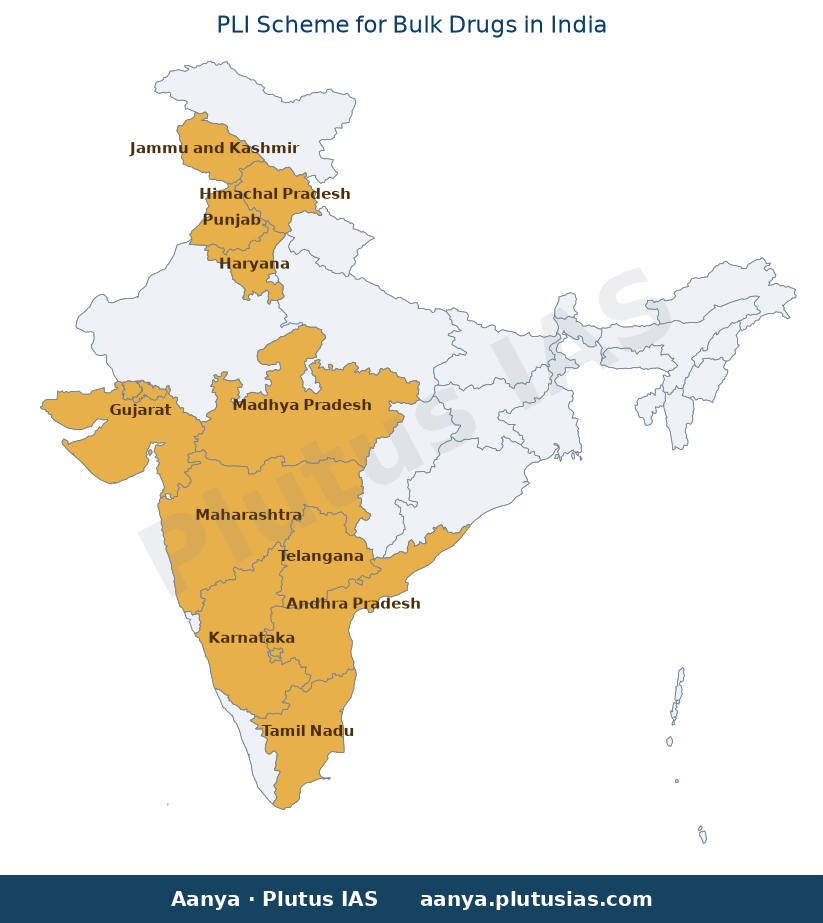
- The scheme is expected to generate significant employment opportunities in the pharmaceutical sector, particularly in states with high pharmaceutical manufacturing potential such as Gujarat, Maharashtra, and Andhra Pradesh.
Key Features
| Feature | Significance |
|---|---|
| Approved Projects (48) | Demonstrates tangible progress in domestic bulk-drug production under PLI scheme. |
| Total Outlay (₹6,940 crore) | Indicates government’s financial commitment to reduce import dependency in critical pharmaceuticals. |
| Investment Mobilised (₹5,070.45 crore) | Shows investor confidence in India’s bulk-drug manufacturing ecosystem. |
| Production Capacity Created (28 APIs/KSMs/DIs) | Enhances domestic self-reliance in essential active pharmaceutical ingredients. |
| Commercial Production (18 APIs) | Directly reduces reliance on imports for life-saving and high-demand drugs. |
Why it Matters
Economic
- Boosts domestic pharmaceutical manufacturing, reducing import dependence for critical APIs (e.g., Penicillin G, Dexamethasone, Atorvastatin).
- Enhances export potential by increasing domestic production of high-value bulk drugs.
- Stimulates ancillary industries such as chemical intermediates, packaging, and logistics.
- Attracts FDI and domestic investment in high-tech pharmaceutical R&D and manufacturing.
Strategic
- Reduces vulnerability in supply chains for essential and life-saving drugs, particularly during global disruptions.
- Strengthens India’s position as a global pharmacy by enhancing self-sufficiency in bulk-drug production.
- Supports the ‘Atmanirbhar Bharat’ initiative by fostering indigenous capabilities in critical pharmaceutical segments.
- Mitigates geopolitical risks associated with over-reliance on imports from specific countries.
Healthcare
- Ensures uninterrupted availability of essential drugs, particularly antibiotics, anti-inflammatory agents, and cardiovascular medications.
- Lowers healthcare costs by reducing import duties and logistics expenses for bulk drugs.
- Supports public health initiatives by ensuring stable supply of drugs like Artemisinin (for malaria) and Lopinavir/Ritonavir (for HIV).
Industrial
- Encourages technology upgradation and adoption of Good Manufacturing Practices (GMP) in bulk-drug manufacturing.
- Promotes clustering of pharmaceutical industries in states like Gujarat, Maharashtra, and Andhra Pradesh, leveraging existing infrastructure.
- Facilitates backward integration, reducing dependency on imported raw materials for bulk-drug production.
Challenges
1. TECHNOLOGICAL GAPS IN API MANUFACTURING
- Limited indigenous capability in fermentation-based APIs (e.g., Penicillin G, Erythromycin), necessitating reliance on imported strains or technologies.
- High energy and water consumption in bulk-drug production, posing sustainability challenges.
- Quality control and adherence to international standards (e.g., USFDA, EU GMP) remain critical hurdles for domestic manufacturers.
UPSC Link: GS3: Industrial Policy
2. FINANCIAL AND MARKET RISKS
- High capital expenditure and long gestation periods for bulk-drug projects deter private investment.
- Price volatility in global markets for APIs and intermediates affects profitability of domestic producers.
- Competition from low-cost producers in China and other Asian countries poses a threat to domestic industry.
UPSC Link: GS3: Investment Models
3. REGULATORY AND COMPLIANCE BOTTLENECKS
- Delays in environmental clearances and land acquisition for pharmaceutical parks hinder project implementation.
- Stringent regulatory frameworks for drug approvals and inspections create operational challenges.
- Lack of harmonised standards for bulk-drug production across states leads to compliance inefficiencies.
UPSC Link: GS2: Governance
4. SKILL AND MANPOWER DEFICITS
- Shortage of skilled workforce in advanced pharmaceutical manufacturing and R&D.
- Limited availability of trained personnel in fermentation technology and high-end chemical synthesis.
- Need for industry-academia collaboration to bridge the skill gap in bulk-drug production.
UPSC Link: GS3: Human Resource Development
5. INFRASTRUCTURE AND LOGISTICS CONSTRAINTS
- Inadequate cold chain and storage facilities for temperature-sensitive APIs.
- Poor connectivity in states like Himachal Pradesh and Jammu & Kashmir delays project execution.
- High logistics costs due to fragmented supply chains and reliance on road transport.
UPSC Link: GS3: Infrastructure
Challenges — UPSC Perspective
| Issue | Concern |
|---|---|
| High Capital Costs | Deters small and medium enterprises from entering bulk-drug manufacturing. |
| Global Competition | China’s dominance in API production exerts pricing pressure on Indian manufacturers. |
| Regulatory Delays | Environmental and land clearances slow down project timelines. |
| Technology Transfer | Lack of indigenous R&D limits innovation in fermentation-based APIs. |
| Market Volatility | Fluctuations in global API prices impact revenue stability of domestic producers. |
| Skill Shortage | Insufficient trained workforce in advanced pharmaceutical manufacturing processes. |
Government Initiatives — Must-Memorise for Prelims
- Production-Linked Incentive (PLI) Scheme for Pharmaceuticals
- Production-Linked Incentive (PLI) Scheme for Bulk Drugs
Way Forward
- Accelerate environmental and land clearances for bulk-drug manufacturing projects to reduce delays.
- Enhance industry-academia collaboration to develop indigenous technologies for fermentation-based APIs.
- Establish dedicated pharmaceutical parks with shared infrastructure to reduce capital costs and improve efficiency.
- Promote skill development programs in collaboration with pharmaceutical associations and technical institutions.
- Strengthen quality control mechanisms to ensure compliance with international standards (USFDA, EU GMP).
- Encourage public-private partnerships for R&D in high-cost, high-risk bulk-drug manufacturing processes.
- Develop a robust logistics and cold-chain infrastructure to support temperature-sensitive API production and distribution.
- Monitor and evaluate the performance of PLI beneficiaries to ensure optimal utilisation of incentives and outcomes.
UPSC Value Addition
Keywords for Mains Answer-Writing
Production-Linked Incentive (PLI) Scheme · Active Pharmaceutical Ingredients (APIs) · Bulk Drugs Policy · Pharmaceutical Industry · Self-reliance in Pharmaceuticals · Atmanirbhar Bharat Mission · Critical Starting Materials (KSM) · Drug Intermediates (DI) · Import Substitution · Pharmaceutical Promotion and Development Scheme (PPDS) · National Pharmaceutical Pricing Authority (NPPA) · Drugs and Cosmetics Act, 1940 · Chemical and Fertilizers Ministry · Make in India in Pharmaceuticals
Concept Flow
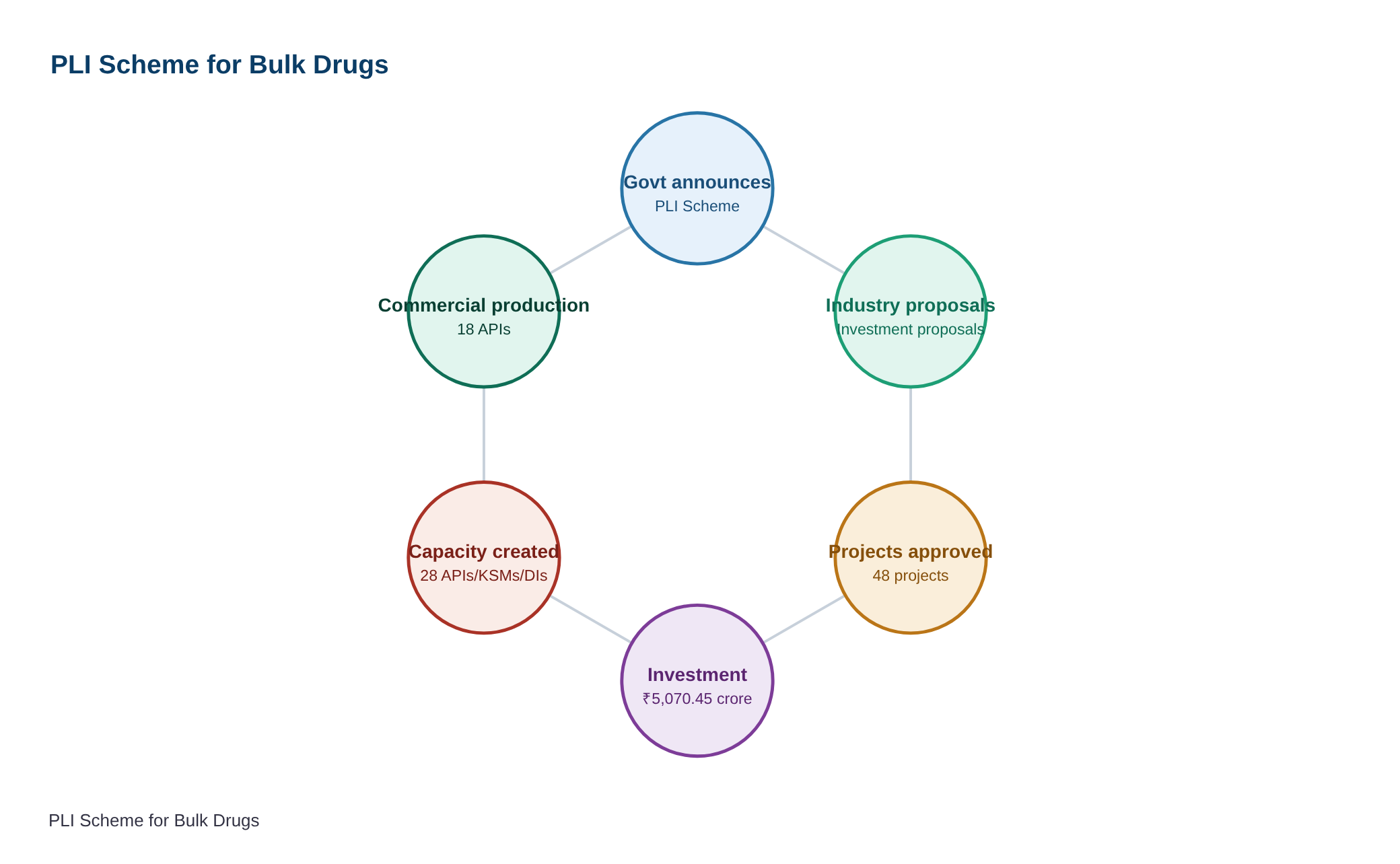
Government announces PLI Scheme for Bulk Drugs → Industry responds with investment proposals → 48 projects approved → ₹5,070.45 crore invested → 28 APIs/KSMs/DIs production capacity created → 18 APIs enter commercial production → Reduction in import dependency for critical drugs → Strengthening of ‘Atmanirbhar Bharat’ in pharmaceuticals → Enhanced self-reliance and export potential
Prelims Practice Questions
Q1. Consider the following statements regarding the Production-Linked Incentive (PLI) Scheme for bulk drugs in India:
1. The scheme aims to promote domestic production of Active Pharmaceutical Ingredients (APIs) and Key Starting Materials (KSM).
2. Under the scheme, 48 projects have been approved with a sanctioned outlay of ₹6,940 crore.
3. The scheme is implemented by the Ministry of Health and Family Welfare.
4. As of March 2026, 10 approved projects have not yet achieved commercial production.
How many of the above statements are correct?
- Only one
- Only two
- Only three
- All four
Answer: All four — Statements 1, 2, and 4 are correct. Statement 3 is incorrect as the scheme is implemented by the Department of Pharmaceuticals under the Ministry of Chemicals and Fertilizers, not the Ministry of Health and Family Welfare.
Q2. Assertion (A): The Production-Linked Incentive (PLI) Scheme for bulk drugs aims to reduce India’s dependence on imports of Active Pharmaceutical Ingredients (APIs).
Reason (R): The scheme provides financial incentives linked to incremental sales and investment in domestic manufacturing of APIs and Key Starting Materials (KSM).
- Both A and R are true, and R is the correct explanation of A
- Both A and R are true, but R is not the correct explanation of A
- A is true, but R is false
- A is false, but R is true
Answer: Both A and R are true, but R is not the correct explanation of A — Both the assertion and reason are true. The PLI scheme for bulk drugs explicitly targets reducing import dependence by incentivizing domestic production of APIs and KSMs through financial linkages to incremental sales and investment.
Q3. Match the following products with their classification under the PLI Scheme for bulk drugs:
Column I (Product) Column II (Classification)
A. Penicillin G 1. Fermentation-based KSM
B. Dexamethasone 2. Chemical synthesis-based API
C. Cyclohexane Diacetic Acid (CDA) 3. Fermentation-based specific KSM/API
D. Atorvastatin 4. Chemical synthesis-based KSM
- A-1, B-3, C-4, D-2; A-1, B-2, C-4, D-3; A-3, B-1, D-2, C-4; A-4, B-3, C-1, D-2
- answer_options_indexed_as_list_in_explain
Answer: A-1, B-3, C-4, D-2; A-1, B-2, C-4, D-3; A-3, B-1, D-2, C-4; A-4, B-3, C-1, D-2 — A-1 (Penicillin G is a fermentation-based KSM), B-3 (Dexamethasone is a fermentation-based specific KSM/API), C-4 (Cyclohexane Diacetic Acid is a chemical synthesis-based KSM), D-2 (Atorvastatin is a chemical synthesis-based API).
Mains Practice Question
✍ Critically examine the significance of the Production-Linked Incentive (PLI) Scheme for bulk drugs in achieving self-reliance in India’s pharmaceutical sector. How far has the scheme succeeded in reducing import dependence for Active Pharmaceutical Ingredients (APIs)? Substantiate your answer with reference to the scheme’s objectives, approved projects, and outcomes as of March 2026. (15 Marks)
Approach: MODEL-ANSWER SKELETON:
1. **Introduction**: Define the PLI Scheme for bulk drugs, its objectives (e.g., reducing import dependence, promoting domestic manufacturing of APIs/KSMs), and its alignment with Atmanirbhar Bharat Mission and the Pharmaceutical Promotion and Development Scheme (PPDS).
2. **Scheme Design and Key Features**:
– Financial outlay: ₹6,940 crore sanctioned; ₹87.70 crore disbursed as incentives by March 2026.
– Incentive structure: Production-linked incentives tied to incremental sales and investment.
– Target sectors: Critical Starting Materials (KSM), Drug Intermediates (DI), and APIs.
– Approved projects: 48 projects across 8 states; 28 APIs/KSMs/DIs with production capacity created.
3. **Outcomes and Performance (as of March 2026)**:
– Investment: ₹5,070.45 crore achieved against a committed ₹4,329.95 crore.
– Production: 18 APIs (e.g., Penicillin G, Dexamethasone, Atorvastatin) have commenced production, reducing import dependence.
– State-wise distribution: Highest projects in Andhra Pradesh (10) and Telangana (13); Gujarat and Maharashtra also significant contributors.
– Remaining gaps: 10 projects yet to achieve commercial production; regional disparities in investment and capacity.
4. **Critical Analysis**:
– **Successes**:
– Reduction in import dependence for 18 APIs, enhancing domestic availability.
– Significant investment inflow and capacity creation in pharmaceutical manufacturing.
– Alignment with global supply chain resilience post-COVID-19.
– **Challenges**:
– Delay in commercial production for 10 projects.
– Regional concentration of projects (e.g., Andhra Pradesh, Telangana) may lead to supply chain imbalances.
– Dependence on imported raw materials for some APIs/KSMs.
– Regulatory hurdles under the Drugs and Cosmetics Act, 1940, and pricing controls by NPPA.
5. **Way Forward**:
– Strengthen backward integration to reduce reliance on imported raw materials.
– Expand the scheme to cover more APIs and KSMs with high import dependence.
– Address regional disparities through targeted incentives for underrepresented states.
– Streamline regulatory processes to expedite project approvals and commercialization.
6. **Conclusion**: The PLI Scheme for bulk drugs has made substantial progress in promoting self-reliance and reducing import dependence for critical pharmaceutical ingredients. However, sustained efforts are required to address challenges and ensure equitable regional development and full commercialization of approved projects.
Source: PIB (Press Information Bureau)
Generated by AanyaAi for educational purpose.

- महाराष्ट्र में त्योहार जुलूसों पर बॉम्बे हाईकोर्ट का बड़ा फैसला: पटाखे, लेजर और संगीत पर रोक - September 24, 2026
- Bombay HC Bans Firecrackers, Music in Maharashtra Processions: Key UPSC Analysis - September 24, 2026
- तमिलनाडु में महिला कर्मचारियों के लिए सवैतनिक माहवारी अवकाश नीति पर HC का आदेश - September 24, 2026

No Comments