


07 Aug UPSC Alert: PLI Scheme for Pharma Sector – Key Facts & Challenges
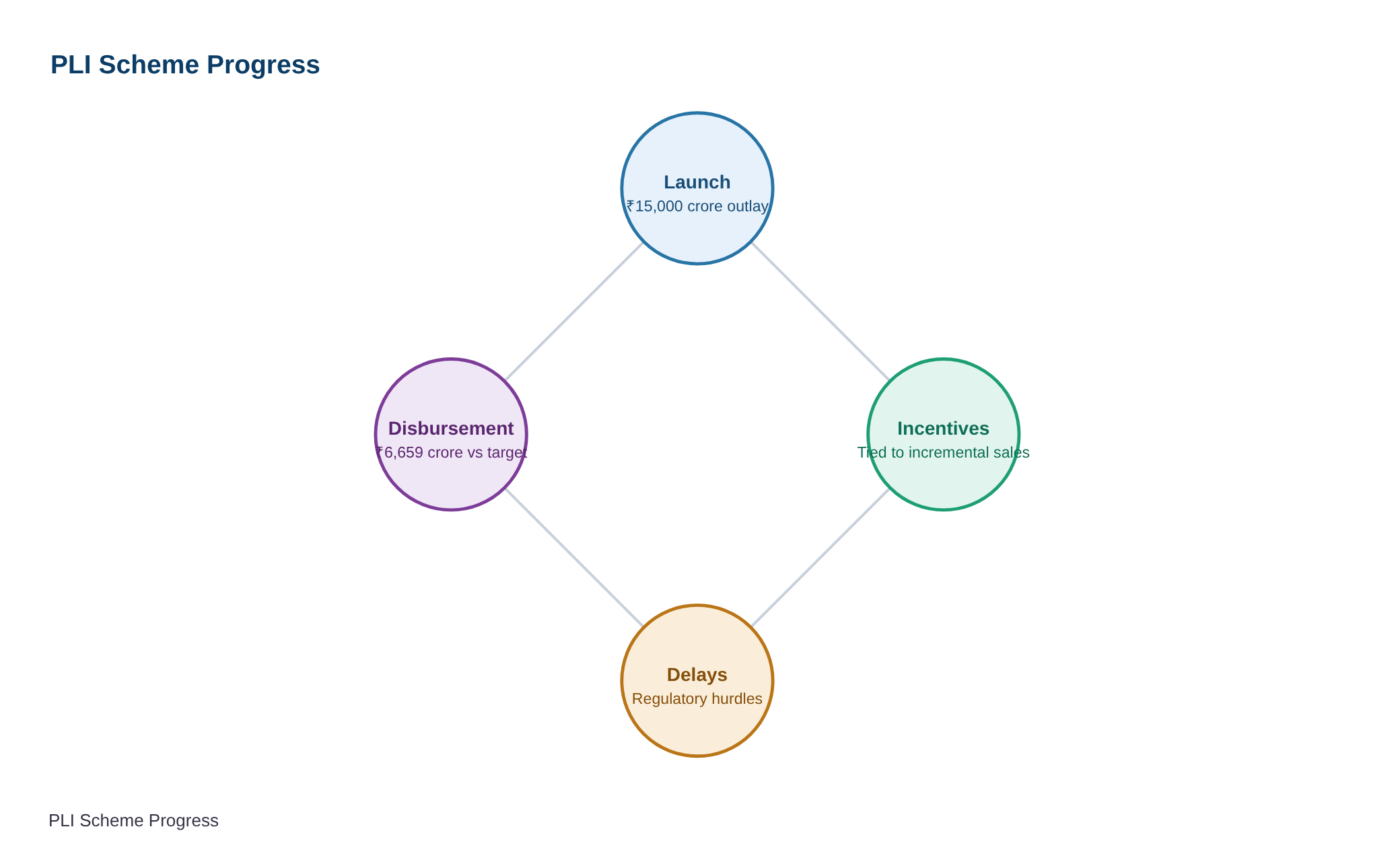
✎ The PLI scheme for pharmaceuticals is a performance-linked incentive mechanism launched in FY 2022-23 with a ₹15,000 crore corpus to boost domestic manufacturing, but its efficacy in fermentation-based bulk drugs is constrained…
Subject Relevance — Where This Topic Fits
- GS Paper II — Government Policies and Interventions for Development in various sectors | GS Paper III — Indian Economy and Issues relating to Planning, Mobilization of Resources, Growth, Development and Employment
- Prelims: Production-Linked Incentive (PLI) Scheme, Pharmaceutical sector in India, Self-reliance in healthcare (Atmanirbhar Bharat), Fermentation-based bulk drugs, Union Budget 2022-23 allocations
- Essay: The role of government incentives in fostering industrial growth and self-reliance, Balancing fiscal prudence with developmental imperatives: A critique of PLI schemes
Quick Revision: The PLI scheme for pharmaceuticals is a performance-linked incentive mechanism launched in FY 2022-23 with a ₹15,000 crore corpus to boost domestic manufacturing, but its efficacy in fermentation-based bulk drugs is constrained by prolonged project timelines and regulatory delays.
Why is this in the news?
The Press Information Bureau (PIB), on 7 August 2026, released an official statement highlighting the progress of the Production-Linked Incentive (PLI) Scheme for the pharmaceutical sector, including specific allocations and disbursements under the scheme for drugs, bulk drugs, and medical devices. The update underscores the challenges faced in the implementation of fermentation-based bulk drug projects, which have led to delays in fund disbursement and project timelines, despite the scheme’s launch in FY 2022-23.
Background
- The PLI scheme for the pharmaceutical sector was launched in FY 2022-23 as part of the Atmanirbhar Bharat initiative to enhance domestic manufacturing capabilities and reduce import dependence in critical healthcare segments.
- The scheme aims to incentivize production by linking financial support to incremental sales of eligible products, thereby fostering investment in high-technology and high-value pharmaceutical manufacturing.
- The pharmaceutical sector in India is a global leader in generic drug production but faces constraints in high-value segments such as fermentation-based bulk drugs and medical devices due to technological and regulatory bottlenecks.
- The PLI scheme for bulk drugs was introduced with a total financial outlay of ₹6,940 crore, while the broader pharmaceutical PLI scheme has a corpus of ₹15,000 crore.
- The scheme’s design includes disbursement of incentives based on actual sales performance, which has resulted in delayed outflows in sectors where project gestation periods are prolonged, such as fermentation-based bulk drugs.
- The Union Budget 2022-23 had earmarked significant allocations for PLI schemes across multiple sectors, reflecting the government’s commitment to boosting domestic manufacturing and reducing import dependency.
What is the Production-Linked Incentive (PLI) Scheme for the Pharmaceutical Sector?
- The PLI scheme for the pharmaceutical sector is a central sector scheme designed to provide financial incentives to manufacturers based on incremental sales of domestically produced pharmaceutical products, including drugs, bulk drugs, and medical devices.
- The scheme’s primary objective is to enhance India’s self-reliance in critical healthcare manufacturing by incentivizing large-scale investments in high-value pharmaceutical production, thereby reducing import dependence and strengthening the domestic supply chain.
- The PLI scheme for pharmaceuticals is structured with a total financial outlay of ₹15,000 crore, with disbursements linked to the incremental sales of eligible products over a five-year period starting from FY 2022-23.
- The scheme covers three sub-sectors: (i) pharmaceutical formulations, (ii) bulk drugs (including fermentation-based drugs), and (iii) medical devices, each with distinct eligibility criteria and incentive structures.
- For bulk drugs, the PLI scheme has a dedicated outlay of ₹6,940 crore, with incentives disbursed based on incremental sales of eligible bulk drug molecules, including those produced through fermentation processes.
- The incentive disbursement mechanism is performance-based, with funds released only upon the sale of products manufactured under the scheme, ensuring fiscal accountability and alignment with actual production outcomes.
- The scheme aims to address structural challenges in the pharmaceutical sector, such as high capital costs, regulatory delays, and technological gaps, by providing predictable and long-term financial support to investors.
Key Features
| Feature | Significance |
|---|---|
| Production-Linked Incentive (PLI) Scheme for Pharmaceuticals | Aims to boost domestic manufacturing of pharmaceuticals by providing financial incentives linked to incremental sales of eligible products, enhancing self-reliance in critical drug production. |
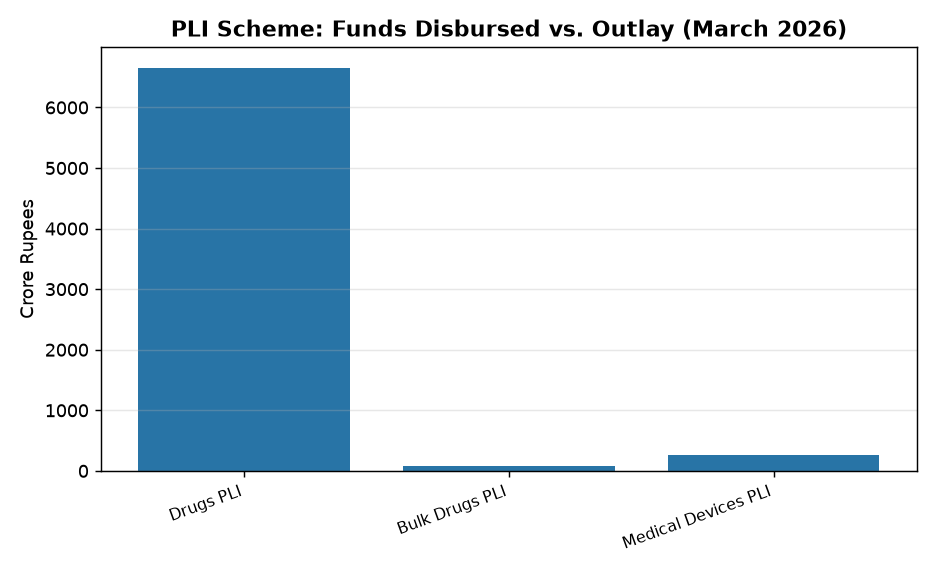
| Financial Outlay of ₹15,000 crore | Demonstrates government commitment to incentivize pharmaceutical sector growth, with ₹6,659 crore already disbursed by March 2026. |
| PLI Scheme for Bulk Drugs (Active Pharmaceutical Ingredients – APIs) | Targets reduction of import dependence in bulk drugs, particularly fermentation-based APIs, by providing ₹6,940 crore in incentives. |
| Component-Linked Incentive (CLI) Framework | Proposed for medical devices to attract more manufacturers, though no such reform is currently planned for pharmaceuticals. |
| Incremental Sales-Based Disbursement | Ensures incentives are tied to actual production and sales, preventing misuse while promoting genuine manufacturing growth. |
Why it Matters
Economic
- Enhances India’s pharmaceutical manufacturing competitiveness by reducing cost disadvantages vis-à-vis global peers.
- Promotes import substitution of critical APIs and bulk drugs, reducing foreign exchange outflows.
- Stimulates ancillary industries such as packaging, logistics, and raw material suppliers through backward linkages.
- Attracts foreign direct investment (FDI) in high-value drug manufacturing segments.
Strategic
- Reduces dependence on China for key pharmaceutical ingredients, mitigating supply chain vulnerabilities.
- Strengthens India’s position as the ‘pharmacy of the world’ through enhanced domestic production capacity.
- Supports India’s Atmanirbhar Bharat initiative by fostering self-sufficiency in essential medicines.
Social
- Ensures stable supply of affordable medicines by reducing reliance on imported APIs, particularly for chronic and critical diseases.
- Creates employment opportunities in pharmaceutical manufacturing and allied sectors, especially in tier-2 and tier-3 cities.
Industrial
- Encourages technological upgradation and adoption of advanced manufacturing processes in the pharmaceutical sector.
- Promotes research and development (R&D) in fermentation-based drug production, a niche with high value addition.
Challenges
1. Regulatory and Land Acquisition Delays
- Lengthy environmental clearances and land acquisition processes delay project implementation, particularly for bulk drug units.
- High utility costs (electricity, water) further strain project viability, especially in energy-intensive fermentation processes.
UPSC Link: Environmental Impact Assessment (EIA) 2006
2. Technological and Process Constraints in Fermentation-Based APIs
- Fermentation relies on biological growth of living cells, which is inherently slower than chemical synthesis, leading to extended production cycles.
- Scalability challenges in fermentation-based production hinder rapid ramp-up of output to meet incentive thresholds.
UPSC Link: Biotechnology in Pharmaceuticals
3. Disbursement Lag Due to Sales-Based Incentives
- Incentives are released only after sales, creating cash-flow gaps for manufacturers during initial production phases.
- Delays in project execution reduce the quantum of incentives disbursed within the scheme’s timeframe.
UPSC Link: Direct Benefit Transfer (DBT)
4. Limited Disbursement in Bulk Drugs Segment
- Only ₹87.70 crore disbursed under the bulk drugs PLI scheme by March 2026, indicating slow progress and low uptake.
- High capital intensity and long gestation periods deter smaller manufacturers from participating.
UPSC Link: Pharmaceutical Pricing and Control Order (DPCO)
5. Competition from Established Global Players
- India faces stiff competition from China, Europe, and the US in bulk drug manufacturing, requiring sustained incentives to bridge cost gaps.
- Price sensitivity in domestic markets limits profit margins, discouraging large-scale investments.
UPSC Link: Global Value Chains (GVCs)
Challenges — UPSC Perspective
| Issue | Concern |
|---|---|
| Environmental Clearances | Delays of 12-18 months in approvals for bulk drug units, impacting project timelines. |
| Land Acquisition | Protracted negotiations and legal hurdles in acquiring industrial land, especially in densely populated states. |
| High Utility Costs | Electricity and water tariffs in India are among the highest globally, eroding cost competitiveness. |
| Fermentation Process Constraints | Biological growth cycles limit production speed, making it difficult to meet incentive thresholds quickly. |
| Sales-Based Disbursement | Cash-flow constraints for manufacturers due to delayed incentive payouts tied to actual sales. |
| Capital Intensity | High initial investment requirements deter small and medium enterprises (SMEs) from participation. |
Government Initiatives — Must-Memorise for Prelims
- Production-Linked Incentive (PLI) Scheme for Pharmaceuticals
- Production-Linked Incentive (PLI) Scheme for Bulk Drugs (APIs)
- Production-Linked Incentive (PLI) Scheme for Medical Devices
Way Forward
- Streamline environmental clearances and land acquisition processes through single-window clearance mechanisms under the Ease of Doing Business reforms.
- Introduce partial upfront disbursement of incentives to alleviate cash-flow constraints for manufacturers, particularly in fermentation-based APIs.
- Enhance infrastructure support, including subsidized utility costs and dedicated power/water supply for bulk drug parks.
- Promote public-private partnerships (PPPs) for setting up common effluent treatment plants (CETPs) to reduce compliance costs.
- Expand the scope of the PLI scheme to include fermentation-based intermediates, not just final APIs, to encourage broader participation.
- Strengthen R&D incentives within the PLI framework to accelerate technological upgradation in fermentation processes.
- Establish dedicated bulk drug parks with pre-cleared land and infrastructure to reduce project execution timelines.
- Monitor and review disbursement mechanisms to ensure timely release of incentives and address bottlenecks in implementation.
UPSC Value Addition
Keywords for Mains Answer-Writing
Production Linked Incentive (PLI) Scheme · Pharmaceutical sector · Bulk drugs · Fermentation-based manufacturing · Land acquisition delays · Environmental clearances · Component-Linked Incentive (CLI) · Medical devices PLI · Atmanirbhar Bharat · Drug Price Control Order (DPCO) · National Pharmaceutical Pricing Authority (NPPA) · Active Pharmaceutical Ingredients (APIs) · Regulatory bottlenecks in pharmaceutical manufacturing · Biological synthesis vs chemical synthesis
Concept Flow
Government identifies pharmaceutical self-reliance as a strategic priority → Announces PLI scheme with ₹15,000 crore outlay → Incentives tied to incremental sales of eligible products → Delays in project execution due to regulatory and land acquisition hurdles → Slow disbursement of incentives (₹6,659 crore vs. target) → Challenges in fermentation-based APIs due to biological process constraints → Limited uptake in bulk drugs segment (₹87.70 crore disbursed) → Need for structural reforms to enhance scheme effectiveness → Way forward includes infrastructure support, R&D incentives, and streamlined clearances.
Prelims Practice Questions
Q1. Consider the following statements regarding the Production Linked Incentive (PLI) Scheme for the pharmaceutical sector:
1. The PLI Scheme for drugs was launched in the financial year 2022-23 with a total financial outlay of ₹15,000 crore.
2. The PLI Scheme for bulk drugs includes a provision for Component-Linked Incentives (CLI) to attract more manufacturers.
3. The incentive amount under the PLI Scheme is disbursed based on the sales of products manufactured under the scheme.
How many of the above statements are correct?
- Only one
- Only two
- All three
- None
Answer: Only two — Statement 1 is correct as the PLI Scheme for drugs was indeed launched in FY 2022-23 with a ₹15,000 crore outlay. Statement 2 is incorrect because the PLI Scheme for bulk drugs does not include a CLI component; it follows the standard PLI framework. Statement 3 is correct as incentives are released based on sales of products manufactured under the scheme.
Q2. Assertion (A): Fermentation-based manufacturing of bulk drugs is inherently slower than chemical synthesis due to its dependence on the growth rate of living cells.
Reason (R): The growth rate of living cells in fermentation is a natural and slow process, unlike the rapid reactions in chemical synthesis.
In the context of the above two statements, which of the following is correct?
- Both A and R are true, and R is the correct explanation of A.
- Both A and R are true, but R is not the correct explanation of A.
- A is true, but R is false.
- A is false, but R is true.
Answer: Both A and R are true, and R is the correct explanation of A. — Both the assertion and reason are correct. Fermentation-based manufacturing is slower because it relies on the biological activity of living cells, whose growth is naturally slow. The reason correctly explains the assertion.
Q3. Match the following PLI Schemes with their respective financial outlays and incentive disbursements as of March 2026:
Column I (Scheme) | Column II (Financial Outlay) | Column III (Incentive Disbursed by March 2026)
— | — | —
A. PLI Scheme for Drugs | i. ₹15,000 crore | 1. ₹6,659 crore
B. PLI Scheme for Bulk Drugs | ii. ₹6,940 crore | 2. ₹87.70 crore
C. PLI Scheme for Medical Devices | iii. ₹5,000 crore | 3. ₹266.64 crore
Select the correct match:
- A-i-1, B-ii-2, C-iii-3
- A-ii-1, B-i-2, C-iii-3
- A-iii-1, B-ii-2, C-i-3
- A-i-2, B-ii-1, C-iii-3
Answer: A-i-1, B-ii-2, C-iii-3 — The correct matches are: A (PLI Scheme for Drugs) with i (₹15,000 crore) and 1 (₹6,659 crore); B (PLI Scheme for Bulk Drugs) with ii (₹6,940 crore) and 2 (₹87.70 crore); C (PLI Scheme for Medical Devices) with iii (₹5,000 crore) and 3 (₹266.64 crore).
Mains Practice Question
✍ The Production Linked Incentive (PLI) Scheme for the pharmaceutical sector represents a strategic intervention to enhance India’s self-reliance in critical drug manufacturing. Critically examine the implementation challenges faced by the PLI Scheme for bulk drugs, particularly in fermentation-based manufacturing. Also, assess the efficacy of the PLI framework in addressing these bottlenecks and suggest measures to improve its outcomes. (15 Marks)
Approach: MODEL-ANSWER SKELETON:
1. **Introduction (2 marks)**: Define the PLI Scheme and its objectives for the pharmaceutical sector, highlighting its role in Atmanirbhar Bharat. Mention the financial outlays and incentive disbursements for drugs, bulk drugs, and medical devices.
2. **Implementation Challenges in Bulk Drug PLI (5 marks)**:
– **Regulatory Bottlenecks**: Delays in land acquisition, environmental clearances, and high utility costs.
– **Technological Constraints**: Fermentation-based manufacturing is slower due to biological processes, unlike chemical synthesis.
– **Financial Disbursement Lag**: Incentives are linked to sales, causing delays in fund release.
– **Market Dynamics**: Competition from cheaper imports and price controls under DPCO/NPPA.
3. **Efficacy of PLI Framework (4 marks)**:
– **Strengths**: Incentivizes domestic production, reduces import dependence, and promotes R&D.
– **Weaknesses**: Inadequate addressing of regulatory hurdles; lack of CLI component for bulk drugs; slow disbursement of funds.
4. **Suggested Measures (4 marks)**:
– **Policy Reforms**: Streamline environmental clearances and land acquisition processes.
– **Financial Incentives**: Introduce upfront grants or viability gap funding for fermentation-based projects.
– **Technology Upgradation**: Support for bioreactor scaling and process optimization.
– **Market Support**: Rationalize DPCO pricing to ensure profitability for bulk drug manufacturers.
5. **Conclusion (1 mark)**: Summarize the need for a balanced approach combining regulatory reforms, financial incentives, and technological support to realize the PLI Scheme’s objectives.
Source: PIB (Press Information Bureau)
Generated by AanyaAi for educational purpose.

- आपातकाल में ‘गायब’ शाह आयोग रिपोर्ट का रहस्यमयी पुनर्प्राप्ति - September 23, 2026
- What happened to the Shah Commission report on Emergency? UPSC analysis - September 23, 2026
- तमिलनाडु के लिए क्या है ‘एल नीनो’ और उत्तर-पूर्वी मानसून का खतरा? - September 23, 2026

No Comments