


28 Jul UPSC Alert: PM Surya Ghar Scheme Benefits 48L+ Families with Free Solar Power
Subject Relevance — Where This Topic Fits
- GS Paper III — Environment, Ecology, Bio-diversity and Climate Change | GS Paper III — Energy
- Prelims: Rooftop Solar Programme, PM-KUSUM Scheme, Grid-connected rooftop solar systems, Subsidy for solar rooftops, Net metering, Discoms, Renewable Purchase Obligations (RPO), Carbon footprint reduction, Energy transition, Solar capacity addition
- Essay: India’s energy transition: Balancing growth and sustainability, Role of decentralized renewable energy in achieving net-zero targets
Quick Revision: PM Surya Ghar: Muft Bijli Yojana is a demand-driven, centrally sponsored scheme providing Central Financial Assistance for rooftop solar installations in residential households, enabling zero electricity bills for beneficiaries through net metering and grid integration.
Why is this in the news?
The PM Surya Ghar: Muft Bijli Yojana has achieved a significant milestone by providing benefits to over 48 lakh households across India as of July 2026, demonstrating rapid adoption of rooftop solar systems under a demand-driven, centrally sponsored scheme. This development underscores the growing momentum in India’s residential solar energy sector and its potential to reduce electricity bills, enhance energy access, and contribute to India’s renewable energy targets.
Background
- India has set an ambitious target of achieving 500 GW of non-fossil fuel-based installed capacity by 2030, with a significant share from solar energy.
- The residential sector contributes approximately 25% of India’s total electricity consumption, making rooftop solar a critical component of the energy transition.
- Prior to PM Surya Ghar, the Government of India had launched the Rooftop Solar Programme Phase-II in 2019, aiming for 40 GW of rooftop solar capacity by 2022, which was later extended.
- The scheme aligns with the National Solar Mission and India’s Intended Nationally Determined Contributions (INDCs) under the Paris Agreement.
- Discoms (Distribution Companies) play a pivotal role in the implementation of grid-connected rooftop solar systems through net metering and feed-in tariffs.
What is PM Surya Ghar: Muft Bijli Yojana?
- Launched in February 2024, the PM Surya Ghar: Muft Bijli Yojana is a demand-driven, centrally sponsored scheme aimed at promoting rooftop solar installations in residential households across India.
- The scheme provides Central Financial Assistance (CFA) to residential consumers for the installation of grid-connected rooftop solar systems, reducing their electricity bills to zero in many cases.
- Beneficiaries include all residential consumers with a grid-connected electricity connection from their local Discom, covering both urban and rural households.
- The scheme operates through a national portal (www.pmsuryaghar.gov.in), where applicants can register, apply for CFA, and monitor the installation process.
- CFA is provided for rooftop solar systems up to 3 kW capacity, with higher subsidies for systems up to 10 kW, ensuring affordability for low-income households.
- The scheme also facilitates the installation of rooftop solar systems in government, commercial, and institutional buildings, though these categories do not receive CFA due to inherent financial viability.
- Net metering is a key feature, allowing consumers to export surplus solar energy to the grid and earn credits or monetary benefits from Discoms.
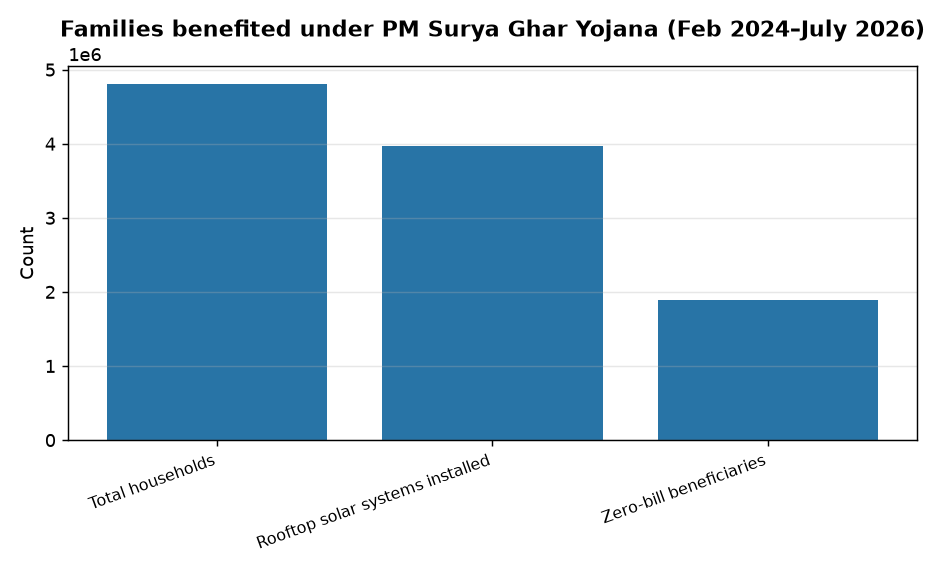
- As of July 2026, the scheme has facilitated the installation of over 39,72,447 rooftop solar systems, benefiting 48,02,717 families.
- The scheme contributes to India’s climate goals by reducing carbon emissions and promoting sustainable energy practices in the residential sector.
Key Features
| Feature | Significance |
|---|---|
| Demand-driven eligibility | All residential consumers with a grid-connected electricity connection, including rural households, can apply through the national portal (www.pmsuryaghar.gov.in), ensuring inclusivity without sectoral exclusions. |
| Central Financial Assistance (CFA) | Provides direct subsidies for rooftop solar installations in residential sectors, reducing upfront capital costs and accelerating adoption. |
| Zero electricity bill mechanism | Excess solar energy fed into the grid earns credits, enabling consumers to offset their electricity bills to zero in billing cycles where self-consumption matches or exceeds generation. |
| Grid integration and net metering | Mandates bidirectional metering to facilitate energy exchange with DISCOMs, ensuring seamless integration of decentralised solar power into the national grid. |
| Multi-sector applicability | While CFA is limited to residential consumers, the scheme encourages rooftop solar adoption in government, commercial, educational, and healthcare institutions due to inherent financial viability. |
Why it Matters
Economic Impact
- Reduces household expenditure on electricity by up to 100% in eligible billing cycles, enhancing disposable income for marginalised and rural households.
- Stimulates local job creation in solar installation, maintenance, and supply chain sectors, particularly in rural and semi-urban areas.
- Lowers aggregate electricity demand from the grid, reducing peak load pressures and deferring costly grid expansion investments by DISCOMs.
- Encourages private investment in renewable energy, aligning with India’s target of 500 GW non-fossil fuel capacity by 2030.
Environmental Sustainability
- Directly contributes to India’s Nationally Determined Contributions (NDCs) under the Paris Agreement by reducing CO₂ emissions through displacement of grid-supplied fossil-based electricity.
- Promotes decentralised renewable energy, reducing transmission losses associated with centralised power generation and distribution.
- Supports India’s commitment to achieving net-zero emissions by 2070 through scalable adoption of rooftop solar in residential sectors.
Energy Security and Access
- Enhances energy self-sufficiency by reducing dependence on imported fossil fuels, particularly coal, for electricity generation.
- Improves last-mile connectivity and reliability of electricity supply in rural and remote areas through decentralised solar power.
- Facilitates energy democracy by empowering consumers to generate, consume, and trade their own electricity, reducing vulnerability to supply disruptions.
Social Inclusion and Equity
- Prioritises inclusion of rural and low-income households, ensuring equitable access to clean energy solutions through targeted financial incentives.
- Empowers women-led households by reducing energy poverty and enabling productive uses of electricity (e.g., irrigation, micro-enterprises).
- Supports the ‘One Sun, One World, One Grid’ (OSOWOG) initiative by fostering distributed solar adoption across geographies.
Challenges
1. Financial Viability and Subsidy Disbursement
- High upfront capital costs for rooftop solar systems despite CFA, deterring participation among low-income households without additional financing options.
- Delays in subsidy disbursement to DISCOMs and consumers due to procedural bottlenecks, reducing the scheme’s attractiveness.
- Limited awareness among potential beneficiaries, particularly in rural areas, about the application process and benefits of the scheme.
UPSC Link: GS3: Energy Infrastructure
2. Technical and Infrastructure Constraints
- Inadequate grid infrastructure in rural and remote areas to support bidirectional energy flow and net metering, leading to technical losses or rejection of applications.
- Variability in rooftop space availability and structural limitations (e.g., weak roofs) in densely populated or informal settlements, restricting installation feasibility.
- Lack of standardised installation protocols and quality control mechanisms, risking suboptimal system performance and safety hazards.
UPSC Link: GS3: Infrastructure
3. Policy and Regulatory Gaps
- Inconsistent net metering policies across states, with some DISCOMs imposing restrictive caps on solar power injection or delaying reimbursements.
- Absence of mandatory rooftop solar installation norms for new residential constructions, limiting scalability despite economic benefits.
- Weak enforcement of renewable purchase obligations (RPOs) by state utilities, reducing incentives for DISCOMs to promote decentralised solar adoption.
UPSC Link: GS2: Federalism
4. Skilling and Supply Chain Bottlenecks
- Shortage of certified solar technicians and engineers, particularly in rural areas, leading to delays and poor-quality installations.
- Dependence on imported solar components (e.g., panels, inverters) increases costs and exposes the sector to global supply chain disruptions.
- Limited local manufacturing capacity for solar components, despite PLI schemes, constrains cost competitiveness and scalability.
UPSC Link: GS3: Industrial Policy
5. Monitoring and Evaluation Challenges
- Lack of real-time monitoring systems to track installation progress, subsidy utilisation, and performance of rooftop solar systems across states.
- Inadequate grievance redressal mechanisms for consumers facing issues with installation, billing, or subsidy disbursement.
- Absence of a unified national database to assess the scheme’s impact on electricity bills, CO₂ reduction, and socio-economic outcomes.
UPSC Link: GS4: Governance
Challenges — UPSC Perspective
| Issue | Concern |
|---|---|
| Subsidy disbursement delays | Undermines consumer trust and reduces participation rates due to prolonged wait times for financial incentives. |
| State-level policy inconsistencies | Creates regulatory uncertainty, discouraging investment and complicating compliance for consumers and installers. |
| Rural grid limitations | Impedes net metering and energy exchange, particularly in areas with weak or unstable grid infrastructure. |
| Awareness and outreach gaps | Results in low participation among target demographics, particularly in remote and tribal regions. |
| Quality assurance deficits | Leads to substandard installations, safety risks, and reduced system efficiency, eroding long-term benefits. |
| Supply chain vulnerabilities | Increases project costs and timelines due to reliance on imported components and global market fluctuations. |
Government Initiatives — Must-Memorise for Prelims
- Pradhan Mantri Kisan Urja Suraksha evam Utthaan Mahabhiyaan (PM-KUSUM)
- Grid Connected Rooftop Solar Programme (Phase-II)
- National Solar Mission
- Make in India (solar manufacturing component)
Way Forward
- Streamline subsidy disbursement by digitising application and verification processes to reduce delays and improve transparency.
- Standardise net metering policies across states with mandatory caps and reimbursement timelines to ensure uniformity and predictability.
- Expand skill development programmes for solar technicians through partnerships with ITIs, polytechnics, and private sector entities to address manpower shortages.
- Enhance grid infrastructure in rural and remote areas through targeted investments in substations, transformers, and smart metering to support bidirectional energy flow.
- Launch targeted awareness campaigns in regional languages, leveraging local leaders, SHGs, and digital platforms to reach marginalised communities.
- Strengthen local manufacturing of solar components via PLI schemes and import substitution measures to reduce costs and supply chain risks.
- Establish a unified national dashboard for real-time monitoring of installations, subsidy utilisation, and performance metrics to enable data-driven policymaking.
- Integrate rooftop solar adoption with other welfare schemes (e.g., PM-KUSUM, Saubhagya) to create synergies and maximise socio-economic impact.
UPSC Value Addition
Keywords for Mains Answer-Writing
PM Surya Ghar Muft Bijli Yojana · Rooftop Solar Scheme · Grid-connected rooftop solar systems · Distributed Renewable Energy · Energy Transition in India · Solar Power Capacity Addition · Net Metering Policy · DISCOM Performance · Rural Electrification through Renewables · Central Financial Assistance (CFA) · Sustainable Energy Access · Energy Efficiency in Residential Sector
Concept Flow
Policy announcement (February 2024) → Demand-driven eligibility expansion → National portal integration → CFA disbursement → DISCOM grid integration → Net metering implementation → Consumer electricity bill reduction → Rural and marginalised household inclusion → CO₂ emissions reduction → Energy security enhancement → Scalability to government/commercial sectors
Prelims Practice Questions
Q1. Consider the following statements regarding the PM Surya Ghar Muft Bijli Yojana:
1. It is a demand-driven scheme open to all residential consumers with a grid-connected electricity connection.
2. Central Financial Assistance (CFA) is provided for rooftop solar installations in government and commercial buildings.
3. The scheme targets installation of 40 lakh rooftop solar systems by 2026.
Which of the statements given above is/are correct?
- 1 only
- 1 and 2 only
- 1 and 3 only
- 2 and 3 only
Answer: 1 and 3 only — Statement 1 is correct as the scheme is open to all residential consumers with grid-connected connections. Statement 2 is incorrect because CFA is not provided for government and commercial buildings. Statement 3 is correct as the scheme has achieved over 39 lakh installations by July 2026.
Q2. Which of the following is NOT a feature of the PM Surya Ghar Muft Bijli Yojana?
- Provision of free electricity up to 300 units per month
- National portal for application and monitoring
- Central Financial Assistance for residential rooftop solar installations
- Inclusion of rural households under the scheme
Answer: Provision of free electricity up to 300 units per month — The scheme does not provide free electricity up to 300 units per month; it provides financial benefits through reduced electricity bills via net metering. The other options are correct features of the scheme.
Q3. The PM Surya Ghar Muft Bijli Yojana primarily aims to achieve which of the following objectives?
- To replace all thermal power plants with solar energy
- To promote distributed solar power generation in the residential sector
- To provide free electricity to all rural households
- To mandate solar installations in all government buildings
Answer: To promote distributed solar power generation in the residential sector — The primary objective of the scheme is to promote distributed solar power generation in the residential sector through rooftop solar installations, leveraging net metering to reduce electricity bills.
Mains Practice Question
✍ Evaluate the significance of the PM Surya Ghar Muft Bijli Yojana in India’s energy transition strategy. How does the scheme contribute to achieving the goals of sustainable energy access and climate change mitigation? (250 words)
Approach: Begin by outlining the scheme’s objectives and operational framework, emphasizing its demand-driven and inclusive nature. Discuss its role in promoting distributed renewable energy, reducing carbon emissions, and enhancing energy security. Highlight the scheme’s impact on reducing electricity bills for households, particularly in rural areas, and its contribution to India’s renewable energy capacity targets. Conclude by assessing the scheme’s scalability and potential for replication in other sectors such as agriculture and small industries.
Source: PIB (Press Information Bureau)
Generated by AanyaAi for educational purpose.

- महाराष्ट्र में त्योहार जुलूसों पर बॉम्बे हाईकोर्ट का बड़ा फैसला: पटाखे, लेजर और संगीत पर रोक - September 24, 2026
- Bombay HC Bans Firecrackers, Music in Maharashtra Processions: Key UPSC Analysis - September 24, 2026
- तमिलनाडु में महिला कर्मचारियों के लिए सवैतनिक माहवारी अवकाश नीति पर HC का आदेश - September 24, 2026

No Comments