


28 Jul UPSC Alert: PM Surya Ghar Scheme Boosts Rooftop Solar with Subsidies & Loans
Subject Relevance — Where This Topic Fits
- GS Paper III — Environment, Conservation, Environmental Pollution and Degradation, Environmental Impact Assessment | GS Paper III — Infrastructure: Energy
- Prelims: Rooftop Solar Programme (RTS), PM-KUSUM, National Solar Mission, Renewable Purchase Obligation (RPO), Energy Transition, Net Metering, Viability Gap Funding (VGF), Renewable Energy Certificates (REC), RESCO Model, Utility-Led Aggregation (ULA) Model, Grid-Connected Solar Systems, Energy Storage Systems (ESS), Decentralised Renewable Energy (DRE)
- Essay: Energy Security and Sustainable Development: Balancing Growth with Environmental Stewardship, India’s Path to Net-Zero: Policy Innovations and Grassroots Transformations
Quick Revision: PM Surya Ghar: Muft Bijli Yojana is a demand-driven, subsidy-linked rooftop solar scheme offering up to 2 kWp capacity with 5.75% interest loans (10 years, no collateral) and RESCO/ULA models to accelerate India’s energy transition and reduce household electricity costs.
Why is this in the news?
The PM Surya Ghar: Muft Bijli Yojana (PMSG-MBY), launched under the broader ambit of India’s renewable energy transition, has gained renewed attention due to its expanded financial incentives, concessional loan facilities, and accelerated deployment of rooftop solar systems (RTS) across 48,02,717 households as of 22 July 2026. The scheme’s emphasis on affordability for middle- and lower-income segments, coupled with its integration of innovative financing models such as RESCO and Utility-Led Aggregation (ULA), underscores its role in democratising clean energy access while addressing fiscal constraints in the power sector.
Background
- India’s energy demand is projected to grow significantly by 2030, necessitating a diversified energy mix to ensure energy security and reduce import dependence.
- The National Solar Mission (2010) and subsequent policies like PM-KUSUM (2019) laid the foundation for decentralised solar energy adoption, particularly through rooftop solar systems.
- The rooftop solar segment remains underpenetrated, with only ~11 GW installed capacity against a potential of 60 GW by 2030, highlighting the need for scalable financing and policy interventions.
- The Ministry of New and Renewable Energy (MNRE) has been recalibrating its schemes to address financial barriers, grid integration challenges, and consumer awareness deficits.
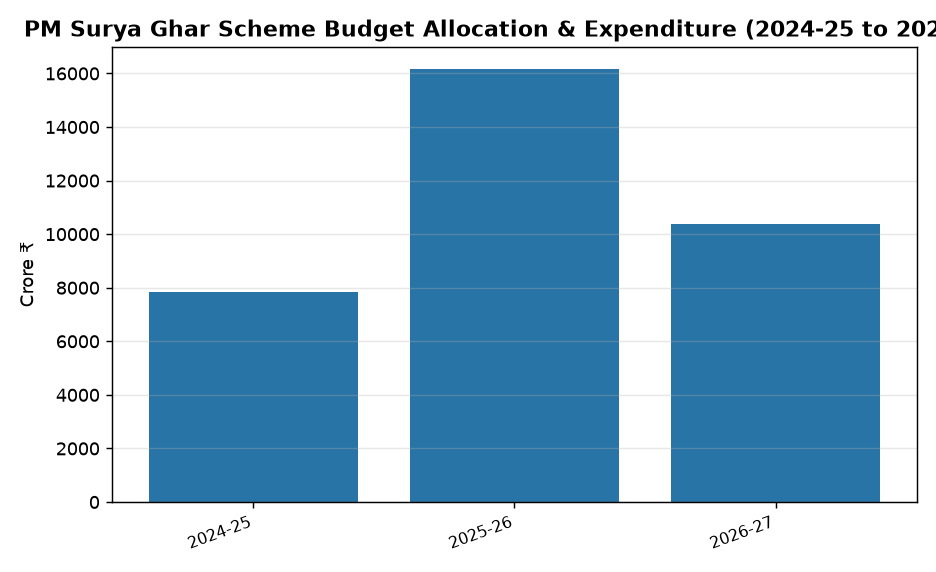
- The Union Budget 2024-25 allocated ₹6,250 crore to PMSG-MBY, reflecting a phased escalation in outlays to ₹22,000 crore by 2026-27, indicating strong political commitment.
- The scheme aligns with India’s Nationally Determined Contributions (NDCs) to achieve 50% cumulative installed capacity from non-fossil fuel-based sources by 2030.
What is PM Surya Ghar: Muft Bijli Yojana (PMSG-MBY)?
- A centrally sponsored scheme launched to provide free electricity to households through rooftop solar systems (RTS), with a target of installing RTS in 1 crore households by 2027.
- The scheme offers enhanced central financial assistance (CFA) for the first 2 kWp of RTS capacity, making it particularly attractive for middle- and lower-income families.
- Concessional financing is provided via nationalised banks at an interest rate of 5.75% per annum (repo rate + 50 basis points) for a 10-year tenure, with no collateral requirement, reducing the upfront capital burden on beneficiaries.
- The scheme incorporates two innovative models: the Renewable Energy Service Company (RESCO) model, where private developers install and maintain RTS on consumer rooftops, and the Utility-Led Aggregation (ULA) model, where distribution companies (DISCOMs) aggregate demand and facilitate installations.
- Beneficiaries receive subsidies directly into their bank accounts via the National Portal for Rooftop Solar, ensuring transparency and reducing leakages in subsidy disbursement.
- The scheme mandates net metering, allowing excess solar power to be fed back into the grid, thereby reducing electricity bills or generating credits for future use.
- Monitoring and evaluation are strengthened through real-time tracking of installations, with 39,72,447 RTS systems already deployed across 48,02,717 households as of 22 July 2026.
- The scheme’s design addresses multiple barriers: financial (via subsidies and loans), technical (via standardised RTS packages), and administrative (via single-window clearance on the national portal).
Key Features
| Feature | Significance |
|---|---|
| Central Financial Assistance (CFA) for first 2 kWp of RTS capacity | Enhances affordability for low- and middle-income households by reducing upfront capital burden, thereby accelerating adoption of rooftop solar systems. |
| Subsidised loans at repo rate + 50 bps (currently 5.75% p.a.) for 10 years without collateral | Provides accessible credit to economically weaker sections, reducing the cost of capital and enabling large-scale deployment of RTS systems. |
| Inclusion of RESCO and Utility-Led Aggregation (ULA) models | Expands implementation pathways beyond consumer-owned systems, leveraging private and utility-driven investments to scale up RTS adoption. |
| Budgetary allocation and expenditure tracking (2024-25 to 2026-27) | Demonstrates government commitment and fiscal planning, with allocations increasing from ₹6,250 crore to ₹22,000 crore, reflecting prioritisation of renewable energy transition. |
| Real-time progress tracking (48,02,717 households with 39,72,447 RTS systems installed by 22.7.2026) | Indicates rapid implementation and monitoring efficiency, ensuring transparency and accountability in scheme execution. |
Why it Matters
Economic
- Reduces household electricity expenditure, particularly for low-income groups, by enabling net-metering and surplus energy export, thereby improving disposable income.
- Stimulates demand for solar manufacturing, installation, and maintenance sectors, creating employment opportunities in the renewable energy value chain.
- Lowers long-term energy import dependency by increasing domestic renewable energy capacity, contributing to energy security and balance-of-payments stability.
Environmental
- Promotes decarbonisation of the residential sector by substituting grid electricity with clean solar energy, thereby reducing carbon dioxide emissions.
- Supports India’s Nationally Determined Contributions (NDCs) under the Paris Agreement by scaling up non-fossil fuel-based electricity generation.
- Contributes to the achievement of the target of 500 GW non-fossil fuel capacity by 2030, aligning with India’s climate commitments.
Social
- Enhances energy access and affordability for economically weaker sections, reducing energy poverty and improving quality of life.
- Empowers households with energy independence, particularly in rural and semi-urban areas where grid reliability is often compromised.
- Encourages community-level adoption through aggregation models, fostering collective action towards sustainable energy solutions.
Technological
- Accelerates technological adoption and innovation in solar rooftop systems, including high-efficiency panels, smart inverters, and energy storage integration.
- Facilitates the integration of distributed renewable energy into the grid, supporting the development of smart grid infrastructure and demand-side management.
- Demonstrates scalability of decentralised energy solutions, paving the way for future hybrid renewable energy systems.
Challenges
1. Financial Viability and Subsidy Disbursement
- Risk of subsidy outflows exceeding budgetary allocations, as seen in FY 2024-25 where expenditure (₹7,822.92 crore) surpassed the budget estimate (₹6,250 crore).
- Delays in subsidy disbursement to beneficiaries due to procedural bottlenecks, potentially discouraging uptake among target groups.
UPSC Link: Economic Survey: Fiscal federalism and subsidy management
2. Grid Integration and Technical Challenges
- Potential strain on local distribution networks due to high penetration of rooftop solar systems, necessitating grid strengthening and smart grid investments.
- Technical issues such as voltage fluctuations, reverse power flow, and metering inaccuracies require robust regulatory and technical frameworks.
UPSC Link: Electricity Act 2003: Grid stability and renewable integration
3. Awareness and Consumer Behaviour
- Limited awareness among target beneficiaries regarding the benefits, eligibility, and procedural aspects of the scheme, particularly in rural areas.
- Reluctance among consumers to adopt RTS due to perceived high upfront costs, despite subsidised loans, indicating a need for targeted awareness campaigns.
UPSC Link: NITI Aayog: Behavioural economics and energy transition
4. Supply Chain and Skilled Workforce Constraints
- Dependence on imported solar components (e.g., panels, inverters) exposes the sector to global supply chain disruptions and currency fluctuations.
- Shortage of skilled technicians for installation, maintenance, and troubleshooting, particularly in remote and underserved regions.
UPSC Link: Make in India: Solar manufacturing and skill development
5. Regulatory and Policy Fragmentation
- Variability in state-level policies, net-metering regulations, and subsidy structures creates confusion and disincentivises uniform adoption.
- Lack of standardised contracts and dispute resolution mechanisms for RESCO and ULA models increases transaction costs and risks for investors.
UPSC Link: Concurrent List: Electricity and renewable energy governance
Challenges — UPSC Perspective
| Issue | Concern |
|---|---|
| Subsidy disbursement delays | Undermines scheme credibility and discourages beneficiary participation. |
| Grid stability risks | High RTS penetration may lead to voltage instability and power quality issues. |
| Limited consumer awareness | Hampers uptake among target groups, particularly in rural areas. |
| Supply chain vulnerabilities | Exposure to global price volatility and import dependencies. |
| Regulatory inconsistencies | Creates market fragmentation and deters private investment. |
Government Initiatives — Must-Memorise for Prelims
- PM-KUSUM (Pradhan Mantri Kisan Urja Suraksha evam Utthaan Mahabhiyaan)
- Grid Connected Rooftop Solar Programme (Phase-II)
- National Solar Mission
Way Forward
- Strengthen inter-ministerial coordination to streamline subsidy disbursement and reduce procedural delays.
- Expand grid infrastructure investments, including smart meters and battery storage, to accommodate high RTS penetration.
- Launch targeted awareness campaigns in regional languages, leveraging local leaders and self-help groups to disseminate scheme benefits.
- Promote domestic manufacturing of solar components through PLI schemes and fiscal incentives to reduce import dependence.
- Standardise state-level net-metering policies and subsidy structures to ensure uniformity and reduce regulatory fragmentation.
- Develop skill development programmes in partnership with ITIs and polytechnics to address the shortage of certified solar technicians.
- Encourage public-private partnerships (PPPs) for large-scale RESCO and ULA projects to accelerate deployment in urban and peri-urban areas.
- Establish a dedicated grievance redressal mechanism for beneficiaries and investors to resolve disputes promptly.
UPSC Value Addition
Keywords for Mains Answer-Writing
PM Surya Ghar Muft Bijli Yojana · Rooftop Solar Scheme · PM-KUSUM · Renewable Energy · Solar Power Adoption · Central Financial Assistance for Solar · Subsidised Interest Rates · Energy Transition in India · Distributed Solar Generation · Energy Poverty Alleviation · National Renewable Energy Mission · Solar Rooftop Capacity · Net Metering · Energy Self-Sufficiency · Sustainable Development Goals 7
Constitutional & Policy Linkages
- Article 243G: Empowerment of Panchayats for rural energy governance
- Article 243W: Municipalities’ role in urban energy planning
Concept Flow
Energy poverty and high electricity costs → Government launches PM-Surya Ghar Muft Bijli Yojana to subsidise rooftop solar systems → Subsidies and low-interest loans reduce upfront costs → Increased affordability for low- and middle-income households → Rooftop solar adoption rises → Households generate own electricity, reducing grid dependency → Surplus energy exported to grid via net-metering → Further reduction in electricity bills and potential zero-bill months → Grid integration challenges emerge → Need for smart grid infrastructure and regulatory reforms → Economic and environmental benefits realised → Job creation, reduced emissions, and energy security → Policy feedback loop → Scheme expansion and refinement based on implementation challenges
Prelims Practice Questions
Q1. Which of the following statements correctly describes the PM Surya Ghar Muft Bijli Yojana?
- It is a centrally sponsored scheme providing free electricity to all households through grid-connected solar rooftop systems.
- The scheme offers subsidised loans at repo rate plus 50 basis points for rooftop solar systems up to 2 kW capacity.
- It mandates the installation of solar panels on all government buildings by 2027.
- The scheme is implemented exclusively through state-owned discoms without any private sector participation.
Answer: The scheme offers subsidised loans at repo rate plus 50 basis points for rooftop solar systems up to 2 kW capacity. — The PM Surya Ghar Muft Bijli Yojana provides subsidised loans at repo rate plus 50 basis points (currently 5.75% per annum) for rooftop solar systems up to 2 kW capacity, as part of its financial assistance framework.
Q2. Under the PM Surya Ghar Muft Bijli Yojana, what is the maximum capacity of rooftop solar systems eligible for enhanced central financial assistance?
- 1 kW
- 2 kW
- 3 kW
- 5 kW
Answer: 2 kW — The scheme provides enhanced central financial assistance for rooftop solar systems up to a maximum capacity of 2 kW, as outlined in its operational guidelines.
Q3. Which of the following models is NOT explicitly mentioned as part of the PM Surya Ghar Muft Bijli Yojana implementation framework?
- RESCO Model
- Utility-Led Aggregation (ULA) Model
- CAPEX Model
- Net Metering Model
Answer: Net Metering Model — The PM Surya Ghar Muft Bijli Yojana explicitly includes the RESCO Model and Utility-Led Aggregation (ULA) Model, but the CAPEX Model is not mentioned as a distinct implementation framework in the scheme’s provisions.
Mains Practice Question
✍ Critically evaluate the role of the PM Surya Ghar Muft Bijli Yojana in India’s energy transition, with particular reference to its financial incentives, institutional mechanisms, and potential socio-economic impacts. (250 words)
Approach: Begin by contextualising the scheme within India’s broader renewable energy goals, such as the National Renewable Energy Mission and SDG 7. Analyse the financial incentives, including central financial assistance and subsidised loans, and their role in reducing the cost barrier for middle-income and economically weaker households. Discuss the institutional mechanisms, such as the RESCO and Utility-Led Aggregation models, and their implications for scalability and private sector participation. Examine the socio-economic impacts, including energy self-sufficiency, reduction in electricity bills, and potential job creation in the solar sector. Conclude by assessing the scheme’s alignment with India’s climate commitments and its potential to address energy poverty while ensuring sustainable and inclusive growth.
Source: PIB (Press Information Bureau)
Generated by AanyaAi for educational purpose.

- ओडिशा में 870 एकड़ में बनेगा ‘सिलिकॉन वैली’, जानिए क्या होगा फायदा - September 19, 2026
- Odisha’s 870-Acre Silicon Valley Hub: UPSC Exam Focus on Semiconductor Growth - September 19, 2026
- यूपीएससी तैयारी: आरबीआई द्वारा 91, 182 और 364 दिनों के ट्रेजरी बिलों की नीलामी - September 19, 2026

No Comments