


22 Jul UPSC Alert: PM Vikas Scheme Boosts Minority Skill Development & Entrepreneurship
Subject Relevance — Where This Topic Fits
- GS Paper II — Social Justice and Welfare Schemes | GS Paper III — Skill Development and Entrepreneurship | GS Paper III — Government Policies and Interventions
- Prelims: Skill India Mission, Usttad Scheme, National Minorities Development and Finance Corporation (NMDFC), National Skill Development Corporation (NSDC), Apprenticeship Rules, 1961
- Essay: Role of Skill Development in Achieving Inclusive Growth, Entrepreneurship as a Catalyst for Economic Empowerment of Marginalised Communities
Quick Revision: The PM VIKAS Scheme is a flagship initiative by the Ministry of Minority Affairs to empower minority communities through skill development, entrepreneurship, and education, with a focus on industry-aligned training and verified placements.
Why is this in the news?
The Press Information Bureau (PIB) released a detailed progress report on 22 July 2026 regarding the implementation of the PM VIKAS Scheme, highlighting its role in promoting skill development and entrepreneurship among minority communities. The report underscores the scheme’s structured approach, stakeholder consultations, and identified areas for strengthening industry linkages, apprenticeship, and placement outcomes. This development is significant as it aligns with broader national objectives of inclusive growth and equitable access to economic opportunities.
Background
- The scheme operates through 59 Project Implementation Agencies (PIAs), including reputed institutions and industry-linked organisations, to ensure quality training and employability outcomes.
- Minority communities in India, as defined under the National Commission for Minorities Act, 1992, constitute approximately 19.3% of the population and face systemic barriers in accessing formal education and employment opportunities.
- The scheme builds upon earlier initiatives such as the Usttad Scheme (2014) and the Seekho aur Kamao Scheme (2013), which aimed to provide vocational training and livelihood support to minority youth.
- The National Skill Development Corporation (NSDC) and the National Minorities Development and Finance Corporation (NMDFC) serve as key institutional partners in the implementation and financing of the scheme.
- India’s demographic dividend, with a median age of 28.4 years, necessitates robust skill development programmes to harness the potential of its youthful workforce and mitigate unemployment challenges.
What is the PM VIKAS Scheme?
- A centrally sponsored scheme launched by the Ministry of Minority Affairs to enhance the employability and entrepreneurship of minority communities through structured skill development and education interventions.
- The scheme is structured around three key components: (i) Skill and Training, (ii) Women Leadership and Entrepreneurship, and (iii) Education, ensuring a holistic approach to economic empowerment.
- Training programmes are designed to align with emerging and future skill requirements, including sectors such as IT-ITeS, healthcare, green energy, and traditional crafts, to enhance industry relevance.
- The scheme integrates apprenticeship opportunities, on-the-job training (OJT), and verified placements to bridge the gap between training and employment, with a focus on strengthening industry-academia linkages.
- Entrepreneurship development is a critical component, offering career counselling, mentorship support through ‘Business Mentors’ or ‘Udyami Mitras’, and facilitated access to concessional credit via the NMDFC for self-employment ventures.
- The scheme mandates regular review meetings with stakeholders, including PIAs, NSDC, awarding bodies, and industry representatives, to address operational challenges and enhance implementation efficacy.
- Monitoring and evaluation are conducted through digital dashboards and field assessments to track progress, identify bottlenecks, and ensure accountability in programme delivery.
Key Features
| Feature | Significance |
|---|---|
| Multi-component design (Skill Training, Women Leadership & Entrepreneurship, Education) | Ensures holistic development by addressing employability, leadership, and foundational education gaps among minority communities. |
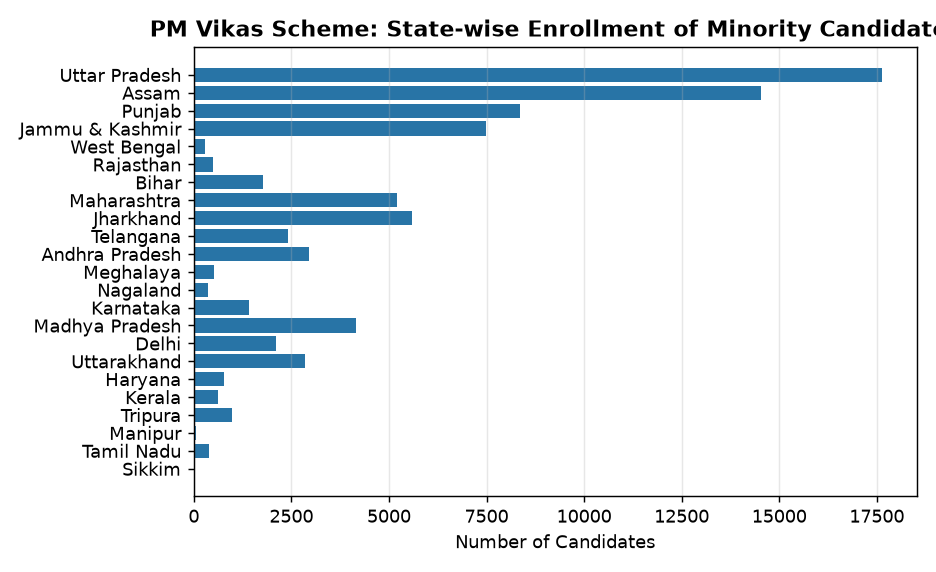
| State-wise target allocation (80,918 candidates across 28 states/UTs) | Demonstrates decentralised planning and addresses regional disparities in skill development access. |
| Industry-linked training through 59 Project Implementation Agencies | Enhances employability by aligning curricula with market demands and emerging sectors. |
| Placement facilitation and career counselling | Bridges the gap between training completion and gainful employment through structured guidance and industry placements. |
| Credit linkages with NMDFC for self-employment | Provides financial inclusion by offering concessional credit to aspiring entrepreneurs from minority communities. |
Why it Matters
Social Inclusion
- Targets historically marginalised minority communities, ensuring equitable access to skill development and entrepreneurship opportunities.
- Promotes gender parity through dedicated components for women leadership and entrepreneurship.
- Reduces socio-economic disparities by enhancing employability and self-employment prospects.
Economic Growth
- Augments the skilled workforce, contributing to higher productivity and economic output.
- Fosters entrepreneurship, leading to job creation and diversified economic activities.
- Aligns with the Skill India Mission, supporting the broader goal of a $5 trillion economy.
Policy Integration
- Complements the National Education Policy 2020 by integrating skill development with formal education.
- Leverages the National Skill Development Corporation (NSDC) and industry bodies for standardised and scalable implementation.
- Strengthens the role of the Minority Affairs Ministry in achieving inclusive growth.
Governance and Monitoring
- Institutionalises regular reviews with stakeholders to address operational challenges and improve outcomes.
- Ensures transparency and accountability through structured monitoring of Project Implementation Agencies.
- Facilitates evidence-based policymaking through data-driven assessment of progress.
Challenges
1. Industry-Academia Gap
- Mismatch between training curricula and evolving industry requirements, particularly in emerging sectors like AI, green energy, and digital skills.
- Limited exposure of trainees to real-world work environments due to inadequate apprenticeship and On-the-Job Training (OJT) opportunities.
UPSC Link: GS-III: Skill Development
2. Placement and Employment Outcomes
- Low verified placement rates post-training, indicating gaps in job-market linkages and employer engagement.
- Regional disparities in employment opportunities, with states like Uttar Pradesh and Assam having higher enrolments but lower placement rates.
UPSC Link: GS-III: Employment Generation
3. Access and Inclusion Barriers
- Limited reach in remote and tribal areas due to logistical and infrastructural constraints.
- Socio-cultural barriers, particularly for women, in accessing training and entrepreneurship opportunities.
UPSC Link: GS-II: Social Justice
4. Financial Constraints
- Inadequate access to credit for self-employment, despite linkages with NMDFC, due to stringent eligibility criteria.
- High dropout rates among trainees due to financial constraints during training periods.
UPSC Link: GS-III: Financial Inclusion
5. Monitoring and Evaluation
- Lack of real-time data on training quality and employment outcomes, hindering evidence-based decision-making.
- Inconsistent performance across Project Implementation Agencies, with some agencies underperforming in placement and certification.
UPSC Link: GS-II: Governance
Challenges — UPSC Perspective
| Issue | Concern |
|---|---|
| Curriculum-Industry Mismatch | Training programmes fail to align with emerging skill demands, reducing employability. |
| Low Apprenticeship Participation | Insufficient OJT and apprenticeship opportunities limit practical exposure. |
| Placement Rate Disparities | Regional and gender-based gaps in verified placements post-training. |
| Financial Accessibility | Barriers in accessing concessional credit for self-employment despite NMDFC linkages. |
| Monitoring Gaps | Delayed and inconsistent data on training outcomes and agency performance. |
| Socio-Cultural Barriers | Women and marginalised groups face challenges in accessing training and entrepreneurship support. |
Government Initiatives — Must-Memorise for Prelims
- Pradhan Mantri Kaushal Vikas Yojana (PMKVY)
- National Skill Development Mission (NSDM)
- Stand-Up India Scheme
- National Minorities Development and Finance Corporation (NMDFC) Schemes
Way Forward
- Strengthen industry partnerships to align training programmes with future skill requirements through sector-specific advisory councils.
- Expand apprenticeship and OJT opportunities by incentivising private sector participation and leveraging corporate social responsibility (CSR) funds.
- Enhance placement facilitation by establishing dedicated career counselling cells in each state and mandating verified placements for a minimum percentage of trainees.
- Improve financial inclusion by simplifying NMDFC credit linkages and introducing microfinance schemes tailored for minority entrepreneurs.
- Address regional disparities by prioritising skill development in aspirational districts and tribal areas through targeted interventions.
- Institutionalise real-time monitoring using digital tools like the Skill India Portal to track training quality, placement rates, and agency performance.
- Promote women-led entrepreneurship by providing mentorship, incubation support, and gender-sensitive financial products.
- Conduct periodic impact assessments to identify best practices and replicate successful models across states.
UPSC Value Addition
Keywords for Mains Answer-Writing
PM VIKAS Scheme · Minority Communities Skill Development · Entrepreneurship Promotion · National Skill Development Corporation · Project Implementation Agencies · Apprenticeship and OJT · Industry-Academia Linkages · Credit Linkages with NMDFC · Women-led Entrepreneurship · Placement and Employment Outcomes · Skill Gap Analysis · Multi-tiered Approach to Employment · Upskilling for Emerging Sectors · Ministry of Minority Affairs · State-wise Skill Distribution
Constitutional & Policy Linkages
- Article 15(4): Special provisions for advancement of socially and educationally backward classes.
- Article 29: Protection of interests of minorities in educational institutions.
- Article 30: Right of minorities to establish and administer educational institutions.
Concept Flow
Identification of skill gaps among minority communities through socio-economic surveys. → Design of multi-component PM Vikas Yojana aligned with National Skill Development Mission. → Allocation of state-wise targets to 59 Project Implementation Agencies for decentralised execution. → Implementation of training programmes with industry linkages and apprenticeship opportunities. → Facilitation of placements, career counselling, and credit linkages for self-employment. → Monitoring and evaluation through stakeholder consultations and digital platforms. → Outcome: Enhanced employability, entrepreneurship, and socio-economic inclusion of minority communities.
Prelims Practice Questions
Q1. Which of the following is NOT a component of the PM VIKAS Scheme as per the given press release?
- A. Skill and Training
- B. Women Leadership and Entrepreneurship
- C. Digital Literacy for Rural Youth
- D. Education
Answer: C. Digital Literacy for Rural Youth — The PM VIKAS Scheme comprises three components: Skill and Training, Women Leadership and Entrepreneurship, and Education. Digital Literacy for Rural Youth is not mentioned as a component in the press release.
Q2. The PM VIKAS Scheme aims to strengthen which of the following through industry linkages and placement facilitation?
- A. Agricultural productivity
- B. Employment outcomes and self-employment opportunities
- C. Military recruitment
- D. Space technology research
Answer: B. Employment outcomes and self-employment opportunities — The PM VIKAS Scheme focuses on improving employment outcomes and self-employment opportunities by strengthening industry linkages and facilitating placements.
Q3. Which statutory body is associated with the PM VIKAS Scheme for credit linkages to support entrepreneurship among minority communities?
- A. National Bank for Agriculture and Rural Development (NABARD)
- B. National Minorities Development and Finance Corporation (NMDFC)
- C. Small Industries Development Bank of India (SIDBI)
- D. Reserve Bank of India (RBI)
Answer: B. National Minorities Development and Finance Corporation (NMDFC) — The National Minorities Development and Finance Corporation (NMDFC) is mentioned as the body providing credit linkages to facilitate entrepreneurship under the PM VIKAS Scheme.
Mains Practice Question
✍ Critically evaluate the effectiveness of the PM VIKAS Scheme in addressing the skill gaps and employment challenges faced by minority communities in India. Suggest measures to enhance its impact on sustainable livelihoods.
Approach: The candidate should analyze the scheme’s structure, including its three components (Skill and Training, Women Leadership and Entrepreneurship, and Education), and assess its implementation through 59 Project Implementation Agencies. Evaluate the scheme’s focus on industry linkages, apprenticeships, and credit facilitation via NMDFC. Highlight strengths such as multi-tiered employment strategies and weaknesses like regional disparities in enrollment (e.g., low numbers in Sikkim and Manipur). Suggest measures like strengthening state-wise skill gap analysis, expanding industry partnerships for OJT/apprenticeships, and leveraging digital platforms for career counseling. Conclude with the need for outcome-based monitoring and inclusive outreach.
Source: PIB (Press Information Bureau)
Generated by AanyaAi for educational purpose.

- महाराष्ट्र में त्योहार जुलूसों पर बॉम्बे हाईकोर्ट का बड़ा फैसला: पटाखे, लेजर और संगीत पर रोक - September 24, 2026
- Bombay HC Bans Firecrackers, Music in Maharashtra Processions: Key UPSC Analysis - September 24, 2026
- तमिलनाडु में महिला कर्मचारियों के लिए सवैतनिक माहवारी अवकाश नीति पर HC का आदेश - September 24, 2026

No Comments