


22 Jul UPSC Alert: PM Yashasvi Scheme Boosts OBC, EBC & DNT Scholarships 2026
Subject Relevance — Where This Topic Fits
- GS Paper II — Social Justice and Welfare Schemes | GS Paper III — Human Resource Development and Education
- Prelims: PM-YASASVI Scheme, OBC, EBC, DNT communities, Pre-Matric and Post-Matric Scholarships, Non-Nomadic and Semi-Nomadic Tribes (DNTs), Financial Inclusion in Education
- Essay: The Role of Government Schemes in Bridging Educational Inequalities, Inclusive Education: A Pillar for National Development
Quick Revision: PM-YASASVI Scheme is a multi-tiered scholarship framework under the Ministry of Social Justice and Empowerment, designed to eliminate financial barriers in education for OBC, EBC, and DNT students through pre-matric, post-matric, and higher education support.
Why is this in the news?
The Union Minister of State for Social Justice and Empowerment, Shri B.L. Verma, recently informed the Lok Sabha about the expansion of the Pradhan Mantri Yashasvi Yojana (PM-YASASVI) to enhance educational opportunities for students belonging to Other Backward Classes (OBC), Economically Backward Classes (EBC), and De-notified, Nomadic, and Semi-Nomadic Tribes (DNTs). This initiative underscores the government’s commitment to reducing financial barriers in education and promoting equitable access to quality learning across pre-matric, post-matric, and higher education stages.
Background
- The PM-YASASVI Scheme is a centrally sponsored initiative launched under the Department of Social Justice and Empowerment to address educational disparities among marginalised communities.
- OBC, EBC, and DNT groups have historically faced socio-economic and educational disadvantages, necessitating targeted interventions like scholarships to ensure equitable participation in the education system.
- The scheme aligns with constitutional provisions (Articles 15(4) and 46) that mandate state support for the advancement of socially and educationally backward classes.
- Pre-existing scholarship schemes for these communities, such as the Post-Matric Scholarship for OBCs and the National Fellowship for Higher Education of STudents (NFST), have been subsumed or enhanced under PM-YASASVI to streamline delivery and expand coverage.
- The DNT community, recognised as a particularly vulnerable group, requires specialised interventions due to their nomadic lifestyle and lack of access to formal education infrastructure.
- The scheme’s design reflects the government’s broader agenda of ‘Sabka Saath, Sabka Vikas, Sabka Vishwas’ by prioritising inclusive growth through education.
What is the Pradhan Mantri Yashasvi Yojana (PM-YASASVI)?
- PM-YASASVI is a comprehensive scholarship scheme to provide financial assistance to students from OBC, EBC, and DNT categories across pre-matric, post-matric, and higher education levels.
- The scheme is implemented by the Ministry of Social Justice and Empowerment and operates under the umbrella of the ‘National Education Policy (NEP) 2020’ to ensure alignment with modern educational goals.
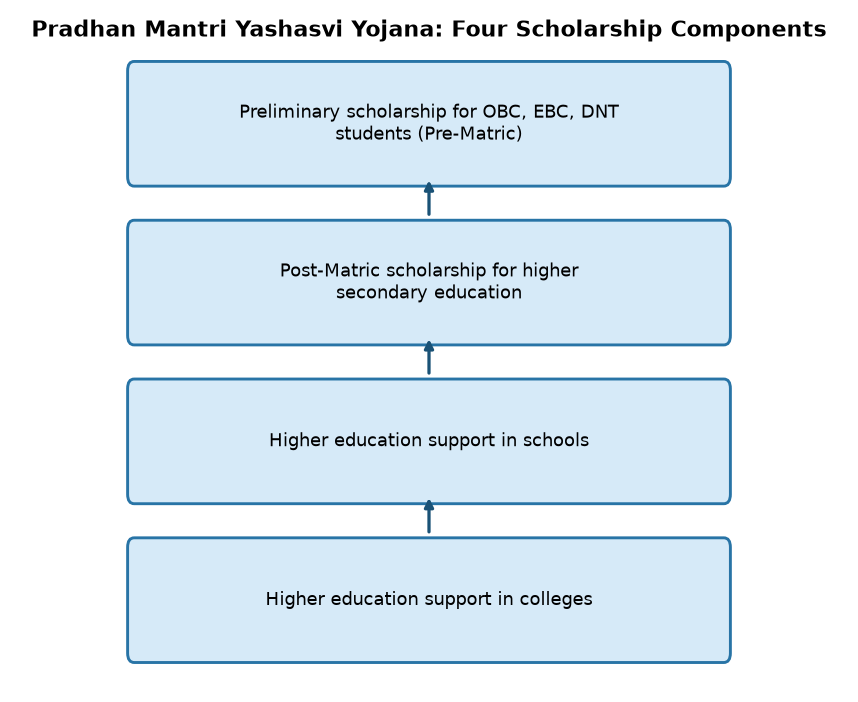
- It comprises four key components: Pre-Matric Scholarship, Post-Matric Scholarship, Top-Class School Education Scheme, and Top-Class College Education Scheme, each tailored to specific educational stages.
- Eligibility is determined by income thresholds (e.g., EBC students with annual family income up to ₹2.5 lakh) and caste certificates for OBC/DNT students, ensuring targeted support to the most needy.
- The scholarships cover tuition fees, maintenance allowances, and other incidental expenses, thereby reducing the financial burden on families and preventing dropout rates.
- The scheme also includes a ‘YASASVI Entrance Test’ for meritorious students from DNT and nomadic communities to access residential schools and colleges, promoting quality education in a conducive environment.
- Monitoring and disbursement are facilitated through the ‘National Scholarship Portal (NSP)’, ensuring transparency, minimising leakages, and enabling real-time tracking of beneficiaries.
- The scheme’s budgetary allocation for 2024-25 reflects a significant increase, underscoring the government’s prioritisation of education as a tool for social mobility and economic empowerment.
Key Features
| Feature | Significance |
|---|---|
| PRI-MATRIC SCHOLARSHIP SCHEME | Provides financial assistance to OBC, EBC, and DNT students from Class 1 to 10, reducing dropout rates and enabling continuous schooling. |
| POST-MATRIC SCHOLARSHIP SCHEME | Supports higher secondary and undergraduate education, covering tuition, maintenance, and other academic expenses for eligible students. |
| HIGHER EDUCATION IN SCHOOLS SCHEME | Targets meritorious students in Classes 11-12 from marginalised communities, offering scholarships for coaching and academic support. |
| HIGHER EDUCATION IN COLLEGES SCHEME | Extends financial aid to undergraduate and postgraduate students in colleges, ensuring access to quality higher education without financial constraints. |
Why it Matters
Socio-Economic Equity
- Addresses historical educational disparities faced by OBC, EBC, and DNT communities through targeted financial interventions.
- Promotes social mobility by enabling access to quality education, thereby breaking intergenerational cycles of poverty.
- Aligns with constitutional directive principles (Article 46) to promote educational and economic upliftment of weaker sections.
Educational Inclusion
- Ensures continuity of education from pre-matric to higher education stages, reducing premature exits from the academic pipeline.
- Facilitates participation in competitive examinations and professional courses by covering tuition and living expenses.
- Bridges the urban-rural divide by extending support to students in remote and underserved regions.
Policy Synergy
- Complements other welfare schemes such as the National Scholarship Portal (NSP) and the PMKVY for skill development.
- Integrates with the NITI Aayog’s Aspirational Districts Programme by targeting educationally lagging regions.
- Supports the implementation of the Right to Education (RTE) Act by reducing financial barriers to schooling.
Demographic Dividend
- Leverages India’s youth population by investing in human capital development of marginalised groups.
- Enhances employability and entrepreneurship potential among beneficiaries, contributing to economic growth.
- Reduces dependency on informal sector employment by fostering formal education and skill acquisition.
Challenges
1. Implementation Bottlenecks
- Delays in disbursement of scholarships due to bureaucratic hurdles and procedural inefficiencies in state nodal agencies.
- Inadequate awareness among eligible beneficiaries, particularly in tribal and remote areas, leading to low utilisation rates.
- Overlapping eligibility criteria with other scholarship schemes, causing confusion and duplication of benefits.
UPSC Link: GS II: Welfare Schemes
2. Financial Constraints
- Insufficient budgetary allocation to meet the demand, especially for post-matric and higher education components.
- Lack of indexed scholarship amounts, leading to erosion of real value due to inflation over time.
- Dependence on central funding, which may be curtailed in fiscally constrained environments.
UPSC Link: GS III: Economic Development
3. Quality and Accessibility
- Limited availability of quality educational institutions in aspirational districts, undermining the impact of financial aid.
- Inadequate infrastructure for digital learning, particularly in tribal and rural areas, exacerbating educational inequities.
- Shortage of trained teachers and mentors in marginalised communities, affecting academic outcomes.
UPSC Link: GS II: Education
4. Social Stigma and Discrimination
- Perpetuation of caste-based biases in educational institutions, discouraging beneficiaries from availing benefits.
- Lack of sensitisation among administrative staff and educators towards the needs of DNT and EBC students.
- Cultural barriers in tribal communities, such as early marriage or labour participation, hindering educational continuity.
UPSC Link: GS I: Social Issues
Challenges — UPSC Perspective
| Issue | Concern |
|---|---|
| Low Awareness | Beneficiaries remain unaware of eligibility criteria, deadlines, and application processes. |
| Delayed Disbursement | Scholarship amounts are released late, disrupting academic planning and continuity. |
| Inadequate Infrastructure | Lack of hostels, libraries, and digital resources in government schools and colleges. |
| Caste-Based Exclusion | Discriminatory practices in admissions and scholarship distribution persist in certain regions. |
| Overlapping Schemes | Multiple scholarships create confusion, leading to underutilisation or misuse of funds. |
| Monitoring Gaps | Absence of robust grievance redressal and performance tracking mechanisms for beneficiaries. |
Way Forward
- Strengthen the National Scholarship Portal (NSP) with multilingual interfaces and mobile-based applications for wider reach.
- Introduce indexed scholarship amounts linked to inflation to maintain real value over time.
- Establish dedicated grievance redressal cells in each state to expedite disbursement and resolve beneficiary queries.
- Conduct awareness campaigns in tribal and remote areas via ASHA workers, anganwadi centres, and local NGOs.
- Expand the coverage of the scheme to include vocational training and skill development programmes aligned with NEP 2020.
- Enhance collaboration with IITs, NITs, and central universities to provide mentorship and academic support to beneficiaries.
- Implement a performance-based monitoring system to assess the academic outcomes and socio-economic impact of the scheme.
UPSC Value Addition
Keywords for Mains Answer-Writing
Pradhan Mantri Yashasvi Yojana · OBC scholarships · EBC scholarships · DNT scholarships · Pre-matric scholarships · Post-matric scholarships · Inclusive education · Socially and educationally backward classes · Financial barriers in education · Non-NOTIFIED nomadic and semi-nomadic tribes · Quality education access · Union Government welfare schemes
Constitutional & Policy Linkages
- Article 15(4): Special provisions for advancement of socially and educationally backward classes.
- Article 46: Promotion of educational and economic interests of weaker sections.
- Article 29(2): Right against discrimination in educational institutions.
- Eighth Schedule: Inclusion of languages for multilingual outreach and awareness.
Concept Flow
Historical educational marginalisation of OBC, EBC, and DNT communities → Policy response: PM-YASASVI scheme → Financial assistance across educational stages → Increased enrolment and retention → Enhanced human capital → Socio-economic mobility and reduced inequality.
Prelims Practice Questions
Q1. Consider the following statements regarding the Pradhan Mantri Yashasvi Yojana:
1. It provides scholarships exclusively to Scheduled Caste students.
2. The scheme includes components for pre-matric and post-matric education.
3. Financial assistance is provided to cover tuition fees and hostel expenses.
Which of the statements given above is/are correct?
- 1 only
- 2 and 3 only
- 1 and 2 only
- 1, 2 and 3
Answer: 2 and 3 only — Statement 1 is incorrect as the scheme targets OBC, EBC, and DNT communities, not Scheduled Castes. Statements 2 and 3 are correct as the scheme covers pre-matric and post-matric scholarships and provides financial assistance for tuition and hostel expenses.
Q2. Which of the following groups are beneficiaries under the Pradhan Mantri Yashasvi Yojana?
1. Other Backward Classes (OBC)
2. Economically Backward Classes (EBC)
3. Scheduled Tribes (ST)
4. De-notified Nomadic and Semi-Nomadic Tribes (DNT)
Select the correct answer using the code below:
- 1 and 2 only
- 1, 2 and 4 only
- 2, 3 and 4 only
- 1, 2, 3 and 4
Answer: 1, 2 and 4 only — The beneficiaries under the Pradhan Mantri Yashasvi Yojana are OBC, EBC, and DNT communities. Scheduled Tribes (ST) are not included in this scheme.
Mains Practice Question
✍ Examine the significance of the Pradhan Mantri Yashasvi Yojana in addressing educational disparities among socially and educationally backward classes in India. How does this scheme contribute to the broader goals of inclusive and equitable quality education as envisaged under the National Education Policy 2020?
Approach: Begin by outlining the objectives and components of the Pradhan Mantri Yashasvi Yojana, emphasizing its focus on OBC, EBC, and DNT communities. Discuss how financial assistance mitigates barriers to education and promotes access to quality schooling and higher education. Link the scheme to the National Education Policy 2020’s emphasis on inclusion, equity, and reducing dropout rates among marginalized groups. Highlight the role of scholarships in fostering social mobility and reducing intergenerational poverty. Conclude with the broader implications for achieving Sustainable Development Goal 4 (Quality Education).
Source: PIB (Press Information Bureau)
Generated by AanyaAi for educational purpose.


No Comments