


11 Aug UPSC Alert: SC Students Benefit from National Overseas Scholarship Scheme (2019-26)
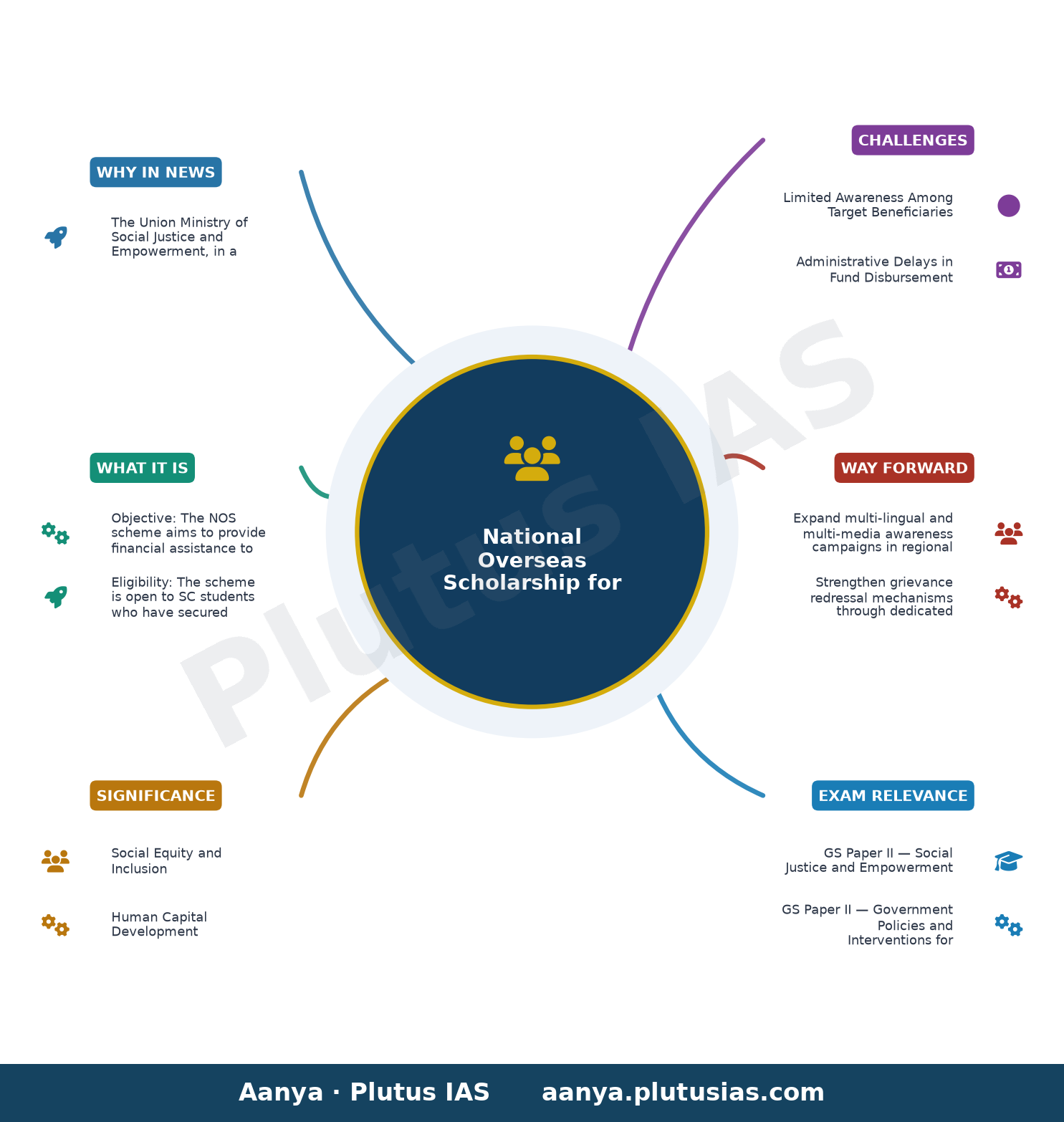
✎ The National Overseas Scholarship (NOS) for Scheduled Caste students is a centrally sponsored scheme that provides financial assistance for higher education abroad, with a focus on merit, digital governance, and equitable access.
Subject Relevance — Where This Topic Fits
- GS Paper II — Social Justice and Empowerment | GS Paper II — Government Policies and Interventions for Development in various sectors
- Prelims: National Overseas Scholarship (NOS), Scheduled Caste (SC) Welfare Schemes, Digital Governance Initiatives (UMANG Portal), Foreign Education Financing, Union Budget Allocations for SC Development
- Essay: Equity in Education: Bridging the Global Divide for Marginalized Communities, Digital Public Infrastructure and Inclusive Governance
Quick Revision: The National Overseas Scholarship (NOS) for Scheduled Caste students is a centrally sponsored scheme that provides financial assistance for higher education abroad, with a focus on merit, digital governance, and equitable access.
Why is this in the news?
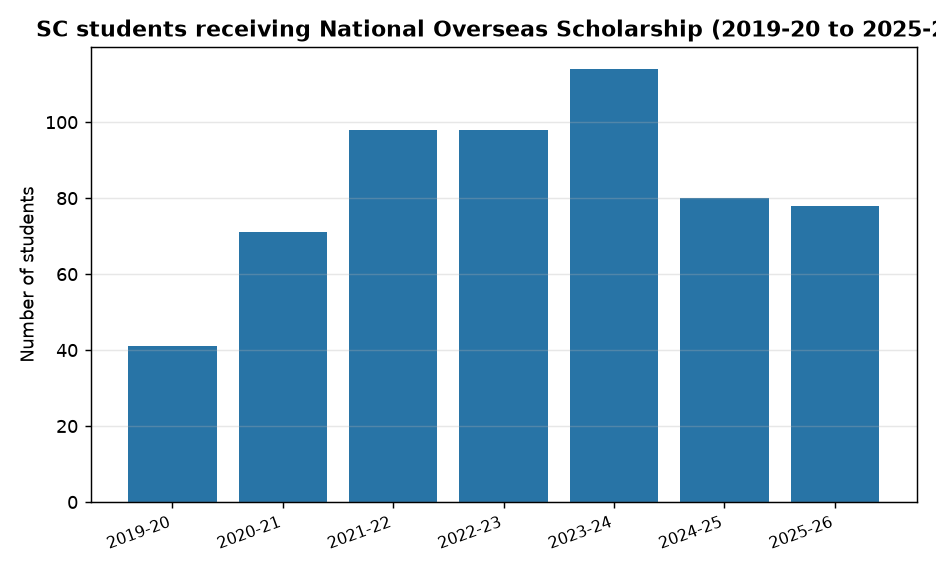
The Union Ministry of Social Justice and Empowerment, in a written reply to the Lok Sabha on 11 August 2026, reported that the National Overseas Scholarship (NOS) scheme for Scheduled Caste (SC) students facilitated the admission of 580 beneficiaries to foreign universities between 2019–20 and 2025–26. This development underscores the government’s efforts to strengthen institutional mechanisms for enhancing access to global higher education among marginalized communities, while also highlighting the role of digital governance in streamlining scholarship disbursement and monitoring.
Background
- The National Overseas Scholarship (NOS) scheme was launched by the Government of India to provide financial assistance to meritorious Scheduled Caste (SC) students for pursuing higher education abroad at the Master’s, Ph.D., and Post-Doctoral levels.
- The scheme is a key component of the Union Government’s broader strategy to promote educational equity and social inclusion, aligning with constitutional provisions such as Article 15(4) and Article 46 of the Constitution of India.
- The NOS scheme operates under the aegis of the Ministry of Social Justice and Empowerment, which is responsible for the welfare and empowerment of marginalized sections of society, including SCs.
- Over the years, the scheme has evolved to incorporate digital governance tools, including the integration with the ‘Integrated Inclusivity (Single Access Mechanism for all Spheres of Empowerment and Social Harmony)’ portal to streamline application, verification, and fund disbursement processes.
- The scheme’s outreach has been enhanced through multi-lingual dissemination via departmental websites, newspaper advertisements, and coordination with state governments and Union Territory administrations.
What is the National Overseas Scholarship (NOS) Scheme for Scheduled Caste Students?
- Objective: The NOS scheme aims to provide financial assistance to meritorious SC students to pursue higher education abroad, thereby enhancing their employability and contributing to the nation’s human capital development.
- Eligibility: The scheme is open to SC students who have secured admission to Master’s, Ph.D., or Post-Doctoral programs in accredited foreign universities. Applicants must meet prescribed academic and income criteria.
- Financial Assistance: The scholarship covers tuition fees, maintenance allowance, contingency allowance, and airfare, subject to a ceiling determined by the Ministry. Funds are disbursed through Indian Missions/Embassies abroad to ensure timely delivery to beneficiaries.
- Selection Process: Applications are invited through an online portal, and selections are made based on merit, subject to the availability of funds. The process includes scrutiny of applications, verification of documents, and final selection by a designated committee.
- Digital Integration: The scheme has been integrated with the ‘Integrated Inclusivity (Single Access Mechanism for all Spheres of Empowerment and Social Harmony)’ portal to streamline application, verification, and fund management, reducing delays and enhancing transparency in disbursement.
- Awareness and Outreach: The Ministry conducts awareness campaigns through departmental websites, newspaper advertisements, and coordination with state governments to ensure wider participation. State-level data indicates varying levels of beneficiary uptake, with some districts showing consistent engagement.
- Monitoring and Evaluation: The scheme is subject to periodic reviews to assess its impact on beneficiaries’ educational outcomes and career progression, with data-driven adjustments made as necessary.
Key Features
| Feature | Significance |
|---|---|
| Digital Integration with UDAAN Portal | Streamlines application, verification, and fund disbursement processes, reducing bureaucratic delays and enhancing transparency for SC students. |
| Advance Fund Release to Indian Missions | Ensures timely disbursement of scholarship funds to students abroad by authorising Indian missions to release funds in advance. |
| Multi-Channel Awareness Campaigns | Utilises departmental websites, newspaper advertisements, and state welfare departments to improve outreach and accessibility of the scheme. |
| Year-wise Distribution of Scholarships | Demonstrates progressive enhancement in scholarship allocation, peaking at 114 beneficiaries in 2023-24, reflecting sustained government commitment. |
| State-Level Implementation Tracking | Provides district-wise beneficiary data for Andhra Pradesh, enabling targeted policy interventions and monitoring of regional disparities. |
Why it Matters
Social Equity and Inclusion
- Facilitates equitable access to global higher education for Scheduled Caste (SC) students, addressing historical educational disparities.
- Promotes socio-economic mobility by enabling advanced academic opportunities that may not be available domestically.
- Aligns with constitutional directive principles under Article 46 to promote educational advancement among marginalised sections.
Human Capital Development
- Enhances India’s soft power by fostering globally competent SC graduates who can contribute to domestic innovation and international collaboration.
- Supports the creation of a skilled workforce capable of addressing global challenges in science, technology, and governance.
- Contributes to the realisation of Sustainable Development Goal 4 (Quality Education) by expanding educational opportunities.
Governance and Administrative Efficiency
- Demonstrates the efficacy of digital governance in reducing procedural bottlenecks and improving service delivery for welfare schemes.
- Showcases inter-departmental coordination between the Ministry of Social Justice and Indian missions abroad for seamless fund management.
- Highlights the role of data-driven policymaking through systematic beneficiary tracking and regional analysis.
Challenges
1. Limited Awareness Among Target Beneficiaries
- Despite multi-channel outreach, awareness gaps persist, particularly in rural and remote SC communities, leading to underutilisation of the scheme.
- Lack of regional language dissemination of scheme details may exclude non-English/Hindi-speaking beneficiaries.
UPSC Link: GS-II: Welfare Schemes
2. Administrative Delays in Fund Disbursement
- Advance fund release to missions mitigates delays, but bureaucratic layers in verification and approval processes can still hinder timely disbursement.
- Coordination challenges between central ministries, state governments, and foreign missions may cause procedural inefficiencies.
UPSC Link: GS-II: Government Policies
3. Regional Disparities in Beneficiary Distribution
- Uneven distribution of scholarships across states and districts, with Andhra Pradesh showing limited uptake despite targeted efforts.
- Urban-centric implementation may exclude SC students from rural and tribal areas with limited access to information or institutional support.
UPSC Link: GS-II: Social Sector Services
4. Stringent Eligibility and Selection Criteria
- Academic merit-based selection, while ensuring quality, may inadvertently exclude meritorious SC students from economically weaker sections due to preparatory gaps.
- Financial constraints in meeting additional costs (e.g., visa, travel) not covered by the scholarship may deter participation.
UPSC Link: GS-II: Education
5. Sustainability of Funding and Scalability
- Long-term financial sustainability of the scheme depends on budgetary allocations, which may fluctuate with changing government priorities.
- Scaling the scheme to accommodate larger cohorts of SC students requires infrastructure, institutional partnerships, and policy stability.
UPSC Link: GS-III: Economic Development
Challenges — UPSC Perspective
| Issue | Concern |
|---|---|
| Awareness Gaps | Underutilisation due to lack of information among SC students in rural areas. |
| Procedural Delays | Potential bottlenecks in verification and fund disbursement despite digital integration. |
| Regional Imbalance | Disproportionate beneficiary distribution favouring certain states over others. |
| Financial Constraints | Additional costs beyond scholarship may limit participation for economically weaker SC students. |
| Eligibility Barriers | Merit-based selection may exclude deserving candidates from socio-economically disadvantaged backgrounds. |
Government Initiatives — Must-Memorise for Prelims
- National Overseas Scholarship (NOS) for Scheduled Castes
Way Forward
- Expand multi-lingual and multi-media awareness campaigns in regional languages to reach SC students in rural and tribal areas.
- Strengthen grievance redressal mechanisms through dedicated helplines and district-level nodal officers for real-time issue resolution.
- Enhance collaboration with state governments to identify and mentor potential beneficiaries through pre-departure orientation programs.
- Conduct periodic reviews of selection criteria to balance merit with socio-economic inclusivity, possibly introducing quotas for economically weaker sections within SC.
- Establish a monitoring framework to track regional disparities and allocate resources dynamically to underrepresented states.
- Promote partnerships with Indian diaspora organisations abroad to facilitate mentorship, accommodation, and integration support for scholarship recipients.
- Ensure budgetary allocations are linked to demographic and educational data to sustain long-term scalability of the scheme.
- Integrate NOS with other scholarship schemes (e.g., for ST, OBC, or PwD) to create a unified portal for all marginalised groups.
UPSC Value Addition
Keywords for Mains Answer-Writing
National Overseas Scholarship Scheme · Scheduled Castes · Higher Education Abroad · Social Justice and Empowerment Ministry · Digital Governance in Scholarships · Ekalavya Portal Integration · Foreign Education Financing · Inclusive Access to Global Education · Scheduled Castes and Scheduled Tribes Welfare · Government Scholarship Schemes · Digital Public Infrastructure · Equity in Education · Foreign University Admissions · Central Sector Schemes for SCs
Constitutional & Policy Linkages
- Article 15(4) – Special provisions for advancement of socially and educationally backward classes
- Article 46 – Promotion of educational and economic interests of weaker sections
- Article 16(4) – Reservation in services for backward classes
- Seventh Schedule – Concurrent List (Entry 25: Education)
Concept Flow
Constitutional mandate (Article 46) → Policy formulation (NOS scheme) → Awareness and outreach (multi-channel campaigns) → Digital integration (UDAAN portal) → Selection and verification → Fund disbursement (via Indian missions) → Beneficiary utilisation (overseas education) → Socio-economic impact (human capital development) → Feedback loop (policy refinement and scalability)
Prelims Practice Questions
Q1. Consider the following statements regarding the National Overseas Scholarship (NOS) Scheme for Scheduled Castes:
1. The NOS Scheme is implemented by the Ministry of Education.
2. Under the NOS Scheme, funds are released in advance to Indian Missions/Embassies for disbursement to selected students.
3. The application process for the NOS Scheme is conducted exclusively through offline mode.
4. The NOS Scheme includes provisions for reimbursement of tuition fees, maintenance allowance, and contingency allowance.
How many of the above statements are correct?
- Only one
- Only two
- Only three
- All four
Answer: Only three — Statements 2 and 4 are correct. The NOS Scheme is implemented by the Ministry of Social Justice and Empowerment, not the Ministry of Education (Statement 1 is incorrect). The application process is online, with the scheme recently integrated into the e-Kalavya (Ekalavya) portal (Statement 3 is incorrect).
Q2. Assertion (A): The National Overseas Scholarship (NOS) Scheme for Scheduled Castes aims to enhance access to higher education abroad for marginalized communities.
Reason (R): The scheme provides financial assistance, including tuition fees, maintenance, and contingency allowances, to selected students for pursuing postgraduate and PhD studies overseas.
In the context of the above two statements, which one of the following is correct?
- Both A and R are true, and R is the correct explanation of A
- Both A and R are true, but R is not the correct explanation of A
- A is true, but R is false
- A is false, but R is true
Answer: Both A and R are true, but R is not the correct explanation of A — Both the Assertion (A) and Reason (R) are true. The NOS Scheme is designed to empower Scheduled Caste students by providing financial support for higher education abroad, thereby addressing equity in access to global educational opportunities. The Reason (R) correctly explains the objective of the Assertion (A).
Mains Practice Question
✍ The National Overseas Scholarship (NOS) Scheme for Scheduled Castes represents a significant intervention in promoting equity in higher education. Critically examine the scheme’s design, implementation mechanisms, and its role in fostering inclusive access to global educational opportunities. Also, evaluate the impact of integrating the scheme with the e-Kalavya (Ekalavya) portal on transparency and efficiency in the selection and disbursement process. (15 Marks)
Approach: MODEL-ANSWER SKELETON:
1. **Introduction (2 Marks)**
– Define the NOS Scheme: A central sector scheme under the Ministry of Social Justice and Empowerment, launched to provide financial assistance to Scheduled Caste (SC) students for pursuing postgraduate and PhD studies abroad.
– Objective: To enhance equity in access to higher education by reducing financial barriers for SC students.
2. **Design and Eligibility Criteria (3 Marks)**
– Eligibility: Age limit (typically 35 years for PhD, 30 for postgraduate), income ceiling (₹6.0 lakh per annum), and academic qualifications (minimum 55% marks in qualifying examination).
– Components of Assistance: Full tuition fees, maintenance allowance (USD 15,400 per annum), contingency allowance (USD 1,500 per annum), and airfare (economy class).
– Target Group: SC students with demonstrated academic merit but limited financial means.
3. **Implementation Mechanisms (4 Marks)**
– Institutional Framework: Role of the Ministry of Social Justice and Empowerment, Indian Missions/Embassies, and nodal agencies (e.g., Educational Consultants India Limited – EdCIL).
– Selection Process: Merit-based, with applications invited online and evaluated by a committee constituted by the Ministry.
– Fund Disbursement: Advance release of funds to Indian Missions/Embassies via Letter of Authority (LOA), ensuring timely disbursement to universities and students.
– Monitoring: Regular reviews and audits to ensure compliance and transparency.
4. **Role in Fostering Inclusive Access (3 Marks)**
– Equity Perspective: Addresses the historical underrepresentation of SC students in foreign higher education due to financial constraints.
– Data from PIB Release (2019-26): 580 SC students benefitted, with increasing participation over the years (e.g., 41 in 2019-20 to 78 in 2025-26).
– Geographic Distribution: Beneficiaries from states like Andhra Pradesh, Maharashtra, and Tamil Nadu, indicating outreach beyond metropolitan areas.
5. **Integration with e-Kalavya (Ekalavya) Portal (2 Marks)**
– Purpose: Streamlining application, selection, and fund disbursement processes through a single digital platform.
– Benefits: Reduced paperwork, enhanced transparency, real-time tracking of applications, and faster disbursement of funds.
– Challenges: Digital divide, awareness gaps among potential beneficiaries, and ensuring last-mile connectivity in rural areas.
6. **Critical Evaluation and Way Forward (3 Marks)**
– Strengths: Aligns with constitutional goals of social justice (Articles 15(4), 16(4)), leverages digital governance for efficiency, and demonstrates measurable impact (580 beneficiaries).
– Limitations: Limited coverage (only postgraduate and PhD studies), potential delays in fund disbursement despite advance releases, and need for broader awareness campaigns.
– Suggestions: Expand eligibility to include undergraduate studies, integrate with other scholarship schemes (e.g., PMKVY), and leverage AI for predictive analytics in selection.
**Conclusion (2 Marks)**
– The NOS Scheme is a commendable step toward inclusive education, but its effectiveness hinges on sustained digital governance, expanded outreach, and periodic reviews to address emerging challenges.
Source: PIB (Press Information Bureau)
Generated by AanyaAi for educational purpose.


No Comments