


27 Jul UPSC Alert: Special Drive to Clear 16,033 Pending Labour Cases by August 2026
Subject Relevance — Where This Topic Fits
- GS Paper II — Governance, Transparency and Accountability | GS Paper III — Labour, Employment and Industrial Relations
- Prelims: Industrial Disputes Act, 1947, Code on Wages, 2019, Gratuity Payment (Amendment) Act, 2023, Maternity Benefit (Amendment) Act, 2023, Chief Labour Commissioner (Central), Regional Labour Offices, Labour Courts, Industrial Tribunals
- Essay: Judicial Pendency and Economic Justice: The Case of Labour Disputes, Administrative Efficiency in Public Service Delivery: Lessons from Labour Case Disposal
Quick Revision: The Special Campaign for Pending Labour Cases (1 June–31 August 2026) aims to resolve industrial disputes, wage claims, and statutory entitlements through administrative expedience, leveraging Regional Labour Offices and digital tools to reduce judicial pendency.
Why is this in the news?
The Ministry of Labour and Employment has launched a three-month special campaign from 1 June 2026 to 31 August 2026 to expedite the disposal of 16,033 pending labour cases across regional offices. This initiative addresses systemic delays in adjudicating industrial disputes, wage claims, gratuity, maternity benefits, and other statutory entitlements, underscoring the government’s commitment to labour welfare and ease of doing business.
Background
- The Indian labour adjudication system is governed by multiple statutes, including the Industrial Disputes Act, 1947, which provides for the resolution of industrial disputes through Labour Courts, Industrial Tribunals, and Arbitration.
- Pending cases in labour adjudication mechanisms have historically resulted from procedural delays, inadequate staffing, multiplicity of forums, and complex legal provisions.
- The Code on Wages, 2019, and subsequent amendments to the Maternity Benefit Act and Gratuity Act have expanded the scope of statutory entitlements, increasing the caseload on labour adjudicating authorities.
- The Chief Labour Commissioner (Central) oversees the enforcement of labour laws and coordinates the functioning of Regional Labour Offices, which are primary nodal agencies for dispute resolution.
- Judicial pendency in labour matters not only affects workers’ access to justice but also deters investment by increasing compliance uncertainty for employers.
- The special campaign aligns with the government’s broader agenda of ‘Ease of Doing Business’ and ‘Labour Reforms’ aimed at simplifying compliance and reducing litigation.
What is the Special Campaign for Expeditious Disposal of Pending Labour Cases?
- The campaign is a time-bound initiative launched by the Chief Labour Commissioner (Central) to resolve pending labour cases across Regional Labour Offices within a three-month period (1 June 2026 – 31 August 2026).
- The campaign targets industrial dispute cases, wage claims, gratuity disputes, maternity benefit claims, and other statutory entitlements under labour laws.
- The initiative employs focused administrative measures, including dedicated benches, streamlined documentation, and periodic review mechanisms to accelerate case disposal.
- Regional Labour Offices function as the primary implementing agencies, supported by Labour Courts and Industrial Tribunals where applicable.
- The campaign leverages digital tools, such as online case tracking and e-filing, to enhance transparency and reduce procedural delays.
- Monitoring is conducted through weekly progress reviews and real-time dashboards to ensure accountability and timely resolution.
- The campaign is part of a broader strategy to reduce judicial pendency and improve the ease of doing business by providing a predictable regulatory environment.
- Success metrics include the number of cases resolved, reduction in average disposal time, and stakeholder feedback on procedural efficiency.
Key Features
| Feature | Significance |
|---|---|
| Duration | A time-bound three-month campaign (1 June 2026 – 31 August 2026) to expedite resolution of pending labour disputes, ensuring adherence to procedural timelines and reducing case backlog. |
| Scope of Disputes | Covers industrial disputes, wage claims, gratuity, maternity benefits, and other statutory entitlements under labour laws, thereby addressing multi-faceted labour grievances. |
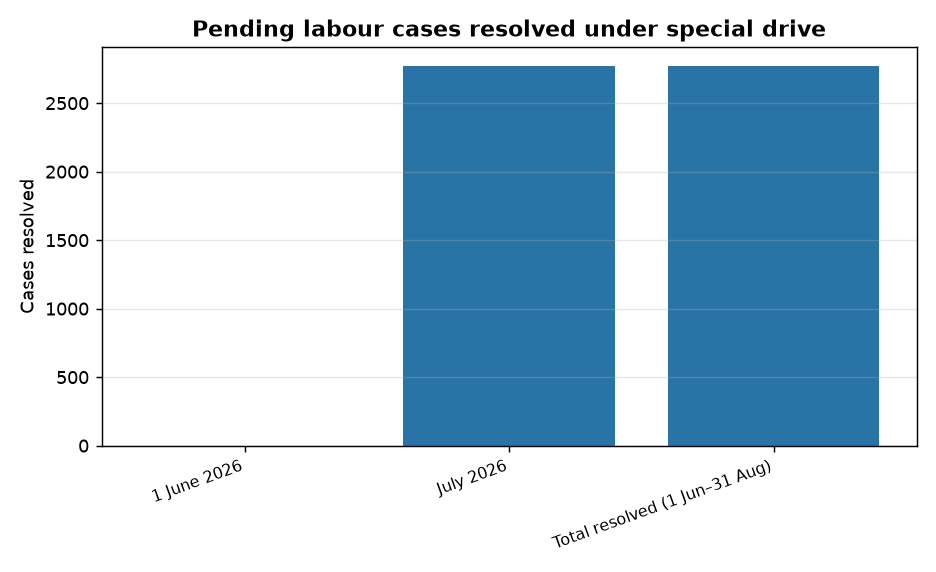
| Baseline Data | As of 1 June 2026, 16,033 cases were pending across regional labour offices, providing a quantified baseline for monitoring campaign progress. |
| Progress Tracking | First-month outcomes show 2,769 cases resolved, demonstrating initial momentum and the efficacy of focused adjudication mechanisms. |
| Institutional Mechanism | Centralised oversight by the Office of the Chief Labour Commissioner (Central), ensuring uniform implementation and accountability across regional offices. |
Why it Matters
Economic
- Enhances labour market efficiency by reducing litigation delays, thereby fostering a more predictable business environment for employers and investors.
- Facilitates timely disbursement of statutory dues (wages, gratuity, maternity benefits), directly augmenting household income and domestic consumption.
- Mitigates adverse effects of prolonged disputes on industrial productivity and supply chains, particularly in labour-intensive sectors.
Legal-Administrative
- Strengthens the credibility of labour adjudication machinery, reinforcing public trust in statutory dispute resolution mechanisms.
- Demonstrates the government’s commitment to expeditious justice delivery, aligning with constitutional directives on speedy trial (Article 21).
- Provides a model for time-bound dispute resolution that can be replicated in other domains of administrative adjudication.
Social
- Protects the rights of vulnerable labour segments (e.g., women workers claiming maternity benefits) by prioritising their grievances.
- Reduces financial hardship for workers awaiting statutory payments, thereby supporting inclusive economic growth.
- Promotes gender-sensitive dispute resolution by addressing maternity benefit claims, a critical component of labour welfare.
Governance
- Illustrates the role of administrative campaigns in achieving policy objectives where legislative or judicial reforms face delays.
- Highlights the importance of data-driven monitoring in public administration, with real-time tracking of case disposal rates.
- Showcases inter-ministerial coordination, as the campaign involves the Ministry of Labour and Employment and parliamentary oversight.
Challenges
1. Jurisdictional Overlaps
- Multiplicity of forums (labour courts, industrial tribunals, civil courts) may lead to conflicting orders or prolonged litigation despite campaign efforts.
- Need for harmonised interpretation of labour statutes across jurisdictions to prevent forum shopping by litigants.
UPSC Link: Judicial Activism vs. Separation of Powers
2. Resource Constraints
- Limited capacity of regional labour offices in terms of staff, infrastructure, and digital tools may hinder efficient case disposal.
- Dependence on manual processes in some offices could slow down the pace of resolution despite campaign directives.
UPSC Link: Governance Challenges in Labour Administration
3. Enforcement Gaps
- Even after favourable orders, delays in enforcement by employers or administrative agencies may undermine the campaign’s impact.
- Lack of robust monitoring mechanisms to ensure compliance with adjudication outcomes post-resolution.
UPSC Link: Implementation Deficits in Welfare Schemes
4. Data Fragmentation
- Inconsistent digitisation of case records across states may impede real-time tracking and analysis of campaign progress.
- Absence of a centralised grievance redressal portal for labour disputes, leading to information asymmetry.
UPSC Link: Digital Governance and E-Governance
5. Worker Awareness
- Low awareness among workers about their statutory rights and the campaign may result in underutilisation of the dispute resolution mechanism.
- Language barriers and lack of access to legal aid in rural or informal sectors could exclude marginalised workers.
UPSC Link: Labour Rights and Social Security
Challenges — UPSC Perspective
| Issue | Concern |
|---|---|
| Forum Shopping | Litigants exploiting multiple forums to prolong disputes, undermining the campaign’s time-bound objective. |
| Digital Divide | Regional disparities in digital infrastructure hinder real-time case tracking and e-filing. |
| Employer Non-Compliance | Reluctance or delay in adhering to adjudication orders, particularly in unorganised sectors. |
| Statutory Ambiguities | Vague or overlapping provisions in labour laws (e.g., definition of ‘wages’) leading to interpretative disputes. |
| Monitoring Bottlenecks | Lack of standardised metrics to assess the quality of dispute resolution beyond mere case disposal numbers. |
| Informal Sector Exclusion | Workers in the informal economy often lack documentation or awareness to file claims, rendering them invisible in the system. |
Way Forward
- Establish a centralised digital dashboard for real-time tracking of case disposal rates, pending cases, and compliance status across regional offices.
- Conduct awareness campaigns in regional languages to educate workers about their statutory rights and the dispute resolution process.
- Strengthen the capacity of regional labour offices through recruitment of additional adjudicating officers and IT infrastructure upgrades.
- Introduce fast-track benches for maternity benefit and wage disputes to prioritise gender-sensitive and economically critical cases.
- Mandate quarterly audits of adjudication orders to identify systemic bottlenecks and enforce compliance through penalties or incentives.
- Develop a grievance redressal portal for workers to file claims and track progress, integrated with Aadhaar for authentication.
- Collaborate with state governments to harmonise labour laws and reduce jurisdictional conflicts, ensuring uniform application.
- Publish success stories of resolved cases to build public confidence and demonstrate the campaign’s tangible impact on labour welfare.
UPSC Value Addition
Keywords for Mains Answer-Writing
Industrial Disputes Act, 1947 · Labour adjudication machinery · Wage and gratuity claims · Maternity Benefit Act, 1961 · Labour courts and tribunals · Pendency of labour cases · Conciliation and arbitration in labour disputes · Statutory benefits for workers · Labour welfare and enforcement · Judicial reforms in labour adjudication
Constitutional & Policy Linkages
- Article 21: Right to Speedy Trial (as part of the broader right to life and personal liberty).
- Article 39: Directive Principles of State Policy (promotion of workers’ welfare and social justice).
- Article 41: Right to Public Assistance in cases of unemployment, old age, sickness, and disablement.
Concept Flow
Prolonged labour disputes → Accumulation of pending cases (16,033 as of 1 June 2026) → Economic stagnation and worker distress. → Government initiates time-bound campaign (1 June – 31 August 2026) → Focus on industrial disputes, wages, gratuity, maternity benefits. → Regional labour offices expedite adjudication → First-month disposal of 2,769 cases → Monitoring via centralised dashboard. → Enforcement of adjudication orders → Compliance challenges (employer reluctance, digital divide) → Need for post-resolution grievance mechanisms. → Broader impact: Enhanced labour market efficiency, reduced litigation delays, and strengthened trust in statutory dispute resolution. → Long-term: Harmonisation of labour laws, digital governance, and awareness campaigns to sustain gains and prevent recurrence.
Prelims Practice Questions
Q1. Which of the following is NOT a statutory benefit covered under the special campaign launched by the Ministry of Labour and Employment for the disposal of pending labour cases?
- Wage arrears
- Gratuity payments
- Maternity benefits
- Provident Fund contributions
Answer: Provident Fund contributions — The special campaign targets disputes related to wages, gratuity, maternity benefits, and other statutory claims under the Industrial Disputes Act, 1947. Provident Fund contributions fall under the purview of the Employees’ Provident Funds and Miscellaneous Provisions Act, 1952, and are not explicitly mentioned in the campaign.
Q2. The special campaign for disposal of pending labour cases is being conducted by which authority?
- Supreme Court of India
- Ministry of Law and Justice
- Office of the Chief Labour Commissioner (Central)
- National Labour Commission
Answer: Office of the Chief Labour Commissioner (Central) — The campaign is being conducted by the Office of the Chief Labour Commissioner (Central), as per the press release issued by the Ministry of Labour and Employment.
Mains Practice Question
✍ Examine the significance of the special campaign launched by the Ministry of Labour and Employment for the disposal of pending labour cases. How does this initiative address the challenges faced by the labour adjudication machinery in India?
Approach: The candidate should analyse the objectives of the campaign, such as expediting the resolution of industrial disputes, wage and gratuity claims, and maternity benefits. They should also discuss the structural challenges in the labour adjudication system, including pendency of cases, delays in justice delivery, and the role of labour courts and tribunals. Additionally, the answer should highlight the potential impact of the campaign on labour welfare, enforcement of statutory rights, and the broader goal of reducing litigation backlog in the labour sector.
Source: PIB (Press Information Bureau)
Generated by AanyaAi for educational purpose.

- ईरान में नागरिकों पर अत्याचार: संयुक्त राष्ट्र के तथ्यान्वेषण मिशन की रिपोर्ट - September 18, 2026
- UN Report: Iran’s Crimes Against Humanity & US War Crimes Exposed - September 18, 2026
- आरबीआई ने गुवाहाटी सहकारी शहरी बैंक पर निर्देशों का विस्तार किया, जानें पूरा मामला - September 18, 2026

No Comments