


18 Sep UPSC Alert: VP Highlights Hyderabad Liberation Day’s Role in National Unity
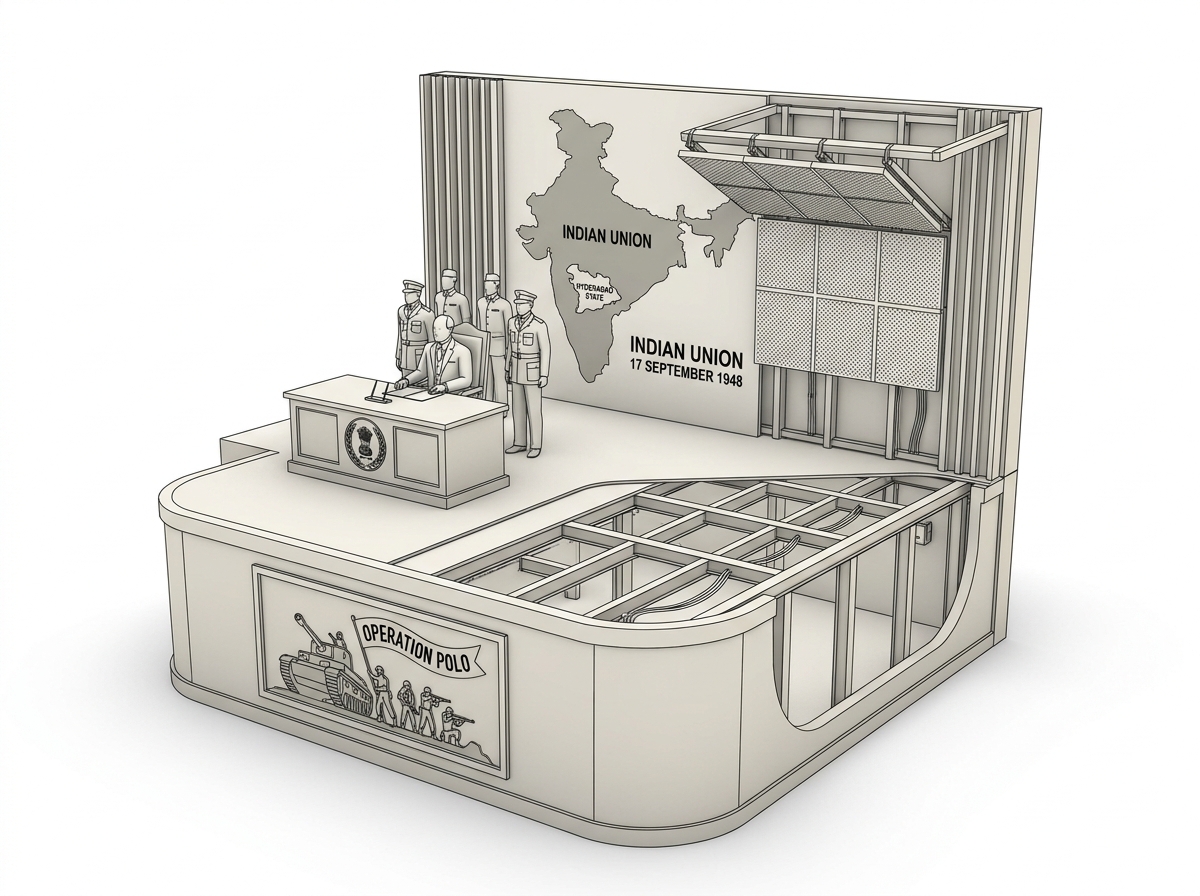
✎ Hyderabad was integrated into the Indian Union on 17 September 1948 through Operation Polo, marking a critical step in the post-independence consolidation of India under the leadership of Sardar Vallabhbhai Patel.
Subject Relevance — Where This Topic Fits
- GS Paper I — Modern Indian History (1857–1947) | GS Paper II — Polity and Governance (Constitutional Framework)
- Prelims: Operation Polo, Sardar Vallabhbhai Patel, Princely States of India, Integration of Hyderabad, Article 370 (historical context), Central Armed Police Forces (CAPFs), State Reorganisation Act, 1956
- Essay: The Role of Sardar Patel in Unifying India, National Integration: Challenges and Achievements in Post-Independence India
Quick Revision: Hyderabad was integrated into the Indian Union on 17 September 1948 through Operation Polo, marking a critical step in the post-independence consolidation of India under the leadership of Sardar Vallabhbhai Patel.
Why is this in the news?
The Vice President of India, Shri C.P. Radhakrishnan, participated as the Chief Guest at the 79th Hyderabad Liberation Day celebrations held in Secunderabad, Telangana, on 17 September 2026. The event commemorated the integration of the erstwhile Hyderabad State into the Indian Union on 17 September 1948, following Operation Polo. The Vice President underscored the historical significance of Hyderabad Liberation as a pivotal chapter in India’s journey toward national unity and constitutional democracy, while also acknowledging the contributions of central armed police forces and the broader public movement that facilitated the state’s integration.
Background
- The Hyderabad State, ruled by the Nizam of Hyderabad, was the largest princely state in British India, covering present-day Telangana, parts of Maharashtra, Karnataka, and Andhra Pradesh.
- Post-independence, the Nizam, Mir Osman Ali Khan, initially sought to retain Hyderabad as an independent state, despite the lapse of paramountcy of the British Crown in August 1947.
- The Nizam’s decision to retain independence led to internal unrest, particularly among the majority Hindu population, who demanded integration with the Indian Union, and the Razakar movement, which sought to suppress such demands through force.
- The Indian government, under the leadership of Sardar Vallabhbhai Patel, initiated Operation Polo (also known as the Police Action) on 13 September 1948, to integrate Hyderabad into the Indian Union, culminating in the state’s formal accession on 17 September 1948.
- The integration of Hyderabad was a critical milestone in the broader process of integrating over 560 princely states into the Indian Union, a task spearheaded by Sardar Patel as the first Deputy Prime Minister and Minister of States.
- The integration of Hyderabad was followed by the linguistic reorganisation of states, culminating in the State Reorganisation Act of 1956, which redrew state boundaries along linguistic lines.
What was the Hyderabad Liberation and its constitutional significance?
- Hyderabad Liberation refers to the integration of the erstwhile Hyderabad State into the Indian Union on 17 September 1948, following Operation Polo, a military action conducted by the Indian Armed Forces to ensure the state’s accession.
- The integration of Hyderabad was a complex process involving diplomatic negotiations, military action, and the suppression of the Razakar movement, which had sought to maintain the Nizam’s independent rule through coercion.
- The integration was achieved through the Instrument of Accession, a legal framework under which princely states could accede to the Indian Union, ensuring their governance under the Indian Constitution while retaining certain internal administrative powers temporarily.
- Sardar Vallabhbhai Patel, as the first Deputy Prime Minister and Minister of States, played a pivotal role in the integration of Hyderabad and other princely states, earning him the title of the ‘Iron Man of India’ for his decisive leadership.
- The integration of Hyderabad was not merely a political or military achievement but also a constitutional milestone, as it reinforced the principle of the supremacy of the Indian Constitution and the authority of the Union Government over all territories within India.
- The event is commemorated annually as Hyderabad Liberation Day to honour the sacrifices of those who fought for integration, including regional leaders like Ramji Gond, Turrebaz Khan, and Komaram Bheem, who led armed resistance against the Nizam’s rule.
- The integration of Hyderabad set a precedent for the integration of other princely states, demonstrating the Indian government’s commitment to national unity and territorial integrity, while also addressing the aspirations of diverse linguistic and cultural communities.
Key Features
| Feature | Significance |
|---|---|
| Hyderabad Liberation Day (17 September 1948) | Marks the military and administrative integration of the erstwhile Hyderabad State into the Indian Union, concluding the Nizam’s rule and ending the political autonomy of a princely state. |
| Operation Polo (13–18 September 1948) | Codename for the military action by the Indian Armed Forces to secure the accession of Hyderabad State, demonstrating the Union Government’s resolve to uphold territorial integrity post-Independence. |
| Role of Sardar Vallabhbhai Patel | As Deputy Prime Minister and Home Minister, Patel spearheaded the integration of 565 princely states into the Indian Union, ensuring national unity and sovereignty. |
| People’s Movement in Hyderabad | Included students, intellectuals, social workers, and local leaders who resisted the Nizam’s autocratic rule and advocated for democratic integration with India. |
| Central Armed Police Forces (CAPFs) | Played a pivotal role in maintaining law and order during and after Operation Polo, facilitating the smooth transition of Hyderabad into the Indian Union. |
Why it Matters
Historical Unity
- Demonstrates the consolidation of post-Independence India through both democratic and military means, ensuring territorial integrity.
- Highlights the principled rejection of princely autocracy in favour of constitutional democracy and popular sovereignty.
- Reinforces the narrative of India as a pluralistic nation where diverse linguistic, cultural, and political identities coexist under a shared constitutional framework.
Constitutional Governance
- Illustrates the application of constitutional provisions (Article 370-like autonomy was not granted to Hyderabad) to integrate princely states into a unified legal and administrative system.
- Shows the transition from feudal structures to a modern, democratic republic, with institutions like the CAPFs ensuring stability during integration.
National Integration Model
- Serves as a case study for the integration of culturally and politically distinct regions into a cohesive national identity.
- Emphasises the role of grassroots movements in shaping national narratives of freedom and self-determination.
Strategic Security
- Underlines the importance of geographic and political cohesion for national security, particularly in border and hinterland regions.
- Demonstrates the Union Government’s commitment to preventing secessionist tendencies and maintaining internal stability.
Challenges
1. Integration of Princely States
- Balancing the aspirations of local rulers with the democratic principles of the Indian Union, especially in states like Hyderabad with strong regional identities.
- Addressing the administrative vacuum post-integration, including the integration of diverse legal, revenue, and governance systems into a unified framework.
- Managing resistance from local elites and sections of the population who favoured continued autonomy or alignment with Pakistan.
UPSC Link: Polity: Federalism; Post-Independence Consolidation
2. Military vs. Democratic Integration
- Balancing the use of force (Operation Polo) with the need to establish democratic legitimacy and public acceptance in the newly integrated region.
- Ensuring that military action does not undermine the long-term goal of fostering a sense of belonging among the local population.
UPSC Link: Modern Indian History: Integration of Princely States
3. Grassroots Mobilisation
- Harnessing and sustaining local movements while ensuring they align with national goals, avoiding fragmentation or extremism.
- Addressing socio-economic disparities that fuelled regional grievances and resistance to integration.
UPSC Link: Post-Independence India: Socio-Political Movements
4. Constitutional Framework Application
- Adapting constitutional provisions to integrate regions with distinct legal and administrative traditions, such as the Hyderabad State’s unique revenue and land systems.
- Ensuring that the integration process did not violate fundamental rights or democratic principles.
UPSC Link: Polity: Fundamental Rights; Directive Principles
5. Post-Integration Governance
- Establishing effective administrative structures in the newly integrated region to prevent administrative gaps or public discontent.
- Integrating local leaders and elites into the national political system to ensure continuity and legitimacy.
UPSC Link: Polity: Federal Structure; Role of States
Challenges — UPSC Perspective
| Issue | Concern |
|---|---|
| Princely State Autonomy | Risk of secessionist tendencies and resistance to integration with the Indian Union. |
| Local Resistance Movements | Potential for armed or non-violent resistance from groups favouring continued Nizam rule or alignment with Pakistan. |
| Administrative Vacuum | Challenges in integrating diverse legal, revenue, and governance systems into a unified framework. |
| Public Acceptance | Ensuring that the integration process is perceived as legitimate and beneficial by the local population. |
| Military-Civilian Transition | Balancing the use of force with the need to establish democratic governance and public trust. |
Way Forward
- Analyse the constitutional and administrative mechanisms used to integrate princely states, drawing parallels with modern federal challenges.
- Study the role of grassroots movements in shaping national integration, with a focus on Hyderabad’s Telangana movement.
- Examine the strategic significance of Operation Polo in the context of post-Independence India’s territorial consolidation.
- Assess the long-term impact of Hyderabad’s integration on India’s federal structure and regional identity politics.
- Explore the lessons from Hyderabad’s integration for contemporary challenges in managing regional aspirations within a unified nation.
- Evaluate the role of central institutions (e.g., CAPFs) in maintaining stability during periods of political transition.
- Reflect on the importance of constitutional democracy in fostering national unity, using Hyderabad’s integration as a case study.
UPSC Value Addition
Keywords for Mains Answer-Writing
Hyderabad Liberation Day · Operation Polo · Integration of Princely States · Sardar Vallabhbhai Patel · National Integration · Constitutional Democracy · Central Armed Police Forces · Riyasat Integration · 79th Hyderabad Liberation Day · State Reorganisation · Article 370 analogy · Federalism in India · Role of Civil Society in National Movement · Sovereignty of People · Unity in Diversity
Constitutional & Policy Linkages
- Article 1: Union and its Territory (Territorial Integrity)
- Article 3: Formation of New States and Alteration of Areas
- Article 370 (repealed): Historical Context of Autonomy Provisions
- Seventh Schedule: Distribution of Legislative Powers (State vs. Union)
Concept Flow
Princely State Autonomy under Nizam → Resistance to Integration → People’s Movement for Liberation → Operation Polo (Military Action) → Integration into Indian Union → Constitutional Governance & Administrative Reforms → National Unity & Federal Structure
Prelims Practice Questions
Q1. Consider the following statements regarding the integration of princely states in India:
1. The integration of princely states was primarily achieved through the use of military force.
2. Sardar Vallabhbhai Patel played a pivotal role in the integration of princely states.
3. The Government of India Act, 1935 provided the legal framework for the integration of princely states.
4. The Instrument of Accession was a voluntary agreement signed by the princely states to join the Indian Union.
How many of the above statements are correct?
- Only one
- Only two
- Only three
- All
Answer: Only three — Statements 2 and 4 are correct. While military action (e.g., Operation Polo) was used in some cases, integration was largely achieved through diplomacy and the Instrument of Accession. Statement 3 is incorrect as the legal framework was provided by the Indian Independence Act, 1947. Statement 1 is partially correct but not entirely accurate as integration was not solely through military force.
Q2. Assertion (A): The integration of the princely state of Hyderabad was achieved through Operation Polo in 1948.
Reason (R): Operation Polo was a military operation launched to integrate Hyderabad into the Indian Union after the Nizam refused to accede.
In the context of the above two statements, which one of the following is correct?
- Both A and R are true, and R is the correct explanation of A.
- Both A and R are true, but R is not the correct explanation of A.
- A is true, but R is false.
- A is false, but R is true.
Answer: Both A and R are true, and R is the correct explanation of A. — Both Assertion (A) and Reason (R) are true, and Reason (R) correctly explains Assertion (A). Operation Polo was indeed the military operation used to integrate Hyderabad after the Nizam’s refusal to accede to the Indian Union.
Q3. Match the following princely states with their respective regions in India:
Column I (Princely State) | Column II (Region)
1. Hyderabad | A. Rajputana
2. Junagadh | B. Deccan
3. Travancore | C. Kathiawar
4. Jaipur | D. Travancore-Cochin
Select the correct match:
- 1-B, 2-C, 3-D, 4-A
- 1-A, 2-B, 3-C, 4-D
- 1-D, 2-C, 3-B, 4-A
- 1-C, 2-A, 3-D, 4-B
Answer: 1-B, 2-C, 3-D, 4-A — The correct matches are: 1. Hyderabad (Deccan), 2. Junagadh (Kathiawar), 3. Travancore (Travancore-Cochin), 4. Jaipur (Rajputana).
Mains Practice Question
✍ The integration of princely states into the Indian Union, exemplified by the Hyderabad Liberation, was a defining moment in India’s nation-building project. Critically examine the role of Sardar Vallabhbhai Patel in this process, highlighting the constitutional, political, and administrative challenges faced. Also, assess the significance of the Instrument of Accession in ensuring the voluntary integration of these states. (15 Marks)
Approach: MODEL-ANSWER SKELETON:
1. **Introduction (2 marks)**: Define the context of princely states post-1947 and the challenge of integration. Mention Sardar Patel’s role as the first Deputy Prime Minister and Home Minister.
2. **Sardar Patel’s Strategy (4 marks)**:
– **Diplomatic Approach**: Use of persuasion, negotiations, and the Standstill Agreement.
– **Legal Framework**: Role of the Instrument of Accession (Article 370 analogy for context) and the Indian Independence Act, 1947.
– **Political Assertiveness**: Handling of recalcitrant states like Hyderabad (Operation Polo), Junagadh, and Kashmir.
– **Administrative Integration**: Formation of the States Department and integration through merger agreements.
3. **Constitutional and Political Challenges (4 marks)**:
– **Diversity of Princely States**: Over 560 states with varying sizes, populations, and political systems.
– **Nizam’s Resistance**: Hyderabad’s case—use of military force vs. constitutional methods.
– **Role of Civil Society**: Mass movements (e.g., Telangana Armed Struggle, Praja Mandal movements) and their impact.
– **Federalism vs. Centralisation**: Balancing state autonomy with national unity.
4. **Significance of the Instrument of Accession (3 marks)**:
– **Voluntary Integration**: Ensured legal and constitutional legitimacy.
– **Preservation of Autonomy**: Allowed states to retain certain powers while joining the Union.
– **Precedent for Future Integrations**: Basis for integration of other states like Manipur, Tripura, and Cooch Behar.
5. **Conclusion (2 marks)**: Evaluate Patel’s legacy in shaping India’s federal structure and national unity. Reflect on the balance between coercion and consent in nation-building.
Source: PIB (Press Information Bureau)
Telangana PCS (TGPSC (TSPSC)) — State PCS Practice
Prelims: Which of the following statements is correct regarding the role of Vice-President Shri C.P. Radhakrishnan in the Hyderabad Liberation Day celebrations held in Telangana?
- He inaugurated the main event at the historic Charminar in Hyderabad.
- He presided over the flag-hoisting ceremony at the Golconda Fort.
- He emphasized the significance of the Hyderabad Liberation Day in strengthening the unity of Telangana.
- He announced a new welfare scheme for freedom fighters during the event.
Answer: He emphasized the significance of the Hyderabad Liberation Day in strengthening the unity of Telangana. — Vice-President C.P. Radhakrishnan highlighted the importance of Hyderabad Liberation Day in fostering Telangana’s unity and historical pride during the celebrations.
Mains: Discuss the historical significance of Hyderabad Liberation Day in the context of Telangana’s state formation and the role of national leaders in preserving its legacy. (15 marks, 250 words)
Generated by AanyaAi for educational purpose.
Related guides on our sites
- Current affairs for upsc 2026
- How to prepare for GS paper 1 for UPSC CSE mains exam
- UPSC History optional
- Is history a good optional for upsc exam

- UPSC Alert: VP Highlights Hyderabad Liberation Day’s Role in National Unity - September 18, 2026
- उत्तराखंड में 100 प्रमुख ट्रेकिंग रूट की जीपीएस-जीआईएस मैपिंग: सीएम धामी ने किया शुभारंभ - September 18, 2026
- CM Dhami Launches GPS-GIS Mapping of 100 Key Trekking Routes in Uttarakhand - September 18, 2026

No Comments