


07 Jul UPSC Botany optional
UPSC Botany Optional – Syllabus, Booklist, PYQs, and Preparation Strategy
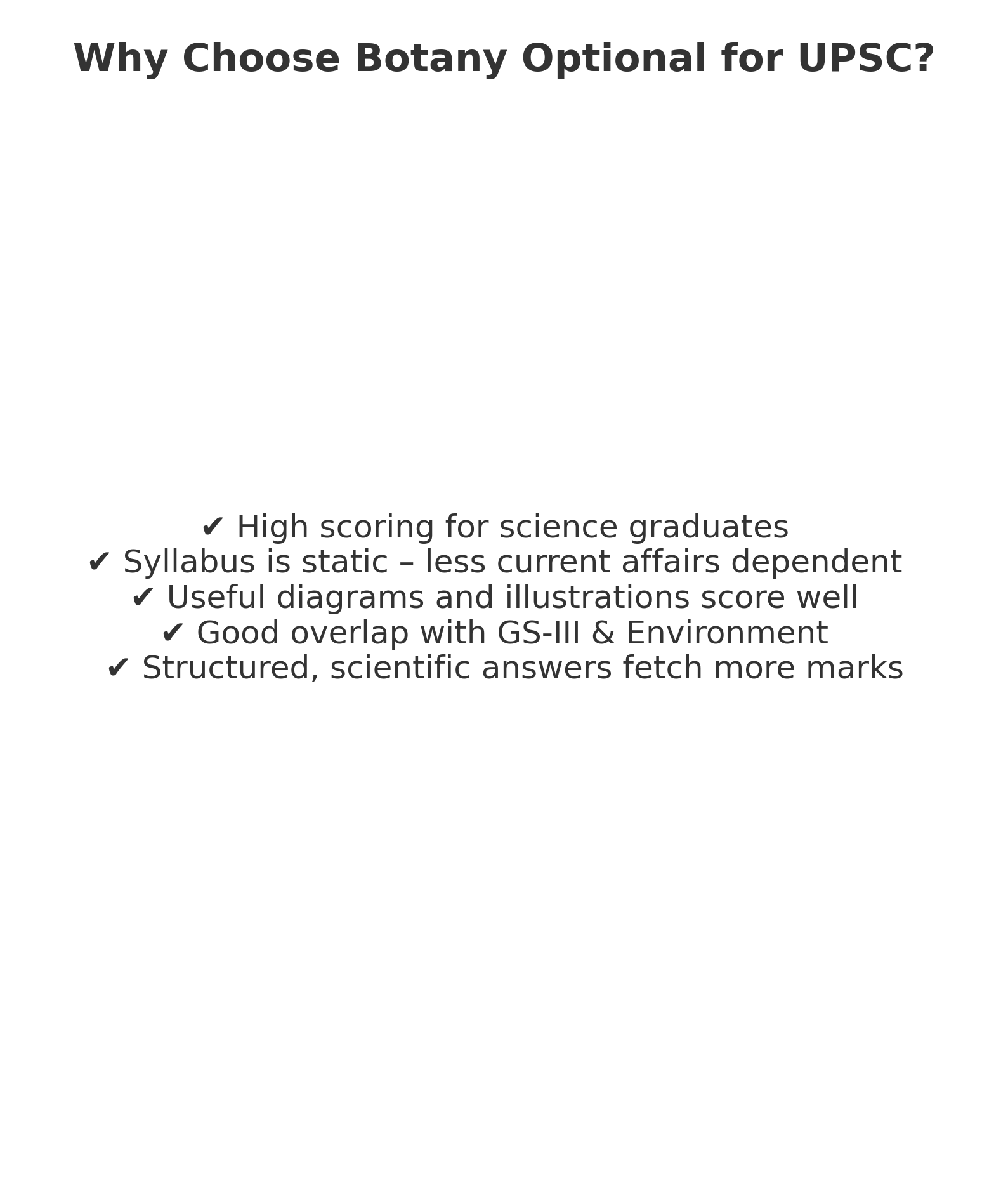
Why Choose Botany Optional for UPSC?
- Highly scoring for candidates with a biology background
- Static syllabus with limited current affairs influence
- Easy availability of resources and standard textbooks
- Overlap with other subjects like agriculture, environment, and GS Paper III
- Scientific and logical presentation helps in better scoring
-
Best ias coaching in hindi medium
UPSC Botany Optional Syllabus
The Botany syllabus is divided into two papers: Paper I and Paper II. Each carries 250 marks and covers a wide range of topics from plant biology to biotechnology.
Paper I
- Microbiology and Plant Pathology
- Cryptogams: Algae, Fungi, Bryophytes, Pteridophytes
- Phanerogams: Gymnosperms, Angiosperms (Morphology, Anatomy, Embryology, Taxonomy)
- Plant Resource Development
- Morphogenesis and Tissue Culture
- Cell Biology
- Genetics, Molecular Biology, and Evolution
Paper II
- Physiology and Biochemistry
- Plant Growth and Development
- Ecology and Phytogeography
- Economic Botany
- Cell Structure and Function
- Biotechnology
- Plant Breeding and Genetic Engineering
Download UPSC Botany Optional Syllabus PDF:
UPSC Botany Optional Syllabus English
UPSC Botany Optional Syllabus Hindi
Best Books for UPSC Botany Optional
Paper I Books
- Introduction to Microbiology – Pelczar
- Cryptogamic Botany – G.M. Smith
- Taxonomy of Angiosperms – B.P. Pandey / Nair
- Plant Anatomy – Esau
- Embryology of Angiosperms – Bhojwani & Bhatnagar
- Cell Biology – De Robertis & Ambrose & Easy Biology Class Notes
- Genetics – P.K. Gupta
Paper II Books
- Plant Physiology – Salisbury & Ross / Taiz & Zeiger
- Biochemistry – Lehninger / Satyanarayana
- Ecology – Odum / Sharma
- Economic Botany – Kochhar
- Plant Biotechnology – B.D. Singh
- Plant Breeding – B.D. Singh
UPSC Botany Optional Previous Year Questions (PYQ)
Practicing previous year questions is crucial to understanding the demand of the exam. Here’s how you can benefit from PYQs:
- Identify high-frequency topics like Morphogenesis, Taxonomy, Plant Physiology
- Understand the structure and pattern of long and short answers
- Compare PYQs across years to identify trends
- Use PYQs to revise in a focused manner
Pro Tip: Divide PYQs year-wise and topic-wise, and practice answer writing in UPSC format.
Strategy to Prepare Botany Optional for UPSC
- Start with NCERTs: Class 11 and 12 Biology books provide a strong foundation.
- Break the syllabus into micro-topics: Cover each one in detail using standard books.
- Make concise notes: Focus on diagrams, labeling, and keywords.
- Use flowcharts and schematics: These improve presentation and understanding.
- Revise consistently: Due to the large content base, timely revision is essential.
- Practice diagrams regularly: UPSC loves well-labeled neat diagrams.
- Enroll in a test series: Helps in time-bound practice and evaluation.
Common Mistakes to Avoid
- Over-reliance on bulky material — stick to the syllabus
- Ignoring diagrams in answers
- Skipping lesser-known topics like phytogeography or tissue culture
- Writing too much theory in numerical-based sections like genetics
Mentorship and Guidance
Botany optional requires detailed understanding and structured guidance. Teachers like Pranab K Sendha from PlutusIAS, an M.Phil in Botany , are known for concept clarity and topic-wise breakdown of the syllabus. If you’re serious about Botany optional, do consider seeking mentorship to streamline your preparation.
Conclusion: Is Botany Optional a Good Choice?
Absolutely! If you have a background in life sciences, B.Sc. Botany, or M.Sc.M.Phil in Botany this subject can work wonders. With proper notes, consistent revision, PYQ practice, and test series, scoring 280+ is definitely achievable in Botany Optional.
✅ Don’t forget to download the complete syllabus in PDF format:

- Karnataka HC rules against insurance condition on tractor-trailers for hire/reward use - October 3, 2026
- युवा संगम: सिक्किम-राजस्थान सांस्कृतिक आदान-प्रदान से सीखें विरासत - October 3, 2026
- Karnataka Launches Praja Seva Legal Aid Centre for Court Case Resolution - October 3, 2026

No Comments