


27 Jul UPSC Exam Alert: PM-ONOS Scheme Expands Access to 13,000+ Journals for Students
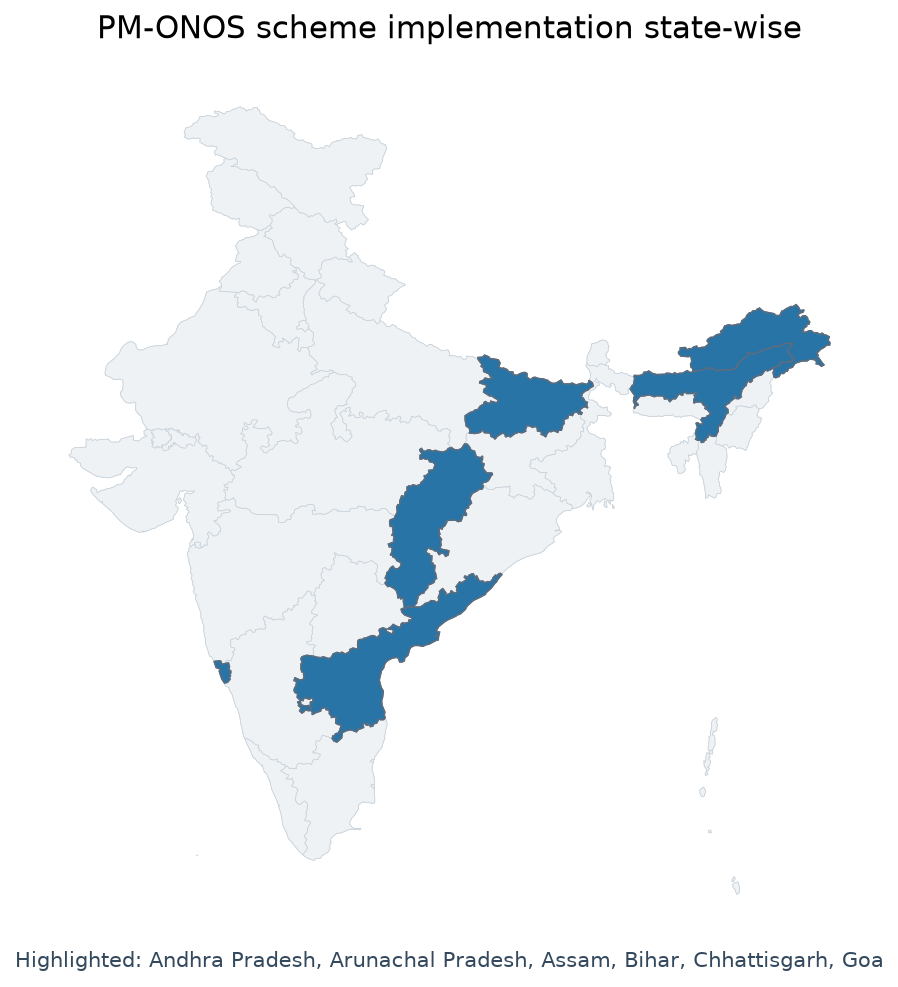
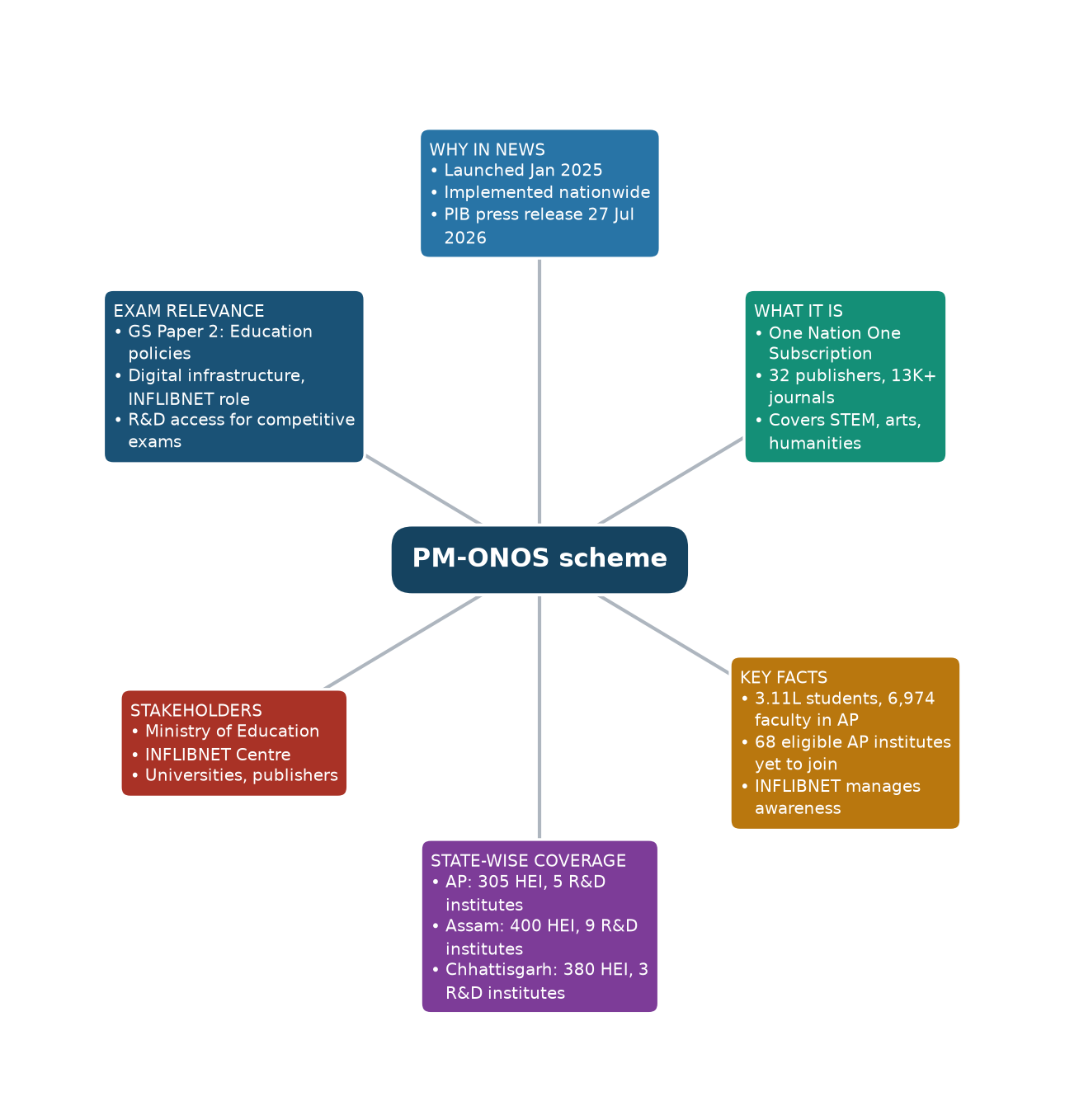
Map & concept mind-map: PM-ONOS scheme implementation state-wise
Subject Relevance — Where This Topic Fits
- GS Paper II — Governance, Administration and Challenges (Digital Public Infrastructure) | GS Paper III — Science and Technology (Innovation in Digital Access)
- Prelims: PM-ONOS, e-Resources, INFLIBNET, Article Processing Charge (APC), Digital Public Infrastructure
- Essay: Digital Public Infrastructure: A Catalyst for Inclusive Education and Research
Quick Revision: PM-ONOS ensures equitable access to 13,000+ academic journals for HEIs and R&D institutions via a single subscription model, implemented by INFLIBNET and aligned with NEP 2020’s digital empowerment goals.
Why is this in the news?
The PM-ONOS (One Nation One Subscription) scheme has gained significant traction in Andhra Pradesh, with over 3.11 lakh students and 6,974 faculty members accessing 13,000+ academic journals across 32 publishers. The implementation status, state-wise coverage, and outreach initiatives were recently highlighted in a written reply to the Lok Sabha, underscoring the scheme’s role in democratising scholarly resources for higher education and research institutions nationwide.
Background
- The PM-ONOS scheme was launched in January 2025 to provide unified access to academic journals for higher education institutions (HEIs) and research & development (R&D) institutions across India.
- The scheme is implemented by the Ministry of Education in collaboration with INFLIBNET (Information and Library Network Centre), a key digital infrastructure provider for academic and research institutions.
- The scheme addresses the critical need for equitable access to high-quality scholarly content, particularly in Tier-2 and Tier-3 cities where digital infrastructure is often limited.
- Prior to PM-ONOS, access to academic journals was fragmented, with institutions relying on individual subscriptions or consortia models, leading to inequities in resource availability.
- The scheme aligns with the National Education Policy (NEP) 2020, which emphasises digital empowerment, research collaboration, and equitable access to knowledge resources.
What is the PM-ONOS Scheme?
- PM-ONOS is a scheme aimed at providing unified, subscription-based access to a curated collection of academic journals for HEIs and R&D institutions in India.
- The scheme covers over 13,000 journals from 32 publishers, spanning disciplines such as science, technology, medicine, arts, and humanities.
- Access is granted through a single portal (https://www.onos.gov.in/), eliminating the need for individual institutional subscriptions and reducing financial burdens on HEIs.
- The scheme is implemented by INFLIBNET, which acts as the nodal agency for coordination, awareness, and technical support across states.
- State-wise coverage is documented in Annexure-I, with detailed institutional lists provided for states like Andhra Pradesh (Annexure-II) and pending institutions (Annexure-III).
- Awareness and outreach initiatives, including webinars, offline lectures, and FAQs, are integral to the scheme’s implementation, ensuring inclusivity for institutions with limited digital access.
Key Features
| Feature | Significance |
|---|---|
| Multi-disciplinary academic access | Provides 13,000+ journals across STEM, medicine, arts, and humanities, enabling holistic research and curriculum development. |
| Nationwide coverage via INFLIBNET | Ensures equitable access for Tier-2 and Tier-3 institutions, bridging digital divide in higher education. |
| Real-time usage metrics | Tracks 3.11 lakh students and 6,974 faculty in Andhra Pradesh, enabling evidence-based policy adjustments. |
| Publisher collaboration | Partners with 32 publishers to include high-impact journals, enhancing research quality and citation metrics. |
| Digital and offline outreach | Combines webinars, FAQs, and on-ground lectures to ensure inclusivity for institutions with limited connectivity. |
Why it Matters
Educational Equity
- Reduces disparities in access to scholarly resources between urban and rural institutions.
- Supports the National Education Policy 2020’s emphasis on digital infrastructure in higher education.
- Enhances research capacity in state universities, traditionally under-resourced compared to central institutions.
Research & Innovation
- Facilitates interdisciplinary research by aggregating journals from diverse fields.
- Lowers Article Processing Charges (APCs) through bulk subscriptions, promoting open-access publishing.
- Strengthens India’s position in global research metrics by improving citation visibility.
Administrative Efficiency
- Centralised platform reduces administrative burden on individual institutions for journal subscriptions.
- Real-time monitoring enables targeted interventions for lagging regions (e.g., 68 pending institutions in Andhra Pradesh).
- Standardised access protocols ensure compliance with academic integrity and copyright norms.
Challenges
1. Digital Divide in Tier-2/3 Institutions
- Limited internet bandwidth and device availability hinder seamless access.
- Lack of IT infrastructure in rural colleges delays adoption despite awareness campaigns.
- Dependence on third-party platforms may expose institutions to cybersecurity risks.
UPSC Link: GS3: Digital Infrastructure
2. Low Awareness Among Stakeholders
- Faculty and students in smaller institutions often remain unaware of available resources.
- Misconceptions about paywalls or subscription costs deter utilisation.
- Language barriers in user interfaces may limit accessibility for non-English speakers.
UPSC Link: GS2: Education Policy
3. Publisher-Platform Coordination Gaps
- Delayed integration of new journals or updates due to bureaucratic or technical delays.
- Disparities in coverage between publishers may skew research priorities.
- Licensing restrictions (e.g., concurrent user limits) restrict simultaneous access.
UPSC Link: GS3: IPR & Innovation
4. Sustainability of Model
- High recurring costs for maintaining subscriptions and platform infrastructure.
- Dependence on government funding makes the scheme vulnerable to budget cuts.
- Need for periodic renewal of publisher agreements adds administrative complexity.
UPSC Link: GS3: Public Expenditure
5. Data Privacy & Security
- Centralised user data collection raises concerns about surveillance and misuse.
- Inadequate cybersecurity measures may expose sensitive research data to breaches.
- Compliance with data localisation norms (e.g., DPDP Act 2023) requires robust safeguards.
UPSC Link: GS3: Cybersecurity
Challenges — UPSC Perspective
| Issue | Concern |
|---|---|
| Infrastructure gaps | Institutions lack reliable internet or computing devices. |
| Language barriers | Non-English journals may be underutilised due to interface limitations. |
| Cost escalation | Inflation in subscription fees may strain government budgets. |
| Stakeholder apathy | Faculty resistance to digital tools reduces adoption rates. |
| Regulatory hurdles | Compliance with multiple copyright laws complicates licensing. |
| Monitoring gaps | Real-time analytics may not capture qualitative research impact. |
Way Forward
- Conduct district-wise audits to identify institutions with critical infrastructure gaps and prioritise them for upgrades.
- Expand multilingual interfaces and provide regional-language user guides to enhance accessibility.
- Establish a dedicated grievance redressal mechanism for technical and administrative issues.
- Introduce performance-based funding for institutions to incentivise utilisation metrics.
- Collaborate with private sector to sponsor subscriptions for under-resourced colleges.
- Integrate ONOS with academic credit systems to encourage student participation.
- Develop a national repository of open-access journals to reduce dependency on proprietary publishers.
- Launch a longitudinal study to assess the scheme’s impact on research output and citation indices.
UPSC Value Addition
Keywords for Mains Answer-Writing
One Nation One Subscription (ONOS) · Digital knowledge repositories · Open access journals · Article Processing Charges (APC) · University Grants Commission (UGC) · Ministry of Education · Information and Library Network (INFLIBNET) · Higher Education Institutions (HEIs) · Research and Development (R&D) institutions · Open Science · Digital divide in education · Academic publishing ecosystem
Concept Flow
National Education Policy 2020 → Digital infrastructure push → PM-ONOS scheme launch (Jan 2025). → Centralised journal aggregation → INFLIBNET coordination → State-wise implementation (e.g., Andhra Pradesh). → User registration and access → Real-time usage tracking → Policy feedback loop. → Publisher partnerships → Subscription model → Cost-sharing and sustainability concerns. → Research output enhancement → Citation metrics improvement → Global academic competitiveness. → Digital divide mitigation → Tier-2/3 institution inclusion → Long-term educational equity.
Prelims Practice Questions
Q1. Consider the following statements regarding the One Nation One Subscription (ONOS) scheme: 1. It provides access to over 13,000 journals from 32 publishers across disciplines. 2. The scheme is implemented by the Ministry of Science and Technology. 3. Article Processing Charges (APC) for open-access publications are covered under ONOS. Which of the statements given above is/are correct?
- 1 only
- 1 and 2 only
- 1 and 3 only
- 1, 2 and 3
Answer: 1 and 3 only — Statement 1 is correct as ONOS provides access to 13,000+ journals from 32 publishers. Statement 2 is incorrect because ONOS is implemented by the Ministry of Education, not the Ministry of Science and Technology. Statement 3 is correct as APC for open-access publications is covered under ONOS.
Q2. Which of the following institutions is responsible for the implementation and coordination of the One Nation One Subscription (ONOS) scheme in India?
- University Grants Commission (UGC)
- Information and Library Network (INFLIBNET)
- National Assessment and Accreditation Council (NAAC)
- All India Council for Technical Education (AICTE)
Answer: Information and Library Network (INFLIBNET) — The Information and Library Network (INFLIBNET) Centre, an autonomous inter-university centre under the University Grants Commission (UGC), is responsible for the implementation and coordination of the ONOS scheme.
Mains Practice Question
✍ Examine the significance of the One Nation One Subscription (ONOS) scheme in addressing the challenges of digital access to scholarly resources in India. How does it contribute to the broader objectives of Open Science and the reduction of the digital divide in higher education?
Approach: The answer should begin by defining ONOS and its core components, such as the provision of access to 13,000+ journals across disciplines and coverage of Article Processing Charges (APC). Next, highlight its role in democratising access to scholarly resources, particularly for institutions in Tier-2 and Tier-3 cities, thereby reducing the digital divide. Discuss its alignment with Open Science principles, including open access to research outputs and the promotion of equitable knowledge dissemination. Conclude by linking ONOS to broader policy objectives like the National Education Policy (NEP) 2020 and the need for sustainable academic publishing models.
Source: PIB (Press Information Bureau)
Generated by AanyaAi for educational purpose.

- भारत ने जी20 ऊर्जा सहमति में किया शामिल, जानिए प्रमुख समझौते - September 21, 2026
- India’s G20 Energy Consensus: Key Outcomes for UPSC & State PCS Aspirants - September 21, 2026
- मध्य प्रदेश स्वामित्व योजना: मुफ्त भूमि रजिस्ट्री में पटवारी की भूमिका, विवादों में सरकार करेगी पैरवी - September 21, 2026

No Comments