


11 Aug UPSC Exam: Govt Initiatives for Menstrual Health & Hygiene Management
✎ Menstrual Health and Hygiene Management (MHM) in India is operationalised through the Menstrual Hygiene Scheme (MHS) under the National Health Mission (NHM), with a focus on adolescent girls, school-based interventions…
Subject Relevance — Where This Topic Fits
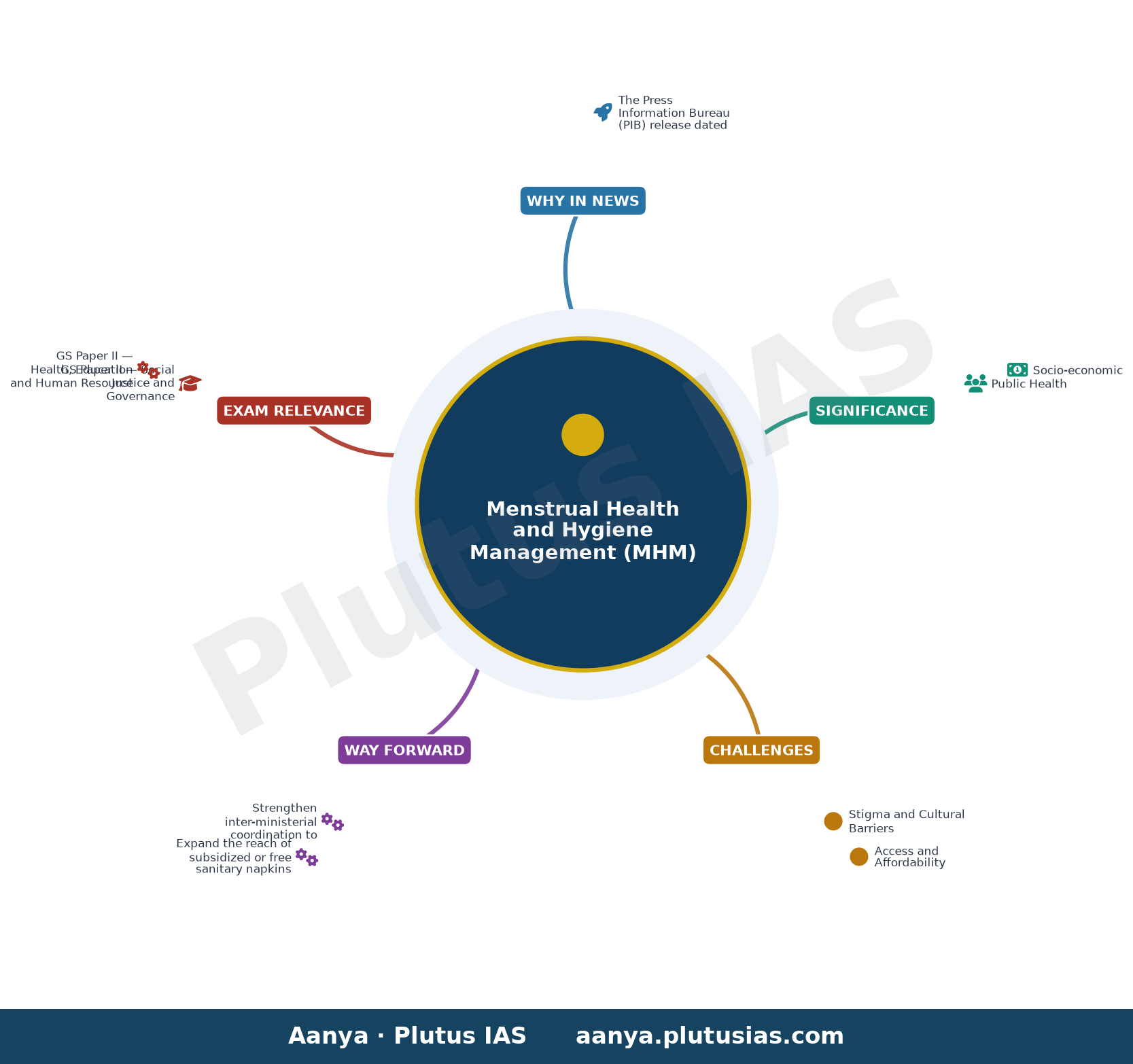
- GS Paper II — Social Justice and Governance | GS Paper II — Health, Education and Human Resource Development | GS Paper III — Science and Technology (Public Health Interventions)
- Prelims: Menstrual Hygiene Scheme (MHS), National Health Mission (NHM), Rashtriya Kishor Swasthya Karyakram (RKSK), Swachh Bharat Mission (SBM), Sustainable Development Goals (SDG 3, SDG 6), Ayushman Bharat, Poshan Abhiyaan
- Essay: The intersection of public health, gender equity and socio-economic development: Lessons from India’s menstrual health policies, Science, technology and innovation in addressing societal taboos: The case of menstrual health management
Quick Revision: Menstrual Health and Hygiene Management (MHM) in India is operationalised through the Menstrual Hygiene Scheme (MHS) under the National Health Mission (NHM), with a focus on adolescent girls, school-based interventions, multi-tiered monitoring, and inter-ministerial coordination.
Why is this in the news?
The Press Information Bureau (PIB) release dated 11 August 2026 highlights the Government of India’s ongoing efforts to institutionalise menstrual health and hygiene management (MHM) through the National Health Mission (NHM), particularly focusing on adolescent girls, school-based interventions, and multi-stakeholder coordination. This development is significant as it underscores the integration of MHM into India’s public health architecture, aligning with constitutional provisions on health and gender equity, and reflects the government’s commitment to achieving Sustainable Development Goals (SDGs) 3 and 6.
Background
- {‘context’: ‘The Government of India recognises menstrual health and hygiene as a critical public health and gender equity issue, with implications for education, dignity, and economic participation of women and girls.’}
- {‘context’: ‘The National Health Mission (NHM), launched in 2005, is the flagship programme for improving health outcomes in India, including reproductive and adolescent health.’}
- {‘context’: ‘The Rashtriya Kishor Swasthya Karyakram (RKSK), launched in 2014, integrates adolescent health, including MHM, into a comprehensive framework for youth well-being.’}
- {‘context’: ‘Article 21 of the Constitution of India guarantees the right to health, while Article 15(3) empowers the state to make special provisions for women and children, providing a constitutional basis for MHM interventions.’}
Menstrual Health and Hygiene Management (MHM): Institutional Framework, Policy Instruments and Implementation Modalities
- {‘explanation’: ‘Menstrual Health and Hygiene Management (MHM) refers to the comprehensive approach to ensuring that women and girls have access to safe, affordable, and environmentally sustainable menstrual hygiene products, along with adequate sanitation facilities, information, and supportive social norms.’}
- {‘explanation’: ‘The Government of India’s MHM strategy is implemented through the Menstrual Hygiene Scheme (MHS), which is a sub-component of the National Health Mission (NHM). The scheme aims to promote awareness, ensure availability of quality and affordable sanitary napkins, and provide guidance on safe disposal and menstrual practices.’}
- {‘explanation’: ‘The scheme operates at the state and union territory levels, with financial support provided to states based on their Annual Programme Implementation Plans (APIPs), ensuring alignment with local needs and regulatory norms.’}
- {‘explanation’: ‘A robust monitoring framework under NHM includes multi-tiered reviews, such as meetings of the National Programme Coordination Committee (NPCC), where state-wise progress is assessed against approved targets.’}
- {‘explanation’: ‘The Annual Common Review Mission (CRM) provides an independent, ground-level assessment of programme implementation, health system strengthening, and progress on key indicators, ensuring accountability and course correction.’}
- {‘explanation’: ‘School-based interventions are a critical component of MHM policy, with coordinated action by states and union territories to ensure that school-going girls have access to safe, effective, and affordable menstrual hygiene products and facilities.’}
- {‘explanation’: ‘The strategy leverages multiple platforms, including health facilities, community forums, frontline health workers (ASHAs, ANMs), digital dissemination tools, and adolescent-focused programmes to conduct Information, Education, and Communication (IEC) activities.’}
- {‘explanation’: ‘The policy also emphasises the need for inter-ministerial collaboration, involving ministries such as Women and Child Development, Drinking Water and Sanitation, and Education, to address the multi-dimensional nature of MHM.’}
Key Features
| Feature | Significance |
|---|---|
| Menstrual Hygiene Scheme (MHS) under NHM | Central sector scheme providing financial assistance to states/UTs for promoting menstrual hygiene among adolescent girls through awareness, supply of sanitary napkins, and safe disposal mechanisms. |
| Annual Programme Implementation Plan (PIP) | State-specific proposals submitted under NHM for funding of menstrual hygiene initiatives, ensuring alignment with national priorities and local needs. |
| Multi-tiered monitoring framework | Includes reviews during National Programme Coordination Committee (NPCC) meetings, state-wise progress assessments, and annual Common Review Missions (CRM) for independent evaluation of implementation and outcomes. |
| Information, Education and Communication (IEC) activities | Continuous awareness campaigns through health facilities, community platforms, frontline health workers, digital platforms, and adolescent-focused programmes to sensitize stakeholders on menstrual health. |
| School-based menstrual hygiene policy | State-coordinated implementation to ensure safe, affordable, and effective access to menstrual hygiene products in schools, reducing absenteeism and promoting gender-inclusive education. |
Why it Matters
Public Health
- Reduces reproductive tract infections (RTIs) and other health complications linked to poor menstrual hygiene practices among adolescent girls and women.
- Promotes holistic adolescent health by integrating hygiene education with broader health and nutrition interventions under NHM.
- Supports the achievement of Sustainable Development Goal (SDG) 3 (Good Health and Well-being) and SDG 4 (Quality Education) through improved school attendance and gender parity.
Socio-economic
- Enhances workforce participation by reducing absenteeism due to menstrual health issues, particularly in rural and marginalized communities.
- Lowers economic burden on households by providing subsidized or free sanitary napkins, thereby improving affordability and accessibility.
- Empowers women and girls through knowledge dissemination, fostering agency in managing menstrual health and breaking societal taboos.
Governance and Institutional
- Demonstrates a coordinated, multi-stakeholder approach involving the Ministry of Health and Family Welfare, states/UTs, and local institutions for effective implementation.
- Strengthens decentralized planning and monitoring through PIPs and CRM, ensuring accountability and evidence-based policymaking.
- Aligns with the principles of cooperative federalism by empowering states to tailor interventions to local contexts while adhering to national guidelines.
Environmental
- Encourages the adoption of eco-friendly menstrual hygiene products (e.g., biodegradable sanitary napkins) and safe disposal practices, reducing environmental pollution from non-biodegradable waste.
- Supports the Swachh Bharat Mission (SBM) objectives by integrating menstrual waste management into broader sanitation and hygiene frameworks.
Challenges
1. Stigma and Cultural Barriers
- Deep-rooted societal taboos and misconceptions about menstruation hinder open discussions and acceptance of menstrual hygiene management (MHM) practices.
- Limited community engagement and resistance from conservative sections of society impede the effectiveness of awareness campaigns.
UPSC Link: GS1: Social empowerment
2. Access and Affordability
- Inadequate distribution networks in remote and tribal areas restrict access to affordable sanitary napkins.
- Economic disparities prevent economically weaker sections from purchasing quality menstrual hygiene products, leading to reliance on unhygienic alternatives.
UPSC Link: GS2: Welfare schemes
3. Supply Chain and Quality Control
- Inconsistent supply of sanitary napkins due to logistical challenges in rural and hilly terrains.
- Quality concerns arise from substandard or counterfeit products entering the market, posing health risks.
UPSC Link: GS3: Food processing & supply chain
4. Monitoring and Evaluation Gaps
- Underreporting of menstrual health issues due to lack of standardized data collection mechanisms at the grassroots level.
- Limited real-time monitoring tools to track the reach and impact of MHM interventions across diverse geographies.
UPSC Link: GS2: Health sector reforms
5. Inter-ministerial Coordination
- Menstrual health management (MHM) requires collaboration between multiple ministries (e.g., Health, Women and Child Development, Education, Environment), which often face coordination challenges.
- Fragmented implementation strategies across sectors dilute the impact of targeted interventions.
UPSC Link: GS2: Inter-state relations
Challenges — UPSC Perspective
| Issue | Concern |
|---|---|
| Low awareness among adolescent girls | Limited knowledge about safe menstrual practices, leading to health risks and social stigma. |
| Inadequate infrastructure in schools | Lack of separate toilets, water facilities, and disposal mechanisms in many government schools. |
| Dependence on unhygienic alternatives | Use of cloth, ash, or leaves due to affordability issues, increasing infection risks. |
| Limited involvement of boys and men | Gender norms restrict male participation in MHM discussions, hindering comprehensive societal change. |
| Climate and geographic constraints | Harsh terrain and extreme weather conditions in certain regions complicate supply chains and awareness campaigns. |
Government Initiatives — Must-Memorise for Prelims
- Menstrual Hygiene Scheme (MHS) under National Health Mission (NHM)
- Rashtriya Kishor Swasthya Karyakram (RKSK)
Way Forward
- Strengthen inter-ministerial coordination to integrate MHM into broader health, education, and sanitation policies, ensuring a unified approach.
- Expand the reach of subsidized or free sanitary napkins through last-mile delivery mechanisms, particularly in tribal and remote areas.
- Enhance community engagement by leveraging local leaders, self-help groups (SHGs), and adolescent peer educators to drive behavioral change.
- Develop standardized data collection tools for real-time monitoring of MHM indicators, enabling evidence-based policymaking.
- Promote the use of eco-friendly menstrual products through awareness campaigns and incentives, aligning with environmental sustainability goals.
- Improve school infrastructure by mandating separate toilets, water facilities, and disposal units in all government schools under the Right to Education (RTE) framework.
- Foster public-private partnerships to scale up production and distribution of quality menstrual hygiene products, ensuring affordability and accessibility.
UPSC Value Addition
Keywords for Mains Answer-Writing
Menstrual Health and Hygiene (MHH) · National Health Mission (NHM) · Menstrual Hygiene Scheme (MHS) · Adolescent health · Information, Education and Communication (IEC) · School-based interventions · Multi-stakeholder coordination · Monitoring and evaluation framework · Sustainable Development Goals (SDG) 3 & 5 · Public health governance · Multi-tiered surveillance · Annual Programme Implementation Plan (PIP)
Concept Flow
Menstrual health stigma and lack of awareness among adolescent girls → Limited access to affordable and safe menstrual hygiene products → Poor infrastructure in schools and public spaces for menstrual hygiene management → Implementation of Menstrual Hygiene Scheme (MHS) under NHM with state-specific PIPs → Awareness campaigns and IEC activities through health facilities and community platforms → Monitoring via multi-tiered framework (NPCC, CRM) and state-wise progress reviews → Outcomes: Reduced absenteeism, improved health outcomes, and enhanced gender parity
Prelims Practice Questions
Q1. Consider the following statements regarding the Menstrual Hygiene Scheme (MHS) under the National Health Mission (NHM):
1. The scheme is implemented by the Ministry of Health and Family Welfare.
2. It focuses on providing free sanitary napkins to all women above 18 years of age.
3. The scheme includes awareness generation and safe disposal mechanisms.
4. Monitoring is conducted through a multi-tiered framework involving the National Health Council (NHC).
How many of the above statements are correct?
- Only one
- Only two
- Only three
- All four
Answer: Only three — Statements 1 and 3 are correct. Statement 2 is incorrect as the scheme targets adolescent girls, not all women above 18 years. Statement 4 is incorrect as the monitoring body is the National Health Council (NPC), not NHC.
Q2. Assertion (A): The Menstrual Hygiene Scheme (MHS) is a centrally sponsored scheme under the National Health Mission (NHM).
Reason (R): The scheme is implemented by state governments with financial support from the central government, as per the Annual Programme Implementation Plan (PIP).
Choose the correct option:
A. Both A and R are true, and R is the correct explanation of A.
B. Both A and R are true, but R is not the correct explanation of A.
C. A is true, but R is false.
D. A is false, but R is true.
- A
- B
- C
- D
Answer: A — Both the assertion and reason are true. The MHS is a centrally sponsored scheme under NHM, and its implementation involves state governments with central financial support as per PIP.
Q3. Match the following initiatives with their respective objectives under the Menstrual Health and Hygiene (MHH) framework:
Initiative
1. Menstrual Hygiene Scheme (MHS)
2. School-based Menstrual Hygiene Policy
3. Information, Education and Communication (IEC) activities
4. Multi-tiered monitoring framework
Objective
A. Ensuring access to safe and affordable menstrual hygiene products in schools
B. Providing financial assistance to states for menstrual hygiene schemes
C. Raising awareness and sensitizing stakeholders on menstrual health
D. Reviewing state-wise progress against approved targets through NPC meetings
Select the correct match:
1-A, 2-B, 3-C, 4-D
1-B, 2-A, 3-C, 4-D
1-B, 2-A, 3-D, 4-C
1-A, 2-B, 3-D, 4-C
- 1-B, 2-A, 3-C, 4-D
- 1-A, 2-B, 3-C, 4-D
- 1-B, 2-A, 3-D, 4-C
- 1-A, 2-B, 3-D, 4-C
Answer: 1-B, 2-A, 3-C, 4-D — 1-B: MHS provides financial assistance to states. 2-A: School-based policy ensures access to products. 3-C: IEC activities focus on awareness. 4-D: Multi-tiered monitoring reviews progress.
Mains Practice Question
✍ The Menstrual Hygiene Scheme (MHS) under the National Health Mission (NHM) represents a multi-dimensional public health intervention aimed at addressing menstrual health and hygiene among adolescent girls. Critically examine the institutional architecture, implementation modalities, and monitoring mechanisms of the MHS. Also, assess its alignment with the Sustainable Development Goals (SDGs). (15 Marks)
Approach: MODEL-ANSWER SKELETON:
1. **Institutional Architecture**:
– Central Ministry: Ministry of Health and Family Welfare (MoHFW) as the nodal agency.
– Implementation Partners: State governments and Union Territories via Annual Programme Implementation Plans (PIPs).
– Multi-stakeholder coordination: Involvement of Ministry of Women and Child Development, Ministry of Education, and local bodies.
– Legal/Constitutional Basis: Part of NHM, which is a flagship scheme under the National Rural Health Mission (NRHM) and National Urban Health Mission (NUHM).
2. **Implementation Modalities**:
– Target Group: Adolescent girls (10-19 years) in schools and communities.
– Components:
a. Provision of quality and affordable sanitary napkins.
b. Awareness generation through IEC activities.
c. Safe and environmentally friendly disposal mechanisms.
d. Counseling on safe menstrual practices.
– Delivery Channels: Health facilities, community platforms, frontline health workers (ASHAs), and digital dissemination.
3. **Monitoring Mechanisms**:
– Multi-tiered framework: Regular reviews with states/UTs during National Health Council (NHC) meetings.
– Annual Shared Review Missions (SRMs): Independent ground assessments of implementation and health system strengthening.
– Key Performance Indicators (KPIs): State-wise progress against approved targets, including coverage of sanitary napkin distribution and IEC activities.
4. **Alignment with SDGs**:
– SDG 3 (Good Health and Well-being): Target 3.7 on universal access to sexual and reproductive health services.
– SDG 5 (Gender Equality): Target 5.6 on ensuring universal access to sexual and reproductive health and rights.
– Inter-linkages: MHH contributes to reducing school absenteeism among girls, improving gender parity in education, and promoting dignity and equity.
5. **Critical Assessment**:
– Strengths: Centralized funding, multi-sectoral approach, and robust monitoring.
– Challenges: Regional disparities in implementation, stigma and cultural barriers, supply chain inefficiencies, and limited private sector involvement.
– Gaps: Need for stronger convergence with education sector, digital literacy for adolescent girls, and long-term behavior change communication.
6. **Way Forward**:
– Strengthening state-level capacities for implementation.
– Leveraging technology for real-time monitoring and grievance redressal.
– Expanding public-private partnerships for sustainable supply chains.
– Integrating MHH into broader adolescent health programs and school health initiatives.
Source: PIB (Press Information Bureau)
Generated by AanyaAi for educational purpose.

- पेंशन भुगतान में विभाजन से बुजुर्गों को मुश्किल, अधिकार समूहों की चिंता - September 26, 2026
- UPSC Alert: Pension Split Policy Raises Hardship Concerns for Elderly in AP - September 26, 2026
- पीएम स्मृति चिह्न ई-नीलामी 2026: ओडिशा की सांस्कृतिक विरासत का अनूठा प्रदर्शन - September 26, 2026

No Comments