


27 Jul UPSC Exam: MyGov Platform Boosts Citizen Participation in Policy Making
Subject Relevance — Where This Topic Fits
- GS Paper II — Governance, Constitution, Polity, Social Justice and International Relations | GS Paper III — Science and Technology, Economic Development, Environment, Disaster Management
- Prelims: MyGov platform, Digital India, Citizen participation, Policy formulation, Data Protection, Aadhaar reforms, National Education Policy (NEP) 2020, Digital Personal Data Protection Bill 2022, Governance transparency
- Essay: Digital democracy and citizen engagement in governance, The role of technology in enhancing participatory democracy
Quick Revision: MyGov is India’s flagship digital governance platform that enhances citizen participation in policy formulation through structured consultations, multilingual support, and mobile accessibility.
Why is this in the news?
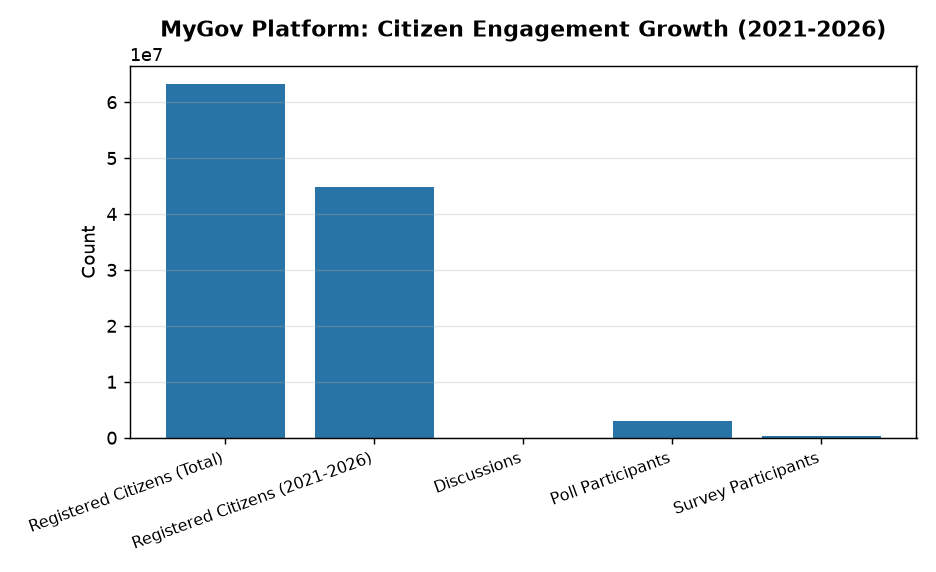
The Press Information Bureau (PIB) has highlighted the significant expansion of citizen participation in policy formulation through the MyGov platform, which has engaged over 6.32 crore citizens in consultations on critical initiatives such as the National Education Policy (NEP)-2020, Digital Personal Data Protection Bill 2022, and amendments to Aadhaar authentication rules. This development underscores the growing integration of digital governance mechanisms in India’s policy-making processes and their role in fostering transparency and inclusivity.
Background
- The MyGov platform was launched in 2014 as a citizen engagement initiative under the Digital India programme to facilitate two-way communication between the government and citizens.
- It operates under the Ministry of Electronics and Information Technology (MeitY) and serves as a participatory governance tool for soliciting public opinions on draft policies, bills, and government schemes.
- The platform has evolved to include features such as discussions, polls, surveys, and thematic campaigns to ensure diverse and inclusive citizen participation.
- Independent third-party impact assessments conducted in 2017 and 2025 have validated the platform’s effectiveness in expanding citizen engagement and improving governance transparency.
- Recent consultations on MyGov have focused on high-priority national initiatives, including the NEP-2020, Digital Personal Data Protection Bill 2022, and reforms in Aadhaar authentication rules, reflecting the government’s commitment to evidence-based policymaking.
- The platform’s reach has expanded significantly, with over 6.32 crore registered users as of July 2026, demonstrating its growing relevance in India’s digital governance ecosystem.
What is the MyGov Platform?
- MyGov is a citizen-centric digital platform launched by the Government of India to facilitate participatory governance by enabling citizens to contribute to policy formulation, legislative processes, and government schemes.
- It operates as a two-way communication channel where the government shares draft policies, bills, and proposals, and citizens provide feedback, suggestions, and recommendations through structured engagement mechanisms.
- The platform supports multiple engagement formats, including discussions, polls, surveys, thematic campaigns, and ground-level activities, to ensure diverse and inclusive participation.
- MyGov is available in 12 languages (English and 11 Indian regional languages) to overcome linguistic barriers and enhance accessibility for citizens across linguistic demographics.
- A dedicated mobile application (MyGov App) has been developed to improve accessibility, particularly for mobile-first users, given the high penetration of smartphones in India.
- The platform’s user interface is periodically updated to enhance usability, accessibility, and overall user experience, ensuring seamless navigation and engagement.
- MyGov compiles citizen feedback and forwards it to the concerned ministries or departments for consideration in policy formulation, review, or implementation.
- The platform’s operations are guided by independent third-party impact assessments, which have consistently highlighted its role in expanding citizen participation and improving governance transparency.
Key Features
| Feature | Significance |
|---|---|
| Multi-modal engagement (Discussions, Polls, Surveys) | Enables structured citizen feedback across multiple formats, ensuring diverse participation in policy formulation. |
| Multilingual accessibility (12 languages) | Reduces linguistic barriers, enhancing inclusivity for non-English speaking citizens. |
| Mobile application (MyGov App) | Leverages India’s high mobile penetration to democratise access to governance processes. |
| Third-party impact assessments (2017, 2025) | Validates effectiveness of citizen engagement mechanisms, guiding iterative improvements. |
| Integration with ministries/departments | Ensures policy-relevant feedback is systematically channelled to decision-makers. |
Why it Matters
Governance & Democracy
- Enhances participatory democracy by institutionalising citizen input in policy cycles, aligning with the constitutional principle of ‘We, the People’ (Preamble).
- Reduces information asymmetry between citizens and policymakers, fostering transparency and accountability in governance.
- Demonstrates the state’s commitment to collaborative governance, a key tenet of the Sustainable Development Goal 16 (Peace, Justice and Strong Institutions).
Policy Formulation
- Provides empirical data on public preferences, aiding evidence-based policymaking in domains like education (NEP 2020), data governance (DPDP Act 2023), and budgetary allocations.
- Facilitates pre-legislative consultation, a statutory requirement under the Pre-Legislative Consultation Policy (PLCP) 2014, ensuring stakeholder buy-in.
- Enables iterative policy refinement through real-time feedback, reducing implementation gaps.
Digital Governance
- Leverages digital public infrastructure to scale citizen engagement, exemplifying the ‘Minimum Government, Maximum Governance’ paradigm.
- Supports India’s push for digital inclusion, as outlined in the Digital India Mission, by ensuring accessibility via mobile platforms.
- Serves as a model for other democracies seeking to integrate citizen feedback into policy cycles.
Challenges
1. Digital Divide and Accessibility
- Urban-rural and socio-economic disparities may limit participation, as internet penetration and digital literacy vary significantly across regions.
- Persons with disabilities may face barriers despite multilingual support, necessitating universal design principles in platform updates.
UPSC Link: GS-II: Governance
2. Quality and Relevance of Feedback
- Risk of low-quality or repetitive inputs, requiring moderation mechanisms to filter noise and prioritise actionable suggestions.
- Ensuring representativeness of feedback to avoid bias towards vocal or organised groups.
UPSC Link: GS-II: Governance
3. Policy Adoption and Implementation
- Final discretion rests with ministries, which may not always incorporate feedback due to bureaucratic inertia or political constraints.
- Lack of statutory obligation to act on citizen suggestions may dilute the platform’s impact over time.
UPSC Link: GS-II: Governance
4. Data Privacy and Security
- Citizen data collected during consultations must comply with the Digital Personal Data Protection Act 2023 to prevent misuse.
- Platform must ensure secure storage and anonymisation of sensitive inputs to maintain public trust.
UPSC Link: GS-III: Security
Challenges — UPSC Perspective
| Issue | Concern |
|---|---|
| Low participation from marginalised groups | Risk of policy capture by elite or urban voices, undermining inclusivity. |
| Over-reliance on digital platforms | Excludes citizens without internet access, particularly in tribal and remote areas. |
| Feedback fatigue among ministries | Possible dilution of engagement due to administrative overload or lack of follow-up. |
| Language barriers despite multilingual support | Regional dialects and scripts may still pose challenges for non-standardised inputs. |
| Political interference in feedback utilisation | Suggestions may be selectively adopted to align with pre-determined agendas. |
Way Forward
- Strengthen offline engagement mechanisms (e.g., gram sabhas, kisan melas) to complement digital consultations and bridge the digital divide.
- Introduce AI-driven sentiment analysis to categorise and prioritise feedback, improving response efficiency.
- Mandate a statutory timeline for ministries to acknowledge and respond to citizen inputs, ensuring accountability.
- Expand multilingual support to include tribal and endangered languages to enhance linguistic inclusivity.
- Conduct quarterly impact assessments to measure the tangible influence of citizen feedback on policy outcomes.
- Develop a grievance redressal portal linked to MyGov, enabling citizens to track the status of their suggestions.
- Partner with civil society organisations to train marginalised communities in effective participation techniques.
UPSC Value Addition
Keywords for Mains Answer-Writing
Citizen participation in governance · MyGov platform · Digital Personal Data Protection Act · National Education Policy 2020 · Aadhaar authentication reforms · Public consultation mechanisms · Government transparency · Digital governance · Policy formulation process · Inclusive governance · Third-party impact assessment · Multi-lingual governance platforms
Concept Flow
Citizen awareness of policy gaps → Participation via MyGov platform → Structured feedback collection (discussions/polls/surveys) → Data compilation and analysis → Transmission to ministries → Policy revision or formulation → Implementation and monitoring → Impact assessment → Iterative improvement of engagement mechanisms.
Prelims Practice Questions
Q1. Which of the following initiatives is NOT directly associated with the MyGov platform as per the given context?
- National Education Policy (NEP)-2020 consultations
- Draft Digital Personal Data Protection Rules-2025
- 8th Central Pay Commission memoranda
- Pradhan Mantri Kisan Samman Nidhi (PM-KISAN)
Answer: Pradhan Mantri Kisan Samman Nidhi (PM-KISAN) — The MyGov platform has facilitated consultations on NEP-2020, draft Digital Personal Data Protection Rules-2025, and memoranda for the 8th Central Pay Commission. PM-KISAN is unrelated to the listed MyGov activities.
Q2. The MyGov platform facilitates citizen participation in governance through which of the following mechanisms?
- Only offline public meetings
- Only online polls and surveys
- Chats, polls, surveys, and discussions
- Exclusively through regional language newspapers
Answer: Chats, polls, surveys, and discussions — The MyGov platform enables citizen engagement through discussions, polls, surveys, and ground-level activities, as explicitly stated in the context.
Q3. Which of the following statements is INCORRECT regarding the MyGov platform?
- It was launched as a citizen engagement platform by the central government.
- It supports 12 languages including English and 11 Indian regional languages.
- It mandates the inclusion of all citizen suggestions in policy formulation.
- It has conducted third-party impact assessments in 2017 and 2025.
Answer: It mandates the inclusion of all citizen suggestions in policy formulation. — While MyGov supports multilingual access, it does not mandate the inclusion of all citizen suggestions; final approval rests with the concerned ministries.
Mains Practice Question
✍ Analyse the significance of citizen participation platforms like MyGov in enhancing governance transparency and accountability in India. How does such participation contribute to the formulation of policies such as the National Education Policy (NEP)-2020 and the Digital Personal Data Protection Act? Substantiate your answer with relevant examples.
Approach: Begin by defining citizen participation platforms and their constitutional context under Article 292 (Part IV-A). Explain the role of MyGov in facilitating multi-modal engagement (polls, surveys, discussions) and its impact on policy formulation. Highlight the inclusion of NEP-2020 and Digital Personal Data Protection Act consultations as case studies. Discuss challenges such as digital divide, language barriers, and the need for structured feedback integration. Conclude with the broader implications for democratic governance and the limitations of such platforms in ensuring full accountability.
Source: PIB (Press Information Bureau)
Generated by AanyaAi for educational purpose.

- यूपीएससी के लिए सीएसआईआर साइक्विज: जानिए कैसे करें भागीदारी और लाभ उठाएं - September 21, 2026
- UPSC Alert: CSIR Science Quiz on My Bharat Portal for UPSC & State PCS 2026 - September 21, 2026
- एमएसएमई मंत्रालय ने शुरू किया विशेष अभियान 6.0: स्वच्छता और शिकायत निपटान पर जोर - September 21, 2026

No Comments