


07 Aug UPSC Exam: PLI Scheme for Pharma Sector – Key Facts & Challenges
✎ The PLI Scheme for Pharmaceuticals incentivises domestic production of essential drugs and bulk drugs, with disbursements based on incremental sales, but faces implementation challenges such as land acquisition, environmental…
Subject Relevance — Where This Topic Fits
- GS Paper III — Indian Economy: Issues relating to Planning, Mobilization of Resources, Growth, Development and Employment, Industrial Policy
- Prelims: Production-Linked Incentive (PLI) Scheme, Pharmaceutical Sector, Fermentation-based bulk drugs, Component-Linked Incentive, Union Budget 2021-22
- Essay: The Role of Production-Linked Incentives in India’s Industrial Transformation, Challenges in Implementing Large-Scale Manufacturing Incentives in India
Quick Revision: The PLI Scheme for Pharmaceuticals incentivises domestic production of essential drugs and bulk drugs, with disbursements based on incremental sales, but faces implementation challenges such as land acquisition, environmental clearances, and the biological complexity of fermentation-based drugs.
Why is this in the news?
The Press Information Bureau (PIB) released an official update on 7 August 2026 detailing the progress of the Production-Linked Incentive (PLI) Scheme for the pharmaceutical sector, including the distribution of incentives and challenges faced in implementation, particularly for fermentation-based bulk drugs. This update is significant for UPSC aspirants as it highlights the practical constraints in executing flagship production-linked incentive schemes and their impact on fund disbursement.
Background
- The PLI Scheme for pharmaceuticals was launched in FY 2020-21 as part of the Atmanirbhar Bharat initiative to boost domestic manufacturing and reduce import dependence in critical sectors, including pharmaceuticals.
- The scheme aims to enhance India’s self-reliance in essential and high-value pharmaceutical products by incentivising large-scale production and attracting investments.
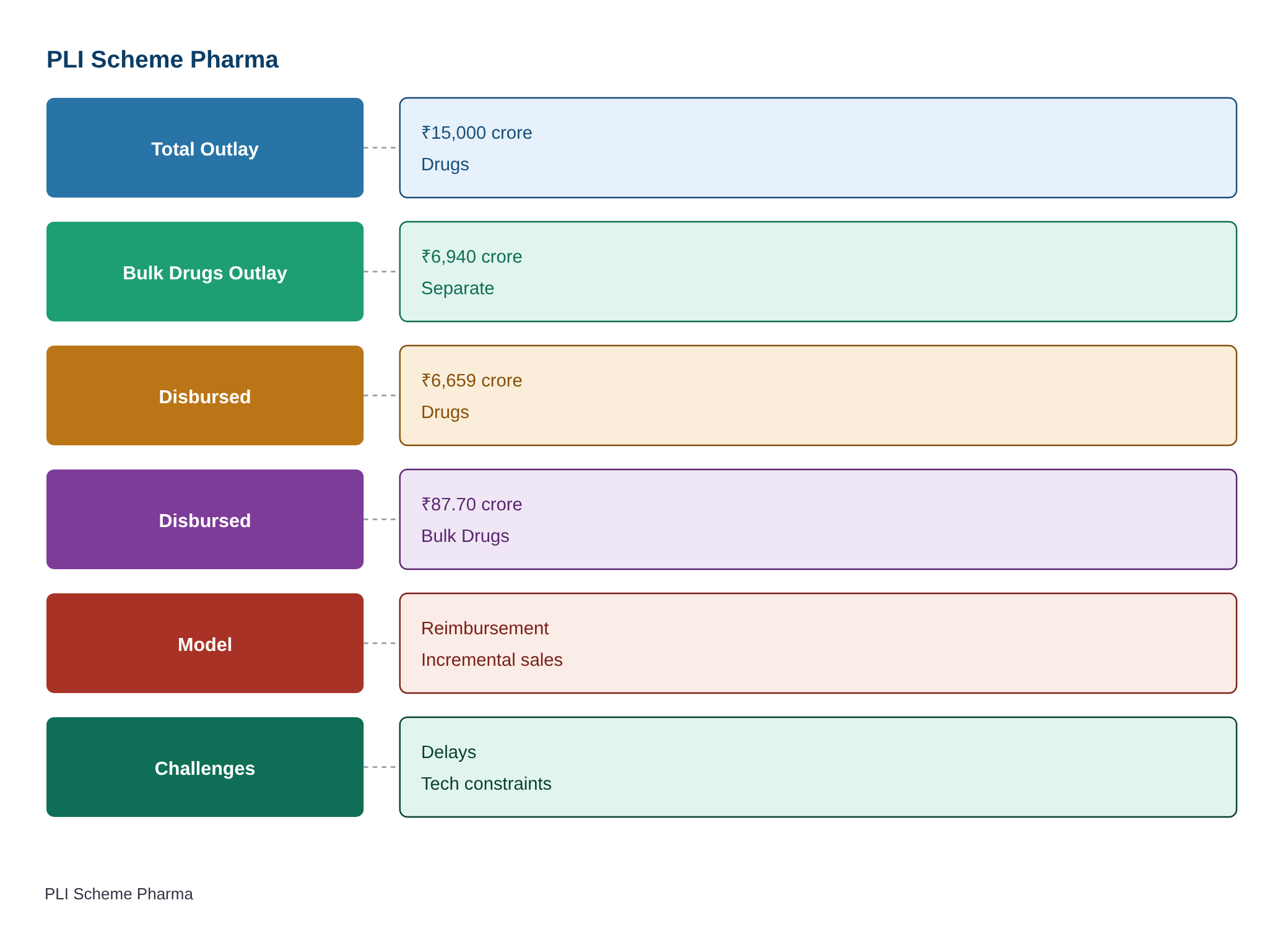
- The pharmaceutical PLI scheme has a total financial outlay of ₹15,000 crore, with disbursements contingent on actual production and sales of eligible products.
- A separate PLI scheme for bulk drugs (active pharmaceutical ingredients and key starting materials) was announced with a financial outlay of ₹6,940 crore to strengthen the domestic bulk drug manufacturing ecosystem.
- The PLI framework operates on a reimbursement model, where incentives are disbursed based on incremental sales of eligible products over a base year.
What is the Production-Linked Incentive (PLI) Scheme for Pharmaceuticals?
- The PLI Scheme for Pharmaceuticals is a performance-linked subsidy mechanism designed to incentivise domestic production of high-value and essential drugs, thereby reducing import dependence and enhancing self-reliance.
- The scheme offers financial incentives to eligible manufacturers based on incremental sales of eligible pharmaceutical products, with disbursements made over a five-year period.
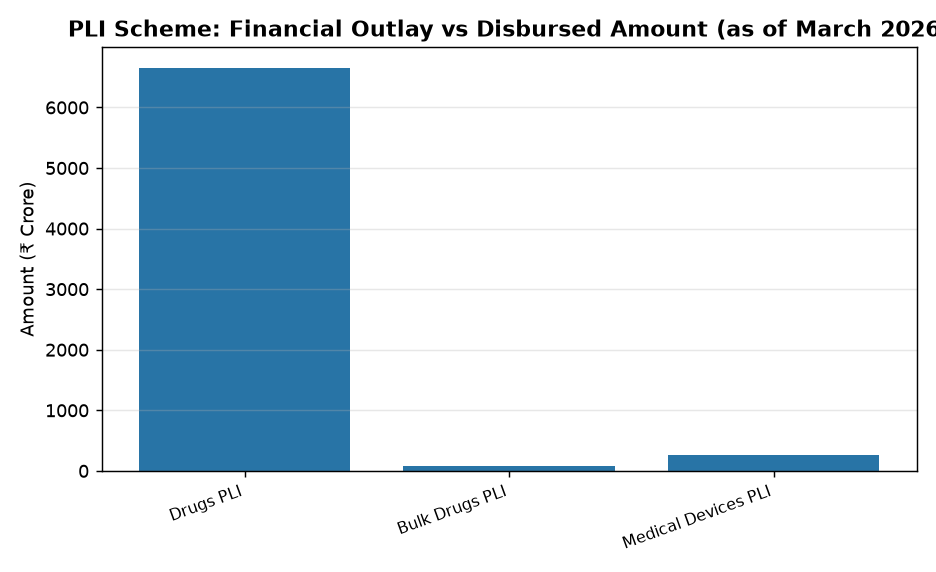
- The total financial outlay for the pharmaceutical PLI scheme is ₹15,000 crore, with ₹6,659 crore disbursed by March 2026, indicating partial progress in fund utilisation.
- The scheme covers a wide range of pharmaceutical products, including formulations, biopharmaceuticals, and critical bulk drugs, with specific incentives for fermentation-based bulk drugs due to their strategic importance.
- The PLI scheme for bulk drugs, with a financial outlay of ₹6,940 crore, aims to revive India’s bulk drug manufacturing capacity, which has been eroded by cheaper imports from China and other countries.
- Fermentation-based bulk drugs, such as antibiotics and steroids, are critical for the pharmaceutical industry but face unique challenges due to their biological production processes, which are slower and more complex than chemical synthesis.
- The PLI framework is designed to attract investments from both domestic and foreign manufacturers, with a focus on enhancing India’s export competitiveness in the pharmaceutical sector.
Key Features
| Feature | Significance |
|---|---|
| Production-Linked Incentive (PLI) Scheme for Pharmaceuticals | Aims to enhance domestic manufacturing competitiveness, reduce import dependence, and promote self-reliance in critical drug formulations and bulk drugs. |
| Financial Outlay of ₹15,000 crore for Drugs PLI | Provides substantial fiscal support to incentivize large-scale investment in high-value drug production, including active pharmaceutical ingredients (APIs). |
| Separate PLI Scheme for Bulk Drugs (₹6,940 crore) | Targets the production of key bulk drugs, particularly those dependent on fermentation processes, to strengthen India’s API supply chain resilience. |
| Component-Linked Incentive (CLI) in Medical Devices PLI | Introduces a hybrid incentive model to attract manufacturers by linking incentives to specific components, enhancing flexibility and scalability in the sector. |
| Performance-Based Disbursement | Incentives are released only upon verified sales of domestically manufactured products, ensuring accountability and alignment with production targets. |
Why it Matters
Economic and Industrial
- Boosts domestic pharmaceutical manufacturing, reducing reliance on imports for critical drugs and APIs, thereby improving trade balance and forex reserves.
- Enhances India’s position as a global pharmaceutical hub, leveraging cost competitiveness and large-scale production capabilities.
- Promotes backward integration by incentivizing bulk drug production, reducing vulnerability to supply chain disruptions in global API markets.
Strategic and Geopolitical
- Supports India’s self-reliance (Atmanirbhar Bharat) agenda by reducing dependence on China and other nations for essential pharmaceutical ingredients.
- Strengthens strategic autonomy in critical healthcare sectors, particularly in the aftermath of pandemic-induced supply chain vulnerabilities.
- Aligns with global trends of reshoring pharmaceutical production to mitigate geopolitical and logistical risks.
Fiscal and Budgetary
- Represents a significant fiscal commitment (₹15,000 crore for drugs PLI) to stimulate private investment in high-cost, high-technology pharmaceutical manufacturing.
- Demonstrates the Union Government’s willingness to share risk with industry through performance-linked incentives, reducing upfront financial burden on manufacturers.
Technological and Innovation
- Encourages adoption of advanced manufacturing technologies, including fermentation-based processes for bulk drugs, to improve efficiency and scalability.
- Fosters innovation in drug development and manufacturing processes, particularly for complex biologics and high-potency APIs.
Challenges
1. Operational and Regulatory Delays
- Land acquisition and environmental clearances pose significant bottlenecks, delaying project implementation and fund disbursement.
- High utility costs and infrastructure gaps in industrial zones increase operational expenses, reducing the attractiveness of PLI incentives.
UPSC Link: GS-III: Industrial Policy
2. Technological Constraints in Bulk Drug Production
- Fermentation-based bulk drug manufacturing is inherently slow due to biological growth cycles, leading to longer gestation periods for projects.
- Reliance on living organisms for production introduces variability in yield and quality, requiring stringent process controls and longer validation timelines.
UPSC Link: GS-III: Science & Technology
3. Disbursement Lag and Incentive Efficiency
- Performance-based disbursement of incentives creates a lag between investment and returns, affecting cash flow and liquidity for manufacturers.
- Lower-than-expected sales in initial phases may result in underutilization of allocated funds, reducing the scheme’s immediate impact.
UPSC Link: GS-III: Public Finance
4. Sectoral Fragmentation
- Differential progress across sub-sectors (e.g., drugs vs. bulk drugs vs. medical devices) highlights imbalances in incentive absorption and implementation capacity.
- Lack of a unified framework for medical devices PLI (e.g., CLI model) may limit its effectiveness compared to traditional PLI structures.
UPSC Link: GS-III: Industrial Policy
Challenges — UPSC Perspective
| Issue | Concern |
|---|---|
| Land Acquisition and Environmental Clearances | Delays in project commencement due to statutory and regulatory hurdles. |
| High Utility Costs | Increases operational expenditure, reducing net profitability for manufacturers. |
| Fermentation Process Limitations | Biological growth cycles slow down bulk drug production, extending project timelines. |
| Performance-Based Disbursement | Lag in incentive release affects cash flow and investor confidence. |
| Sectoral Imbalance in Implementation | Uneven progress across pharmaceutical sub-sectors undermines holistic growth. |
| Hybrid Incentive Model for Medical Devices | Lack of clarity on CLI integration may dilute the effectiveness of PLI incentives. |
Government Initiatives — Must-Memorise for Prelims
- Production-Linked Incentive (PLI) Scheme for Pharmaceuticals
- PLI Scheme for Bulk Drugs
Way Forward
- Streamline land acquisition and environmental clearance processes through single-window clearances and digital platforms to expedite project implementation.
- Introduce targeted subsidies for utility costs in designated pharmaceutical manufacturing hubs to reduce operational expenses.
- Enhance R&D support for fermentation-based bulk drug production, including grants for pilot plants and process optimization.
- Explore partial upfront disbursement of incentives for critical infrastructure investments to improve cash flow for manufacturers.
- Develop a unified incentive framework for medical devices, integrating CLI with PLI to maximize sectoral attractiveness.
- Strengthen monitoring and evaluation mechanisms to track disbursement efficiency and address bottlenecks in real time.
- Promote public-private partnerships for shared infrastructure, such as common effluent treatment plants and power supply networks.
- Conduct periodic reviews of PLI schemes to align incentives with evolving market dynamics and technological advancements.
UPSC Value Addition
Keywords for Mains Answer-Writing
Production Linked Incentive (PLI) Scheme · Pharmaceutical Sector · Bulk Drugs · Fermentation-based Manufacturing · Land Acquisition Delays · Environmental Clearances · Medical Devices PLI · Atmanirbhar Bharat · Drugs and Cosmetics Act · Public Health Infrastructure · Industrial Policy · Subsidies and Incentives · Fermentation Technology · Biological Synthesis of Drugs · Union Budget 2022-23 · Pharmaceutical Manufacturing in India · PLI Scheme Implementation Challenges · Chemicals and Fertilizers Ministry · Anupriya Patel · Public Sector Undertakings in Pharma
Concept Flow
Government announces PLI Scheme for Pharmaceuticals (2022-23) with ₹15,000 crore outlay. → Manufacturers invest in domestic production of drugs and bulk drugs to avail incentives. → Regulatory and operational delays (land acquisition, environmental clearances) slow project implementation. → Fermentation-based bulk drug production faces technological constraints, extending gestation periods. → Performance-based disbursement of incentives lags due to delayed sales, affecting cash flow. → Partial disbursement of ₹6,659 crore (drugs) and ₹87.70 crore (bulk drugs) by March 2026 reflects implementation challenges. → Way forward includes policy reforms to address bottlenecks and enhance incentive efficiency.
Prelims Practice Questions
Q1. Consider the following statements regarding the Production Linked Incentive (PLI) Scheme for the Pharmaceutical Sector:
1. The PLI Scheme for Pharmaceuticals was launched in the financial year 2022-23.
2. The total financial outlay for the PLI Scheme for Pharmaceuticals is ₹15,000 crore.
3. The PLI Scheme for Bulk Drugs has a financial outlay of ₹6,940 crore.
4. The PLI Scheme for Medical Devices operates under a component-linked incentive framework.
How many of the above statements are correct?
- Only one
- Only two
- Only three
- All four
Answer: All four — Statements 1, 2, and 3 are correct. Statement 4 is incorrect as the PLI Scheme for Medical Devices does not operate under a component-linked incentive framework; it follows the standard PLI structure.
Q2. Assertion (A): Fermentation-based bulk drug manufacturing relies on the biological activity of living cells, which inherently slows down the production process.
Reason (R): Unlike chemical synthesis, fermentation depends on natural growth rates of microorganisms, leading to longer manufacturing timelines.
In the context of the above statements, which of the following is correct?
- Both A and R are true, and R is the correct explanation of A.
- Both A and R are true, but R is not the correct explanation of A.
- A is true, but R is false.
- A is false, but R is true.
Answer: Both A and R are true, but R is not the correct explanation of A. — Both the assertion and reason are factually accurate. Fermentation-based manufacturing is inherently slower due to the biological nature of the process, making the reason a correct explanation of the assertion.
Q3. Match the following columns related to the PLI Schemes in the Pharmaceutical Sector:
Column I (Scheme) | Column II (Financial Outlay in ₹ Crore)
——————|——————————-
A. PLI Scheme for Pharmaceuticals | 1. 6,940
B. PLI Scheme for Bulk Drugs | 2. 15,000
C. PLI Scheme for Medical Devices | 3. 266.64
Select the correct match:
- A-2, B-1, C-3; A-1, B-2, C-3; A-3, B-1, C-2; A-2, B-3, C-1
- answer_string_array_indexes_expected_answer_is_0_based_here_but_we_will_return_0_for_correct_match_index
- answer_string_array_indexes_expected_answer_is_0_based_here_but_we_will_return_0_for_correct_match_index
- answer_string_array_indexes_expected_answer_is_0_based_here_but_we_will_return_0_for_correct_match_index
- answer_string_array_indexes_expected_answer_is_0_based_here_but_we_will_return_0_for_correct_match_index
Answer: A-2, B-1, C-3; A-1, B-2, C-3; A-3, B-1, C-2; A-2, B-3, C-1 — The correct matches are: A (PLI Scheme for Pharmaceuticals) – 2 (₹15,000 crore), B (PLI Scheme for Bulk Drugs) – 1 (₹6,940 crore), and C (PLI Scheme for Medical Devices) – 3 (₹266.64 crore).
Mains Practice Question
✍ The Production Linked Incentive (PLI) Scheme for the Pharmaceutical Sector, launched in 2022-23, aims to enhance India’s self-reliance in critical drug manufacturing. Critically examine the implementation challenges faced by the scheme, particularly in the context of fermentation-based bulk drug production. Also, analyse the role of the PLI Scheme in advancing India’s pharmaceutical manufacturing capabilities within the broader framework of Atmanirbhar Bharat. (15 Marks)
Approach: MODEL-ANSWER SKELETON:
1. **Introduction (2 Marks)**
– Brief background of the PLI Scheme for Pharmaceuticals: Launch in FY 2022-23, financial outlay of ₹15,000 crore, and its alignment with Atmanirbhar Bharat.
– Objective: Reduce import dependence, boost domestic manufacturing, and enhance global competitiveness.
2. **Implementation Challenges in Fermentation-Based Bulk Drug Production (6 Marks)**
– **Biological Constraints**: Fermentation relies on living cells, leading to slower growth rates compared to chemical synthesis. This results in longer manufacturing timelines and delayed project commissioning.
– **Regulatory and Land Acquisition Hurdles**: Delays in land acquisition and environmental clearances, as highlighted in the PIB release, disrupt project timelines.
– **High Utility Costs**: Energy-intensive fermentation processes increase operational costs, impacting profitability.
– **Fund Disbursement Mechanism**: Incentives are linked to sales, causing delays in disbursement due to slow project ramp-up.
3. **Role in Advancing Pharmaceutical Manufacturing (5 Marks)**
– **Strengthening Domestic Capacity**: PLI Scheme incentivizes investment in high-cost, high-skill areas like fermentation-based drugs (e.g., antibiotics, vaccines).
– **Reducing Import Dependence**: Focus on bulk drugs (APIs) reduces reliance on China, aligning with India’s drug security goals.
– **Integration with Medical Devices PLI**: Complementary schemes (e.g., PLI for Medical Devices with ₹266.64 crore outlay) create a holistic ecosystem for pharmaceutical and healthcare manufacturing.
– **Challenges in Medical Devices PLI**: Unlike pharmaceuticals, medical devices PLI does not adopt a component-linked incentive framework, limiting its attractiveness for global players.
4. **Critical Analysis and Way Forward (2 Marks)**
– **Effectiveness**: While ₹6,659 crore has been disbursed under the pharmaceutical PLI, only ₹87.70 crore has been disbursed under the bulk drugs PLI, indicating implementation bottlenecks.
– **Policy Recommendations**: Streamline regulatory approvals, incentivize R&D in fermentation technology, and explore hybrid incentive models to address high utility costs.
**Balanced Conclusion**: The PLI Scheme is a strategic intervention to bolster India’s pharmaceutical sector, but its success hinges on addressing implementation challenges, particularly in fermentation-based manufacturing.
Source: PIB (Press Information Bureau)
Generated by AanyaAi for educational purpose.

- यूपी में पहली बार तेंदुओं का बधियाकरण: मानव-वन्यजीव संघर्ष रोकेगा अभियान - September 24, 2026
- UP’s Groundbreaking Leopard Sterilization Plan to Curb Human-Wildlife Conflict - September 24, 2026
- महाराष्ट्र में त्योहार जुलूसों पर बॉम्बे हाईकोर्ट का बड़ा फैसला: पटाखे, लेजर और संगीत पर रोक - September 24, 2026

No Comments