


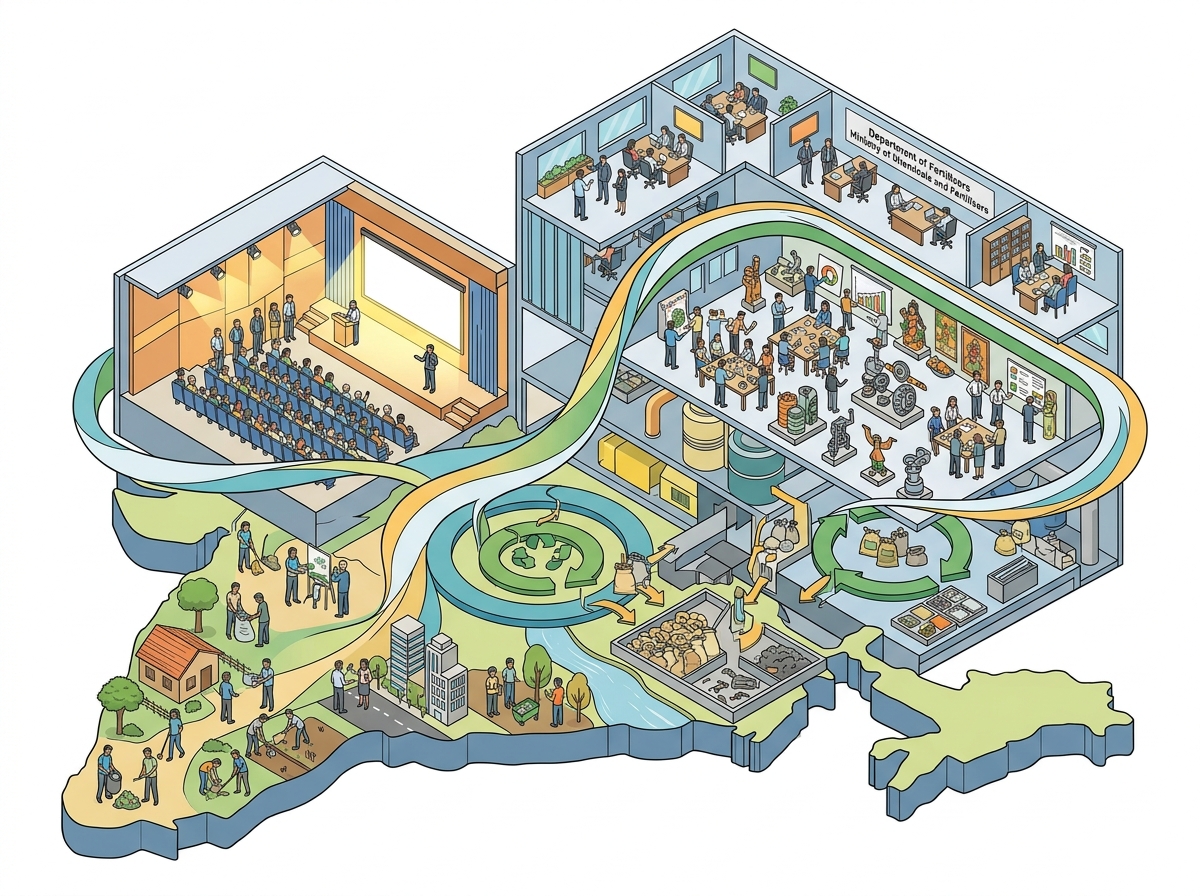
22 Sep UPSC Exam: ‘Swachhata Hi Seva’ Campaign & Fertilizer Dept’s Innovative Role
✎ Swachhata Hi Seva (SHS) 2026 is a government-led sanitation campaign integrating circular economy (Kabadd Se Kala), employee creativity, and multi-stakeholder engagement, with a structured five-pillar approach and real-time…
Subject Relevance — Where This Topic Fits
- GS Paper II — Governance, Transparency and Accountability | GS Paper III — Environment, Sustainable Development and Circular Economy
- Prelims: Swachh Bharat Mission, Swachhata Hi Seva, Circular Economy, Solid Waste Management, Public Sector Undertakings (PSUs), FICCI, Waste-to-Art, National Cleanliness Policy, Mahatma Gandhi’s concept of ‘Cleanliness is next to Godliness’
- Essay: Sustainable Development: Balancing Economic Growth and Environmental Stewardship, Innovation in Governance: Transforming Bureaucratic Culture through Citizen Participation
Quick Revision: Swachhata Hi Seva (SHS) 2026 is a government-led sanitation campaign integrating circular economy (Kabadd Se Kala), employee creativity, and multi-stakeholder engagement, with a structured five-pillar approach and real-time digital monitoring.
Why is this in the news?
The Department of Fertilizers, Ministry of Chemicals and Fertilizers, Government of India, has undertaken a structured and participatory approach to the Swachhata Hi Seva (SHS) 2026 campaign by integrating circular economy principles, employee creativity, and multi-stakeholder engagement. This initiative, led by the Fertilizer Department and its associated Public Sector Undertakings (PSUs), cooperative societies, and private fertilizer companies, exemplifies the convergence of sanitation, innovation, and administrative reform in public sector governance. The campaign’s emphasis on ‘Kabadd Se Kala’ (Waste-to-Art) and structured employee participation marks a significant departure from traditional top-down cleanliness drives, positioning SHS 2026 as a model for scalable citizen-government collaboration in environmental governance.
Background
- The Swachhata Hi Seva (SHS) campaign is an annual nationwide sanitation initiative launched by the Government of India to commemorate the birth anniversary of Mahatma Gandhi. It is aligned with the Swachh Bharat Mission (SBM) and promotes cleanliness, waste management, and environmental sustainability across all sectors of society.
- The Department of Fertilizers, under the Ministry of Chemicals and Fertilizers, is responsible for the production, distribution, and regulation of fertilizers in India, a critical input for agricultural productivity. Its associated entities include 10 Public Sector Undertakings (PSUs), cooperative societies, and private fertilizer companies, collectively employing a large workforce across India.
- Circular economy principles emphasize waste reduction, reuse, and recycling to minimize environmental degradation. The ‘Kabadd Se Kala’ initiative aligns with this framework by transforming industrial and office waste into artistic and functional products, fostering innovation and resource efficiency.
- Employee engagement in governance has gained prominence as a tool for improving administrative efficiency and fostering a culture of ownership. The SHS 2026 campaign leverages this approach by integrating creativity, sports, and dialogue to enhance participation and accountability.
- The campaign period (17 September to 2 October 2026) coincides with the ‘Azadi Ka Amrit Mahotsav’ celebrations, reinforcing the government’s commitment to citizen-centric governance and environmental stewardship.
What is the Swachhata Hi Seva (SHS) 2026 campaign in the context of the Department of Fertilizers?
- The SHS 2026 campaign is a structured, multi-stakeholder sanitation initiative led by the Department of Fertilizers, Ministry of Chemicals and Fertilizers, as part of the broader Swachh Bharat Mission. It spans from 17 September to 2 October 2026, culminating in a nationwide ‘Maha-Sharamdaan’ on 1 October.
- The campaign is built on five conceptual pillars: (1) Swachhata (Cleanliness) — deep cleaning and beautification of office complexes, workplaces, residential colonies, and public spaces; (2) Kabadd Se Kala (Waste-to-Art) — transforming unused industrial and office waste into artistic and functional products to promote circular economy principles; (3) Sports and Team Spirit — organizing fitness and sports competitions to foster discipline, health, and teamwork among employees and their families; (4) Dialogue — conducting seminars and awareness sessions on water conservation, environmental protection, and nature conservation; and (5) Knowledge Yatra (Knowledge March) — mobilizing youth and local communities through rallies to spread awareness on environmental responsibility.
- The ‘Kabadd Se Kala’ initiative is a novel component of SHS 2026, where employees are encouraged to repurpose waste materials into creative products. Submissions are invited from all associated companies and PSUs by 28 September 2026, with the best entries receiving recognition and incentives. This aligns with the government’s push for innovation in governance and the adoption of circular economy models in public sector operations.
- The campaign emphasizes structured employee participation through ‘One Suggestion for Cleanliness,’ where personnel are encouraged to share ground-level suggestions for policy improvements. These inputs are integrated into administrative reforms, ensuring that grassroots insights inform higher-level decision-making.
- A robust monitoring and reporting mechanism has been established, requiring all units to upload high-quality photographs, videos, and data on the dedicated ‘SHS-2026 Portal’ daily. Real-time coordination is maintained via official WhatsApp groups, enabling transparent and centralized reporting for national-level reviews.
- The ‘Maha-Sharamdaan’ on 1 October 2026 is a symbolic nationwide cleanliness drive where all personnel across fertilizer PSUs, plants, and regional offices will participate in a coordinated ‘One Day, One Hour, Together’ effort to clean their respective workplaces and surrounding areas.
- The campaign also includes ‘Cleanliness Audits’ conducted by senior officials to assess the progress and effectiveness of the activities, ensuring accountability and continuous improvement in sanitation practices.
Key Features
| Feature | Significance |
|---|---|
| Swachhata Hi Seva (SHS) Campaign | A nationwide mass movement for cleanliness and sanitation, leveraging public participation to achieve Sustainable Development Goal 6 (Clean Water and Sanitation). |
| Kabad Se Kalā (Waste to Art) | Promotes circular economy principles by transforming industrial and office waste into artistic and utilitarian products, fostering innovation and sustainability within the workforce. |
| Maha-Shramdaan (1 Oct 2026) | A synchronized nationwide cleanliness drive where all personnel engage in collective labour for one hour, reinforcing community participation and institutional commitment. |
| Digital Monitoring via SHS-2026 Portal | Ensures real-time transparency and accountability through mandatory uploads of photographs, videos, and data, enabling national-level review and centralized reporting. |
| Internal Audit and Employee Engagement | Institutes ‘Swachhata Audits’ and ‘Ek Suggestion Swachhata Ki Ore’ to integrate ground-level feedback into policy improvements and enhance employee ownership. |
Why it Matters
Administrative and Governance
- Demonstrates the integration of behavioural change initiatives within government departments, aligning with the ‘Jan Andolan’ approach for public service delivery.
- Highlights the role of senior leadership in driving grassroots participation, ensuring institutional ownership of cleanliness as a public good.
- Showcases the use of structured campaigns to achieve measurable outcomes in sanitation and environmental sustainability.
Environmental and Sustainability
- Advances circular economy principles by repurposing industrial and office waste, reducing landfill burden and promoting resource efficiency.
- Aligns with India’s commitments under the SDGs, particularly SDG 6 (Clean Water and Sanitation) and SDG 12 (Responsible Consumption and Production).
- Encourages sustainable practices within public sector undertakings (PSUs) and private enterprises in the fertilizer sector.
Economic and Industrial
- Fosters innovation and creativity among employees, potentially leading to cost savings and new revenue streams through waste-to-value initiatives.
- Strengthens the public image of fertilizer PSUs and companies by demonstrating corporate social responsibility (CSR) in environmental stewardship.
- May serve as a model for other industrial sectors to adopt similar participatory and circular economy-based cleanliness drives.
Social and Behavioural
- Encourages community engagement and inter-generational participation through sports, seminars, and rallies, fostering a culture of collective responsibility.
- Promotes health and well-being by integrating fitness activities and environmental awareness into the campaign framework.
- Enhances employee morale and job satisfaction through recognition of creative contributions and active involvement in nation-building activities.
Challenges
1. Sustaining Long-Term Engagement
- Ensuring continued employee and public participation beyond the campaign period, particularly in the absence of immediate incentives.
- Avoiding superficial compliance where activities are performed merely for documentation rather than genuine behavioural change.
UPSC Link: GS Paper 2: Governance, Citizens Charters
2. Resource Allocation and Logistics
- Managing the logistical challenges of organizing nationwide cleanliness drives, especially in remote or resource-constrained areas.
- Ensuring equitable distribution of materials and tools for cleanliness activities across diverse geographical regions.
UPSC Link: GS Paper 3: Resource Mobilization
3. Monitoring and Accountability
- Maintaining rigorous quality control over uploaded data on the SHS-2026 portal to prevent misreporting or superficial documentation.
- Balancing centralized reporting with decentralized implementation to ensure local ownership and context-specific solutions.
UPSC Link: GS Paper 4: Ethics in Governance
4. Circular Economy Implementation
- Addressing technical and financial barriers in converting industrial waste into marketable products, particularly in small-scale units.
- Ensuring compliance with environmental regulations while promoting upcycling and repurposing of waste materials.
UPSC Link: GS Paper 3: Environmental Pollution
5. Cultural and Behavioural Resistance
- Overcoming societal attitudes that may prioritize immediate convenience over long-term environmental benefits.
- Encouraging behavioural change in communities accustomed to traditional waste disposal practices.
UPSC Link: GS Paper 1: Social Empowerment
Challenges — UPSC Perspective
| Issue | Concern |
|---|---|
| Employee Fatigue | Risk of burnout due to repetitive or excessive participation in cleanliness activities without adequate rest or recognition. |
| Data Verification | Difficulty in verifying the authenticity of uploaded photographs and videos, leading to potential misrepresentation of progress. |
| Waste Segregation Infrastructure | Inadequate infrastructure for segregating and processing industrial and office waste in some regions. |
| Public Awareness Gaps | Limited understanding among the general public about the benefits of circular economy practices like ‘Kabad Se Kalā’. |
| Policy Coordination | Challenges in aligning the campaign with existing waste management policies and local governance structures. |
| Seasonal Constraints | Adverse weather conditions or seasonal activities (e.g., festivals) may disrupt planned cleanliness drives. |
Way Forward
- Institutionalize the ‘Kabad Se Kalā’ initiative by establishing dedicated workshops or innovation hubs within fertilizer PSUs to sustain circular economy practices.
- Develop a standardized training module for employees on waste segregation, upcycling, and circular economy principles to ensure scalability.
- Strengthen the SHS-2026 portal with AI-based tools for real-time data validation and automated progress tracking to enhance transparency.
- Partner with educational institutions to integrate cleanliness and sustainability themes into curricula, fostering early behavioural change.
- Conduct periodic ‘Swachhata Audits’ with third-party participation to ensure objectivity and identify areas for improvement.
- Expand the ‘Maha-Shramdaan’ model to other government departments and private sectors, creating a national network of synchronized cleanliness drives.
- Launch a nation-wide awareness campaign highlighting the economic and environmental benefits of circular economy practices, leveraging social media and local influencers.
- Establish a feedback mechanism for employees and the public to suggest improvements, ensuring the campaign evolves based on ground realities.
UPSC Value Addition
Keywords for Mains Answer-Writing
Swachhata Hi Seva Abhiyan 2026 · Circular Economy · Kabad se Kala initiative · Personnel participation in governance · Public Sector Undertakings (PSUs) · Corporate Social Responsibility (CSR) · Sustainable Development Goals (SDGs) · Institutional cleanliness drives · Employee engagement in public administration · Digital monitoring of government schemes
Concept Flow
Initiation of ‘Swachhata Hi Seva’ campaign → Mobilization of public and private stakeholders in the fertilizer sector → Implementation of structured activities (cleanliness drives, waste-to-art, sports, seminars) → Real-time monitoring via digital platforms → National-level review and centralized reporting → Feedback integration and policy refinement → Sustained behavioural change and institutionalization of practices.
Prelims Practice Questions
Q1. Consider the following statements regarding the ‘Swachhata Hi Seva’ Abhiyan 2026:
1. The campaign is exclusively focused on the physical cleaning of office premises.
2. The ‘Kabad se Kala’ initiative aims to promote circular economy principles.
3. All fertiliser PSUs are mandated to upload daily progress reports on the SHS-2026 portal.
4. The campaign includes mandatory participation of employees’ families in cleanliness drives.
How many of the above statements are correct?
- Only one
- Only two
- Only three
- All four
Answer: Only three — Statements 2 and 3 are correct. Statement 1 is incorrect as the campaign includes broader activities beyond office cleaning. Statement 4 is incorrect as participation of employees’ families is encouraged but not mandated.
Q2. Assertion (A): The ‘Swachhata Hi Seva’ Abhiyan 2026 includes a nationwide mega-sharamdaan on 1 October 2026.
Reason (R): The campaign is aligned with the National Cleanliness Mission and aims to foster citizen participation in cleanliness drives.
Options:
A. Both A and R are true, and R is the correct explanation of A.
B. Both A and R are true, but R is not the correct explanation of A.
C. A is true, but R is false.
D. A is false, but R is true.
Answer: ? — Both Assertion (A) and Reason (R) are true. The mega-sharamdaan on 1 October 2026 is a key component of the campaign, and the campaign is indeed aligned with the National Cleanliness Mission, making R the correct explanation for A.
Q3. Match the following initiatives under the ‘Swachhata Hi Seva’ Abhiyan 2026 with their corresponding objectives:
Column I (Initiative) Column II (Objective)
1. Swachhata Hi Seva A. Promoting team spirit and discipline through sports
2. Kabad se Kala B. Sensitising citizens on water and environmental conservation
3. Sports and Sportsmanship C. Encouraging innovation by transforming waste into art
4. Dialogue D. Comprehensive cleaning and beautification of public spaces
Select the correct match:
- 1-D, 2-C, 3-A, 4-B
- 1-A, 2-B, 3-C, 4-D
- 1-B, 2-A, 3-D, 4-C
- 1-C, 2-D, 3-B, 4-A
Answer: 1-D, 2-C, 3-A, 4-B — The correct matches are: 1-D (Swachhata Hi Seva involves comprehensive cleaning), 2-C (Kabad se Kala promotes circular economy), 3-A (Sports and Sportsmanship fosters team spirit), 4-B (Dialogue includes seminars on water and environmental conservation).
Mains Practice Question
✍ The ‘Swachhata Hi Seva’ Abhiyan 2026, launched by the Department of Fertilizers, integrates multiple dimensions of cleanliness and sustainability through institutional participation. Critically examine the significance of such campaigns in fostering a culture of cleanliness and environmental stewardship in public administration. Also, analyse how the ‘Kabad se Kala’ initiative aligns with the principles of the circular economy and contributes to sustainable development goals. (15 Marks)
Approach: MODEL-ANSWER SKELETON:
1. **Introduction (2 marks)**
– Define ‘Swachhata Hi Seva’ Abhiyan and its objectives as a mass movement for cleanliness.
– Highlight the role of public institutions in leading by example in governance.
2. **Significance of Cleanliness Campaigns in Public Administration (4 marks)**
– **Institutional Accountability**: Discuss how such campaigns enhance the accountability of public institutions in adhering to cleanliness standards (e.g., Swachh Bharat Mission, SDG 6, SDG 11).
– **Employee Engagement**: Explain the psychological and motivational benefits of employee participation in cleanliness drives (e.g., Maslow’s hierarchy of needs, Herzberg’s motivation theory).
– **Public Trust**: Analyse how visible cleanliness initiatives build public trust in government institutions.
– **Policy Integration**: Link the campaign to broader policy frameworks like the National Cleanliness Mission and SDGs.
3. **Circular Economy and ‘Kabad se Kala’ Initiative (5 marks)**
– **Definition and Principles**: Define circular economy (Ellen MacArthur Foundation framework) and its three core principles: design out waste, keep products in use, regenerate natural systems.
– **Alignment with ‘Kabad se Kala’**: Explain how the initiative transforms waste into art, promoting resource efficiency and reducing landfill burden.
– **Sustainable Development Goals (SDGs)**: Connect the initiative to SDG 12 (Responsible Consumption and Production) and SDG 11 (Sustainable Cities and Communities).
– **Institutional Role**: Discuss the responsibility of public sector undertakings (PSUs) in adopting circular economy practices within their operations.
4. **Challenges and Critique (3 marks)**
– **Sustainability of Engagement**: Address potential challenges in maintaining long-term employee and public participation.
– **Resource Allocation**: Discuss the need for adequate funding and infrastructure to sustain such initiatives.
– **Measurement of Impact**: Highlight the importance of robust monitoring mechanisms (e.g., digital portals, audits) to ensure transparency and accountability.
5. **Conclusion (1 mark)**
– Summarise the role of institutional campaigns like ‘Swachhata Hi Seva’ in promoting environmental stewardship and sustainable governance.
– Emphasise the need for integrating such initiatives into routine administrative practices rather than treating them as ad-hoc events.
Source: PIB (Press Information Bureau)
Generated by AanyaAi for educational purpose.
Related guides on our sites
- Best PSIR optional coaching for upsc
- Best economics optional coaching for upsc
- Best PSIR optional teacher for upsc
- Best teacher of PSIR optional for upsc

- UPSC Exam: ‘Swachhata Hi Seva’ Campaign & Fertilizer Dept’s Innovative Role - September 22, 2026
- आरबीआई ने जून 2026 के लिए अनुसूचित वाणिज्यिक बैंकों का डेटा गुणवत्ता सूचकांक जारी किया - September 22, 2026
- RBI’s Supervisory Data Quality Index for Banks: June 2026 Insights for UPSC - September 22, 2026

No Comments