


11 Aug UPSC Focus: ₹19,216 Cr SC Scholarships in 3 Years – Key Schemes & State-wise Allocation
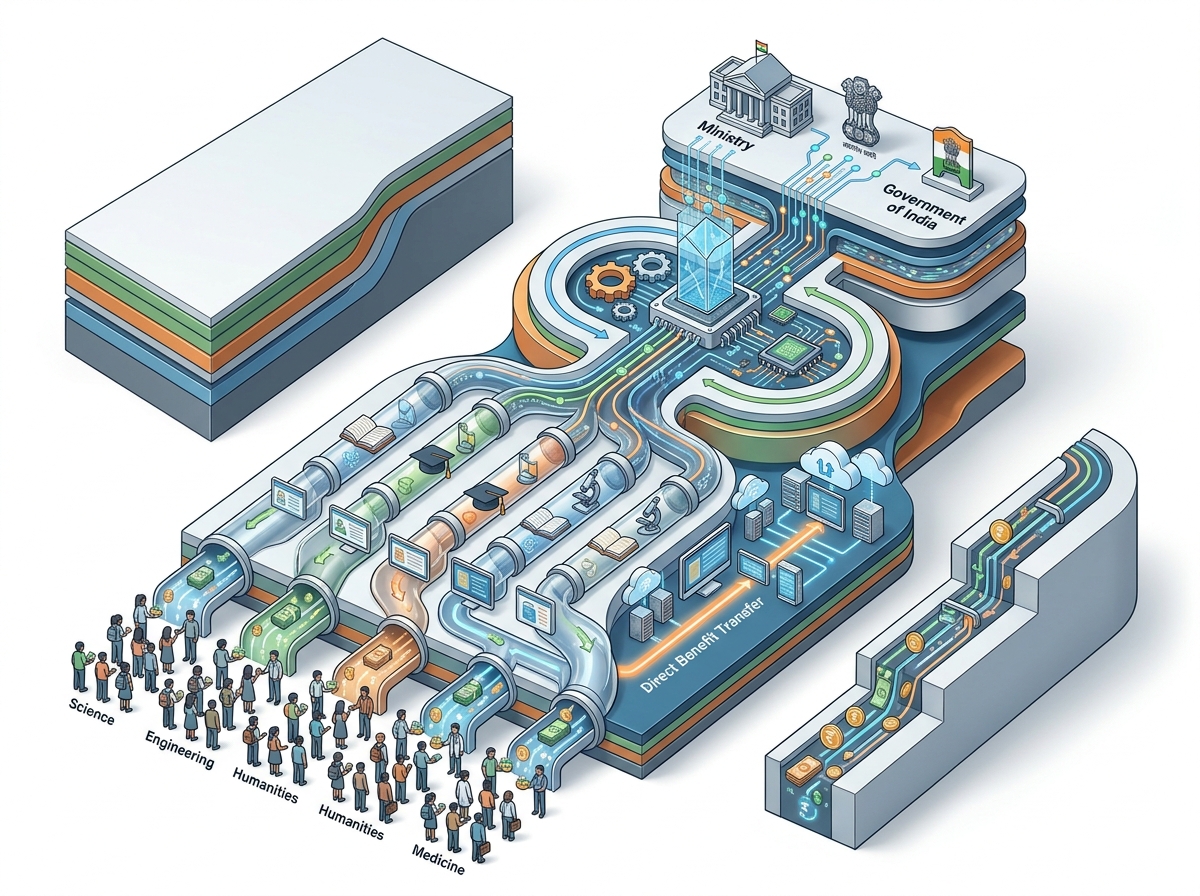
✎ Direct Benefit Transfer (DBT) and Aadhaar-linked payments have streamlined scholarship disbursements for Scheduled Castes, reducing leakages and delays while ensuring fiscal accountability in centrally sponsored and central…
Subject Relevance — Where This Topic Fits
- GS Paper II — Governance, Welfare Schemes for Vulnerable Sections | GS Paper III — Public Finance and Direct Benefit Transfers
- Prelims: Direct Benefit Transfer (DBT), Scheduled Castes (SCs), Pre-Matric Scholarship, Post-Matric Scholarship, Central Sector Schemes, Centrally Sponsored Schemes, Aadhaar-linked Payments, Union Budget Allocations
- Essay: Role of Direct Benefit Transfers in reducing leakages in welfare delivery systems, Equity in education financing: Challenges and solutions for marginalised communities
Quick Revision: Direct Benefit Transfer (DBT) and Aadhaar-linked payments have streamlined scholarship disbursements for Scheduled Castes, reducing leakages and delays while ensuring fiscal accountability in centrally sponsored and central sector schemes.
Why is this in the news?
The Ministry of Social Justice and Empowerment, Government of India, released data on the disbursement of scholarships for Scheduled Caste (SC) students over the past three financial years (2023-24 to 2025-26), amounting to ₹19,216.46 crore. This expenditure reflects the scale and reach of centrally sponsored and central sector scholarship schemes, alongside the government’s emphasis on Direct Benefit Transfer (DBT) and digital governance to streamline welfare delivery. The announcement underscores the fiscal commitment to educational equity and the operational efficiency of scholarship disbursement mechanisms.
Background
- The Constitution of India, under Articles 15(4) and 16(4), empowers the state to make special provisions for the advancement of socially and educationally backward classes, including Scheduled Castes (SCs).
- The National Commission for Scheduled Castes (NCSC) monitors the implementation of safeguards and welfare measures for SCs under the Constitution.
- The Pre-Matric and Post-Matric Scholarship Schemes for SCs were launched to address the barriers to education faced by marginalised communities, particularly in higher education.
- The shift from in-kind subsidies to cash transfers (DBT) has been a key governance reform to reduce leakages and improve targeting efficiency.
- The Aadhaar-enabled Payment System (AePS) has been integrated with scholarship disbursements to ensure transparency and minimise delays.
What are the key scholarship schemes for Scheduled Castes and their governance mechanisms?
- **Post-Matric Scholarship for SCs (PMS-SC):**** A centrally sponsored scheme providing financial assistance to SC students pursuing education from Class 11 to PhD levels. The scheme covers tuition fees, maintenance allowance, and other academic expenses. Over the past three years, ₹17,224.63 crore was disbursed under this scheme, with Tamil Nadu, Maharashtra, and Uttar Pradesh being the top beneficiaries.
- **Pre-Matric Scholarship for SCs and Others:**** A centrally sponsored scheme aimed at SC students from Class 1 to 10, designed to reduce dropout rates by covering school fees, uniforms, and stationery. A total of ₹1,469.92 crore was released over three years, with Tamil Nadu receiving the highest allocation.
- **Higher Level Education Scheme (TCS):**** A central sector scheme providing full financial support to SC students pursuing higher education in top institutions (e.g., IITs, IIMs, NITs). ₹304.29 crore was disbursed under this scheme.
- **National Overseas Scholarship (NOS) Scheme for Scheduled Castes and Other Eligible Candidates:**** A central sector scheme offering financial assistance to SC students for higher studies abroad. ₹217.62 crore was released over three years, with funds disbursed in advance to Indian Missions via Letters of Authority (LoA).
- The schemes are administered under the **Social Justice and Empowerment Ministry**, with **Direct Benefit Transfer (DBT)** being the primary mode of disbursement for central sector schemes, while centrally sponsored schemes involve **cost-sharing between the Centre and States** (typically 60:40 or 90:10, depending on the scheme and state category).
- State-level nodal agencies, such as **State SC Finance Corporations** and **Social Welfare Departments**, play a critical role in verifying eligibility, processing applications, and releasing matching state shares where applicable.
- The **Aadhaar-linked Payment System (AePS)** ensures that scholarships are credited directly to beneficiaries’ bank accounts, reducing intermediaries and minimising delays.
Key Features
| Feature | Significance |
|---|---|
| Direct Benefit Transfer (DBT) Mechanism | Ensures timely disbursal of scholarships by linking Aadhaar-enabled bank accounts, reducing leakages and delays in fund distribution. |
| Centralised Monitoring via National Portal | Facilitates real-time tracking of scholarship disbursements, enabling systematic review and corrective measures across states/UTs. |
| Multi-Scheme Integration | Consolidates multiple scholarship schemes (Post-Matric, Pre-Matric, National Overseas Scholarship, etc.) under a unified framework for streamlined administration. |
| State Share Coordination | Ensures timely release of state contributions before central funds are disbursed, maintaining fiscal federalism in scholarship distribution. |
| Capacity Building Initiatives | Regular review mechanisms, workshops, and technical assistance programmes enhance administrative efficiency in state implementing agencies. |
Why it Matters
Social Equity
- Enhances educational access for Scheduled Caste (SC) students by providing financial support across all levels of education, from pre-matric to post-graduate and overseas studies.
- Reduces economic barriers to higher education, thereby promoting social mobility and inclusion of marginalised communities.
- Supports the constitutional mandate of equality (Article 14) and non-discrimination (Article 15) by addressing historical educational disadvantages faced by SC students.
Economic Impact
- Investment in human capital through scholarships contributes to long-term economic growth by improving workforce skills and productivity.
- Reduces intergenerational poverty by enabling SC students to pursue higher education and access better employment opportunities.
- Stimulates demand in education-related sectors (e.g., coaching, books, digital infrastructure) through increased student participation.
Administrative Efficiency
- DBT and centralised portals minimise administrative delays and corruption risks in scholarship disbursement.
- Regular reviews and capacity-building programmes improve the efficacy of welfare delivery systems at the state level.
- Data-driven decision-making enhances transparency and accountability in fund utilisation.
Policy Alignment
- Aligns with the National Education Policy (NEP) 2020’s emphasis on inclusive education and equitable access to opportunities.
- Supports the Sustainable Development Goal 4 (Quality Education) by ensuring no SC student is left behind due to financial constraints.
- Complements the Scheduled Castes and Scheduled Tribes (Prevention of Atrocities) Act, 1989, by addressing systemic educational gaps.
Challenges
1. Implementation Gaps at State Level
- Delays in release of state shares can stall central disbursements, defeating the purpose of timely financial support.
- Inadequate administrative capacity in some states leads to underutilisation of allocated funds or inefficient targeting of beneficiaries.
UPSC Link: GS-II: Centre-State Relations
2. Digital Divide and Exclusion Risks
- Aadhaar-linked DBT may exclude marginalised SC students without valid identification or bank accounts, particularly in remote areas.
- Limited digital literacy among beneficiaries and implementing agencies can hinder effective utilisation of scholarship portals.
UPSC Link: GS-II: Welfare Schemes
3. Targeting and Leakage Concerns
- Ensuring scholarships reach only eligible SC students without duplication or inclusion of ineligible beneficiaries remains a challenge.
- Lack of robust grievance redressal mechanisms delays resolution of beneficiary complaints, eroding trust in the system.
UPSC Link: GS-II: Governance Issues
4. Sustainability of Funding
- Fluctuations in budgetary allocations may lead to inconsistent support, affecting long-term educational planning for SC students.
- Over-reliance on central funds without adequate state contributions can strain fiscal federalism.
UPSC Link: GS-III: Resource Mobilisation
5. Monitoring and Evaluation Deficits
- Inadequate tracking of outcomes (e.g., dropout rates, employment post-graduation) limits evidence-based policy refinement.
- Absence of standardised metrics across states complicates comparative assessment of scheme effectiveness.
UPSC Link: GS-II: Social Sector Services
Challenges — UPSC Perspective
| Issue | Concern |
|---|---|
| State Share Delays | Central disbursements are contingent on timely state contributions, leading to cascading delays. |
| Aadhaar Linkage Exclusions | Beneficiaries without Aadhaar or bank accounts face exclusion from DBT mechanisms. |
| Administrative Capacity Gaps | States with weak implementation frameworks struggle to process applications efficiently. |
| Leakage and Duplication | Risk of ineligible beneficiaries receiving funds due to inadequate verification systems. |
| Digital Literacy Barriers | Beneficiaries and officials lack skills to navigate centralised portals effectively. |
| Outcome Tracking Gaps | Lack of longitudinal data on educational and career trajectories post-scholarship. |
Government Initiatives — Must-Memorise for Prelims
- Post-Matric Scholarship for Scheduled Castes (PMSCS)
- Pre-Matric Scholarship for Scheduled Castes and Others
Way Forward
- Strengthen inter-state coordination mechanisms to ensure timely release of state shares, possibly through legally binding timelines.
- Expand Aadhaar enrolment drives and financial inclusion initiatives in SC-concentrated districts to minimise DBT exclusions.
- Develop a unified national dashboard for real-time monitoring of scholarship disbursements, beneficiary progress, and grievance redressal.
- Institutionalise periodic capacity-building programmes for state officials and implementing agencies on scheme administration and digital tools.
- Introduce outcome-based funding models where a portion of central grants is linked to measurable educational outcomes (e.g., graduation rates).
- Enhance grievance redressal through dedicated helplines, district-level facilitation centres, and transparent escalation protocols.
- Conduct independent impact assessments to evaluate the long-term socio-economic benefits of scholarships for SC students.
- Promote public-private partnerships to supplement government efforts in mentorship, skill development, and career guidance for beneficiaries.
UPSC Value Addition
Keywords for Mains Answer-Writing
Scheduled Caste Scholarships · Direct Benefit Transfer (DBT) · Central Sector Schemes · Centrally Sponsored Schemes · Social Justice and Empowerment · Pre-Matric Scholarship · Post-Matric Scholarship · National Overseas Scholarship · Higher Education Schemes · Digital Public Infrastructure
Constitutional & Policy Linkages
- Article 15(4) – Special provisions for advancement of socially and educationally backward classes
- Article 46 – Promotion of educational and economic interests of Scheduled Castes
- Article 29(2) – Right against discrimination in educational institutions
- Seventh Schedule – Concurrent List (Entry 25: Education)
Concept Flow
Constitutional mandate for social justice → Expansion of scholarship schemes for SC students → Centralised funding and DBT mechanisms → Streamlined disbursement and reduced leakages → State-level implementation challenges → Delays in fund release and administrative inefficiencies → Digital inclusion gaps → Risk of exclusion for marginalised beneficiaries → Monitoring and evaluation deficits → Limited evidence on long-term impact → Way forward: Institutional reforms → Sustainable and equitable scholarship delivery
Prelims Practice Questions
Q1. Consider the following statements regarding the Scheduled Caste Post-Matric Scholarship Scheme:
1. It is a centrally sponsored scheme.
2. The central government releases the scholarship amount directly to the beneficiaries’ bank accounts.
3. The scheme includes provisions for reimbursement of maintenance allowance and other academic expenses.
How many of the above statements are correct?
- Only one
- Only two
- All three
- None
Answer: All three — Statements 1 and 3 are correct. The Post-Matric Scholarship Scheme is a centrally sponsored scheme where the central government releases funds to states/UTs after their share is deposited, and the central share is disbursed via the central portal. Statement 2 is incorrect as the central government does not release the amount directly to beneficiaries; states/UTs disburse it after receiving the central share.
Q2. Assertion (A): The National Overseas Scholarship (NOS) for Scheduled Caste students is a Central Sector Scheme.
Reason (R): Under the NOS, funds are released in advance to Indian Missions through Letters of Authority (LOA) for disbursement to eligible students.
Options:
A. Both A and R are true, and R is the correct explanation of A.
B. Both A and R are true, but R is not the correct explanation of A.
C. A is true, but R is false.
D. A is false, but R is true.
Answer: ? — Assertion (A) is true: NOS is a Central Sector Scheme. Reason (R) is also true and correctly explains (A) as the advance release mechanism via LOA to Indian Missions is a defining feature of Central Sector Schemes.
Q3. Match the following scholarship schemes with their respective financial years’ disbursement (in crore rupees) for Scheduled Caste students:
Column I (Scheme) | Column II (Disbursement in 2025-26)
——————————————|—————————————
A. Post-Matric Scholarship | 1. 562.36
B. Higher Education Scheme (TCS) | 2. 6,186.95
C. National Overseas Scholarship (NOS) | 3. 304.29
D. Pre-Matric Scholarship | 4. 217.62
- A-1, B-3, C-4, D-2
- A-2, B-3, C-4, D-1
- A-4, B-2, C-3, D-1
- A-2, B-4, C-3, D-1
Answer: A-2, B-3, C-4, D-1 — Correct matching: Post-Matric Scholarship (A-2: 6,186.95 crore), Higher Education Scheme (B-3: 304.29 crore), National Overseas Scholarship (C-4: 217.62 crore), Pre-Matric Scholarship (D-1: 562.36 crore).
Mains Practice Question
✍ The Government of India has significantly enhanced the disbursement of scholarships for Scheduled Caste students over the past three years, leveraging Direct Benefit Transfer (DBT) and systematic reviews. Critically examine the institutional mechanisms and policy instruments that have contributed to this improvement. Also, assess the challenges in ensuring equitable access and timely disbursement of these scholarships across states. (15 Marks)
Approach: MODEL-ANSWER SKELETON:
1. **Institutional Mechanisms and Policy Instruments:**
– **Central Sector vs. Centrally Sponsored Schemes:** Differentiate between Central Sector Schemes (e.g., NOS, Higher Education Scheme) and Centrally Sponsored Schemes (e.g., Post-Matric, Pre-Matric). Explain the role of the Ministry of Social Justice and Empowerment in designing, funding, and monitoring these schemes.
– **Direct Benefit Transfer (DBT):** Explain how DBT has streamlined disbursement, reduced leakages, and ensured transparency. Cite the use of Aadhaar-linked bank accounts for beneficiaries.
– **Systematic Reviews and Capacity Building:** Highlight the role of regular reviews, capacity-building programs, and workshops involving states, UTs, and stakeholders in addressing delays and inefficiencies.
2. **Policy Instruments for Efficiency:**
– **Digital Public Infrastructure:** Discuss the role of the central portal in disbursing scholarships, ensuring real-time tracking, and reducing intermediaries.
– **State Participation:** Emphasize the requirement for states to contribute their share before the central government releases funds, ensuring shared accountability.
3. **Challenges in Equitable Access and Timely Disbursement:**
– **Regional Disparities:** Analyze data on disbursement across states (e.g., Tamil Nadu, Maharashtra, Uttar Pradesh) to highlight disparities in fund allocation and disbursement timelines.
– **Administrative Bottlenecks:** Discuss issues such as delayed state contributions, bureaucratic delays, and lack of awareness among beneficiaries.
– **Digital Divide:** Examine how limited digital literacy or infrastructure in rural areas may hinder access to scholarships.
– **Monitoring and Grievance Redressal:** Assess the effectiveness of grievance redressal mechanisms and the role of technology in addressing beneficiary complaints.
4. **Way Forward:**
– Propose measures such as strengthening state-level monitoring, enhancing digital literacy, and leveraging technology (e.g., blockchain for transparent transactions) to further improve efficiency and equity.
– Suggest periodic independent audits to identify systemic gaps and ensure accountability.
Balance of Views: Acknowledge the progress made in disbursement volumes and transparency while critically examining the persistent challenges in equitable access and timely delivery.
Source: PIB (Press Information Bureau)
Generated by AanyaAi for educational purpose.


No Comments