


11 Aug UPSC Focus: Green India Mission Restores 1.84 Lakh Hectares Degraded Forest Land
✎ The Green India Mission (GIM) is a flagship programme under the National Action Plan on Climate Change (NAPCC), operational since 2015-16, through an integrated landscape approach, community participation, and multi-tiered…
Subject Relevance — Where This Topic Fits
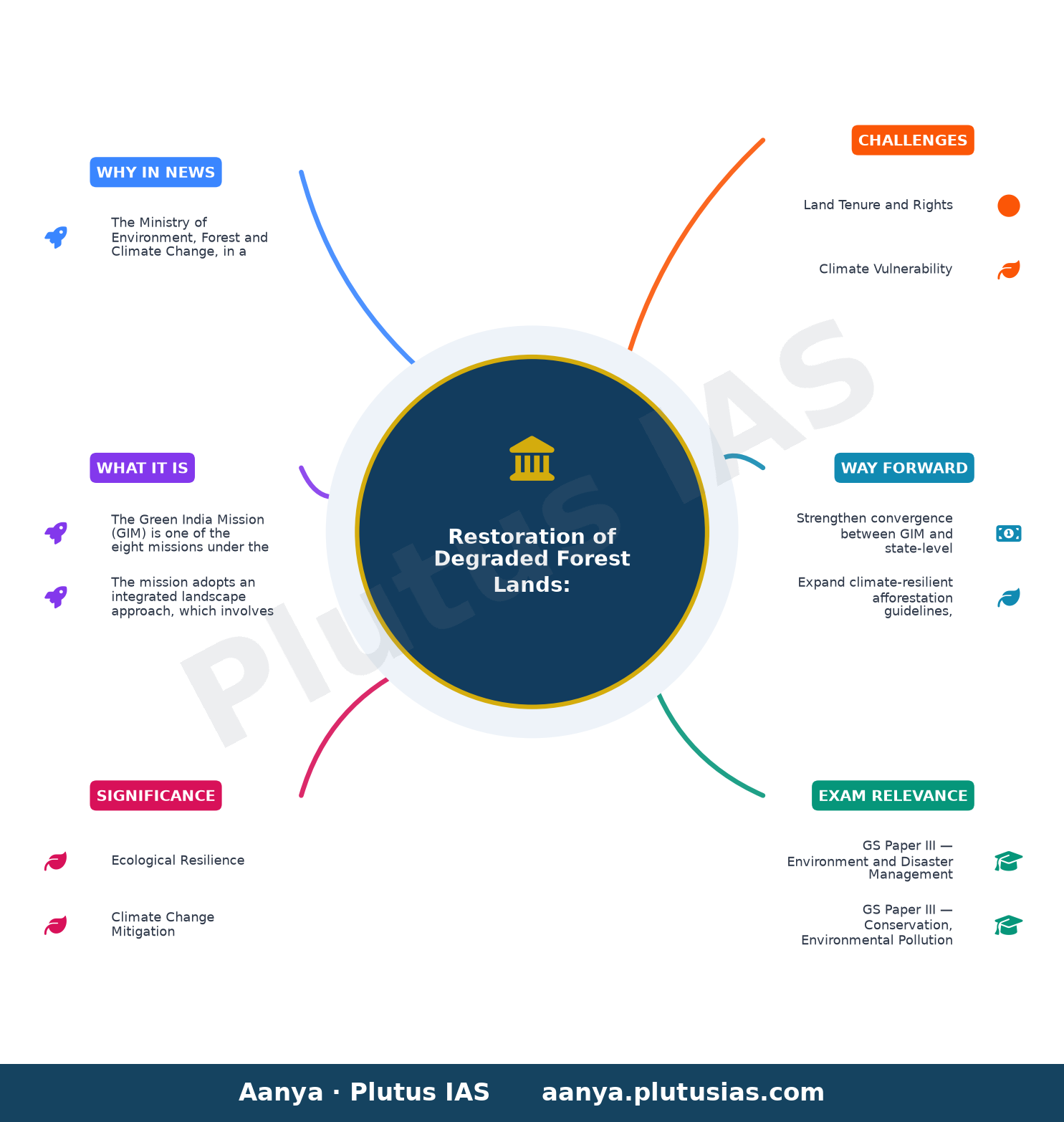
- GS Paper III — Environment and Disaster Management | GS Paper III — Conservation, Environmental Pollution and Degradation | GS Paper III — Government Policies and Interventions for Development in Various Sectors | GS Paper II — Functions and Responsibilities of the Union and the States
- Prelims: National Action Plan on Climate Change (NAPCC), Green India Mission (GIM), Compensatory Afforestation Fund Management and Planning Authority (CAMPA), Joint Forest Management Committees (JFMC), Forest Survey of India (FSI), India State of Forest Report (ISFR), Integrated Landscape Approach, Geo-tagging of plantation sites, Urban Forest Scheme (Nagari Van Yojana), Micro-climate improvement
- Essay: Climate change mitigation and ecological restoration: Balancing development and conservation, Community participation in environmental governance: Lessons from forest restoration initiatives
Quick Revision: The Green India Mission (GIM) is a flagship programme under the National Action Plan on Climate Change (NAPCC), operational since 2015-16, through an integrated landscape approach, community participation, and multi-tiered monitoring mechanisms.
Why is this in the news?
The Ministry of Environment, Forest and Climate Change, in a written reply to a Lok Sabha question on 10 August 2026, provided an update on the implementation of the Green India Mission (GIM), including the extent of degraded forest land restored across 17 States and one Union Territory, the allocation of funds for 2026-27, and the monitoring mechanisms employed to ensure ecological outcomes. The response underscores the mission’s integrated landscape approach and its alignment with the National Action Plan on Climate Change (NAPCC).
Background
- The GIM was approved in 2011 and operationalised from 2015-16, with the objective of increasing forest cover on degraded lands and improving ecosystem services through an integrated landscape approach.
- Degraded forest lands, including shifting cultivation areas, scrublands, and abandoned agricultural lands, are targeted for restoration to enhance biodiversity, carbon sequestration, and resilience to climate change.
- The Compensatory Afforestation Fund Management and Planning Authority (CAMPA) was established under the Compensatory Afforestation Fund Act, 2016, to utilise funds collected for compensatory afforestation and related activities, including those under GIM.
- The Forest Survey of India (FSI) conducts biennial assessments of forest cover and publishes the India State of Forest Report (ISFR), which serves as a critical data source for monitoring ecological outcomes of restoration initiatives.
- Urban greening initiatives, such as the Nagari Van Yojana (Urban Forest Scheme), complement GIM by enhancing green cover in urban areas to improve air quality and micro-climates.
What is the Green India Mission (GIM)?
- The Green India Mission (GIM) is one of the eight missions under the National Action Plan on Climate Change (NAPCC), launched in 2008 to address climate change through sector-specific interventions.
- The mission adopts an integrated landscape approach, which involves restoring degraded lands through afforestation, agroforestry, and other ecological restoration techniques, while ensuring community participation and livelihood support.
- GIM is implemented through a decentralised framework, with funds allocated to States and Union Territories based on approved Annual Plans of Operations (APOs), which outline specific restoration activities and targets.
- The mission prioritises the involvement of local institutions such as Joint Forest Management Committees (JFMCs), Village Forest Committees (VFCs), and Self-Help Groups (SHGs) to ensure grassroots participation and sustainable outcomes.
- Monitoring and evaluation of GIM are conducted through multi-tiered systems, including geo-tagging of plantation sites, GIS-based mapping, drone surveillance, and third-party assessments to ensure transparency and accountability.
- Funds for GIM are utilised for afforestation, nursery development, post-plantation care, and livelihood-linked activities, with a focus on improving the survival rate of planted saplings and long-term ecological restoration.
- The mission aligns with India’s international commitments, including the United Nations Sustainable Development Goals (SDGs), particularly SDG 13 (Climate Action), SDG 15 (Life on Land), and the Paris Agreement on climate change.
Key Features
| Feature | Significance |
|---|---|
| Integrated Landscape Approach | Adopts a holistic, multi-sectoral strategy to restore degraded forests and non-forest areas, integrating ecological, social, and economic dimensions for sustainable landscape management. |
| Eco-Restoration Targets (2015-16 to 2026-27) | Restoration of 1,84,467 hectares across 17 states and 1 UTs, demonstrating national-scale commitment to combating land degradation and enhancing carbon sinks. |
| Urban Forest Scheme (Nagar Van Yojana) | Aims to develop 600 urban forests and 400 urban gardens by 2026-27, targeting micro-climate improvement and urban air quality enhancement in 600 cities. |
| Community-Based Implementation | Engages Joint Forest Management Committees (JFMCs), Village Forest Committees (VFCs), and Self-Help Groups (SHGs) for planting, maintenance, and livelihood-linked activities, ensuring local ownership and sustainability. |
| Multi-Level Monitoring Framework | Utilises geotagging, GIS mapping, drone surveillance, and third-party audits to track survival rates, identify gaps, and enforce corrective measures, ensuring accountability and transparency. |
Why it Matters
Ecological Resilience
- Enhances biodiversity conservation by restoring degraded ecosystems, thereby supporting critical habitats for flora and fauna.
- Augments carbon sequestration potential, contributing to India’s Nationally Determined Contributions (NDCs) under the Paris Agreement.
- Improves soil health and water retention, mitigating desertification and land degradation in vulnerable regions.
Climate Change Mitigation
- Supports India’s climate action goals by increasing forest cover, a key pillar of the National Action Plan on Climate Change (NAPCC).
- Urban forests under NVY directly address urban heat islands and particulate matter pollution, aligning with climate-resilient city planning.
Socio-Economic Benefits
- Generates rural and peri-urban employment through afforestation, nursery development, and allied livelihood activities.
- Strengthens community resilience by integrating traditional knowledge with modern restoration techniques, fostering inclusive governance.
Institutional Capacities
- Builds institutional frameworks for participatory forest management, enhancing the role of local institutions like JFMCs and VFCs.
- Leverages technological tools (GIS, drones, remote sensing) for evidence-based decision-making and adaptive management.
Challenges
1. Land Tenure and Rights
- Ambiguities in land ownership and forest rights under the Forest Rights Act (FRA), 2006, can delay or obstruct restoration projects on community lands.
- Encroachment and competing land uses (agriculture, mining) pose threats to restored areas, necessitating robust legal and administrative safeguards.
UPSC Link: Forest Rights Act 2006
2. Climate Vulnerability
- Increased frequency of extreme weather events (droughts, floods) threatens sapling survival rates, requiring climate-resilient species selection and adaptive management.
- Regions with high aridity or salinity (e.g., parts of Rajasthan, Gujarat) face inherent ecological constraints in afforestation.
UPSC Link: Climate Vulnerability Atlas
3. Funding and Resource Gaps
- Dependence on central allocations under CAMPA and state budgets may lead to funding shortfalls, especially during fiscal constraints.
- High maintenance costs post-planting (irrigation, protection from grazing) require sustained financial commitments beyond initial plantation phases.
UPSC Link: Compensatory Afforestation Fund Management and Planning Authority
4. Technological and Human Resource Constraints
- Limited capacity among state forest departments for advanced monitoring tools (drones, remote sensing) hinders real-time data collection.
- Shortage of skilled personnel for nursery management, species selection, and community engagement affects project efficacy.
UPSC Link: Forest Survey of India
5. Monitoring and Evaluation Bottlenecks
- Delayed or inconsistent reporting by states on survival rates and ecological outcomes undermines adaptive management.
- Third-party audits, while mandated, may lack independence or technical rigor, leading to gaps in accountability.
UPSC Link: India State of Forest Report
Challenges — UPSC Perspective
| Issue | Concern |
|---|---|
| Land encroachment and competing uses | Restoration efforts on degraded lands are often undermined by illegal encroachments or conversion for agriculture/mining. |
| Low sapling survival rates | Survival rates below 50% in some regions due to poor site selection, lack of post-planting care, or adverse climatic conditions. |
| Fragmented institutional coordination | Overlapping mandates among forest departments, revenue authorities, and local bodies lead to implementation delays. |
| Limited community participation | Inadequate awareness or incentives for local communities to engage in long-term maintenance of restored areas. |
| Data gaps in monitoring | Inconsistent geotagging, delayed GIS updates, and lack of standardised survival assessment protocols hinder evidence-based planning. |
Government Initiatives — Must-Memorise for Prelims
- National Mission for a Green India (GIM)
- Nagar Van Yojana (NVY)
- Compensatory Afforestation Fund Management and Planning Authority (CAMPA)
Way Forward
- Strengthen convergence between GIM and state-level afforestation schemes (e.g., MGNREGA) to leverage additional funding and manpower for maintenance activities.
- Expand climate-resilient afforestation guidelines, incorporating species selection based on local ecological conditions and projected climate scenarios.
- Enhance capacity-building programs for forest department staff, JFMCs, and SHGs on nursery management, species diversification, and adaptive monitoring techniques.
- Mandate real-time geotagging and drone-based surveillance for all restoration sites, with quarterly survival rate assessments published in the India State of Forest Report.
- Integrate restoration projects with existing livelihood programs (e.g., Van Mitra Yojana) to ensure sustained community engagement and economic benefits.
- Establish a national-level grievance redressal mechanism for land disputes related to afforestation, ensuring timely resolution of encroachment issues.
- Promote public-private partnerships (PPPs) for urban forest development under NVY, leveraging corporate social responsibility (CSR) funds for scaling up urban green cover.
UPSC Value Addition
Keywords for Mains Answer-Writing
Green India Mission (GIM) · National Action Plan on Climate Change (NAPCC) · National Mission for a Green India · degraded forest land restoration · integrated landscape approach · Joint Forest Management Committees (JFMCs) · Community-based forest management · ecological restoration · urban forests and urban groves · geotagging and GIS-based monitoring · India State of Forest Report (ISFR) · forest landscape restoration · climate change mitigation · National Afforestation Programme (NAP) · Forest Rights Act, 2006 · biodiversity conservation · micro-climate improvement · sustainable forest management
Constitutional & Policy Linkages
- Article 48A (Directive Principles of State Policy) — Protection and improvement of environment and safeguarding of forests and wildlife
- Seventh Schedule (State List, Entry 17A) — Forest conservation and land management
- Forest Rights Act, 2006 — Recognition of forest dwellers’ rights and community forest management
Concept Flow
Degradation of forest and non-forest lands due to anthropogenic pressures (deforestation, agriculture, mining) and climate change impacts (droughts, fires) → Adoption of Integrated Landscape Approach under GIM to restore ecological functions and enhance carbon sinks → Implementation through community-based institutions (JFMCs, VFCs) with technical support from forest departments and scientific agencies → Monitoring via geotagging, GIS, drones, and third-party audits to assess survival rates and ecological outcomes → Corrective measures (gap-filling, maintenance) based on real-time data to ensure long-term sustainability → Integration with urban forest schemes (NVY) to address climate resilience in cities and peri-urban areas → Contribution to India’s NDCs under the Paris Agreement and alignment with Sustainable Development Goals (SDG 13, 15)
Prelims Practice Questions
Q1. Consider the following statements regarding the Green India Mission (GIM):
1. GIM is one of the nine missions under the National Action Plan on Climate Change (NAPCC).
2. It aims to restore degraded forest and non-forest landscapes through an integrated landscape approach.
3. GIM has been implemented since 2015-16 and covers 17 states and one Union Territory.
4. The mission does not involve community participation in its implementation.
How many of the above statements are correct?
- Only one
- Only two
- Only three
- All four
Answer: Only three — Statements 1, 2, and 3 are correct. Statement 4 is incorrect as GIM actively involves local communities through Joint Forest Management Committees (JFMCs) and Village Forest Committees (VFCs).
Q2. Which of the following is NOT a feature of the monitoring mechanism under the Green India Mission (GIM)?
- Geotagging of plantation sites
- GIS-based mapping
- Drone-based monitoring in all states
- Third-party evaluation
Answer: Drone-based monitoring in all states — Drone-based monitoring is not universally applied in all states under GIM; it is used selectively where states opt for it. Other listed features are part of the monitoring framework.
Q3. Assertion (A): The Green India Mission (GIM) prioritises afforestation in urban areas to enhance micro-climates and air quality.
Reason (R): The National Urban Forest Mission (NVF) is a sub-scheme under GIM aimed at developing 600 urban forests and 400 urban groves by 2026-27.
- Both A and R are true, and R is the correct explanation of A
- Both A and R are true, but R is NOT the correct explanation of A
- A is true, but R is false
- A is false, but R is true
Answer: A is true, but R is false — While GIM does include urban greening components, the National Urban Forest Mission (NVF) is a separate scheme implemented by the Ministry of Environment, Forest and Climate Change, not a sub-scheme under GIM. Hence, R is not the correct explanation of A.
Mains Practice Question
✍ The Green India Mission (GIM), a flagship programme under the National Action Plan on Climate Change (NAPCC), adopts an integrated landscape approach to restore degraded forest and non-forest landscapes. In this context, critically examine the efficacy of GIM’s implementation strategy, with particular reference to its community-based governance model and technological monitoring mechanisms. (15 Marks)
Approach: MODEL-ANSWER SKELETON:
1. **Introduction (2 marks)**
– Briefly define GIM: one of nine missions under NAPCC (2008), operational since 2015-16.
– Objective: ecological restoration of 1,84,467 hectares across 17 states and 1 UT via integrated landscape approach.
– Statutory/constitutional basis: NAPCC is a policy framework under the National Action Plan on Climate Change, guided by the Ministry of Environment, Forest and Climate Change.
2. **Community-based Governance Model (5 marks)**
– **Joint Forest Management Committees (JFMCs) and Village Forest Committees (VFCs)**: Legal framework under the Forest Rights Act, 2006 and state forest acts; empower local communities in decision-making.
– **Livelihood linkages**: Inclusion of Self-Help Groups (SHGs) for nursery development, post-plantation care, and alternative livelihoods (e.g., NTFP collection).
– **Strengths**: Enhances ownership, reduces encroachment, and ensures long-term sustainability.
– **Challenges**: Limited capacity of local institutions, bureaucratic delays, and uneven implementation across states.
3. **Technological Monitoring Mechanisms (5 marks)**
– **Geotagging and GIS-based mapping**: Real-time tracking of plantation sites; ensures transparency and accountability.
– **Third-party audits and drone-based monitoring**: Used selectively to validate survival rates and identify gaps (e.g., in Chhattisgarh, Madhya Pradesh).
– **Role of FSI and ISFR**: Biennial assessment of forest cover via remote sensing; data published in India State of Forest Report (ISFR).
– **Strengths**: Data-driven decision-making, reduces leakages, and enables corrective measures.
– **Limitations**: High initial costs, digital divide in remote areas, and need for periodic capacity building.
4. **Critical Evaluation and Way Forward (3 marks)**
– **Successes**: GIM has restored significant degraded land (1,84,467 hectares) and improved micro-climates in urban areas via NVF.
– **Gaps**: Variability in state-wise performance (e.g., Madhya Pradesh vs. Punjab); need for stronger convergence with MGNREGA and CAMPA funds.
– **Recommendations**:
– Strengthen JFMCs/VFCs through training and financial autonomy.
– Expand drone-based monitoring to all high-priority states.
– Integrate climate resilience metrics in monitoring frameworks.
**Balanced conclusion**: GIM’s integrated approach, combining community governance and technology, is a model for ecological restoration. However, scalability and equity remain challenges requiring multi-stakeholder collaboration.
Source: PIB (Press Information Bureau)
Generated by AanyaAi for educational purpose.

- PM Modi Praises Youth-Led Nasha Mukt Yuva Abhiyan Momentum - September 27, 2026
- राजनाथ सिंह का बड़ा बयान: भारत किसी की ज़मीन कब्ज़ा नहीं करेगा, लेकिन सुरक्षा पर होगा कठोर - September 27, 2026
- Exercise Tarang Shakti 2026: India’s Mega Multi-Nation Air Power Showcase - September 27, 2026

No Comments