


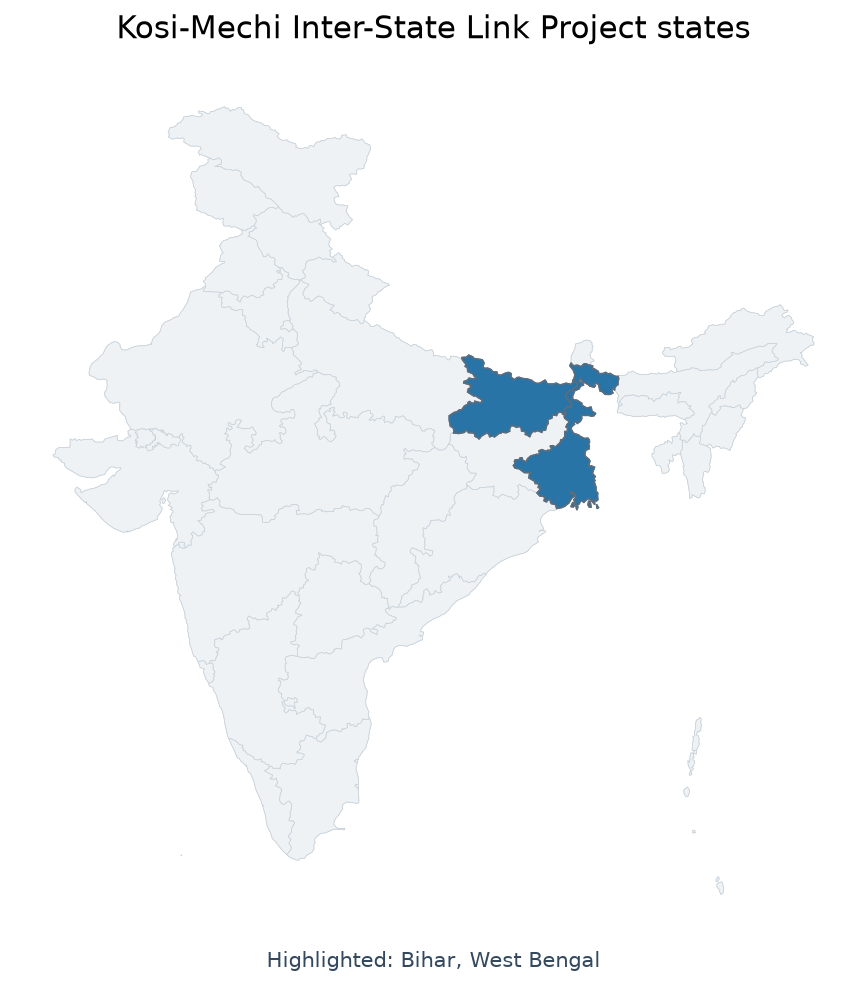
27 Jul UPSC Focus: Koshi-Mechi Inter-State Link Project Explained for Prelims & Mains
Subject Relevance — Where This Topic Fits
- GS Paper II — International Relations (India-Nepal cooperation) | GS Paper III — Agriculture (irrigation), Water Resources (interlinking of rivers), Environment (flood management)
- Prelims: Kosi-Mechhi Link Project, PMKSY-AIBP, Sapt-Kosi Multipurpose Project, Sun-Kosi-Kamala Diversion Project, GLOF studies, Joint Project Office (JPO-SKSKI)
- Essay: Inter-state water resource management: Balancing development, diplomacy, and disaster mitigation, Climate-resilient infrastructure: Lessons from India’s river-linking initiatives
Quick Revision: The Kosi-Mechhi Inter-State Link Project is a ₹6,143.22 crore initiative under PMKSY-AIBP to transfer surplus Kosi waters to the Mechi basin, aiming to mitigate floods in Bihar, and enhance regional water security through Indo-Nepal cooperation.
Why is this in the news?
The Kosi-Mechhi Inter-State Link Project has been included under the Pradhan Mantri Krishi Sinchayee Yojana-Accelerated Irrigation Benefits Programme (PMKSY-AIBP) with a central assistance of ₹3,652.56 crore, marking a significant step toward its implementation. The project, aimed at augmenting irrigation and flood control in Bihar, is progressing with 8.5% physical completion as of July 2026, while ongoing negotiations with Nepal highlight its transboundary implications for water resource management and regional cooperation.
Background
- The Kosi River, originating in Nepal, is a major tributary of the Ganga and is notorious for its devastating floods in North Bihar, necessitating comprehensive flood management strategies.
- The Kosi-Mechi link is part of India’s broader National Perspective Plan (NPP) for interlinking rivers (ILR), aimed at transferring surplus water from flood-prone basins to water-deficit regions.
- Historically, the Kosi has been a flashpoint for Indo-Nepalese cooperation due to its transboundary nature, with both countries sharing responsibilities for flood control, irrigation, and hydropower development.
- The 2003 Joint Project Office (JPO-SKSKI) was established to prepare Detailed Project Reports (DPRs) for the Sapt-Kosi Multipurpose Project and Sun-Kosi-Kamala Diversion Project, reflecting decades of bilateral engagement.
- Bihar’s vulnerability to floods has led to recurring central assistance under programmes like the Flood Management and Border Areas Programme (FMBAP), with ₹206.77 crore released over the past three years.
- The project aligns with the Pradhan Mantri Krishi Sinchayee Yojana (PMKSY), which integrates micro-irrigation, watershed development, and accelerated irrigation benefits to enhance agricultural productivity.
What is the Kosi-Mechhi Inter-State Link Project?
- A multipurpose infrastructure project aimed at linking the Kosi River (Bihar) with the Mechi River to transfer surplus water for irrigation, mitigate floods, and enhance water security in eastern India.
- The project is part of the broader National Perspective Plan (NPP) for interlinking rivers (ILR), which envisages 30 river links to address regional water imbalances and flood risks.
- The estimated cost of the project is ₹6,143.22 crore, with ₹3,652.56 crore provided as central assistance under PMKSY-AIBP, and completion targeted by March 2029.
- The project includes the reconstruction of the Eastern Kosi Main Canal, with a contract worth ₹2,639.80 crore awarded for a 41.30 km stretch, currently at 8.5% physical progress.
- Key objectives include reducing flood damage in North Bihar, and improving groundwater recharge in the Mechi basin.
- The project involves extensive geological, hydrological, and seismic studies, including 1,258 meters of drilling for the Sapt-Kosi Multipurpose Project and 1,549 meters for the Sun-Kosi-Kamala Diversion Project.
- The project incorporates Glacial Lake Outburst Flood (GLOF) studies to assess climate-induced risks, reflecting its integration with disaster resilience frameworks.
- The project is being implemented in collaboration with Nepal, with ongoing dialogues on transboundary water management, including potential dam construction on the Kosi River.
Key Features
| Feature | Significance |
|---|---|
| Total Project Cost | The Koshi-Mechhi inter-State link project entails an estimated cost of ₹6,143.22 crore, with ₹3,652.56 crore provided as central assistance under PMKSY-AIBP, ensuring financial viability and accelerated implementation. |
| Project Timeline | The project is scheduled for completion by March 2029, indicating a compressed implementation phase to address irrigation deficits and flood mitigation in the region. |
| Progress on Eastern Koshi Main Canal | Reconstruction of the 41.30 km stretch of the Eastern Koshi Main Canal has commenced with a ₹2,639.80 crore contract, achieving 8.5% physical progress, demonstrating early-stage execution. |
| Nepal-India Bilateral Engagement | Regular diplomatic consultations between India and Nepal on Koshi river basin projects, including dam construction for mutual benefits such as flood control and irrigation, underscore the transboundary nature of the initiative. |
| Pre-Project Studies | Completion of comprehensive surveys (topographic, hydrological, seismic, and GLOF studies) for the Sapta-Koshi and Sun-Koshi-Kamala diversion projects, ensuring technical feasibility and risk mitigation. |
Why it Matters
Economic
- Augments irrigation potential in drought-prone regions of Bihar and adjoining areas, enhancing agricultural productivity and rural incomes.
- Reduces dependency on monsoon rainfall, mitigating crop losses and ensuring food security in eastern India.
- Stimulates local economies through infrastructure development, employment generation in construction and allied sectors.
Strategic
- Strengthens India-Nepal hydrological cooperation, fostering regional stability and addressing shared water-security challenges.
- Mitigates flood risks in the Koshi basin, protecting lives, livelihoods, and critical infrastructure in downstream regions.
- Demonstrates India’s commitment to sub-regional water diplomacy, countering China’s strategic influence in the Himalayan water discourse.
Environmental
- Integrates flood control measures with irrigation, balancing ecological sustainability and developmental imperatives.
- Incorporates GLOF studies to assess glacial lake outburst flood risks, safeguarding downstream communities and ecosystems.
- Promotes efficient water resource utilisation, reducing over-extraction of groundwater in the region.
Institutional
- Reinforces the role of the Joint Project Office (JPO-SKSKI) in facilitating transboundary water governance and technical collaboration.
- Demonstrates the efficacy of PMKSY-AIBP in accelerating large-scale irrigation projects through centralised funding and monitoring.
Challenges
1. Transboundary Water Governance
- Negotiations with Nepal on dam construction and water-sharing remain protracted, delaying project implementation.
- Divergent national priorities and geopolitical sensitivities in the Koshi basin complicate consensus-building.
- Lack of recent India-Nepal Joint Committee meetings (since 2025-26) signals stagnation in bilateral dialogue.
UPSC Link: GS-II: India-Nepal relations
2. Technical and Geological Risks
- Seismic vulnerability of the Himalayan region necessitates rigorous structural designs to withstand earthquakes.
- GLOF risks from glacial lakes in Nepal require continuous monitoring and adaptive engineering solutions.
- Complex topography and soil conditions in the Koshi basin pose challenges for canal construction and stability.
UPSC Link: GS-III: Disaster Management
3. Financial and Administrative Bottlenecks
- Delays in land acquisition and rehabilitation may escalate project costs and trigger legal disputes.
- Coordinating multi-agency approvals (MoWR, MoEFCC, state governments) prolongs decision-making.
- Inadequate progress (8.5% completion) in the Eastern Koshi Main Canal underscores implementation challenges.
UPSC Link: GS-III: Infrastructure Development
4. Environmental and Social Concerns
- Potential displacement of communities and loss of livelihoods due to reservoir construction and canal alignment.
- Risk of ecological degradation in the Koshi floodplains, including wetlands and biodiversity hotspots.
- Need for robust environmental impact assessments (EIAs) and stakeholder consultations to ensure sustainability.
UPSC Link: GS-III: Environmental Pollution & Degradation
5. Climate Change Vulnerabilities
- Altered precipitation patterns and glacial retreat may reduce water availability in the Koshi basin over time.
- Increased frequency of extreme weather events (floods, droughts) necessitates adaptive water management strategies.
- Long-term climate projections must inform project design to ensure resilience against future climatic shifts.
UPSC Link: GS-III: Climate Change
Challenges — UPSC Perspective
| Issue | Concern |
|---|---|
| Nepal-India Bilateral Negotiations | Protracted talks on dam construction and water-sharing delay project timelines. |
| Seismic and GLOF Risks | High vulnerability to earthquakes and glacial lake outburst floods necessitates robust engineering. |
| Land Acquisition and Rehabilitation | Potential delays due to legal disputes and compensation claims. |
| Multi-Agency Coordination | Delays in approvals from central and state agencies hinder implementation. |
| Environmental Impact | Risk of ecological degradation and biodiversity loss in the Koshi basin. |
| Climate Change Adaptation | Uncertainty in long-term water availability due to changing climatic patterns. |
Way Forward
- Accelerate negotiations with Nepal on the Sapta-Koshi and Sun-Koshi-Kamala projects to finalise DPRs and secure bilateral agreements.
- Establish a dedicated task force to monitor the Eastern Koshi Main Canal reconstruction, ensuring timely progress and quality control.
- Conduct comprehensive environmental and social impact assessments (ESIA) with public consultations to address stakeholder concerns.
- Integrate climate resilience into project design, incorporating adaptive measures for flood control and irrigation infrastructure.
- Strengthen institutional mechanisms for transboundary water governance, including regular India-Nepal Joint Committee meetings.
- Leverage PMKSY-AIBP funding to expedite land acquisition and rehabilitation processes, minimising delays.
- Enhance inter-state coordination between Bihar, Nepal, and central agencies to streamline approvals and implementation.
- Develop a long-term water-sharing and flood management framework with Nepal to ensure equitable benefits and risk mitigation.
UPSC Value Addition
Keywords for Mains Answer-Writing
Kosi-Mechi Inter-State Link Project · Flood management in Eastern India · Bihar-Nepal transboundary water cooperation · Pradhan Mantri Krishi Sinchayee Yojana-Accelerated Irrigation Benefit Programme (PMKSY-AIBP) · Kosi-Gandak Basin Authority · Sapta-Kosi Multipurpose Project · Sun-Kosi-Kamala Diversion Multipurpose Project · Hydrological and seismic studies for river projects · Glacial Lake Outburst Flood (GLOF) studies · Inter-basin water transfer in India · Central assistance for irrigation projects · India-Nepal Joint Project Office (JPO-SKS&KI)
Concept Flow
Koshi-Mechhi inter-State link project announced → Financial allocation under PMKSY-AIBP → Implementation of Eastern Koshi Main Canal reconstruction → Transboundary consultations with Nepal on dam construction → Completion of pre-project studies (topographic, hydrological, seismic) → Progress monitoring and risk assessment → Environmental and social impact assessments → Climate resilience integration → Finalisation of DPRs and bilateral agreements → Project completion and operationalisation
Prelims Practice Questions
Q1. Consider the following statements regarding the Kosi-Mechi Inter-State Link Project: 1) It is funded under the PMKSY-AIBP with a total outlay of ₹6,143.22 crore. 2) The project aims to link the Kosi and Mechi rivers for irrigation and flood control. 3) It includes the construction of a new dam on the Kosi River in Nepal. Which of the statements given above is/are correct?
- 1 and 2 only
- 2 and 3 only
- 1 and 3 only
- 1, 2 and 3
Answer: 1 and 2 only — Statement 1 is correct as the project is funded under PMKSY-AIBP with a central assistance of ₹3,652.56 crore. Statement 2 is correct as the project aims to link the Kosi and Mechi rivers. Statement 3 is incorrect as the project does not include construction of a new dam in Nepal.
Q2. Which of the following studies have been completed for the Sapta-Kosi Multipurpose Project? 1) Hydrological studies 2) Seismic studies 3) Glacial Lake Outburst Flood (GLOF) studies 4) Soil fertility studies Select the correct answer using the code given below:
- 1, 2 and 3 only
- 2, 3 and 4 only
- 1, 3 and 4 only
- 1, 2, 3 and 4
Answer: 1, 2 and 3 only — The Sapta-Kosi Multipurpose Project has completed hydrological studies, seismic studies, and Glacial Lake Outburst Flood (GLOF) studies. Soil fertility studies are not mentioned in the project details.
Mains Practice Question
✍ Analyze the significance of the Kosi-Mechi Inter-State Link Project in the context of India’s water resource management and bilateral cooperation with Nepal. Discuss the challenges and the role of technical studies in ensuring the project’s success.
Approach: The answer should begin by highlighting the dual objectives of the Kosi-Mechi Inter-State Link Project—irrigation augmentation and flood mitigation—within the broader framework of India’s water resource management policies, particularly the PMKSY-AIBP. Emphasize the project’s transboundary nature, necessitating cooperation with Nepal, and the necessity of joint technical studies such as hydrological, seismic, and GLOF assessments to mitigate risks. Address challenges like geological instability, glacial lake outburst risks, and diplomatic coordination, while underscoring the project’s potential to enhance agricultural productivity in Bihar and reduce flood vulnerabilities in the region.
Source: PIB (Press Information Bureau)
Generated by AanyaAi for educational purpose.

- बिहार सरकार का बड़ा फैसला: कारोबार शुरू करने में होगी आसानी, जानिए कैसे मिलेगा फायदा - September 23, 2026
- Bihar Launches Single Window Portal for 62 Business Services: UPSC & PCS Guide - September 23, 2026
- ग्रीनलैंड समझौता: अमेरिका को मिले अतिरिक्त रक्षा क्षेत्र, जानिए पूरा मामला - September 23, 2026

No Comments