


06 Aug UPSC Focus: MAHA Jal Mission & ANRF’s Role in Water Governance
✎ The MAHA Jal Programme integrates mission-mode research, public-private partnerships, and digital innovation to address India’s water challenges through sustainable, scalable, and climate-resilient solutions.
Subject Relevance — Where This Topic Fits
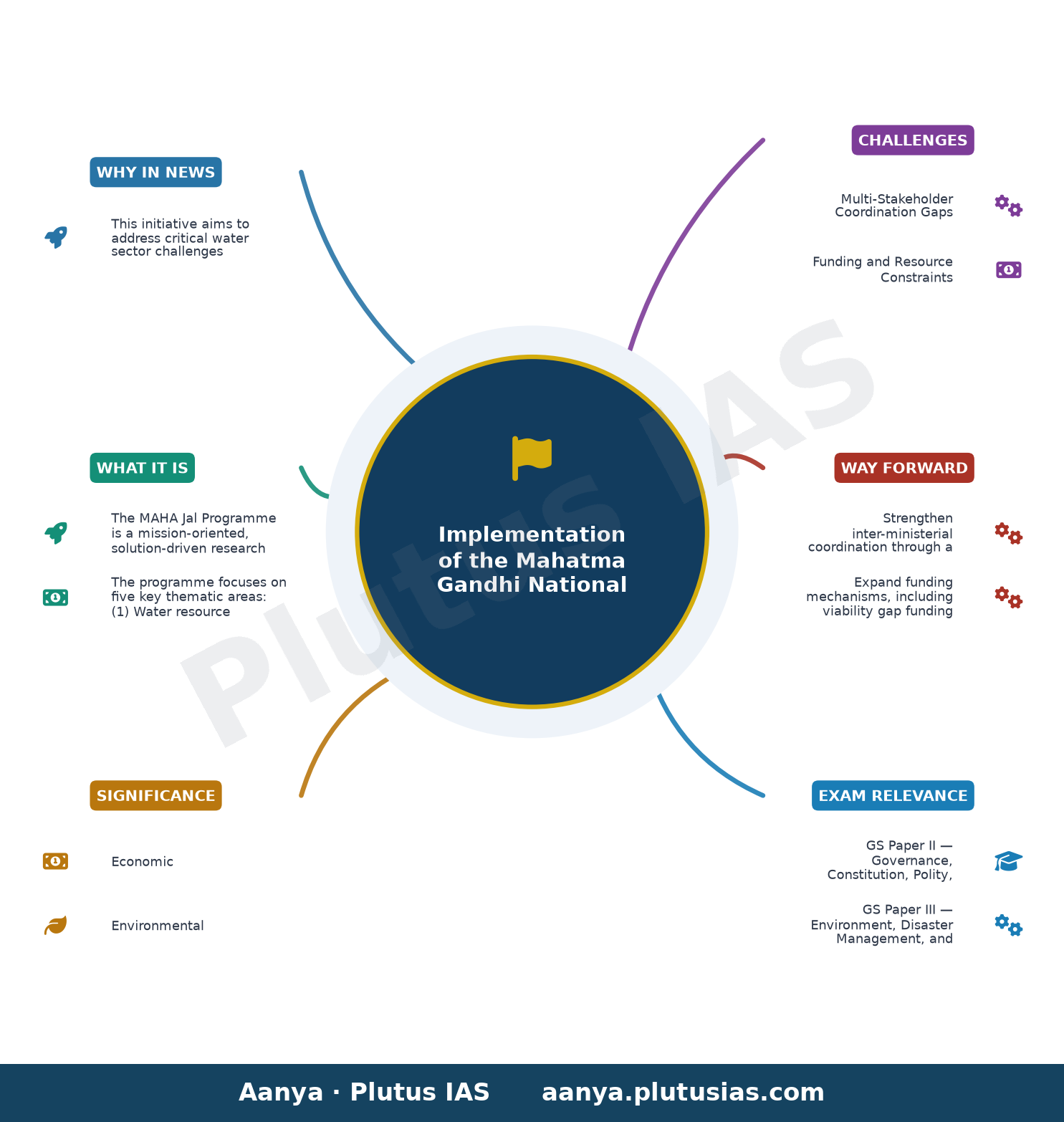
- GS Paper II — Governance, Constitution, Polity, Social Justice and International Relations | GS Paper III — Environment, Disaster Management, and Sustainable Development
- Prelims: National Research Foundation (NRF), ANRF Act 2023, Mission for Advancement in High-Impact Areas (MAHIA), Jal Shakti Ministry, Water Quality Management, Circular Economy in Water, Climate Resilience in Water Sector
- Essay: Climate Change and Water Security: Balancing Development and Sustainability, Role of Science and Technology in Addressing Societal Challenges
Quick Revision: The MAHA Jal Programme integrates mission-mode research, public-private partnerships, and digital innovation to address India’s water challenges through sustainable, scalable, and climate-resilient solutions.
Why is this in the news?
This initiative aims to address critical water sector challenges through mission-oriented, solution-driven research with a focus on sustainability, circular economy, and climate resilience. The programme’s emphasis on multi-stakeholder collaboration, including academia, industry, and startups, underscores its significance in India’s water governance and sustainable development agenda.
Background
- The National Research Foundation (ANRF) was established under the ANRF Act, 2023, as a statutory body to promote scientific and technological research, innovation, and entrepreneurship across natural sciences, humanities, and social sciences in alignment with the National Education Policy (NEP) 2020.
- The Mission for Advancement in High-Impact Areas (MAHA) is an ANRF programme designed to focus on India’s most pressing societal needs through mission-mode, interdisciplinary research with industrial partnerships.
- The MAHA Jal Programme is a joint initiative by the ANRF and the Ministry of Jal Shakti, launched to address water sector challenges such as resource assessment, potable water supply, water quality, ecological health, and climate resilience.
- The programme mandates a minimum 10% cash contribution from project costs and requires participation from at least one startup/MSME/industry partner, reflecting a push for public-private partnerships in water innovation.
- The ‘Jal Shakti Hackathon-2025’ was organised to accelerate the development and deployment of field-ready water technologies, complementing the MAHA Jal Programme.
- The initiative aligns with India’s commitment to the Sustainable Development Goals (SDGs), particularly SDG 6 (Clean Water and Sanitation) and SDG 13 (Climate Action).
What is the MAHA Jal Programme?
- The MAHA Jal Programme is a mission-oriented, solution-driven research initiative launched by the Ministry of Jal Shakti and the ANRF to address India’s critical water sector challenges.
- The programme focuses on five key thematic areas: (1) Water resource assessment and sustainable management, (2) Potable water supply, (3) Water quality, (4) Human and ecological health, and (5) Water-use efficiency, circular economy, and climate resilience.
- The initiative adopts a multidisciplinary, multi-institutional, and multi-investigator approach, involving academia, research organisations, industry partners, startups, and MSMEs.
- It mandates a minimum 10% cash contribution from project costs and requires participation from at least one startup/MSME/industry partner to foster innovation and commercialisation of water technologies.
- The programme leverages digital platforms such as the WIN (Water Innovation) Portal to facilitate collaboration between startups, MSMEs, and research institutions for rapid technology development and deployment.
- Research outcomes are shared with stakeholders, including state governments, union territories, and implementing agencies, to ensure practical adoption and scalability of solutions.
- The initiative is aligned with national priorities such as the National Water Mission, Atal Mission for Rejuvenation and Urban Transformation (AMRUT), and the Jal Jeevan Mission (JJM).
Key Features
| Feature | Significance |
|---|---|
| Establishment of ANRF (2023) | Provides high-level strategic direction for scientific research, innovation, and entrepreneurship across natural sciences, humanities, and social sciences, aligning with NEP 2020 recommendations. |
| MAHA Water Programme (MAHA Jal) | A mission-oriented, solution-driven research initiative under ANRF and Ministry of Jal Shakti to address critical water sector challenges in India. |
| Five Priority Themes of MAHA Jal | Focuses on sustainable water resource management, potable water, water quality, ecological health, circular economy in water use, and climate resilience. |
| Consortium-Based Research Model | Encourages multi-disciplinary, multi-institutional, and multi-investigator collaborations, including start-ups, MSMEs, and industry partners for practical solutions. |
| 10% Cash Contribution Requirement | Ensures financial commitment from industry partners, fostering public-private partnerships and accelerating technology adoption. |
| WIN Portal for Start-ups/MSMEs | Facilitates faster development and deployment of water-related technologies by streamlining partnerships and reducing bureaucratic hurdles. |
| Jal Shakti Hackathon-2025 | Promotes field-ready, scalable technologies to address pressing water challenges through competitive innovation. |
| Knowledge Dissemination Mechanism | Ensures research outcomes are shared with stakeholders (states, ministries, implementing agencies) for adoption and implementation. |
Why it Matters
Economic
- Enhances water-use efficiency, reducing economic losses from water scarcity and contamination in agriculture, industry, and domestic sectors.
- Promotes circular economy models in water management, creating new economic opportunities in recycling and reuse technologies.
- Encourages private sector investment in water infrastructure and R&D, boosting GDP growth in allied sectors.
Environmental
- Supports sustainable water resource management, mitigating over-extraction and depletion of groundwater resources.
- Improves water quality through research on pollution control and remediation technologies.
- Strengthens climate resilience by developing adaptive strategies for water scarcity and extreme weather events.
Social
- Ensures equitable access to potable water, addressing disparities in rural and urban water supply.
- Protects human and ecological health by addressing waterborne diseases and ecosystem degradation.
- Empowers local communities through participatory research and technology adoption in water management.
Scientific
- Fosters interdisciplinary research, bridging natural sciences, humanities, and social sciences for holistic water solutions.
- Accelerates innovation in water technologies through mission-mode research and industry-academia collaboration.
- Builds institutional capacity in water research through multi-institutional consortia and global partnerships.
Challenges
1. Multi-Stakeholder Coordination Gaps
- Lack of synchronisation between central ministries, state governments, and research institutions may delay project implementation.
- Divergent priorities among stakeholders (e.g., agriculture vs. urban water needs) can hinder consensus on solutions.
UPSC Link: GS II: Centre-State Relations
2. Funding and Resource Constraints
- Limited public funding for large-scale water research projects despite high capital requirements.
- Industry participation may be deterred by high upfront costs (e.g., 10% cash contribution) and uncertain ROI in water technologies.
UPSC Link: GS III: Investment Models
3. Technological and Infrastructure Bottlenecks
- Slow adoption of indigenous water technologies due to lack of testing infrastructure and regulatory support.
- High dependence on imported solutions for advanced water treatment and recycling technologies.
UPSC Link: GS III: Science & Technology
4. Regulatory and Policy Hurdles
- Fragmented regulatory frameworks across states for water use, quality standards, and pollution control.
- Lack of enforceable policies for circular economy in water use, limiting scalability of research outputs.
UPSC Link: GS II: Government Policies
5. Public Awareness and Behavioural Challenges
- Low community engagement in water conservation initiatives due to lack of awareness or incentive structures.
- Resistance to adopting new water-saving technologies due to cultural practices or economic constraints.
UPSC Link: GS IV: Ethics & Human Values
6. Climate Change Amplification
- Increased frequency of extreme weather events (droughts, floods) exacerbates water stress, outpacing research and adaptation efforts.
- Shifts in monsoon patterns and glacier melt disrupt traditional water management strategies.
UPSC Link: GS III: Climate Change
Challenges — UPSC Perspective
| Issue | Concern |
|---|---|
| Groundwater Depletion | Over-extraction for agriculture and industry threatens long-term water security, especially in North-West India. |
| Water Pollution | Industrial effluents, agricultural runoff, and untreated sewage degrade water quality, posing health risks. |
| Urban Water Stress | Rapid urbanisation strains existing water supply systems, leading to shortages in cities like Bengaluru and Chennai. |
| Agricultural Water Inefficiency | Flood irrigation and outdated techniques contribute to 60-70% water wastage in agriculture. |
| Lack of Standardised Data | Inconsistent water data collection and sharing across states hinder evidence-based policymaking. |
| Limited Private Sector Participation | High risk perception in water projects deters investment despite potential returns. |
Government Initiatives — Must-Memorise for Prelims
- Jal Shakti Hackathon-2025
Way Forward
- Strengthen inter-ministerial coordination through a dedicated task force under the Ministry of Jal Shakti to align central and state priorities.
- Expand funding mechanisms, including viability gap funding and tax incentives, to attract private sector investment in water R&D.
- Establish regional water innovation hubs to provide testing infrastructure and regulatory sandboxes for start-ups and MSMEs.
- Develop a national water data repository with standardised protocols for real-time monitoring and decision-making.
- Launch mass awareness campaigns in collaboration with NGOs and educational institutions to promote water conservation and technology adoption.
- Integrate climate resilience into all MAHA Jal projects, aligning with India’s National Action Plan on Climate Change (NAPCC).
- Encourage state-level adoption of circular economy models in water management through fiscal incentives and regulatory reforms.
- Enhance international collaborations, particularly with countries like Israel and Netherlands, for technology transfer and capacity building.
UPSC Value Addition
Keywords for Mains Answer-Writing
National Research Foundation (NRF) · Mission for Advancement in High-Impact Areas (MAHIA) · Maha Jal Mission · Jal Shakti Ministry · ANRF Act 2023 · Mission-mode research in water sector · Circular economy in water management · Climate resilience and water adaptation · Multi-institutional research consortia · Public-private partnerships in R&D · Water quality monitoring · Sustainable water resource management · Field-ready water technologies · Water Hackathon-2025
Concept Flow
Water scarcity and pollution → National water security crisis → Policy response (MAHA Jal Programme) → Mission-mode research and innovation → Multi-stakeholder collaboration (ANRF, Jal Shakti, states, industry) → Development of scalable technologies → Adoption and implementation → Enhanced water resilience and sustainability
Prelims Practice Questions
Q1. Consider the following statements regarding the National Research Foundation (NRF):
1. NRF is a statutory body established under the NRF Act, 2023.
2. It was established to promote research, innovation, and entrepreneurship in natural sciences, humanities, and social sciences.
3. The Mission for Advancement in High-Impact Areas (MAHIA) is a programme under NRF.
4. MAHIA is a mission-mode initiative focused solely on agricultural research.
How many of the above statements are correct?
- Only one
- Only two
- Only three
- All
Answer: Only three — Statements 1, 2, and 3 are correct. Statement 4 is incorrect because MAHIA is not focused solely on agricultural research; it addresses multiple high-impact areas, including the water sector.
Q2. Assertion (A): The Maha Jal Mission is a joint initiative of the National Research Foundation (NRF) and the Jal Shakti Ministry.
Reason (R): The mission aims to promote mission-oriented, solution-based research to address critical water sector challenges.
Options:
A. Both A and R are true, and R is the correct explanation of A.
B. Both A and R are true, but R is not the correct explanation of A.
C. A is true, but R is false.
D. A is false, but R is true.
Answer: ? — Both Assertion (A) and Reason (R) are true, and Reason (R) correctly explains Assertion (A). The Maha Jal Mission is indeed a joint initiative of NRF and the Jal Shakti Ministry, with the stated objective of promoting mission-oriented research in the water sector.
Q3. Match the following initiatives with their respective objectives:
Column I (Initiative) | Column II (Objective)
——————————————|——————————————
A. Maha Jal Mission | 1. To promote mission-oriented research in water sector
B. MAHIA Programme | 2. To provide strategic direction for research in natural and social sciences
C. Water Hackathon-2025 | 3. To accelerate development and deployment of water technologies
D. ANRF Act, 2023 | 4. To foster innovation through competitive hackathons
Options:
A. A-1, B-2, C-4, D-3
B. A-1, B-2, C-3, D-4
C. A-2, B-1, C-4, D-3
D. A-3, B-4, C-1, D-2
Answer: ? — The correct match is: A-1 (Maha Jal Mission aims to promote mission-oriented research in the water sector), B-2 (MAHIA Programme provides strategic direction for research in natural and social sciences), C-4 (Water Hackathon-2025 fosters innovation through competitive hackathons), and D-3 (ANRF Act, 2023 establishes the National Research Foundation to promote research and innovation).
Mains Practice Question
✍ The National Research Foundation (NRF) and its Mission for Advancement in High-Impact Areas (MAHIA) programme, particularly the Maha Jal Mission, represent a paradigm shift in India’s approach to addressing water sector challenges. Critically examine this statement with reference to the objectives, institutional framework, and collaborative mechanisms of these initiatives. Also, analyse the potential challenges in their implementation and suggest measures to enhance their effectiveness. (15 Marks)
Approach: MODEL-ANSWER SKELETON:
1. **Introduction (2 marks)**
– Briefly introduce the NRF (established under NRF Act, 2023) and its mandate to promote research, innovation, and entrepreneurship in natural and social sciences.
– Highlight the MAHIA programme as a mission-mode initiative under NRF to address high-impact areas, including the water sector.
– Define the Maha Jal Mission as a joint initiative of NRF and the Jal Shakti Ministry, launched on 01 June 2026, to promote mission-oriented, solution-based research in water management.
2. **Objectives and Institutional Framework (3 marks)**
– **Objectives of Maha Jal Mission**: Focus on five key themes—(i) water resource assessment and sustainable management, (ii) drinking water, (iii) water quality, (iv) human and ecological health, (v) water-use efficiency and circular economy, and (vi) climate resilience and adaptation.
– **Institutional Framework**: NRF as a statutory body providing strategic direction; Jal Shakti Ministry as the implementing authority; multi-institutional consortia involving academic institutions, research organisations, and industry partners.
– **Collaborative Mechanisms**: Multi-disciplinary, multi-institutional, and multi-investigator projects; mandatory participation of start-ups/MSMEs/industry partners with at least 10% cash contribution; use of platforms like the WIN (Water Innovation) portal to facilitate collaboration.
3. **Paradigm Shift in Approach (4 marks)**
– **Mission-mode Research**: Shift from traditional, fragmented research to mission-oriented, solution-based research addressing critical water challenges.
– **Multi-stakeholder Participation**: Involvement of academic institutions, research organisations, industry, and start-ups, ensuring a holistic and practical approach.
– **Field-ready Technologies**: Emphasis on developing and deploying practical, scalable, and field-ready technologies (e.g., Water Hackathon-2025).
– **Integration of Science and Policy**: Linking research outcomes directly to policy implementation and state-level adoption, as evidenced by the sharing of R&D results with stakeholders.
– **Circular Economy and Climate Resilience**: Incorporation of modern concepts like circular economy and climate resilience, aligning with global best practices.
4. **Potential Challenges (3 marks)**
– **Funding and Resource Constraints**: Limited public funding and reliance on industry contributions may pose sustainability challenges.
– **Inter-institutional Coordination**: Complexity in managing multi-institutional consortia, including alignment of research priorities and intellectual property rights.
– **Scalability and Field Implementation**: Ensuring that research outcomes are scalable and can be effectively implemented at the grassroots level.
– **Regulatory and Bureaucratic Hurdles**: Delays in approvals, compliance, and adoption of new technologies by state governments.
– **Data and Monitoring Challenges**: Ensuring real-time data collection, monitoring, and evaluation of research outcomes.
5. **Measures to Enhance Effectiveness (3 marks)**
– **Strengthening Funding Mechanisms**: Exploring public-private partnerships (PPPs), international collaborations, and dedicated funds for high-impact research.
– **Capacity Building**: Training researchers and practitioners in multi-disciplinary approaches and field-level implementation.
– **Streamlining Institutional Processes**: Simplifying approval processes, reducing bureaucratic delays, and ensuring faster adoption of research outcomes.
– **Enhancing Industry Participation**: Incentivising industry partners through tax benefits, subsidies, and recognition for contributions.
– **Public Awareness and Stakeholder Engagement**: Involving local communities, NGOs, and civil society to ensure grassroots-level adoption and feedback.
– **Leveraging Technology**: Utilising AI, IoT, and big data analytics for real-time monitoring, predictive modelling, and decision-making.
6. **Conclusion (2 marks)**
– Summarise the paradigm shift represented by NRF, MAHIA, and the Maha Jal Mission in addressing water sector challenges.
– Emphasise the need for sustained political will, adequate funding, and robust institutional mechanisms to realise the full potential of these initiatives.
– Highlight the long-term benefits of a mission-mode, collaborative, and solution-driven approach to water management in India.
Source: PIB (Press Information Bureau)
Generated by AanyaAi for educational purpose.

- तमिलनाडु के लिए क्या है ‘एल नीनो’ और उत्तर-पूर्वी मानसून का खतरा? - September 23, 2026
- El Nino & Northeast Monsoon: Impact on Tamil Nadu for UPSC 2026 - September 23, 2026
- हिमाचल में डिजिटल भुगतान क्रांति: बिलासपुर अव्वल, महिलाओं की भागीदारी 93% तक पहुंची - September 23, 2026

No Comments