


11 Aug UPSC Focus: Parliamentary Panel’s 392nd Report on Next-Gen Bus Mobility
✎ The 392nd report of the Parliamentary Standing Committee on Transport, Tourism and Culture recommends transforming India’s bus transport through digital integration, regulatory reforms, and gender-inclusive policies to achieve…
Subject Relevance — Where This Topic Fits
- GS Paper II — Governance, Constitution and Polity (Parliamentary Committees) | GS Paper III — Infrastructure and Services (Urban Transport, Digital Public Infrastructure)
- Prelims: Parliamentary Standing Committees, Public-Private Partnership (PPP), Fastag, Geotagging, Bharat Stage Emission Standards, National Green Tribunal, Digital India, UMANG App
- Essay: Role of Parliamentary Committees in Policy Formulation and Oversight, Sustainable Urban Mobility as a Catalyst for Inclusive Development
Quick Revision: The 392nd report of the Parliamentary Standing Committee on Transport, Tourism and Culture recommends transforming India’s bus transport through digital integration, regulatory reforms, and gender-inclusive policies to achieve sustainable and inclusive mobility.
Why is this in the news?
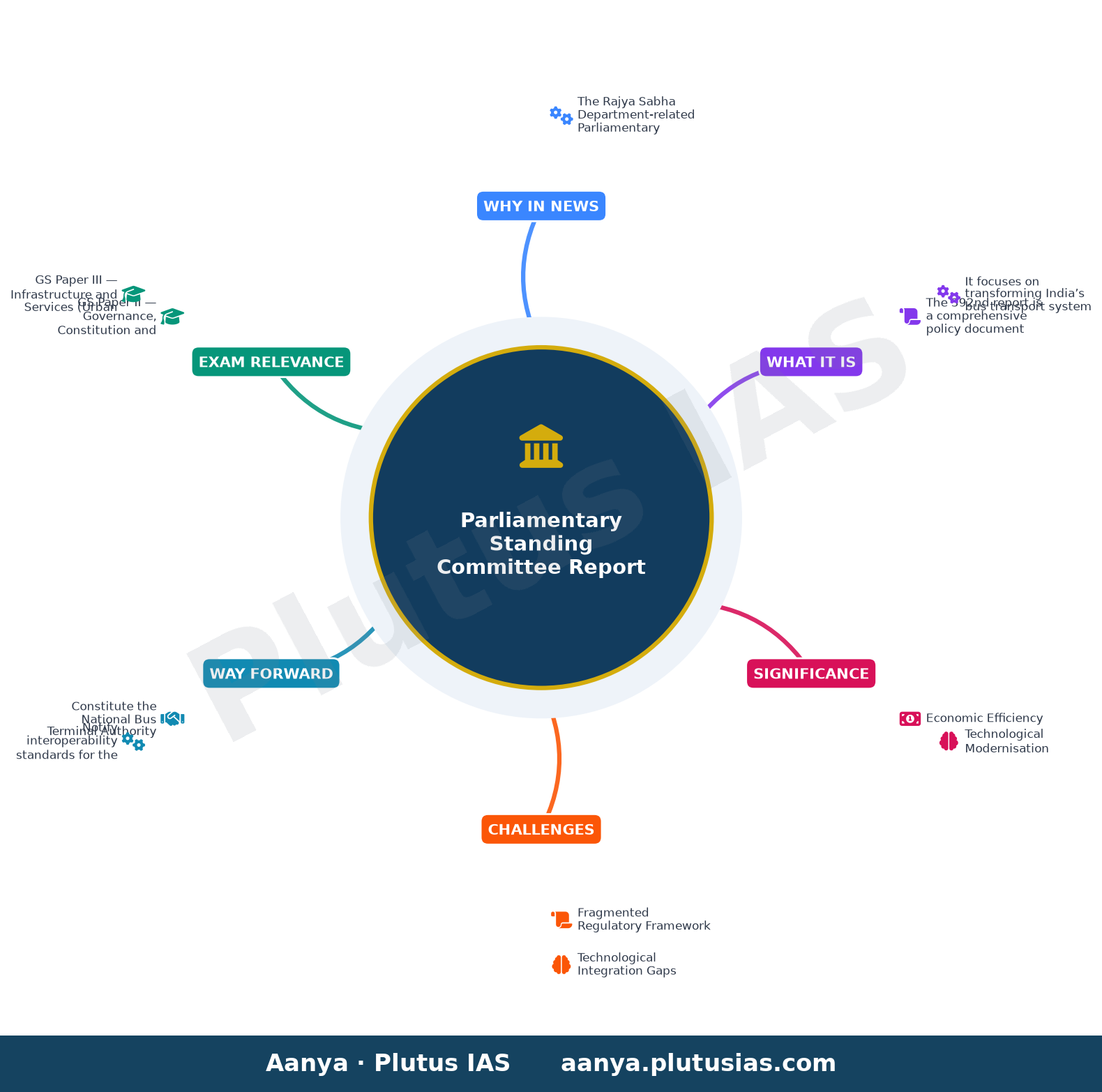
The Rajya Sabha Department-related Parliamentary Standing Committee on Transport, Tourism and Culture presented its 392nd report on 11 August 2026, titled ‘Enabling Inclusive, Digital and Sustainable Bus Transport: Policy, Regulation and Public-Private Partnership’. The report, adopted on 6 August 2026, proposes transformative recommendations to modernise India’s bus transport ecosystem through digital integration, regulatory reforms, and gender-inclusive operational practices. This aligns with the broader national agenda of sustainable mobility and digital governance.
Background
- Bus transport constitutes approximately 90% of India’s public transport, serving as the primary mode for intercity and intracity mobility, particularly for low-income groups.
- The sector faces challenges such as fragmented regulatory frameworks, inadequate digital integration, safety concerns, and environmental sustainability issues.
- Digital public infrastructure (DPI) initiatives such as FASTag, Aadhaar-enabled services, and the UMANG platform are cited as precedents for scalable solutions in transport governance.
- The report emphasises alignment with the Sustainable Development Goals (SDG 11: Sustainable Cities and Communities) and India’s climate commitments under the Paris Agreement.
What is the 392nd Report of the Parliamentary Standing Committee on Transport, Tourism and Culture?
- The 392nd report is a comprehensive policy document submitted by the Rajya Sabha’s Department-related Standing Committee on Transport, Tourism and Culture, chaired by Shri Sanjay Kumar Jha.
- It focuses on transforming India’s bus transport system into a modern, digital, inclusive, and sustainable framework through policy, regulatory, and institutional reforms.
- The report addresses five key thematic areas: (1) All-India Passenger Permits, (2) National Bus Terminal Authority, (3) National Bus Digital Grid, (4) Operator-Centric Safety, and (5) Fleet Transition Compact.
- It advocates for the separation of terminal ownership from bus operations, mirroring the model of the Airports Authority of India, to ensure non-discriminatory access and standardised infrastructure.
- The report proposes the establishment of a National Bus Digital Grid to enable real-time tracking, unified booking systems, and crowd-sourced rating mechanisms for buses and terminals.
- The report aligns with the government’s push for electric mobility by proposing a phased transition to electric buses, including scrapping incentives and end-of-life frameworks for batteries.
- It highlights the role of public-private partnerships (PPPs) in financing and operationalising bus terminals and digital infrastructure, with measurable timelines for implementation.
Key Features
| Feature | Significance |
|---|---|
| All-India Passenger Permit (AIPP) Replacement | Replaces fragmented state-specific permits with a unified, electronically monitored national permit system to enhance interstate bus operations and reduce regulatory friction. |
| National Bus Terminal Authority (NBTA) | Establishes a dedicated authority for bus terminal management, modeled on airport authorities, to ensure standardized infrastructure and non-discriminatory access across terminals. |
| National Bus Digital Grid (NBDG) | Creates a unified digital platform for real-time bus tracking, integrated booking, and crowd-sourced ratings, enabling seamless interoperability between public and private operators. |
| Operator-Centric Safety Framework | Introduces automated fitness testing, mandatory safety equipment verification, and operator safety ratings to enforce compliance with life-safety standards in bus fleets. |
| Fleet Transition Compact for Electric Buses | Facilitates phased adoption of electric buses through bulk procurement, scrap-and-lease schemes, and regional manufacturing clusters to accelerate decarbonization of public transport. |
| Women-Led Bus Services Initiative | Promotes gender-inclusive employment in bus operations, mandates CCTV in new buses, and standardizes toilet facilities in buses under the Bus Body Code. |
Why it Matters
Economic Efficiency
- Reduces transaction costs and regulatory delays by replacing state-specific permits with a unified All-India Passenger Permit, enhancing interstate mobility.
- Lowers operational inefficiencies in bus terminal management through the proposed National Bus Terminal Authority, modeled on airport authorities.
- Accelerates the transition to electric buses via bulk procurement and scrap-and-lease schemes, reducing long-term fuel and maintenance costs.
Technological Modernisation
- Establishes the National Bus Digital Grid, a real-time tracking and integrated booking platform, to improve service reliability and passenger experience.
- Implements electronic monitoring of permits, vehicle data, and insurance claims, reducing fraud and disputes.
- Introduces automated fitness testing and safety verification systems to ensure compliance with life-safety standards.
Sustainability and Decarbonisation
- Promotes the adoption of electric buses through structured procurement and regional manufacturing clusters, aligning with India’s climate commitments.
- Encourages standardized charging infrastructure tailored to operational zones, ensuring feasibility for electric bus deployment.
Social Inclusion and Gender Equity
- Launches a program for women-led bus services during peak hours, promoting gender-inclusive employment in the transport sector.
- Mandates CCTV installation in new buses and standardizes toilet facilities, enhancing safety and comfort for all passengers.
Regulatory and Institutional Reforms
- Proposes the separation of terminal ownership from bus operations, ensuring non-discriminatory access and standardized infrastructure.
- Recommends the establishment of a dedicated authority (NBTA) to oversee terminal management, modeled on airport authorities.
Challenges
1. Fragmented Regulatory Framework
- Current state-specific permit systems create regulatory barriers and inefficiencies in interstate bus operations.
- Lack of standardized terminal infrastructure leads to non-uniform service quality and access issues.
UPSC Link: GS-II: Transport policies and regulatory frameworks
2. Technological Integration Gaps
- Limited interoperability between public and private bus operators hinders seamless service delivery.
- Absence of a unified digital platform for real-time tracking and integrated booking reduces transparency and passenger trust.
UPSC Link: GS-III: Digital infrastructure and public transport
3. Safety and Compliance Challenges
- Inadequate enforcement of life-safety standards in bus fleets, particularly in older vehicles.
- Lack of automated testing stations and standardized safety verification processes.
UPSC Link: GS-II: Public health and safety regulations
4. Transition to Electric Buses
- High upfront costs and limited regional manufacturing capacity for electric buses and batteries.
- Insufficient charging infrastructure tailored to operational zones, especially in rural and remote areas.
UPSC Link: GS-III: Sustainable transport and climate action
5. Gender Inclusion in Transport Sector
- Underrepresentation of women in bus operations, particularly in driver and conductor roles.
- Safety concerns for women passengers in the absence of standardized facilities like toilets and CCTV.
UPSC Link: GS-I: Social empowerment and gender equity
Challenges — UPSC Perspective
| Issue | Concern |
|---|---|
| State-specific permits | Regulatory fragmentation and inefficiencies in interstate bus operations. |
| Non-standardized terminals | Non-uniform service quality and access issues across bus terminals. |
| Lack of digital integration | Limited interoperability and transparency in bus operations. |
| Safety compliance gaps | Inadequate enforcement of life-safety standards in bus fleets. |
| High transition costs for electric buses | Limited regional manufacturing and charging infrastructure. |
| Gender underrepresentation in transport | Underutilization of women’s workforce in bus operations. |
Way Forward
- Constitute the National Bus Terminal Authority (NBTA) within one year, modeled on airport authorities, to oversee standardized terminal infrastructure.
- Notify interoperability standards for the National Bus Digital Grid (NBDG) within one year to enable seamless integration of public and private bus operations.
- Establish automated fitness testing stations in all districts within six months to enforce life-safety standards in bus fleets.
- Launch a phased program for women-led bus services during peak hours within six months, including CCTV installation in new buses.
- Develop a time-bound plan for bulk procurement of electric buses, including regional manufacturing clusters and charging infrastructure tailored to operational zones.
- Implement an end-of-life framework for electric buses and batteries within one year to ensure sustainable disposal and recycling.
- Standardize toilet facilities in buses under the Bus Body Code and expand alert systems in 16 states to enhance passenger safety.
- Collaborate with the Insurance Regulatory and Development Authority (IRDAI) to streamline insurance claims for injured passengers.
UPSC Value Addition
Keywords for Mains Answer-Writing
Parliamentary Standing Committee on Transport, Tourism and Culture · Inclusive, Digital and Sustainable Bus Transport · All-India Passenger Permit · National Bus Terminal Authority · National Bus Digital Grid · Operator-Centric Safety · Fleet Transition Compact · Public-Private Partnership in Mobility · Electronic Toll Collection (ETC) and FASTag · Geographical Information System (GIS) for Mobility · Retrofitting of Buses for Safety · End-of-Life Framework for Electric Buses · Women-operated Bus Services · Standardisation of Bus Stops · National Code for Bus Terminals
Constitutional & Policy Linkages
- Article 246: Division of legislative powers between the Union and States in matters of transport and infrastructure (Union List, Item 23).
- Article 262: Adjudication of disputes relating to interstate rivers and transport (Parliamentary authority to regulate interstate transport).
Concept Flow
Fragmented state-specific permits → Regulatory inefficiencies in interstate bus operations → Proposal for All-India Passenger Permit (AIPP) with electronic monitoring. → Non-standardized bus terminals → Non-uniform service quality → Proposal for National Bus Terminal Authority (NBTA) modeled on airport authorities. → Limited digital integration → Lack of real-time tracking and integrated booking → Establishment of National Bus Digital Grid (NBDG). → Inadequate safety enforcement → High risk in bus fleets → Automated fitness testing and operator safety ratings. → High transition costs for electric buses → Slow decarbonization → Fleet Transition Compact with bulk procurement and scrap-and-lease schemes. → Underrepresentation of women in transport → Gender inequity → Women-led bus services initiative with CCTV and standardized facilities.
Prelims Practice Questions
Q1. Consider the following statements regarding the recommendations of the 392nd Report of the Parliamentary Standing Committee on Transport, Tourism and Culture:
1. The Committee recommends replacing the All-India Tourist Permit with an All-India Passenger Permit issued by the state of first registration.
2. The Committee proposes the establishment of a dedicated National Bus Terminal Authority modelled on the Airport Authority of India.
3. The Committee advocates for the mandatory installation of CCTV in all buses within six months.
How many of the above statements are correct?
- Only one
- Only two
- All three
- None
Answer: All three — Statement 1 and 2 are correct as per the report. Statement 3 is incorrect; the report mandates CCTV installation in new buses, not all buses.
Q2. Assertion (A): The 392nd Report recommends the creation of a National Bus Digital Grid to integrate public and private bus operators through interoperable standards.
Reason (R): The report emphasises the need for a GIS-based network atlas to track bus and terminal conditions in real-time.
- Both A and R are true, and R is the correct explanation of A
- Both A and R are true, but R is not the correct explanation of A
- A is true, but R is false
- A is false, but R is true
Answer: Both A and R are true, but R is not the correct explanation of A — Both the assertion and reason are correct, and the reason correctly explains the assertion as the National Bus Digital Grid is designed to integrate operators and enable real-time tracking via GIS.
Mains Practice Question
✍ The Parliamentary Standing Committee on Transport, Tourism and Culture, in its 392nd Report, advocates for a paradigm shift towards ‘inclusive, digital and sustainable bus transport’ in India. Critically examine the key recommendations of the report, with particular reference to their feasibility, potential impact on public mobility, and alignment with constitutional provisions governing inter-state coordination. (15 Marks)
Approach: MODEL-ANSWER SKELETON:
1. **Introduction (2 Marks)**
– Context: Rising urbanisation, demand for affordable mobility, and environmental sustainability.
– Constitutional basis: Article 246 (7th Schedule, Concurrent List, Entry 20: ‘Economic and Social Planning’) and Article 256 (duty of states to ensure compliance with laws).
2. **Key Recommendations and Analysis (8 Marks)**
– **All-India Passenger Permit (1.5 Marks)**: Replace tourist permit; digital tracking via FASTag and vehicle location data; eliminate border checkpoints in six states.
– *Feasibility*: Requires inter-state coordination under Article 256 and cooperation with IRDAI for seamless insurance claims.
– **National Bus Terminal Authority (1.5 Marks)**: Modelled on Airport Authority of India; national code for terminals within one year.
– *Impact*: Standardisation of infrastructure; potential reduction in congestion and delays.
– **National Bus Digital Grid (2 Marks)**: Interoperable booking systems; GIS-based real-time tracking; crowd-sourced rating system.
– *Alignment*: Leverages Digital India initiatives (e.g., UMANG, MyGov) and Article 300A (right to livelihood).
– **Operator-Centric Safety (1.5 Marks)**: Mandatory retrofitting of sleeper/school buses; emergency warning systems within one year.
– *Constitutional angle*: Directive Principles (Article 39(e)) and Fundamental Duties (Article 51A(g)).
– **Fleet Transition Compact (1.5 Marks)**: Scrap-and-lease model for electric buses; end-of-life framework.
– *Sustainability*: Aligns with Faster Adoption and Manufacturing of Hybrid and Electric Vehicles (FAME) Scheme.
3. **Challenges and Critique (3 Marks)**
– **Inter-State Coordination**: Requires consensus among states for permit harmonisation (e.g., Article 263 Inter-State Council).
– **Digital Divide**: Rural areas may lack infrastructure for real-time tracking and digital permits.
– **Cost Implications**: High initial investment for terminals, digital grid, and retrofitting; potential burden on state exchequers.
– **Equity Concerns**: Focus on urban mobility may marginalise rural connectivity.
4. **Conclusion (2 Marks)**
– The recommendations represent a forward-looking, technology-driven approach to bus transport.
– Success hinges on multi-stakeholder collaboration (Centre, states, private sector) and alignment with existing schemes (e.g., PM-eBus Sewa).
– Recommendation: Pilot projects in model states (e.g., Gurugram, Katra) before nationwide rollout.
Source: PIB (Press Information Bureau)
Generated by AanyaAi for educational purpose.

- यूएस-चीन एआई हॉटलाइन: क्यों शी जिनपिंग-ट्रम्प शिखर वार्ता में टैरिफ से आगे बढ़ा ‘सुपर इंटेलिजेंस’ का मुद्दा - September 26, 2026
- US-China AI Hotline: Xi-Trump Summit’s Game-Changing AI Dialogue Explained - September 26, 2026
- आईसीएआर द्वारा स्वच्छता अभियान: गणेश विसर्जन से पर्यावरण संरक्षण तक - September 26, 2026

No Comments