


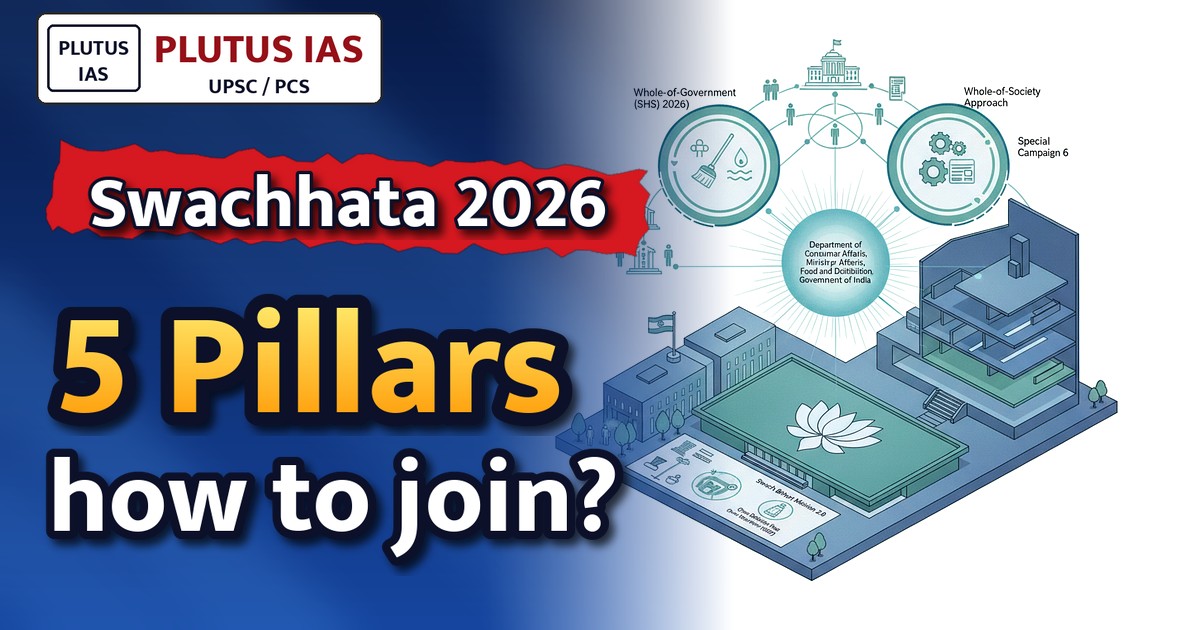
29 Sep UPSC Focus: Swachhata Hi Seva 2026 & Special Campaign 6 for Governance Reforms
✎ Swachhata Hi Seva 2026 and Special Campaign 6 are twin initiatives promoting cleanliness through citizen participation, administrative reforms, and compliance with the Solid Waste Management Rules, 2026.
Subject Relevance — Where This Topic Fits
- GS Paper II — Governance, Transparency and Accountability | GS Paper III — Environment and Pollution Control | GS Paper IV — Ethics in Public Governance
- Prelims: Swachh Bharat Mission 2.0, Solid Waste Management Rules 2026, Safai Mitras, Source Segregation, Circular Economy, Special Campaign for Disposal of Pending Matters
- Essay: Cleanliness as a Public Good: Bridging Individual Responsibility and State Action, Administrative Reforms and Citizen Participation in Governance
Quick Revision: Swachhata Hi Seva 2026 and Special Campaign 6 are twin initiatives promoting cleanliness through citizen participation, administrative reforms, and compliance with the Solid Waste Management Rules, 2026.
Why is this in the news?
The Department of Consumer Affairs, Ministry of Consumer Affairs, Food and Public Distribution, Government of India, is actively participating in ‘Swachhata Hi Seva (SHS) 2026’ and Special Campaign 6, two nationwide initiatives aimed at institutionalising cleanliness, reducing pending administrative matters, and fostering public participation in sanitation. These campaigns, launched on 17 September 2026 and 2 October 2026 respectively, align with the broader objectives of ‘Swachh Bharat Mission 2.0’ and administrative reform agendas, emphasising a ‘Whole-of-Government’ and ‘Whole-of-Society’ approach.
Background
- The Swachh Bharat Mission (SBM), launched in 2014, was a transformative programme aimed at achieving universal sanitation and cleanliness, culminating in the declaration of Open Defecation Free (ODF) India in 2019.
- Post-2019, SBM 2.0 was launched with a focus on sustaining ODF status, ensuring solid and liquid waste management, and promoting behaviour change towards cleanliness.
- Special Campaigns for disposal of pending matters were initiated by the Department of Administrative Reforms and Public Grievances (DARPG) in 2021 to expedite the resolution of long-pending government files and public grievances.
- The ‘Swachhata Hi Seva’ campaign, first launched in 2017, is an annual mass mobilisation initiative to promote cleanliness through voluntary participation, awareness drives, and institutional reforms.
- The 2026 edition of SHS and Special Campaign 6 are being conducted under the thematic slogan ‘Swachhata Mein Sahbhag; Swachh Bharat, Vikasit Bharat’, reinforcing the link between cleanliness, development, and citizen engagement.
What are Swachhata Hi Seva 2026 and Special Campaign 6?
- Swachhata Hi Seva (SHS) 2026 is a nation-wide cleanliness campaign organised annually by the Government of India, with the 2026 edition running from 17 September to 2 October 2026 under the Ministry of Housing and Urban Affairs and the Department of Drinking Water and Sanitation.
- The campaign adopts a ‘Whole-of-Government’ and ‘Whole-of-Society’ approach, engaging central ministries, state governments, local bodies, civil society, and citizens in cleanliness drives, awareness programmes, and institutional reforms.
- SHS 2026 is structured around five thematic pillars: (1) Transformation of Cleanliness Target Units (CTUs) to eliminate neglected and dark spots; (2) ‘Swachh Pathshala’ to involve students and youth in solid waste management, rainwater harvesting, and sanitation dialogues; (3) ‘Safai Mitra Safety and Dignity Camps’ to provide health check-ups, PPE, and welfare linkages to sanitation workers; (4) Citizen participation in source segregation, recycling, and waste-to-wealth initiatives; and (5) स्वच्छता से समृद्धि: चक्रीय अर्थव्यवस्था, अपशिष्ट से धन और अपशिष्ट से कला की पहलों पर ध्यान केंद्रित करना।
- Special Campaign 6, organised by the Department of Administrative Reforms and Public Grievances (DARPG), runs from 2 October to 31 October 2026 in two phases: preparation (15 September–1 October 2026) and implementation (2–31 October 2026). It focuses on reducing pendency in government offices, resolving public grievances, and disposing of scrap and waste in compliance with environmental guidelines.
- The Department of Consumer Affairs is actively participating in both campaigns by conducting cleanliness drives in its offices and subordinate organisations, organising ‘Safai Mitra’ camps, promoting source segregation, and ensuring compliance with waste management rules.
- Key activities under Special Campaign 6 include identification and disposal of long-pending files, review of public grievances, scrap disposal, record management, and e-waste handling in accordance with the Ministry of Environment, Forest and Climate Change guidelines.
- The campaigns are supported by institutions such as the Bureau of Indian Standards (BIS), National Test House (NTH), National Cooperative Consumers’ Federation of India (NCCF), National Consumer Disputes Redressal Commission (NCDRC), and regional reference standard laboratories to ensure standardisation and effective implementation.
Key Features
| Feature | Significance |
|---|---|
| Swachhata Hi Seva 2026 (SHS 2026) | A nation-wide mass mobilization campaign for cleanliness, sanitation, and waste management, aligning with the ‘Swachh Bharat Mission’ and promoting ‘Whole of Government’ and ‘Whole of Society’ approaches. |
| Special Campaign 6 (SC-6) | An administrative reform initiative to reduce pendency of public grievances and appeals in government offices, ensuring timely disposal of cases and improving governance efficiency. |
| Swachh Patshala-Swachhata ke Liye Yuva | Engagement of students and youth through cleanliness knowledge campaigns, solid waste management facilities, and dialogues on sanitation and water conservation. |
| Safai Mitra Safety & Samman Shivir | Safety camps for sanitation workers providing health check-ups, PPE, welfare linkages, and recognition to enhance dignity and safety in sanitation services. |
| Circular Economy Initiatives | Promotion of waste-to-wealth and waste-to-art projects to foster sustainable consumption and production patterns under the SHS 2026 framework. |
Why it Matters
Governance & Public Administration
- Demonstrates the Union Government’s commitment to participatory governance through citizen-led cleanliness drives and institutional reforms.
- Highlights the role of administrative reforms in reducing pendency and improving service delivery in government offices.
- Showcases the integration of ‘Swachh Bharat Mission’ principles into sectoral governance mechanisms.
Environmental Sustainability
- Promotes source segregation, recycling, and circular economy models to mitigate environmental degradation from solid waste.
- Encourages water conservation and rainwater harvesting as part of sanitation awareness campaigns.
- Aligns with India’s commitments under global environmental agreements (e.g., SDGs, Paris Agreement) on waste management.
Social Inclusion & Welfare
- Prioritizes the safety, dignity, and welfare of sanitation workers (Safai Mitras) through health and safety interventions.
- Leverages youth and educational institutions as agents of behavioral change in sanitation practices.
- Strengthens linkages between sanitation workers and existing welfare schemes to ensure social security.
Institutional Coordination
- Fosters multi-stakeholder collaboration among ministries (e.g., MoHUA, Jal Shakti), departments, and autonomous bodies for unified action.
- Demonstrates the ‘Whole of Government’ approach by involving PMO, DARPG, and other agencies in campaign implementation.
- Ensures compliance with environmental guidelines (e.g., E-waste management) across government offices.
Challenges
1. Behavioral Change Resistance
- Overcoming deep-rooted societal habits in waste disposal and sanitation practices requires sustained behavioral interventions.
- Need for continuous awareness campaigns to maintain momentum beyond the campaign period.
UPSC Link: GS-2: Social Empowerment
2. Institutional Pendency & Efficiency
- Reducing backlog of grievances and appeals in government offices demands systemic reforms and digitalization of records.
- Ensuring timely disposal of cases requires robust monitoring and accountability mechanisms.
UPSC Link: GS-2: Governance
3. Safety & Welfare of Sanitation Workers
- Addressing occupational hazards and ensuring social security for sanitation workers remains a persistent challenge.
- Need for comprehensive data on sanitation workforce to design targeted welfare schemes.
UPSC Link: GS-1: Social Issues
4. Circular Economy Transition
- Scaling up waste-to-wealth initiatives requires investment in recycling infrastructure and market linkages.
- Regulatory frameworks for extended producer responsibility (EPR) need strengthening to drive circularity.
UPSC Link: GS-3: Environment & Economy
5. Multi-Stakeholder Coordination
- Ensuring seamless collaboration among central ministries, state governments, and local bodies is complex.
- Need for standardized protocols for waste management across diverse geographies and administrative units.
UPSC Link: GS-2: Federalism
Challenges — UPSC Perspective
| Issue | Concern |
|---|---|
| Low Public Participation | Sustaining citizen engagement in cleanliness drives beyond symbolic events. |
| Data Deficiencies | Lack of real-time data on waste generation, disposal, and recycling for evidence-based policymaking. |
| Infrastructure Gaps | Inadequate waste processing facilities in rural and peri-urban areas. |
| Policy Fragmentation | Overlapping mandates among agencies (e.g., MoHUA, CPCB, State Pollution Control Boards) leading to implementation gaps. |
| Financial Constraints | Limited budgetary allocations for sanitation and waste management in local bodies. |
Government Initiatives — Must-Memorise for Prelims
- Swachh Bharat Mission (SBM) 2.0
Way Forward
- Strengthen inter-ministerial coordination through dedicated task forces for waste management and sanitation.
- Scale up digital platforms for real-time monitoring of waste collection, segregation, and disposal.
- Expand Safai Mitra safety and welfare programs with mandatory health insurance and skill development.
- Integrate circular economy principles into procurement policies of government departments.
- Launch localized awareness campaigns in regional languages to enhance community participation.
- Establish a national repository of best practices in waste management for replication across states.
- Enhance funding for rural sanitation infrastructure under SBM 2.0 and convergence with MGNREGS.
- Conduct periodic audits of government offices to ensure compliance with cleanliness and e-waste disposal norms.
UPSC Value Addition
Keywords for Mains Answer-Writing
Swachhata Hi Seva 2026 · Swachh Bharat Mission · Special Campaign 6 · solid waste management · source segregation · Safai Mitra Safety and Dignity Camps · Circular economy · Swachhata Pakhwada · Mahatma Gandhi’s legacy · Jan Bhagidari · Sampoorn Sarkar-Sampoorn Samaj approach · Swachh Bharat Diwas · DARPG · consumer protection · waste-to-wealth initiatives · Rainwater harvesting · Extended Producer Responsibility (EPR) · Swachh Vidyalaya Abhiyan
Concept Flow
Government-led cleanliness campaigns (SHS 2026) → Mass mobilization and behavioral change → Improved sanitation and waste management → Environmental sustainability and public health benefits. → Administrative reforms (Special Campaign 6) → Reduction in pendency of grievances → Enhanced governance efficiency → Improved public trust in institutions. → Youth and educational engagement (Swachh Patshala) → Long-term cultural shift in sanitation practices → Sustainable development outcomes. → Safety and welfare of sanitation workers → Dignified livelihoods and reduced occupational hazards → Social inclusion and equity. → Circular economy initiatives → Waste-to-wealth projects → Resource efficiency and climate resilience. → Multi-stakeholder coordination (Whole of Government) → Unified policy implementation → Scalable and replicable models.
Prelims Practice Questions
Q1. Consider the following statements about ‘Swachhata Hi Seva 2026’:
1. It is a pan-India campaign launched by the Ministry of Consumer Affairs, Food and Public Distribution.
2. The campaign is structured around five thematic pillars, including ‘Swachhata ke liye Jan Bhagidari’ and ‘Safai Mitra Suraksha evam Samman’.
3. The campaign culminates on 2nd October, coinciding with Swachh Bharat Diwas.
4. It mandates the establishment of a new statutory body for solid waste management under the Environment Protection Act, 1986.
How many of the above statements are correct?
- Only one
- Only two
- Only three
- All four
Answer: Only three — Statements 1, 2, and 3 are correct as per the PIB release. Statement 4 is incorrect because the campaign does not establish a new statutory body; it operates within existing legal frameworks such as the Solid Waste Management Rules, 2026.
Q2. Assertion (A): The ‘Sampoorn Sarkar-Sampoorn Samaj’ approach in Swachhata Hi Seva 2026 emphasizes a whole-of-government and whole-of-society model for sanitation.
Reason (R): This approach is mandated by the Constitution of India under Article 47, which directs the State to improve public health and sanitation.
In the context of the above two statements, which one of the following is correct?
- Both A and R are true, and R is the correct explanation of A.
- Both A and R are true, but R is NOT the correct explanation of A.
- A is true, but R is false.
- A is false, but R is true.
Answer: Both A and R are true, but R is NOT the correct explanation of A. — Both the assertion and reason are correct. The ‘Sampoorn Sarkar-Sampoorn Samaj’ model aligns with the constitutional directive under Article 47, which enjoins the State to endeavour to improve public health and sanitation.
Q3. Match the following initiatives under Swachhata Hi Seva 2026 with their respective thematic pillars:
Column I (Initiative) Column II (Pillar)
A. Swachh Vidyalaya Abhiyan 1. Swachhata ke liye Jan Bhagidari
B. Safai Mitra Suraksha evam Samman 2. Swachhata se Samriddhi
C. Waste-to-Wealth initiatives 3. Swachh Prakshal
D. Source segregation awareness campaigns 4. Swachh Pathanshala-Swachhta ke liye Yuva
Choose the correct match:
- A-4, B-3, C-2, D-1
- A-1, B-3, C-2, D-4
- A-4, B-1, C-2, D-3
- A-2, B-4, C-1, D-3
Answer: A-4, B-3, C-2, D-1 — A-4 (Swachh Vidyalaya Abhiyan aligns with ‘Swachh Pathanshala-Swachhta ke liye Yuva’), B-3 (Safai Mitra Suraksha evam Samman aligns with ‘Swachh Prakshal’), C-2 (Waste-to-Wealth initiatives align with ‘Swachhata se Samriddhi’), D-1 (Source segregation aligns with ‘Swachhata ke liye Jan Bhagidari’).
Mains Practice Question
✍ ‘Swachhata Hi Seva 2026’ represents a multi-dimensional, citizen-centric approach to sanitation and waste management in India. Critically examine its five thematic pillars and evaluate how the ‘Sampoorn Sarkar-Sampoorn Samaj’ framework operationalises this campaign. Also, analyse the constitutional and statutory foundations that underpin these initiatives. (15 Marks)
Approach: MODEL-ANSWER SKELETON:
1. Introduction (1 mark)
– Brief context: Swachh Bharat Mission’s evolution and the launch of Swachhata Hi Seva 2026.
– Objective: To achieve universal sanitation and sustainable waste management by 2026.
2. Five Thematic Pillars (5 marks)
a. Swachhata Lakshya Units (SLUs) Transformation: Focus on neglected, dark, and inaccessible sites; cite examples of urban slums or railway stations.
b. Swachh Pathanshala-Swachhta ke liye Yuva: Integration of sanitation education in schools; link to National Education Policy 2020 and Sustainable Development Goal 4 (Quality Education).
c. Safai Mitra Suraksha evam Samman: Safety protocols for sanitation workers; reference to Prohibition of Employment as Manual Scavengers and their Rehabilitation Act, 2013, and Safai Mitra Suraksha Challenge.
d. Swachhata ke liye Jan Bhagidari: Citizen participation in source segregation; cite Solid Waste Management Rules, 2016 (amended 2022) and Extended Producer Responsibility (EPR) framework.
e. Swachhata se Samriddhi: Circular economy models; reference to Waste to Wealth initiatives, ‘RRR Recyclers Meets’, and ‘One Tree Maa ke Naam’ campaign.
3. Sampoorn Sarkar-Sampoorn Samaj Framework (4 marks)
– Whole-of-Government: Inter-ministerial coordination (e.g., MoHUA, MoDWS, MoEFCC) and institutional mechanisms like the National Council for Sustainable Development.
– Whole-of-Society: Role of NGOs, private sector (e.g., Swachhata Hi Seva corporate partnerships), and community-based organisations (e.g., Self-Help Groups in rural areas).
– Legal and Policy Instruments: Reference to Article 47 (DPSP), 7th Schedule (State List on sanitation), and National Urban Sanitation Policy 2008.
4. Constitutional and Statutory Foundations (3 marks)
– Directive Principles of State Policy (Article 39(e), 47): Emphasis on public health and sanitation.
– Fundamental Duties (Article 51A(g)): Citizen’s duty to protect and improve the natural environment.
– Statutory Frameworks: Solid Waste Management Rules, 2016 (amended 2022), Plastic Waste Management Rules, 2022, and Prohibition of Employment as Manual Scavengers and their Rehabilitation Act, 2013.
– Judicial Precedents: Reference to Supreme Court judgments on sanitation workers’ rights (e.g., Safai Karamchari Andolan v. Union of India, 2014) and right to clean environment (Subhash Kumar v. State of Bihar, 1991).
5. Challenges and Way Forward (2 marks)
– Implementation gaps: Urban-rural divide, lack of infrastructure in peri-urban areas, and behavioural resistance to source segregation.
– Innovative solutions: Use of technology (AI for waste segregation), behaviour change communication (Swachh Bharat Mission’s ‘Darwaza Band’ campaign), and convergence with MGNREGA for rural sanitation.
Conclusion (1 mark)
– Reiterate the significance of citizen-state synergy in achieving sanitation goals.
– Emphasise the role of Swachhata Hi Seva 2026 as a model for participatory governance in public health and environmental sustainability.
Source: PIB (Press Information Bureau)
Generated by AanyaAi for educational purpose.
Related guides on our sites
- Current affairs for upsc 2026
- Best PSIR optional coaching for upsc
- Best PSIR optional teacher for upsc
- Best teacher of PSIR optional for upsc

- UPSC Focus: Swachhata Hi Seva 2026 & Special Campaign 6 for Governance Reforms - September 29, 2026
- NSDA conducts emergency plan review for Lonavala & Bhushi dams - September 29, 2026
- एचएएल बाहर, 5वीं पीढ़ी के लड़ाकू विमान परियोजना में निजी क्षेत्र का प्रवेश - September 29, 2026

No Comments