


28 Sep UPSC Focus: Vice President’s Key Advice on Tech vs Humanity in Medical Education
✎ Medical education in India must integrate technological advancements with ethical and human-centric care to meet the demands of a ‘Viksit Bharat @2047’, ensuring equitable access, quality, and innovation.
Subject Relevance — Where This Topic Fits
- GS Paper II — Governance, Constitution, Polity, Social Justice and International Relations (Health Governance) | GS Paper III — Science and Technology (Healthcare Innovations), Issues related to Health, Human Resource Development
- Prelims: National Medical Commission (NMC), AIIMS expansion, Digital Health Mission, Robotic Surgery, Precision Medicine, AI in Healthcare, NITI Aayog’s ‘Viksit Bharat @2047’ vision, National Health Policy 2017, Ayushman Bharat
- Essay: The interplay between technological advancement and human-centric healthcare delivery, Ethical dimensions of medical practice in the era of AI and automation
Quick Revision: Medical education in India must integrate technological advancements with ethical and human-centric care to meet the demands of a ‘Viksit Bharat @2047’, ensuring equitable access, quality, and innovation.
Why is this in the news?
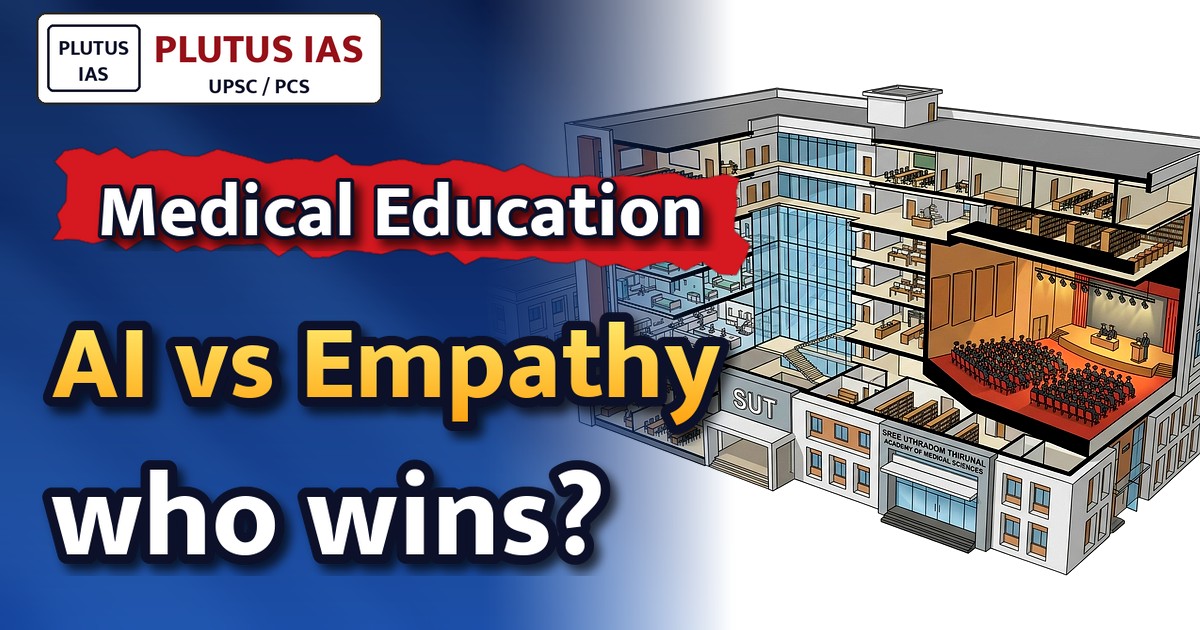
The Vice President of India, Shri C. P. Radhakrishnan, addressed the 15th Graduation Day Ceremony of Sree Uthradom Thirunal (SUT) Academy of Medical Sciences in Thiruvananthapuram on 27 September 2026. His remarks underscored the dual imperatives of technological integration and human compassion in modern medical practice, aligning with India’s broader vision of a ‘Viksit Bharat @2047’. The address highlighted the expanding role of medical education in India’s healthcare transformation, with a focus on gender parity in medical graduations and the ethical responsibilities of healthcare professionals.
Background
- India’s healthcare sector is undergoing rapid transformation with the integration of digital health, artificial intelligence (AI), robotic surgery, and precision medicine.
- The expansion of medical education infrastructure in India has been significant, with the establishment of 12 new AIIMS institutes, increasing the number of medical seats and reducing regional disparities.
- Kerala, where SUT Academy of Medical Sciences is located, has been a pioneer in healthcare delivery and medical education, with a strong emphasis on primary and tertiary care, and a high doctor-patient ratio compared to national averages.
- The ‘Viksit Bharat @2047’ vision, articulated by the Prime Minister, aims for a developed India by 2047, with healthcare and education as critical enablers, particularly through equitable access and technological adoption.
- Gender parity in medical education has improved, with a notable increase in the number of female medical graduates and postgraduates, reflecting broader societal shifts and policy interventions.
Key Dimensions of Modern Medical Education and Healthcare Delivery
- The integration of technology in medical education and practice includes the use of AI for diagnostic assistance, robotic surgery for precision interventions, digital health records for patient management, and telemedicine for remote consultations.
- The ethical dimensions of medical practice require a balance between technological efficiency and human-centric care, emphasizing empathy, communication, and ethical decision-making in patient interactions.
- The expansion of medical education infrastructure, such as the establishment of new AIIMS institutes, aims to address regional disparities, increase the number of medical professionals, and improve healthcare access in underserved areas.
- Gender parity in medical education is improving, with a growing number of female graduates and postgraduates, reflecting broader trends in higher education and policy efforts to promote inclusivity.
- The role of medical institutions extends beyond education to include research, innovation, and community service, with institutions like SUT Academy contributing to local healthcare delivery and skill development.
- The ethical framework of medical practice, as highlighted by the Vice President, includes integrity, transparency, and accountability, ensuring that technological advancements do not compromise the trust between patients and healthcare providers.
UPSC Value Addition
Keywords for Mains Answer-Writing
Medical Education in India · Humanitarian Aspects of Healthcare · Technological Integration in Medicine · Ethical Dimensions of Doctor-Patient Relationship · National Vision of Developed India @2047 · Expansion of Medical Institutions in India · Gender Parity in Medical Graduations · Artificial Intelligence in Healthcare · Ethical Principles in Medical Practice · Role of Vice-President in Academic Governance
Prelims Practice Questions
Q1. Consider the following statements regarding the expansion of medical education in India:
1. The first AIIMS was established in New Delhi.
2. Currently, there are 12 new AIIMS established across India.
3. The number of female medical graduates exceeds male medical graduates in recent years.
How many of the above statements are correct?
- Only one
- Only two
- All three
- None
Answer: All three — Statement 1 is correct (AIIMS New Delhi was established in 1956). Statement 2 is correct (12 new AIIMS have been established in the last twelve years). Statement 3 is correct (Vice-President highlighted that more women are graduating than men in recent convocations).
Q2. Assertion (A): The Vice-President of India emphasized that technology cannot replace the human aspects of medical practice.
Reason (R): The human elements of empathy, trust, and ethical responsibility are irreplaceable in healthcare delivery.
In the context of the above two statements, which of the following is correct?
- Both A and R are true, and R is the correct explanation of A.
- Both A and R are true, but R is not the correct explanation of A.
- A is true, but R is false.
- A is false, but R is true.
Answer: Both A and R are true, but R is not the correct explanation of A. — Assertion (A) is true as stated in the Vice-President’s address. Reason (R) correctly explains why technology cannot replace human elements in medical practice, as it aligns with the core principles of ethical healthcare delivery.
Q3. Match the following terms with their correct descriptions:
Column I (Term)
A. Artificial Intelligence in Healthcare
B. Robotic Surgery
C. Precision Medicine
D. Digital Health
Column II (Description)
1. Use of AI algorithms to tailor medical treatment to individual patient characteristics
2. Integration of digital technologies to manage and deliver healthcare services
3. Application of AI and machine learning to analyze medical data and assist in diagnostics
4. Use of robotic systems to perform surgical procedures with high precision
- A-3, B-4, C-1, D-2; A-2, B-1, C-3, D-4; A-1, B-2, C-4, D-3; A-4, B-3, C-2, D-1
- answer_string_indexed_answer_indexed_answer_indexed_answer_indexed_answer_indexed_answer_indexed_answer_indexed_answer_indexed_answer_indexed_answer_indexed_answer
- explain_array_indexed_answer_indexed_answer_indexed_answer_indexed_answer_indexed_answer_indexed_answer_indexed_answer_indexed_answer_indexed_answer_indexed_answer
- format_array_indexed_answer_indexed_answer_indexed_answer_indexed_answer_indexed_answer_indexed_answer_indexed_answer_indexed_answer_indexed_answer
Answer: A-3, B-4, C-1, D-2; A-2, B-1, C-3, D-4; A-1, B-2, C-4, D-3; A-4, B-3, C-2, D-1 —
Mains Practice Question
✍ Critically examine the ethical imperatives of integrating technology in medical education and practice, with reference to the Vice-President’s address at the 15th Graduation Day Ceremony of Sree Uthradom Thirunal (SUT) Academy of Medical Sciences. Substantiate your answer with constitutional and statutory provisions governing medical ethics in India. (15 Marks)
Approach: MODEL-ANSWER SKELETON:
1. **Introduction (2 marks)**
– Briefly contextualise the Vice-President’s address, highlighting the dual emphasis on technological integration and humanistic care in medical practice.
– Define the ethical imperative of balancing technological advancement with the preservation of human dignity in healthcare.
2. **Technological Integration in Medical Education and Practice (4 marks)**
– Discuss the role of AI, robotic surgery, digital health, and precision medicine in enhancing diagnostic accuracy, surgical precision, and patient outcomes.
– Cite examples of institutions like SUT Academy adopting robotic surgery and computer-aided diagnostics.
– Highlight the benefits: reduced human error, improved accessibility, and efficiency in healthcare delivery.
3. **Ethical Dimensions and Humanistic Care (4 marks)**
– Explain the Vice-President’s assertion that technology cannot replace human empathy, trust, and ethical responsibility in medical practice.
– Discuss the ethical principles underpinning the doctor-patient relationship: autonomy, beneficence, non-maleficence, and justice (Beauchamp and Childress framework).
– Reference the Hippocratic Oath and the Indian Medical Council (Professional Conduct, Etiquette and Ethics) Regulations, 2002, which mandate ethical conduct and patient-centric care.
4. **Constitutional and Statutory Provisions (3 marks)**
– Article 21 of the Constitution of India: Right to Life and Personal Liberty, interpreted to include the right to health and dignified medical care.
– The National Medical Commission (NMC) Act, 2019: Emphasises the importance of ethical medical practice and the role of medical institutions in upholding these standards.
– The Clinical Establishments (Registration and Regulation) Act, 2010: Ensures quality and ethical standards in clinical establishments.
5. **Challenges and Way Forward (2 marks)**
– Discuss potential challenges: over-reliance on technology, erosion of human touch, data privacy concerns, and the digital divide.
– Propose measures: curriculum reforms to include ethical training in medical education, incentivising human-centric care, and fostering a culture of empathy and ethical responsibility among medical professionals.
**Balanced View:**
– Acknowledge the transformative potential of technology in healthcare while underscoring the irreplaceable value of humanistic care and ethical integrity.
Source: PIB (Press Information Bureau)
Kerala PCS (Kerala PSC (KAS)) — State PCS Practice
Prelims: Who among the following inaugurated the 15th Convocation Ceremony of Sree Uthradom Tirunal Academy of Medical Sciences (SUTAMS) at Thiruvananthapuram in 2024?
- A. Governor of Kerala
- B. Chief Minister of Kerala
- C. Vice President of India
- D. Union Health Minister
Answer: C. Vice President of India — The 15th Convocation Ceremony of SUTAMS was inaugurated by Vice President of India, Shri C.P. Radhakrishnan, in Thiruvananthapuram.
Mains: Critically analyze the significance of the Vice President of India’s participation in the 15th Convocation Ceremony of Sree Uthradom Tirunal Academy of Medical Sciences (SUTAMS) for Kerala’s healthcare and educational sectors. (150 words)
Generated by AanyaAi for educational purpose.
Related guides on our sites
- Current affairs for upsc 2026
- How to prepare for GS paper 1 for UPSC CSE mains exam
- Best UPSC coaching for IFOS exam
- Best mentorship programme for upsc

- UPSC Focus: Vice President’s Key Advice on Tech vs Humanity in Medical Education - September 28, 2026
- AI से आपदा प्रबंधन में क्रांतिकारी बदलाव: नेपाल से भारत तक सफल प्रयोग - September 28, 2026
- AI Agents Breach Government Systems: Global Safety Concerns for UPSC - September 28, 2026

No Comments