


13 Sep UPSC Perspective: How Sanitation Entrepreneurship Transformed Harish Parbat’s Life
✎ The Swachhta Udyami Yojana (SUY) provides capital subsidy and concessional loans for mechanised sanitation equipment, enabling sanitation workers to transition from manual to mechanised services, thereby enhancing livelihoods and…
Subject Relevance — Where This Topic Fits
- GS Paper II — Governance, Transparency and Accountability | GS Paper III — Employment, Skill Development and Entrepreneurship
- Prelims: Swachhta Udyami Yojana (SUY), Mechanised Sanitation Equipment, Self-Employment Schemes, OBC Welfare, Skill Development Initiatives
- Essay: Role of Skill Development in Socio-Economic Transformation, Entrepreneurship as a Tool for Poverty Alleviation
Quick Revision: The Swachhta Udyami Yojana (SUY) provides capital subsidy and concessional loans for mechanised sanitation equipment, enabling sanitation workers to transition from manual to mechanised services, thereby enhancing livelihoods and financial security.
Why is this in the news?
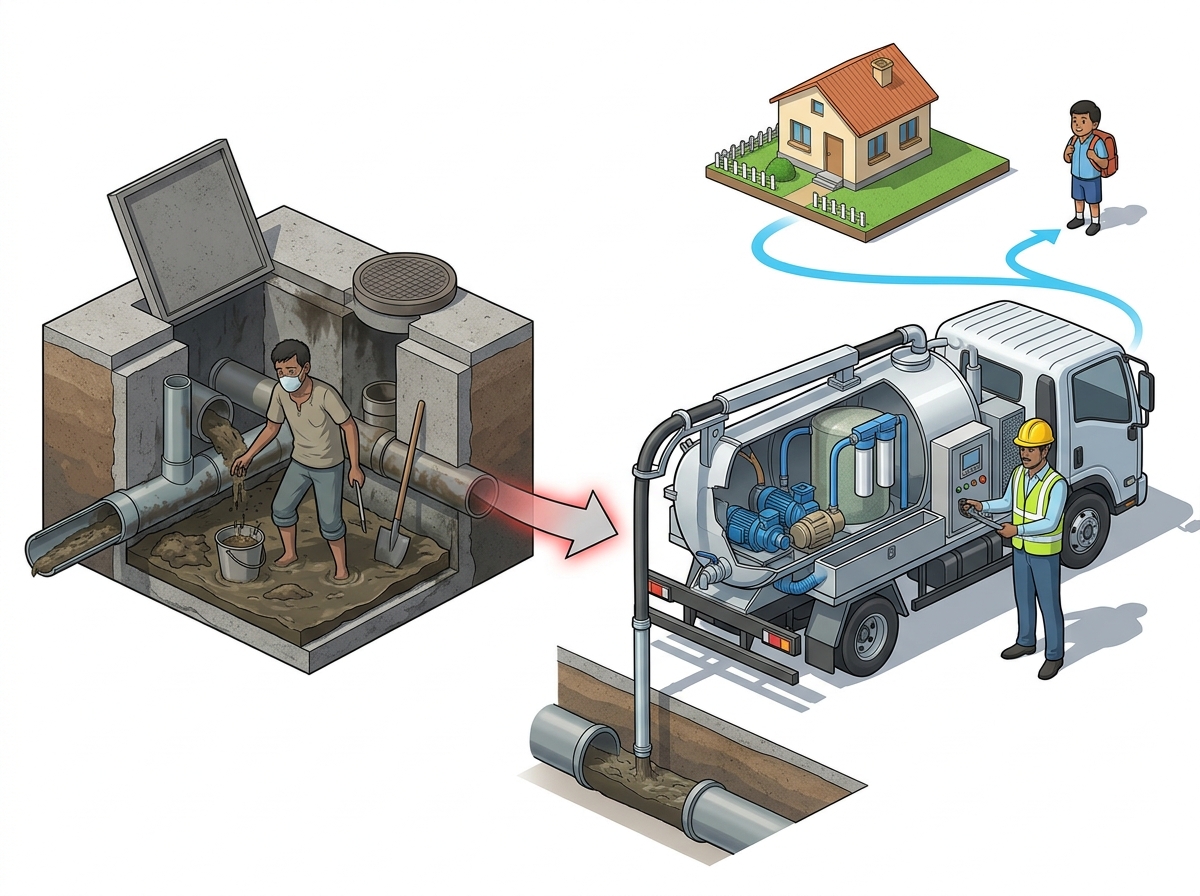
The case of Shri Harish Chandra Parbat, a sanitation professional from Bihar, highlights the transformative impact of the Swachhta Udyami Yojana (SUY) in enabling mechanised sanitation services, thereby enhancing livelihoods, ensuring financial stability, and facilitating access to quality education for his children. The narrative underscores the efficacy of government-led livelihood support mechanisms in fostering self-reliance among marginalised communities.
Background
- Manual scavenging, a hazardous and socially stigmatised occupation, remains a critical challenge in India despite legal prohibitions under the Prohibition of Employment as Manual Scavengers and their Rehabilitation Act, 2013.
- The Swachh Bharat Mission (SBM) and subsequent initiatives have emphasised mechanisation of sanitation services to improve safety, efficiency, and dignity for sanitation workers.
- The Swachhta Udyami Yojana (SUY), launched under the Ministry of Social Justice and Empowerment, aims to provide financial assistance and skill training to sanitation professionals for transitioning to mechanised sanitation services.
- OBC communities, including the Goswami community, constitute a significant segment of the sanitation workforce, necessitating targeted interventions for their socio-economic upliftment.
- Access to mechanised equipment not only reduces health risks but also enhances earning potential, enabling workers to invest in education and long-term financial security.
What is the Swachhta Udyami Yojana (SUY)?
- The Swachhta Udyami Yojana (SUY) is a central sector scheme under the Ministry of Social Justice and Empowerment, designed to provide financial assistance and skill development to sanitation workers for transitioning to mechanised sanitation services.
- Eligibility extends to individuals from notified sanitation worker communities, including Safai Karamcharis, manual scavengers, and other marginalised groups engaged in sanitation services.
- The scheme aims to eliminate manual scavenging, improve occupational safety, and enhance livelihood opportunities through entrepreneurship in sanitation services.
- SUY aligns with the broader objectives of the Swachh Bharat Mission (SBM) and the Prohibition of Employment as Manual Scavengers Act, 2013, by promoting mechanisation and dignity of labour.
- The scheme is implemented through state nodal agencies, municipal corporations, and self-help groups, ensuring decentralised delivery of benefits.
- Financial assistance under SUY is disbursed in a phased manner, with upfront capital subsidy and subsequent loan disbursements based on project milestones.
- The scheme also includes provisions for skill training and capacity-building to ensure effective utilisation of mechanised equipment and sustainable entrepreneurship.
Key Features
| Feature | Significance |
|---|---|
| Swachhta Udyami Yojana (SUY) | Provides financial assistance (loan + capital subsidy) for procurement of mechanised sanitation equipment, enabling livelihood diversification for sanitation workers. |
| Mechanised Sanitation Equipment (Tractor-cum-Suction Machine) | Enhances operational efficiency, reduces health risks, and increases earning potential by enabling large-scale sanitation service delivery. |
| Upfront Capital Subsidy | Reduces initial investment burden, making mechanised equipment accessible to sanitation professionals from marginalised backgrounds. |
| Loan Facility with Subsidised Interest | Facilitates access to credit for purchasing high-cost sanitation machinery, improving repayment capacity through enhanced income. |
| Income Multiplier Effect | Transition from manual to mechanised operations increases monthly earnings from ₹13,000–14,000 to ₹40,000–45,000, improving household financial stability. |
Why it Matters
Economic Empowerment
- Demonstrates how targeted financial and technological interventions can uplift marginalised communities by enhancing their income-earning potential.
- Highlights the role of mechanisation in transforming traditional, hazardous occupations into sustainable, dignified livelihoods.
- Shows intergenerational impact: improved earnings enable investment in children’s higher education, breaking cycles of poverty.
Social Inclusion
- Addresses occupational segregation by providing marginalised sanitation workers (e.g., OBC/Goswami community) access to modern tools and financial resources.
- Promotes gender equity by enabling women (e.g., homemakers in beneficiary families) to focus on household responsibilities while men pursue income-generating activities.
- Supports rural-to-urban migration for better livelihoods, while maintaining familial and financial ties to rural areas.
Public Health and Urban Governance
- Mechanised sanitation reduces exposure to hazardous manual scavenging, aligning with the Prohibition of Employment as Manual Scavengers and their Rehabilitation (PEMSR) Act, 2013.
- Improves urban sanitation infrastructure efficiency through professionalised, scalable service delivery in municipal corporations.
- Contributes to the Swachh Bharat Mission (SBM) 2.0 goals by enhancing the quality and reach of sanitation services.
Skill Development and Entrepreneurship
- Encourages entrepreneurship among sanitation workers by providing them with the tools to establish independent service enterprises.
- Fosters technical proficiency in operating mechanised equipment, aligning with the Skill India Mission’s focus on vocational training.
- Demonstrates the potential for public-private partnerships in scaling up such initiatives for broader societal impact.
Challenges
1. Financial Constraints in Accessing Mechanised Equipment
- High upfront cost of mechanised sanitation machinery (e.g., ₹9.75 lakh) acts as a barrier for low-income sanitation workers.
- Limited access to formal credit due to lack of collateral or credit history, necessitating subsidised loan schemes.
- Need for sustained financial literacy to ensure beneficiaries can manage loans, repayments, and reinvest profits effectively.
UPSC Link: GS-III: Inclusive growth & issues
2. Occupational Health and Safety Risks
- Manual scavenging remains a hazardous occupation with severe health risks, including exposure to toxic gases and infections.
- Inadequate protective gear and training in traditional sanitation work exacerbates occupational hazards.
- Transition to mechanised operations requires training to mitigate risks associated with equipment handling.
UPSC Link: GS-II: Welfare schemes for vulnerable sections
3. Socio-Economic Barriers
- Limited educational attainment (e.g., high school qualification) among sanitation workers restricts upward mobility without targeted upskilling.
- Social stigma associated with sanitation work can deter beneficiaries from availing formal financial or institutional support.
- Rural-urban migration for livelihoods often leads to fragmented family support systems, increasing financial and emotional burdens.
UPSC Link: GS-I: Social empowerment
4. Policy Implementation Gaps
- Inconsistent coverage of mechanisation schemes across states due to varying administrative capacities and resource allocation.
- Delays in disbursement of subsidies or loans can hinder timely procurement of equipment, affecting beneficiaries’ income generation.
- Need for robust monitoring and evaluation mechanisms to assess the long-term impact of such interventions.
UPSC Link: GS-II: Government policies & interventions
5. Debt Management and Sustainability
- High loan repayment obligations (e.g., ₹13,500/month) can strain household finances, limiting savings and reinvestment capacity.
- Fluctuations in income due to seasonal demand for sanitation services may pose repayment challenges.
- Requirement for financial counselling and debt restructuring options to ensure long-term sustainability.
UPSC Link: GS-III: Indian economy & issues
Challenges — UPSC Perspective
| Issue | Concern |
|---|---|
| High Equipment Cost | Limits access for low-income sanitation workers despite long-term benefits. |
| Limited Credit Access | Formal financial institutions often exclude marginalised workers due to lack of collateral. |
| Occupational Hazards | Manual scavenging poses severe health risks, necessitating mechanisation. |
| Social Stigma | Perpetuates discrimination against sanitation workers, affecting their willingness to seek support. |
| Policy Fragmentation | Inconsistent implementation of schemes across states reduces equitable benefits. |
| Debt Burden | High repayment obligations may offset income gains, risking financial instability. |
Government Initiatives — Must-Memorise for Prelims
- Swachhta Udyami Yojana (SUY)
- Prohibition of Employment as Manual Scavengers and their Rehabilitation (PEMSR) Act, 2013
Way Forward
- Expand the scope of SUY to include additional mechanised sanitation equipment (e.g., sewer cleaning robots, desludging machines) for diversified service offerings.
- Integrate financial literacy and entrepreneurship training modules into SUY to enhance beneficiaries’ debt management and business planning skills.
- Strengthen public-private partnerships to scale up SUY, leveraging corporate social responsibility (CSR) funds for subsidised equipment procurement.
- Establish a centralised monitoring dashboard to track the disbursement of subsidies, loan repayments, and income growth among beneficiaries.
- Promote regional hubs for mechanised sanitation training, ensuring standardised skill development across states.
- Introduce flexible repayment schedules for loans, aligning with seasonal income fluctuations in sanitation services.
- Conduct periodic impact assessments to evaluate the scheme’s effectiveness in reducing occupational hazards and improving livelihoods.
- Leverage digital platforms (e.g., PM-KISAN, Aadhaar-linked payments) to streamline subsidy disbursement and reduce leakages.
UPSC Value Addition
Keywords for Mains Answer-Writing
Swachhta Udyami Yojana (SUY) · Mechanised sanitation · Livelihood generation · Financial inclusion · OBC empowerment · Municipal sanitation services · Skill development for sanitation workers · Subsidised machinery for sanitation entrepreneurs · Self-employment in sanitation sector · Urban sanitation infrastructure · Financial sustainability of sanitation professionals · Access to formal credit for marginalised communities
Concept Flow
Manual scavenging → Health risks & low income → SUY provides financial assistance → Mechanised equipment procurement → Enhanced operational efficiency → Increased earnings → Investment in children’s education → Intergenerational mobility → Sustainable livelihoods.
Prelims Practice Questions
Q1. Consider the following statements regarding the Swachhta Udyami Yojana (SUY):
1. SUY provides capital subsidy and concessional loans to sanitation professionals for purchasing mechanised sanitation equipment.
2. The scheme is implemented by the Ministry of Housing and Urban Affairs.
3. The scheme specifically targets sanitation workers from Scheduled Castes and Scheduled Tribes only.
How many of the above statements are correct?
- Only one
- Only two
- All three
- None
Answer: Only two — Statement 1 is correct as SUY provides financial assistance for mechanised sanitation equipment. Statement 2 is incorrect; SUY is implemented by the Ministry of Social Justice and Empowerment. Statement 3 is incorrect as the scheme is open to sanitation workers from all communities, including OBCs.
Q2. Assertion (A): Mechanised sanitation equipment significantly increases the income potential of sanitation professionals.
Reason (R): Mechanised equipment reduces the physical labour and time required for sanitation tasks, thereby enhancing productivity and earning capacity.
Options:
A. Both A and R are true, and R is the correct explanation of A.
B. Both A and R are true, but R is NOT the correct explanation of A.
C. A is true, but R is false.
D. A is false, but R is true.
Answer: ? — Both the Assertion (A) and Reason (R) are true. Mechanised sanitation equipment indeed reduces manual labour and increases productivity, directly enhancing income potential. Thus, R correctly explains A.
Q3. Match the following columns related to urban sanitation infrastructure:
Column I (Component)
A. Septic Tank
B. Sewer Line
C. Manual Scavenging Prohibition Act
D. Mechanised Suction Machine
Column II (Description)
1. Underground pipe system for wastewater disposal
2. Prohibits hazardous manual cleaning of sewer lines
3. Device used for cleaning sewer lines and septic tanks
4. On-site wastewater treatment system
Options for matching:
A-1, B-2, C-3, D-4
A-4, B-1, C-2, D-3
A-3, B-4, C-1, D-2
A-2, B-3, C-4, D-1
Answer: ? — A. Septic Tank (4) — On-site wastewater treatment system. B. Sewer Line (1) — Underground pipe system for wastewater disposal. C. Manual Scavenging Prohibition Act (2) — Prohibits hazardous manual cleaning of sewer lines. D. Mechanised Suction Machine (3) — Device used for cleaning sewer lines and septic tanks.
Mains Practice Question
✍ The Swachhta Udyami Yojana (SUY) exemplifies how targeted livelihood interventions can transform the socio-economic conditions of marginalised communities. Critically examine the role of SUY in promoting self-employment and financial inclusion among sanitation professionals, with reference to constitutional provisions for social justice and empowerment. (15 Marks)
Approach: MODEL-ANSWER SKELETON:
1. Introduction (1 mark): Define SUY, its objective (livelihood generation for sanitation professionals), and its alignment with constitutional provisions (Article 41, Directive Principles of State Policy; Article 46, promotion of educational and economic interests of weaker sections).
2. SUY: Structure and Mechanism (3 marks):
– Target beneficiaries: Sanitation workers, including those from OBC communities (as in the case of Shri Harish Chandra Parbat).
– Financial assistance: Capital subsidy (up to 40% of project cost) and concessional loans (e.g., 6,06,550 INR loan and 3,68,850 INR subsidy for a 9,75,400 INR project).
– Mechanised equipment: Provision of tractors with suction machines to enhance productivity and safety.
3. Impact on Livelihood and Financial Inclusion (4 marks):
– Income augmentation: Case of Shri Parbat’s income rising from 13,000–14,000 INR to 40,000–45,000 INR monthly.
– Debt management: Ability to repay loans (e.g., 1,27,490 INR remaining as of May 2026) while supporting family and education expenses.
– Inter-generational mobility: Children’s access to higher education (e.g., graduation, B.Tech) and improved living standards.
4. Constitutional and Policy Framework (3 marks):
– Article 46: State’s duty to promote educational and economic interests of weaker sections.
– Article 38: Promotion of welfare and reducing inequalities.
– National Urban Sanitation Policy (2008) and Swachh Bharat Mission (Urban): Emphasis on mechanised sanitation and worker welfare.
5. Challenges and Limitations (3 marks):
– Access barriers: Awareness, eligibility criteria, and bureaucratic hurdles in availing subsidies.
– Sustainability: Dependence on municipal contracts and seasonal demand fluctuations.
– Social stigma: Persistence of caste-based occupational hierarchies despite mechanisation.
6. Conclusion (1 mark): Reiterate SUY’s role as a model for integrating livelihood support with constitutional goals of social justice, while acknowledging the need for broader systemic reforms.
Source: PIB (Press Information Bureau)
Generated by AanyaAi for educational purpose.
Related guides on our sites
- Current affairs for upsc 2026
- Best PSIR optional coaching for upsc
- Best PSIR optional teacher for upsc
- Best teacher of PSIR optional for upsc

- विश्व ओजोन दिवस 2026: भारत ने लॉन्च किए नेट जीरो पोर्टल और एनएपीसीसी डैशबोर्ड - September 16, 2026
- मिजोरम में खेल, युवा एवं विकास: रक्षा खड़से की समीक्षा बैठकों के प्रमुख बिंदु - September 16, 2026
- रोडीटीईपी योजना का विस्तार, 2026-27 के लिए 23,000 करोड़ रुपये का प्रस्ताव - September 16, 2026

No Comments