


31 Jul UPSC & State PCS: ‘पोषण ट्रैकर’ App for Nutrition Monitoring in Mission Poshan 2.0
✎ Poshan Tracker, under Mission Poshan 2.0, leverages ICT to transform Anganwadi Centres into data-driven hubs for malnutrition eradication, integrating supplementary nutrition, growth monitoring, and community engagement for…

Subject Relevance — Where This Topic Fits
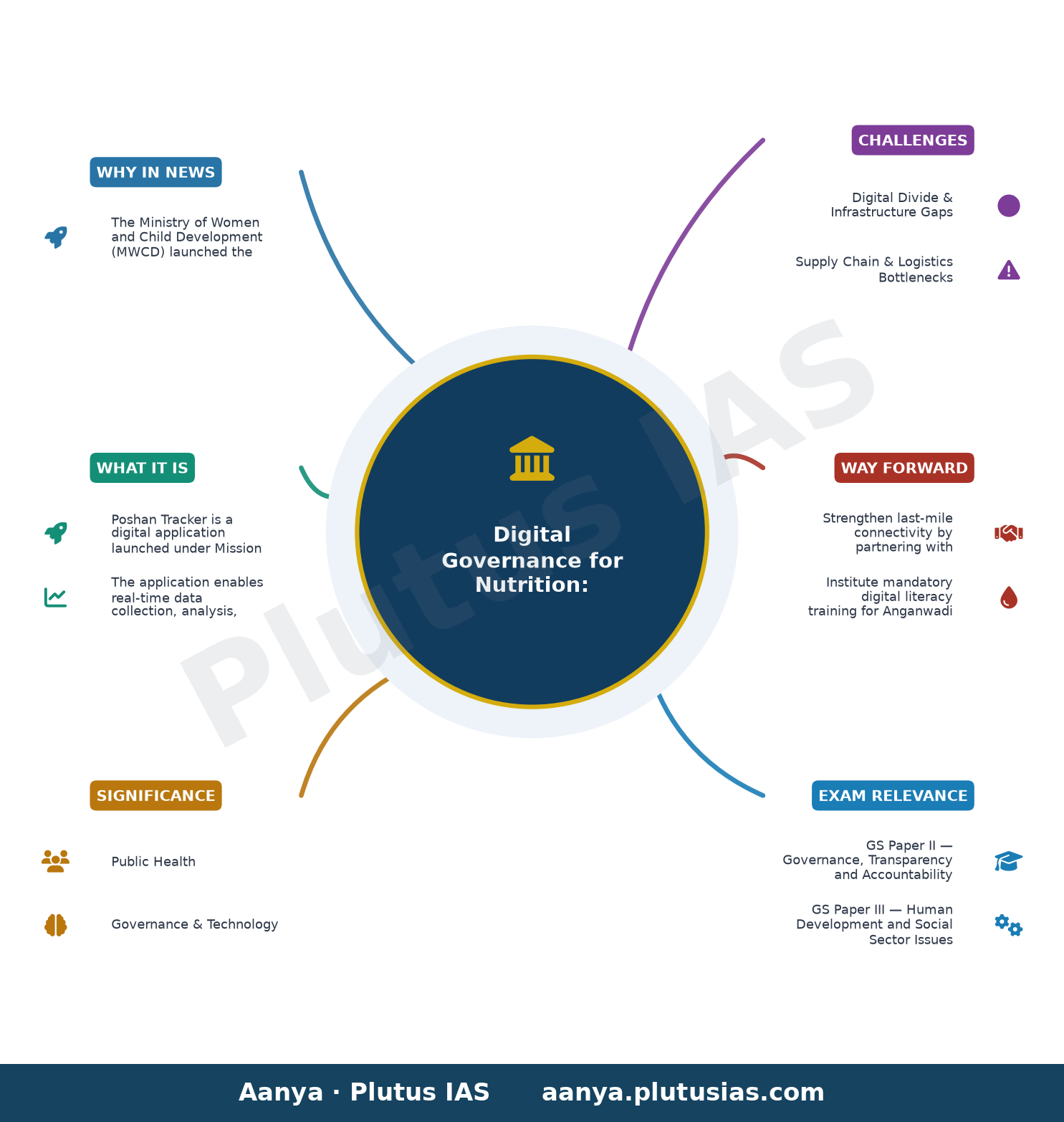
- GS Paper II — Governance, Transparency and Accountability | GS Paper III — Human Development and Social Sector Issues | GS Paper IV — Ethical Governance and Use of Technology
- Prelims: Poshan Tracker, Mission Poshan 2.0, ICDS, NFSA 2013, SAM children, THR (Take-Home Ration), Growth Monitoring Devices (GMD), Poshan Vatikas, Poshan Maah, Poshan Pakhwada
- Essay: Role of Technology in Public Health Governance, Intersection of Nutrition, Women Empowerment, and Digital India
Quick Revision: Poshan Tracker, under Mission Poshan 2.0, leverages ICT to transform Anganwadi Centres into data-driven hubs for malnutrition eradication, integrating supplementary nutrition, growth monitoring, and community engagement for holistic child development.
Why is this in the news?
The Ministry of Women and Child Development (MWCD) launched the digital application ‘Poshan Tracker’ under Mission Poshan 2.0 to enhance real-time monitoring of nutrition services delivered through Anganwadi Centres (AWCs) across India. This initiative marks a significant shift from traditional paper-based reporting to ICT-enabled governance, ensuring data-driven decision-making for malnutrition eradication. The application’s nationwide adoption, including in Gujarat, underscores its scalability and potential to transform nutritional outcomes through transparency and accountability.
Background
- The Integrated Child Development Services (ICDS) Scheme, launched in 1975, is India’s flagship programme for early childhood care and development, covering children aged 0–6 years, pregnant women, lactating mothers, and adolescent girls.
- The National Food Security Act (NFSA), 2013, mandates the provision of supplementary nutrition under Schedule-II, including Hot Cooked Meal (HCM) and Take-Home Ration (THR) for children aged 6 months to 6 years, pregnant women, lactating mothers, and adolescent girls.
- Mission Poshan 2.0, an evolution of the Poshan Abhiyaan (launched in 2018), integrates convergence across ministries, leverages technology, and adopts a life-cycle approach to address malnutrition holistically.
- Severe Acute Malnutrition (SAM) remains a critical challenge, with over 1 million children affected in India, necessitating targeted interventions like THR and community-based care.
- The use of ICT in governance has gained traction post-2015, with the Digital India initiative aiming to bridge the digital divide and enhance service delivery efficiency in social sector programmes.
What is Poshan Tracker and Mission Poshan 2.0?
- Poshan Tracker is a digital application launched under Mission Poshan 2.0 to monitor and track all services provided to beneficiaries registered at Anganwadi Centres (AWCs), including supplementary nutrition, growth monitoring, and counselling services.
- The application enables real-time data collection, analysis, and dissemination through a centralised dashboard (https://www.poshantracker.in/statistics), facilitating evidence-based policymaking and programme implementation.
- Mission Poshan 2.0 aims to address malnutrition through a multi-pronged strategy: supplementary nutrition (HCM and THR), growth monitoring, community mobilisation, and convergence with health and nutrition programmes.
- Growth Monitoring Devices (GMDs) such as infantometers, stadiometers, and weighing scales are deployed at AWCs to track child growth parameters, enabling early identification of malnutrition and timely interventions.
- Frontline workers (AWWs) are equipped with smartphones and data recharge facilities to enhance their capacity for service delivery, data reporting, and community engagement.
- Poshan Vatikas (nutrition gardens) are being established at AWCs to promote the consumption of locally grown, seasonal fruits and vegetables, thereby improving dietary diversity and micronutrient intake.
- Community mobilisation efforts, including Poshan Maah (September) and Poshan Pakhwada (March–April), are conducted to raise awareness about nutrition, hygiene, and early childhood development, fostering behavioural change at the grassroots level.
Key Features
| Feature | Significance |
|---|---|
| Digital Application ‘Poshan Tracker’ | Enables real-time monitoring, tracking, and data-driven governance of nutritional services provided to beneficiaries (children 0-6 years, pregnant/lactating mothers, adolescent girls) across all Anganwadi Centres (AWCs) through a centralised ICT platform. |
| Development Monitoring Devices (GMD) | Facilitates regular anthropometric measurements (height, weight, neonatal checks) at AWCs to identify malnutrition (stunting, wasting, underweight) dynamically and enable timely interventions. |
| Nutrition Month (Poshan Maah) & Poshan Pakhwada | Community mobilisation campaigns (September & March-April) to drive behavioural change in dietary habits, leveraging local influencers and grassroots participation for sustained nutritional awareness. |
| Nutrition Gardens (Poshan Vatika) | Promotes dietary diversity by cultivating local, seasonal fruits and vegetables at AWCs, ensuring micro-nutrient-rich diets and reducing dependency on external food supplies. |
| Inter-Ministerial Protocols | Joint protocols by MWCD and MoHFW for Severe Acute Malnutrition (SAM) management, standardising treatment protocols to reduce morbidity and mortality in children under 5. |
Why it Matters
Public Health
- Addresses the triple burden of malnutrition (undernutrition, micronutrient deficiencies, and overweight/obesity) through targeted supplementary nutrition and dietary diversification.
- Reduces stunting, wasting, and underweight prevalence in children under 6 by enabling early detection via Poshan Tracker and GMDs.
- Lowers maternal and neonatal mortality by ensuring adequate nutrition for pregnant/lactating women and infants through Hot Cooked Meals (HCM) and Take-Home Rations (THR).
Governance & Technology
- Demonstrates India’s commitment to leveraging ICT for social welfare delivery, with Poshan Tracker serving as a model for real-time monitoring and accountability in public health programmes.
- Enhances transparency and efficiency in service delivery by digitising beneficiary data, reducing leakages, and enabling evidence-based policy adjustments.
- Strengthens frontline worker (Anganwadi workers) capacity through smartphone access and data connectivity, improving outreach and service quality.
Social & Behavioural Change
- Promotes community-led nutrition awareness through Poshan Maah and Poshan Pakhwada, fostering long-term behavioural change in dietary practices.
- Encourages local participation in nutrition gardens, aligning with the ‘Vocal for Local’ initiative and reducing food miles for nutritious produce.
- Empowers women and adolescent girls as key agents of change in household nutrition decision-making.
Inter-Sectoral Coordination
- Bridges gaps between health (MoHFW) and welfare (MWCD) sectors via joint protocols for SAM management, ensuring holistic care for malnourished children.
- Facilitates district-level (District Nutrition Committees) and state-level (State Operations Committee) reviews, ensuring multi-stakeholder accountability and resource optimisation.
Challenges
1. Digital Divide & Infrastructure Gaps
- Uneven smartphone access and internet connectivity in rural and tribal areas may hinder Poshan Tracker’s real-time data submission, particularly in remote AWCs.
- Dependence on ICT tools risks excluding illiterate or digitally inexperienced beneficiaries and frontline workers, necessitating parallel offline reporting mechanisms.
UPSC Link: GS-II: Governance, e-governance
2. Supply Chain & Logistics Bottlenecks
- Delayed procurement and distribution of THR and HCM due to logistical challenges in hilly, tribal, and conflict-affected regions, undermining nutritional security.
- Quality control issues in locally sourced food items for nutrition gardens, potentially compromising nutritional efficacy.
UPSC Link: GS-III: Food Security, Supply Chain
3. Behavioural Resistance & Cultural Barriers
- Deep-rooted dietary taboos and gender norms may limit the adoption of diverse diets, particularly in marginalised communities, despite awareness campaigns.
- Low prioritisation of nutrition in household budgets, especially among economically vulnerable groups, despite subsidised food schemes.
UPSC Link: GS-I: Social Empowerment
4. Frontline Worker Capacity & Accountability
- High attrition rates and inadequate training among Anganwadi workers in ICT tools and nutritional counselling may dilute programme impact.
- Lack of standardised performance metrics for frontline workers, leading to inconsistent service delivery across regions.
UPSC Link: GS-II: Human Resource in Governance
5. Data Privacy & Security Risks
- Centralised storage of beneficiary data in Poshan Tracker raises concerns about data privacy, consent, and potential misuse under the Digital Personal Data Protection Act, 2023.
- Inadequate cybersecurity measures in rural AWCs may expose sensitive health and nutritional data to breaches.
UPSC Link: GS-II: Cyber Security, Data Governance
Challenges — UPSC Perspective
| Issue | Concern |
|---|---|
| Digital Literacy | Limited ICT skills among AWWs and beneficiaries may hinder effective use of Poshan Tracker. |
| Seasonal Availability | Nutrition gardens face challenges in maintaining year-round produce diversity due to climatic constraints. |
| Monitoring Efficacy | Reliance on self-reported data by AWWs may lead to underreporting of malnutrition cases. |
| Funding Disparities | Variations in state allocations for THR/HCM and nutrition gardens create inequities in service delivery. |
| Stigma & Discrimination | Children with SAM or disabilities may face social exclusion, reducing community support for their care. |
Government Initiatives — Must-Memorise for Prelims
- Mission Poshan 2.0
- Poshan Tracker
- Integrated Child Development Services (ICDS)
- National Food Security Act, 2013 (Schedule-II)
- Poshan Maah & Poshan Pakhwada
Way Forward
- Strengthen last-mile connectivity by partnering with BharatNet and CSC e-Governance Services to ensure uninterrupted internet access in AWCs.
- Institute mandatory digital literacy training for Anganwadi workers and beneficiaries, with certification to ensure competence in using Poshan Tracker.
- Expand the coverage of nutrition gardens by integrating them with MGNREGA for land development and water conservation, ensuring sustainability.
- Develop a grievance redressal mechanism within Poshan Tracker to address beneficiary complaints and supply chain delays in real time.
- Conduct bi-annual nutritional audits of THR and HCM to ensure quality compliance with FSSAI standards and local dietary needs.
- Launch region-specific behavioural change campaigns, leveraging local leaders and ASHAs to address cultural barriers and dietary taboos.
- Establish a dedicated fund under the National Nutrition Mission to address disparities in state allocations for supplementary nutrition programmes.
UPSC Value Addition
Keywords for Mains Answer-Writing
Mission Poshan 2.0 · Poshan Tracker · Anganwadi Services · Digital Governance in Nutrition · Severe Acute Malnutrition (SAM) · Take-Home Ration (THR) · Hot Cooked Meal (HCM) · Nutrition Month and Poshan Pakhwada · Nutrition Gardens · Inter-sectoral Convergence
Constitutional & Policy Linkages
- [‘Article 47’, ‘Directive Principles of State Policy – raising nutrition levels and public health standards.’]
- [‘Article 243G’, ‘Empowerment of Panchayats to plan and implement nutrition programmes at the grassroots level.’]
- [‘Seventh Schedule’, ‘Concurrent List – coordination between Centre and States for welfare schemes like ICDS.’]
Concept Flow
High prevalence of malnutrition in children under 6 and women → Launch of Mission Poshan 2.0 with Poshan Tracker for real-time monitoring → Deployment of GMDs for anthropometric tracking → Identification of stunting/wasting cases → Targeted supplementary nutrition (THR/HCM) and nutrition gardens → Community mobilisation via Poshan Maah/Pakhwada → Behavioural change in dietary habits → Reduction in malnutrition indicators → Improved maternal and child health outcomes.
Prelims Practice Questions
Q1. Consider the following statements regarding the Poshan Tracker application launched under Mission Poshan 2.0:
1. It is an ICT-based governance tool for monitoring and tracking services provided to beneficiaries at Anganwadi Centres.
2. The application is operational in all states and Union Territories except Gujarat.
3. It enables real-time tracking of the prevalence of stunting, wasting, and underweight among children.
4. The application provides home-delivered rations (THR) to severely malnourished children.
How many of the above statements are correct?
- Only one
- Only two
- Only three
- All four
Answer: Only three — Statements 1 and 3 are correct as Poshan Tracker is an ICT-based tool for monitoring Anganwadi services and tracks malnutrition prevalence. Statement 2 is incorrect because Gujarat is among the states where the application is operational. Statement 4 is incorrect because THR is provided under the National Food Security Act, not directly through Poshan Tracker.
Q2. Assertion (A): The Poshan Tracker application is designed to facilitate real-time monitoring of nutritional outcomes among children and mothers.
Reason (R): It integrates data from Anganwadi Centres across all states and Union Territories to provide a unified dashboard for policymakers.
Options:
A. Both A and R are true, and R is the correct explanation of A.
B. Both A and R are true, but R is not the correct explanation of A.
C. A is true, but R is false.
D. A is false, but R is true.
Answer: ? — Both Assertion (A) and Reason (R) are true. The Poshan Tracker indeed facilitates real-time monitoring of nutritional outcomes. Reason (R) correctly explains how the application achieves this by integrating data from Anganwadi Centres across all states and Union Territories to provide a unified dashboard.
Q3. Match the following initiatives under Mission Poshan 2.0 with their respective objectives:
Column I (Initiative) | Column II (Objective)
— | —
A. Poshan Tracker | 1. Provision of supplementary nutrition to children and mothers
B. Nutrition Month and Poshan Pakhwada | 2. Real-time tracking of malnutrition prevalence
C. Take-Home Ration (THR) | 3. Community mobilization and awareness campaigns
D. Nutrition Gardens | 4. Promotion of locally grown fruits and vegetables
Options:
A-2, B-3, C-1, D-4
A-1, B-2, C-3, D-4
A-2, B-1, C-3, D-4
A-3, B-2, C-1, D-4
Answer: ? — A. Poshan Tracker (2) is an ICT-based tool for real-time tracking of malnutrition prevalence. B. Nutrition Month and Poshan Pakhwada (3) are community mobilization and awareness campaigns. C. Take-Home Ration (THR) (1) is provided as supplementary nutrition. D. Nutrition Gardens (4) promote locally grown fruits and vegetables.
Mains Practice Question
✍ The integration of digital tools such as the Poshan Tracker under Mission Poshan 2.0 represents a paradigm shift in the governance of nutrition programmes in India. Critically examine the potential of such ICT-based interventions to address malnutrition, with particular reference to their role in data-driven decision-making and inter-sectoral convergence. (15 Marks)
Approach: MODEL-ANSWER SKELETON:
1. **Introduction (2 Marks)**: Briefly introduce Mission Poshan 2.0 and the Poshan Tracker as an ICT-based governance tool. Highlight the context of malnutrition in India (e.g., prevalence of stunting, wasting, and underweight among children).
2. **Role of ICT in Nutrition Governance (4 Marks)**:
– **Real-time Data Collection and Monitoring**: Explain how Poshan Tracker enables real-time tracking of nutritional outcomes, beneficiary registration, and service delivery at Anganwadi Centres.
– **Data-Driven Decision-Making**: Discuss how the application supports evidence-based policymaking by providing granular data on malnutrition prevalence and service gaps.
– **Transparency and Accountability**: Highlight the role of ICT in reducing leakages and ensuring targeted delivery of services (e.g., THR, HCM).
3. **Inter-Sectoral Convergence (4 Marks)**:
– **Integration with Health and Other Departments**: Discuss how Poshan Tracker facilitates convergence between the Ministry of Women and Child Development, Ministry of Health and Family Welfare, and other stakeholders.
– **District and State-Level Committees**: Explain the role of District Nutrition Committees and State-Level Operation Committees in monitoring progress and ensuring coordination.
– **Nutrition Gardens and Local Solutions**: Link the use of ICT with grassroots initiatives like nutrition gardens to promote dietary diversity.
4. **Challenges and Limitations (3 Marks)**:
– **Digital Divide**: Discuss the challenges of ensuring last-mile connectivity and digital literacy among Anganwadi workers.
– **Data Privacy and Security**: Highlight concerns related to the storage and use of sensitive beneficiary data.
– **Sustainability**: Address the need for continuous capacity-building and maintenance of ICT infrastructure.
5. **Conclusion (2 Marks)**: Summarize the transformative potential of ICT in nutrition governance while acknowledging the need for addressing structural challenges. Provide a balanced view on the efficacy of Poshan Tracker in achieving the goals of Mission Poshan 2.0.
Source: PIB (Press Information Bureau)
Generated by AanyaAi for educational purpose.

- महाराष्ट्र में त्योहार जुलूसों पर बॉम्बे हाईकोर्ट का बड़ा फैसला: पटाखे, लेजर और संगीत पर रोक - September 24, 2026
- Bombay HC Bans Firecrackers, Music in Maharashtra Processions: Key UPSC Analysis - September 24, 2026
- तमिलनाडु में महिला कर्मचारियों के लिए सवैतनिक माहवारी अवकाश नीति पर HC का आदेश - September 24, 2026

No Comments