


25 Sep US-Iran Talks on Strait of Hormuz: Phased Deal to End Blockade Explained for UPSC

✎ The Strait of Hormuz is a critical global chokepoint through which 20–30% of seaborne oil transits, making its security a key determinant of international energy prices and geopolitical stability.
Subject Relevance — Where This Topic Fits
- GS Paper II — International Relations: Regional and global groupings and agreements involving India and/or affecting India’s interests | GS Paper II — International Relations: Effect of policies and politics of developed and developing countries on India’s interests
- Prelims: Strait of Hormuz, Chokepoint, Maritime choke points, US-Iran relations, Oil supply routes, UNCLOS, International Maritime Organization (IMO), Economic sanctions
- Essay: Geopolitical flashpoints and their implications for global energy security
Quick Revision: The Strait of Hormuz is a critical global chokepoint through which 20–30% of seaborne oil transits, making its security a key determinant of international energy prices and geopolitical stability.
Why is this in the news?
Recent reports indicate that the United States and Iran are engaged in indirect negotiations in New York to explore a phased arrangement that could restore maritime traffic through the Strait of Hormuz—a critical global oil transit route—while easing economic pressures on Iran. The discussions, framed as a potential step toward de-escalating the ongoing conflict, underscore the Strait’s enduring geopolitical significance as a chokepoint in international trade and energy security.
Background
- The Strait of Hormuz connects the Persian Gulf to the Gulf of Oman and is one of the world’s most strategically vital maritime chokepoints, through which approximately 20–30% of global oil supply passes annually.
- Tensions in the Strait have periodically escalated due to geopolitical rivalries, including the 1980s Tanker War during the Iran-Iraq conflict and more recent incidents such as the 2019 attacks on oil tankers and the 2021 seizure of a South Korean tanker by Iran.
- The United States has imposed extensive economic sanctions on Iran, including secondary sanctions targeting countries importing Iranian oil, aimed at curbing Iran’s nuclear and regional influence.
- Diplomatic efforts to resolve the crisis have historically relied on phased agreements, such as the 2015 Joint Comprehensive Plan of Action (JCPOA), which sought to balance sanctions relief with nuclear non-proliferation commitments.
- The Strait’s status under international law, particularly the United Nations Convention on the Law of the Sea (UNCLOS), remains contested, with Iran asserting its right to regulate passage under certain conditions.
What is the Strait of Hormuz and why is it strategically significant?
- The Strait of Hormuz is a narrow waterway, approximately 21 nautical miles wide at its narrowest point, separating Iran from Oman and the United Arab Emirates, and serving as the sole maritime outlet for Persian Gulf oil exports.
- It is classified as a chokepoint—a narrow passage through which a disproportionate volume of global trade, particularly oil and liquefied natural gas (LNG), must transit, making disruptions highly consequential for energy markets.
- The Strait handles an estimated 20–30 million barrels of oil per day, equivalent to roughly one-third of the world’s seaborne traded oil, according to the U.S. Energy Information Administration (EIA).
- Geopolitical control over the Strait has been a recurring flashpoint, with Iran historically leveraging its geographic position to assert influence, including during the 1980s Iran-Iraq War and more recent tensions with the United States.
- Under the United Nations Convention on the Law of the Sea (UNCLOS), straits used for international navigation are subject to a regime of transit passage, allowing free and unimpeded passage for all vessels, though coastal states retain certain regulatory and environmental responsibilities.
- The International Maritime Organization (IMO) sets global standards for maritime safety and security, but enforcement in contested waters like the Strait of Hormuz depends on the willingness of littoral states and international consensus.
- Disruptions in the Strait can trigger immediate spikes in global oil prices, as witnessed during the 2019 attacks on tankers, which led to a temporary surge in Brent crude prices.
- The Strait’s strategic importance extends beyond oil, as it is also a critical route for LNG exports from Qatar, the world’s largest LNG exporter, and for imports of food and goods to Gulf states.
Key Features
| Feature | Significance |
|---|---|
| Strait of Hormuz | A critical chokepoint for global oil transit, accounting for approximately 20% of the world’s daily oil supply, making its closure a strategic leverage point in geopolitical negotiations. |
| US-Iran Economic Blockade | A unilateral economic measure imposed by the US, leveraging sanctions to restrict Iran’s oil exports and financial transactions, thereby exerting pressure on Iran’s economy and political decisions. |
| Phased Negotiation Approach | A structured diplomatic strategy involving incremental concessions from both sides to build trust, reduce escalation risks, and achieve a sustainable resolution to the blockade. |
| Frozen Asset Repatriation | The potential release of Iran’s overseas financial assets, currently held in foreign banks, as part of a negotiated settlement to provide economic relief to Iran. |
| Midterm Elections Context (US) | The political timeline in the United States, with midterm elections scheduled for November 3, 2026, influencing the urgency and strategic calculations of negotiators. |
Why it Matters
Economic Significance
- Global Oil Supply: The Strait of Hormuz is a vital artery for crude oil transportation, linking the Persian Gulf to international markets; any disruption directly impacts global energy prices and economic stability.
- US Gasoline Prices: The reopening of the Strait could alleviate upward pressure on US gasoline prices, a politically sensitive issue during election periods.
- Iranian Economic Collapse: Prolonged blockade has crippled Iran’s economy, leading to hyperinflation, currency devaluation, and public unrest, creating domestic pressure for a resolution.
- Trade Disruptions: Closure of the Strait would disrupt supply chains for essential commodities, including oil, gas, and food, affecting economies worldwide, particularly in Asia and Europe.
Strategic and Geopolitical Significance
- Leverage in Negotiations: Control over the Strait provides the US with significant bargaining power, while Iran’s ability to blockade it serves as a counter-leverage in diplomatic engagements.
- Regional Stability: The conflict risks escalating into a broader regional crisis, involving Gulf Cooperation Council (GCC) states, Israel, and other stakeholders, with potential implications for global security.
- US-Iran Relations: The negotiations reflect broader efforts to reset bilateral relations, which have been strained since the 1979 Islamic Revolution and further deteriorated post-2018 US withdrawal from the JCPOA.
- International Diplomacy: The involvement of European and regional actors underscores the multilateral nature of the crisis, with potential implications for global non-proliferation and counter-terrorism efforts.
Diplomatic and Legal Significance
- International Law of the Sea: The Strait of Hormuz falls under the United Nations Convention on the Law of the Sea (UNCLOS), which governs the rights of coastal states and the transit passage regime for international shipping.
- Sanctions Regime: The US economic blockade operates under the framework of unilateral sanctions, which are subject to international legal scrutiny and potential challenges under WTO rules or bilateral agreements.
- Trust-Building Mechanisms: Phased negotiations aim to establish confidence-building measures, such as temporary truces or limited sanctions relief, to create an environment conducive to a permanent resolution.
Challenges
1. Asymmetric Negotiation Leverage
- US Position: The US holds significant economic and military leverage, including control over the Strait and the ability to impose or lift sanctions, which complicates Iran’s willingness to concede.
- Iranian Domestic Constraints: Iran faces internal political pressures, including hardline factions resistant to concessions and public dissatisfaction with economic hardship, limiting its negotiating flexibility.
- Trust Deficit: Historical mistrust between the US and Iran, compounded by past failed agreements (e.g., JCPOA), makes it difficult for either side to commit to durable concessions without verifiable reciprocity.
UPSC Link: GS II: International Relations – Bilateral/Multilateral Agreements
2. Economic and Humanitarian Fallout
- Humanitarian Crisis: Prolonged blockade exacerbates food and medicine shortages in Iran, risking public health crises and social unrest, which could destabilize the region.
- Global Supply Chain Disruptions: Closure of the Strait would disrupt oil and gas supplies, leading to price volatility and potential energy shortages in importing nations, particularly in South Asia and Europe.
- Sanctions Evasion: Iran’s attempts to circumvent sanctions through alternative trade routes or shadow fleets could lead to secondary sanctions on third-party entities, complicating enforcement and diplomacy.
UPSC Link: GS III: Effects of Liberalization on the Economy
3. Regional and Global Security Risks
- Escalation Risks: Miscalculations or accidental military confrontations in the Strait could trigger a broader conflict, involving regional powers such as Saudi Arabia, Israel, and the UAE.
- Proxy Conflicts: The crisis could intensify proxy warfare in Yemen, Syria, or Iraq, further destabilizing the Middle East and complicating diplomatic efforts.
- Nuclear Non-Proliferation Concerns: Iran’s nuclear program remains a contentious issue; prolonged tensions could undermine non-proliferation efforts and lead to further proliferation risks in the region.
UPSC Link: GS II: Security Challenges and their Management
4. Political Timing and Domestic Pressures
- US Midterm Elections: The political calendar in the US introduces urgency, as negotiators seek a deal before November 3, 2026, to align with electoral incentives or avoid post-election complications.
- Iranian Leadership Dynamics: Supreme Leader Khamenei’s hardline stance and the influence of the Islamic Revolutionary Guard Corps (IRGC) constrain President Raisi’s ability to make significant concessions.
- Public Sentiment: In both countries, public opinion shapes political narratives; economic hardship in Iran and gasoline prices in the US create domestic pressures that influence negotiation stances.
UPSC Link: GS II: Government Policies and Interventions
5. Legal and Institutional Constraints
- Sanctions Legality: The legality of US sanctions under international law is contested, particularly regarding secondary sanctions that target non-US entities, raising questions about WTO compliance and diplomatic friction.
- UNCLOS Compliance: The closure of the Strait may violate the transit passage provisions of UNCLOS, which guarantees freedom of navigation for all ships in international straits, potentially inviting legal challenges.
- Verification Mechanisms: Ensuring compliance with a phased deal requires robust monitoring and verification mechanisms, which are difficult to establish in a climate of mutual distrust.
UPSC Link: GS II: Important International Institutions
Challenges — UPSC Perspective
| Issue | Concern |
|---|---|
| Asymmetric Power Dynamics | The imbalance in economic and military leverage between the US and Iran complicates equitable negotiations and trust-building. |
| Humanitarian Impact | Prolonged blockade exacerbates food and medicine shortages, risking public health crises and social instability in Iran. |
| Regional Escalation Risks | Military confrontations or proxy conflicts in the Strait could destabilize the Middle East and draw in regional powers. |
| Domestic Political Constraints | Election cycles in the US and leadership dynamics in Iran limit negotiators’ flexibility and willingness to compromise. |
| Legal and Compliance Challenges | Disputes over the legality of sanctions and UNCLOS compliance create additional hurdles for a durable agreement. |
Way Forward
- Establish a **verifiable ceasefire** in the Strait of Hormuz to prevent accidental escalations and create a conducive environment for negotiations.
- Initiate **confidence-building measures**, such as limited sanctions relief or humanitarian aid, to reduce economic pressure on Iran and demonstrate good faith.
- Engage **third-party mediators**, such as the European Union or the United Nations, to facilitate dialogue and ensure balanced concessions from both sides.
- Develop a **phased roadmap** with clear timelines and benchmarks for sanctions relief, asset repatriation, and reopening of the Strait, ensuring reciprocity at each stage.
- Strengthen **monitoring and verification mechanisms**, including satellite surveillance and on-ground inspections, to ensure compliance with the agreement.
- Address **regional security concerns** by engaging Gulf Cooperation Council (GCC) states and other stakeholders to prevent proxy conflicts and regional instability.
- Prioritize **humanitarian exemptions** in sanctions to allow the flow of essential goods, such as food and medicine, to mitigate public suffering in Iran.
- Conduct **parallel track-II diplomacy** involving civil society, business leaders, and former officials to build public support for a negotiated settlement.
UPSC Value Addition
Keywords for Mains Answer-Writing
Strait of Hormuz · maritime security · geopolitical leverage · economic sanctions · phased diplomatic arrangement · global oil supply chain · maritime blockade · United Nations General Assembly · US-Iran relations · maritime trade routes · energy security · diplomatic negotiations · geostrategic chokepoint · international law of the sea
Constitutional & Policy Linkages
- [‘UNCLOS Part III: Transit Passage Regime’, ‘Governs rights of ships in international straits like Hormuz.’]
- [‘Article 1(1) of UN Charter’, ‘Prohibits use of force against territorial integrity of states.’]
Concept Flow
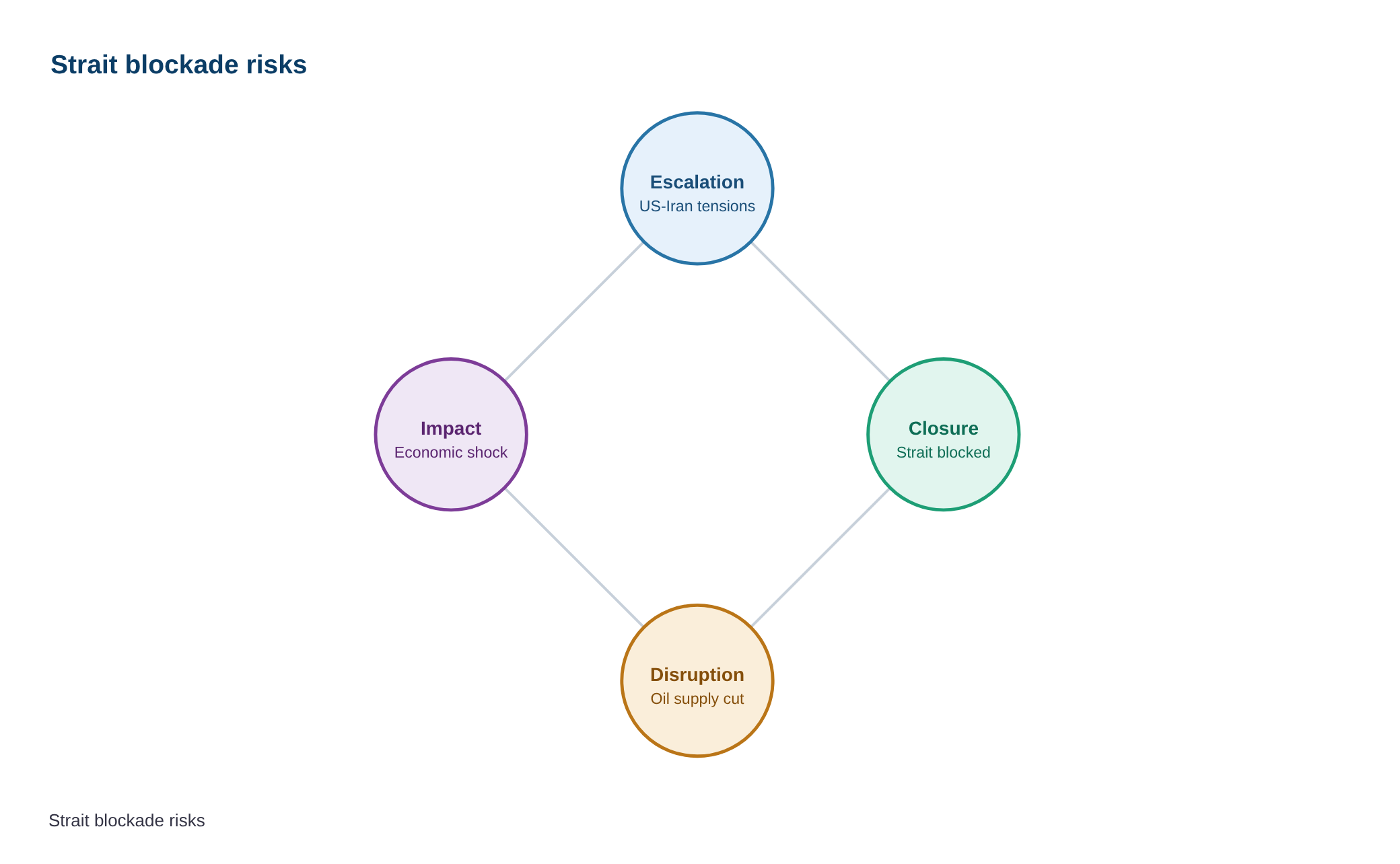
Escalation of US-Iran tensions → Closure of Strait of Hormuz → Disruption of global oil supply → Economic sanctions imposed by US → Iranian economic collapse → Domestic unrest in Iran → Negotiations for phased deal → Phased sanctions relief → Reopening of Strait → Stabilization of global oil prices → Regional security concerns addressed
Prelims Practice Questions
Q1. Consider the following statements regarding the Strait of Hormuz:
1. It is a narrow waterway connecting the Persian Gulf to the Gulf of Oman.
2. It is the world’s most important chokepoint for oil transit, with approximately 20% of global oil supply passing through it daily.
3. The Strait of Hormuz lies entirely within the territorial waters of Iran.
4. The legal regime governing the Strait of Hormuz is primarily governed by the United Nations Convention on the Law of the Sea (UNCLOS).
How many of the above statements are correct?
- Only one
- Only two
- Only three
- All
Answer: All — Statements 1, 2, and 4 are correct. Statement 3 is incorrect as the Strait of Hormuz is bordered by Iran and Oman, with Oman controlling the southern entrance.
Q2. Assertion (A): Economic sanctions imposed by the United States on Iran have significantly disrupted global oil supply chains.
Reason (R): The Strait of Hormuz, a critical maritime chokepoint, has been intermittently blocked by Iran in response to these sanctions.
Options:
A. Both A and R are true, and R is the correct explanation of A.
B. Both A and R are true, but R is not the correct explanation of A.
C. A is true, but R is false.
D. A is false, but R is true.
Answer: ? — Both the assertion and the reason are true. The Strait of Hormuz is a vital oil transit route, and Iran’s intermittent blocking of the strait in response to US sanctions has indeed disrupted global oil supply chains.
Q3. Match the following maritime chokepoints with their respective regions:
Column I (Chokepoint) Column II (Region)
A. Strait of Hormuz 1. Between Malaysia and Indonesia
B. Strait of Malacca 2. Between Yemen and Djibouti
C. Bab el-Mandeb 3. Between Iran and Oman
D. Strait of Gibraltar 4. Between Spain and Morocco
Options:
A-3, B-1, C-2, D-4
A-1, B-3, C-4, D-2
A-4, B-2, C-1, D-3
A-2, B-4, C-3, D-1
- A-3, B-1, C-2, D-4
- A-1, B-3, C-4, D-2
- A-4, B-2, C-1, D-3
- A-2, B-4, C-3, D-1
Answer: A-3, B-1, C-2, D-4 — The correct matching is: A-3 (Strait of Hormuz: Iran-Oman), B-1 (Strait of Malacca: Malaysia-Indonesia), C-2 (Bab el-Mandeb: Yemen-Djibouti), D-4 (Strait of Gibraltar: Spain-Morocco).
Mains Practice Question
✍ The Strait of Hormuz, a critical maritime chokepoint, has emerged as a focal point in geopolitical negotiations between the United States and Iran. Critically examine the strategic significance of the Strait of Hormuz in global energy security and the implications of its potential blockade for international maritime law and trade. Also, analyse the challenges posed by phased diplomatic arrangements in resolving such geopolitical disputes. (15 Marks)
Approach: MODEL-ANSWER SKELETON:
1. **Strategic Significance of the Strait of Hormuz** (4 marks)
– Define the Strait of Hormuz: narrow waterway connecting the Persian Gulf to the Gulf of Oman, bordered by Iran and Oman.
– Quantify its importance: ~20-30% of global oil supply transits daily; vital for energy security of major economies (e.g., China, India, EU, US).
– Reference UNCLOS (Part III, Articles 37-45) on transit passage rights and obligations of coastal states.
– Cite recent incidents (e.g., 2019 attacks on tankers) to illustrate its vulnerability.
2. **Implications of a Blockade** (4 marks)
– Economic disruptions: spike in global oil prices, inflationary pressures, and supply chain volatility.
– Geopolitical tensions: escalation of proxy conflicts, military posturing, and regional alliances (e.g., US-led maritime coalition vs. Iran-backed groups).
– Legal dimensions: violation of UNCLOS provisions on freedom of navigation; potential invocation of Article 39 (suspension of innocent passage) or Chapter VII (UN Security Council resolutions).
– Humanitarian impact: disruption of food and medical supply chains to landlocked countries (e.g., Afghanistan, Iraq).
3. **Challenges in Phased Diplomatic Arrangements** (5 marks)
– Asymmetric bargaining power: Iran’s economic vulnerability vs. US strategic control over the Strait.
– Trust deficit: history of failed agreements (e.g., 2015 JCPOA collapse, 2026 temporary fixes).
– Domestic constraints: political incentives in both countries (e.g., US midterm elections, Iran’s economic collapse narrative).
– Third-party mediation: role of EU, China, or regional actors (e.g., Oman) in facilitating trust-building measures.
– Legal and procedural hurdles: sequencing of sanctions relief, verification mechanisms, and enforcement mechanisms.
4. **Conclusion** (2 marks)
– Balanced view: phased arrangements may offer a pragmatic solution but require robust safeguards against relapse.
– Emphasise the need for multilateral frameworks (e.g., UN-led maritime security initiatives) to prevent unilateral actions.
Source: Mint
Generated by AanyaAi for educational purpose.
Related guides on our sites
- Current affairs for upsc 2026
- Best PSIR optional coaching for upsc
- Best economics optional coaching for upsc
- Best PSIR optional teacher for upsc

- आठवां वेतन आयोग: रेलकर्मियों हेतु जोखिम भत्ते की मांग और प्रस्ताव - November 9, 2026
- सार्वजनिक सेवक की न्यायिक हिरासत: 48 घंटे से अधिक पर स्वतः निलंबन – सुप्रीम कोर्ट - November 9, 2026
- Law Affairs Dept’s Special Campaign 6: Key Achievements & Governance - November 9, 2026

No Comments