


27 Feb Veer Savarkar: The Revolutionary Leader
This article covers “Daily Current Affairs” and topic details of the Veer Savarkar: The Revolutionary Leader
SYLLABUS MAPPING:
GS- 01- Modern Indian History – Veer Savarkar: The Revolutionary Leader
FOR PRELIMS
Veer Savarkar organization and News paper, various Revolutionary Organization and there Member associated to Organization.
FOR MAINS
Why in the News?
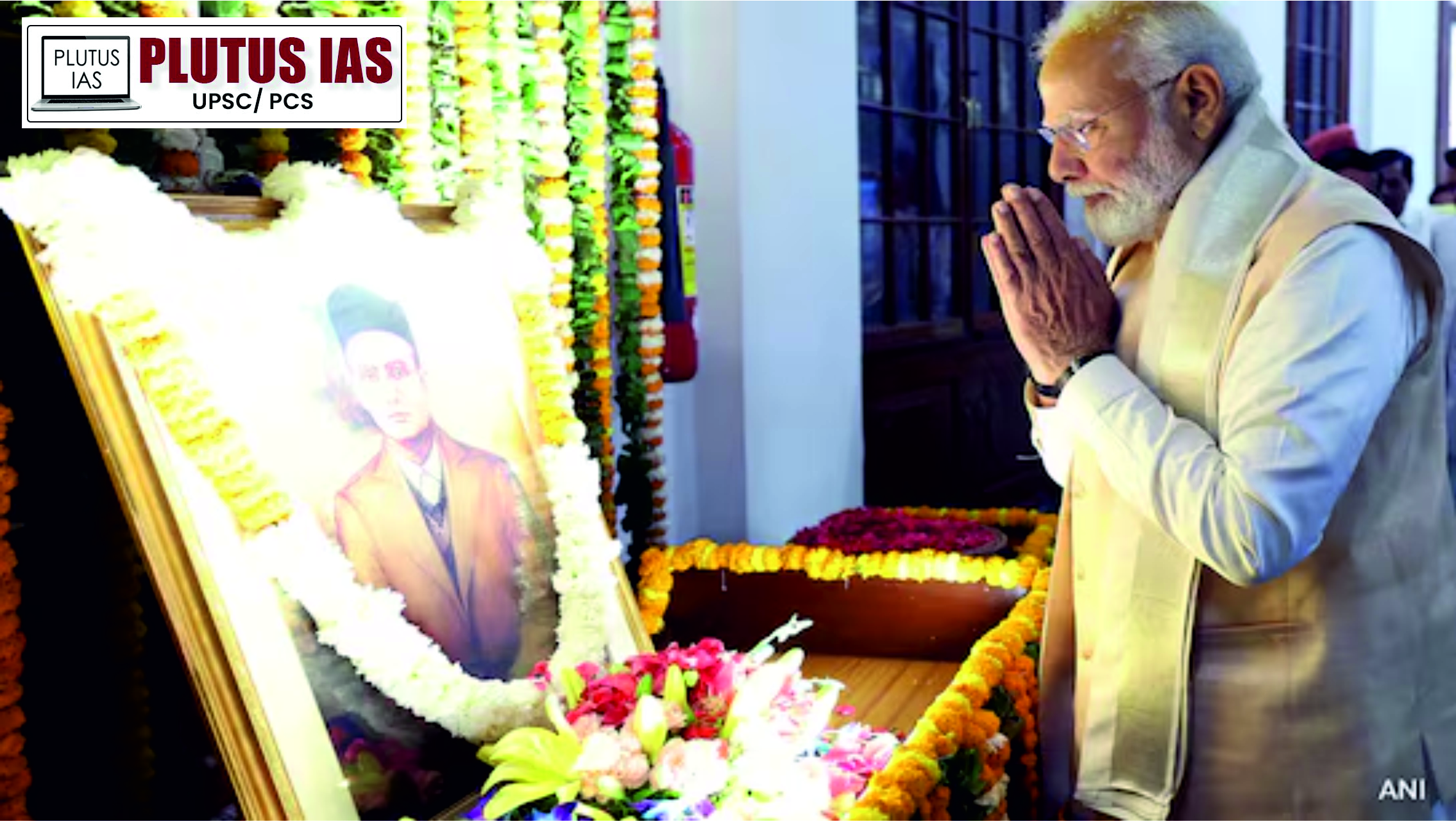
Veer Savarkar has been in the news recently due to tributes paid to him by Prime Minister Narendra Modi and the Rashtriya Swayamsevak Sangh (RSS) on his death anniversary. PM Modi shared a heartfelt tribute on social media, stating that the nation can never forget Savarkar’s invaluable contribution filled with penance, sacrifice, courage, and struggle in the freedom movement. The RSS and several other political leaders also honored his legacy, reaffirming his role as one of the most influential figures in India’s freedom struggle and nationalist movement.
Who was the Veer Savarkar?
Vinayak Damodar Savarkar, popularly known as Veer Savarkar, was a prominent freedom fighter, writer, poet, and political thinker. He played a crucial role in India’s independence movement and is remembered for his staunch advocacy of Hindutva and revolutionary nationalism. He was a firm believer in armed struggle against British rule and was instrumental in inspiring many revolutionaries through his writings and activism.
Background and Early Life
Veer Savarkar was born on May 28, 1883, in the village of Bhagur, Maharashtra. From a young age, he exhibited a strong sense of patriotism and was deeply influenced by the rising nationalist sentiments in the country. He pursued his higher education at Fergusson College in Pune, where he became actively involved in political movements.
In 1906, Savarkar traveled to London to study law, but his main objective was to organize revolutionary activities against British rule. While in London, he founded the Abhinav Bharat Society, a secret organization aimed at overthrowing British rule in India through armed revolution. His activities in London caught the attention of the British authorities, leading to his arrest in 1909 for his involvement in a conspiracy against British officials.
Contribution to India’s Freedom Struggle
Veer Savarkar played a crucial role in the freedom struggle through both direct revolutionary activities and intellectual contributions. Some of his key contributions include:
1. Promoting Revolutionary Activities
Savarkar was one of the earliest advocates of armed resistance against the British. He provided ideological guidance to various revolutionary groups and encouraged youth to take up arms.
2. Literary Contributions
His book, The First War of Indian Independence (1857), argued that the 1857 revolt was not just a mutiny but India’s first war of independence. This book inspired many revolutionaries, including Bhagat Singh and Subhas Chandra Bose.
3. Role in Secret Societies
Savarkar established and worked with secret societies such as Mitra Mela and Abhinav Bharat, which trained revolutionaries and spread nationalist sentiments.
4. Influence on Hindu Nationalism
He formulated the concept of Hindutva, emphasizing the cultural and national identity of Hindus. This ideology later played a crucial role in shaping Indian politics.
5. Years in Cellular Jail (Kala Pani)
Savarkar was sentenced to life imprisonment in 1911 and sent to the infamous Andaman Cellular Jail. Despite inhumane conditions, he continued to inspire fellow prisoners and wrote extensively on nationalism and history.
Revolutionary Organizations and Their Contributions
| Organization | Founder/Leader | Key Activities and Contributions |
| Abhinav Bharat | Veer Savarkar | Armed struggle, literature promoting revolution |
| Anushilan Samiti | Barindra Ghosh, Aurobindo Ghosh | Revolutionary training, attacks on British officials |
| Ghadar Party | Lala Har Dayal | Mobilized Indians abroad for armed resistance |
| Hindustan Socialist Republican Association (HSRA) | Bhagat Singh, Chandrashekhar Azad | Bombings, assassination of British officials |
| Indian National Army (INA) | Subhas Chandra Bose | Armed struggle against British rule with Japanese support |
Why Revolutionary Nationalism Had Limited Impact
Lack of Mass Support – The majority of Indians, including the Congress leadership, supported non-violent means rather than armed struggle.
British Repression – The British used harsh measures, including arrests, executions, and deportations, to suppress revolutionary activities.
Lack of Coordination – Revolutionary groups often worked in isolation without a unified strategy.
Limited Resources – Unlike the Congress, revolutionaries lacked financial and logistical resources to sustain prolonged resistance.
Appeal of Non-Violence – The rise of Mahatma Gandhi’s non-violent movement attracted widespread support, sidelining revolutionary groups.
Significant Contributions of Revolutionary Nationalism
Even though revolutionary nationalism did not directly achieve independence, it had a profound impact on the freedom movement:
Inspiration for Future Movements – The bravery and sacrifices of revolutionaries inspired future freedom fighters and nationalists.
Fear Among British Authorities – The British recognized the threat posed by revolutionaries, leading to policy changes and reforms.
Pressure on British Rule – Continuous armed resistance forced the British to take Indian demands more seriously.
Legacy in Indian History – Many revolutionaries, including Veer Savarkar, continue to be celebrated as symbols of patriotism and resistance.
Contribution to Nationalist Literature – The writings of revolutionaries provided ideological motivation for generations of Indians.
Conclusion
Veer Savarkar was a pioneering revolutionary whose contribution to India’s freedom struggle remains unparalleled. His vision of armed resistance and ideological commitment to nationalism left a lasting imprint on India’s political landscape. Although revolutionary nationalism had a limited direct impact on securing independence, it played a crucial role in shaping nationalist consciousness and inspiring future generations. Today, Savarkar’s legacy continues to spark discussions on nationalism, identity, and the nature of India’s independence movement.
Download Plutus IAS Current Affairs (Eng) 27th Feb 2025
Prelims Questions:
Consider the following pairs:
| List I (Revolutionary Organization) | List II (Member) |
|---|---|
| 1. Abhinav Bharat | Ganesh Damodar Savarkar |
| 2. Anushilan Samiti | Barindra Kumar Ghosh |
| 3. Ghadar Party | Khudiram Bose |
| 4. Hindustan Socialist Republican Association (HSRA) | Sachindra Nath Bakshi |
| 5. Indian National Army (INA) | B. C. Dutta |
Which of the pairs given above is/are correctly matched?
(a) 1, 4, and 5
(b) 1 and 3 only
(c) 2 and 3 only
(d) 1, 2, and 4
ANSWER: D
Mains Questions:
Q.Discuss the role of revolutionary organizations in India’s struggle for independence. How did they contribute to the nationalist movement, and what were their limitations? (250 words, 15 marks)


No Comments