


01 Sep Vice Admiral Manish Honwad takes charge as AFMC Pune Director
✎ The Director and Commandant of AFMC, Pune, is a key administrative and academic leader in the Armed Forces Medical Services, responsible for ensuring excellence in military medical education, research, and healthcare delivery.
Subject Relevance — Where This Topic Fits
- GS Paper II — Governance, Transparency and Accountability | GS Paper III — Science and Technology (Healthcare Innovations and Medical Education)
- Prelims: Armed Forces Medical College (AFMC), Pune, Director General Armed Forces Medical Services (DGAFMS), Vice Admiral (Surgeon), Vishisht Seva Medal (VSM), Healthcare Simulation Education, National Institute of Mental Health and Neurosciences (NIMHANS), Indian Institute of Public Administration (IIPA)
- Essay: Role of Medical Institutions in National Security: A Case Study of AFMC, Ethical Leadership in Healthcare: Balancing Clinical Excellence and Administrative Responsibility
Quick Revision: The Director and Commandant of AFMC, Pune, is a key administrative and academic leader in the Armed Forces Medical Services, responsible for ensuring excellence in military medical education, research, and healthcare delivery.
Why is this in the news?
The appointment of Surgeon Vice Admiral Manish Honwad, VSM, as Director and Commandant of the Armed Forces Medical College (AFMC), Pune, underscores the institutional emphasis on leadership continuity and excellence in military medical education and healthcare delivery. AFMC, a premier institution under the Armed Forces Medical Services (AFMS), plays a pivotal role in training medical officers for the armed forces and advancing research in military medicine. The appointment highlights the integration of clinical expertise, academic leadership, and administrative acumen required for such a role.
Background
- The Armed Forces Medical College (AFMC), Pune, was established in 1948 as a premier medical institution under the aegis of the Armed Forces Medical Services (AFMS) to provide medical education and research tailored to the needs of the armed forces.
- AFMS operates under the administrative control of the Ministry of Defence and is responsible for healthcare delivery, medical research, and training of medical personnel for the Indian Army, Navy, and Air Force.
- The Director and Commandant of AFMC is a dual-role position, combining academic leadership with administrative command, ensuring the institution’s alignment with the operational and healthcare requirements of the armed forces.
- The AFMS follows a hierarchical structure, with the Director General Armed Forces Medical Services (DGAFMS) at the apex, overseeing the medical services of all three branches of the armed forces.
- The appointment of senior medical officers to leadership positions in AFMS institutions is governed by a combination of merit, experience, and institutional requirements, reflecting the armed forces’ commitment to excellence in medical governance.
What is the Armed Forces Medical College (AFMC), Pune?
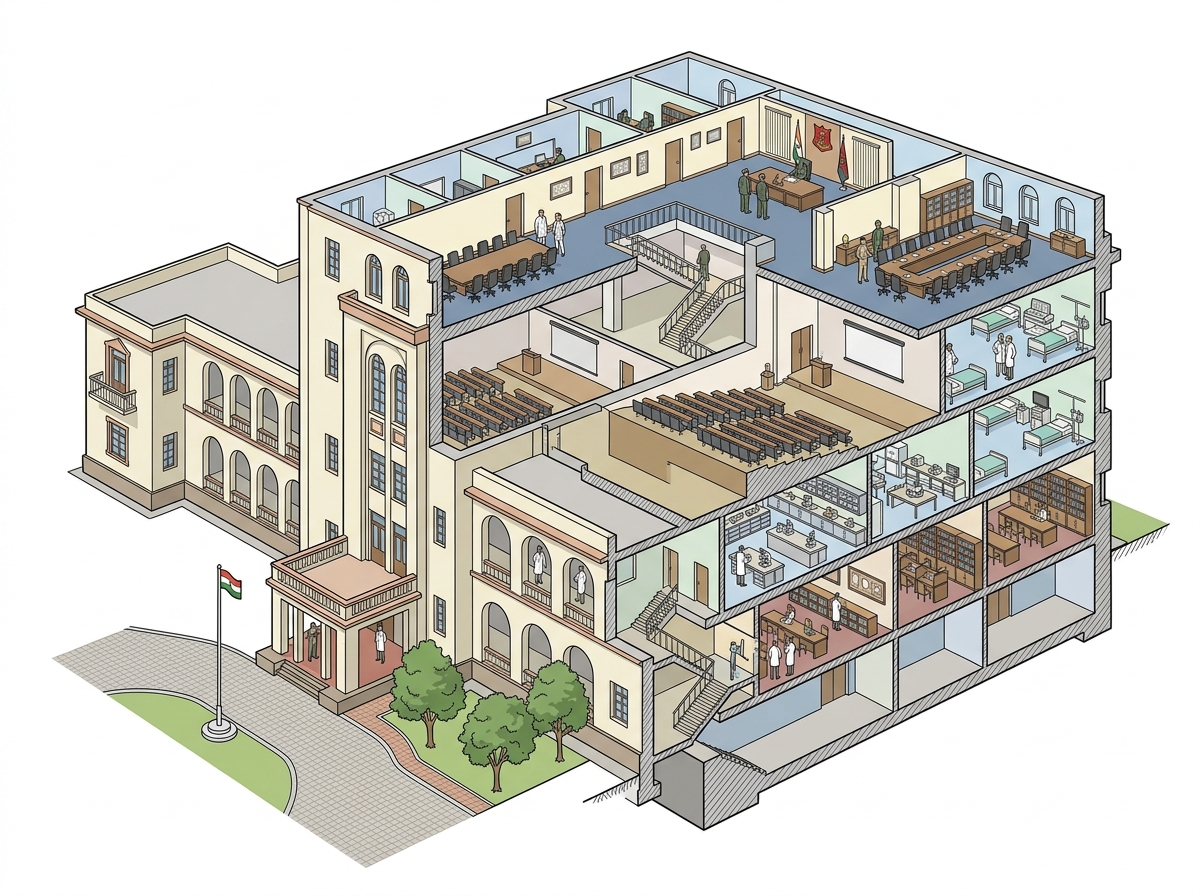
- AFMC, Pune, is a tertiary care medical institution and a deemed university under the Armed Forces Medical Services (AFMS).
- It is one of the oldest and most prestigious medical colleges in India, offering undergraduate (MBBS), postgraduate (MD/MS), and super-specialty courses in various medical disciplines.
- The college is also a centre for advanced medical research, particularly in areas relevant to military medicine, trauma care, and disaster management.
- AFMC is responsible for training medical officers for the armed forces, ensuring they are equipped with both clinical skills and leadership qualities to serve in diverse operational environments.
- The institution operates under the aegis of the Director General Armed Forces Medical Services (DGAFMS), who is the principal medical advisor to the Ministry of Defence on matters related to armed forces healthcare.
- AFMC’s curriculum integrates medical education with military training, including field exercises, disaster response drills, and exposure to high-altitude and extreme-environment medicine.
- The college is equipped with state-of-the-art simulation laboratories, including those certified by international bodies like the Society for Simulation in Healthcare (SSIH), to enhance training in critical care and emergency medicine.
Key Features
| Feature | Significance |
|---|---|
| Appointment of Surgeon Vice Admiral Manish Honwad, VSM | Represents continuity and leadership transition in a premier tri-services medical training institution (AFMC, Pune), ensuring sustained academic and clinical excellence. |
| 37+ years of service in Armed Forces Medical Services | Demonstrates institutional memory, operational experience, and a career dedicated to military medicine, trauma care, and healthcare administration. |
| Dual academic credentials: MD (Anaesthesiology & Critical Care) and MPhil (Public Administration) | Highlights the integration of clinical expertise with administrative acumen, essential for leadership in complex healthcare systems. |
| WHO Fellowship in Neuro-anaesthesiology (NIMHANS) | Reflects alignment with global best practices in critical care neurosciences, enhancing standardisation of neurocritical care protocols in the armed forces. |
| Certified Healthcare Simulation Educator (SSIH, USA) | Emphasises adoption of simulation-based medical education, a modern pedagogical tool critical for training in high-risk, low-frequency scenarios in military medicine. |
Why it Matters
Institutional Excellence and Tri-Service Integration
- AFMC, Pune, is the apex tri-service medical training institution under the Directorate General of Armed Forces Medical Services (DGAFMS), responsible for shaping the medical leadership of the Indian Armed Forces.
- The appointment underscores the importance of inter-service cooperation in medical education and trauma care, aligning with the government’s vision of ‘One Health, One Force’ for integrated defence healthcare.
- AFMC’s role in producing medical officers trained in both clinical and operational domains enhances the operational readiness of the armed forces in medical emergencies.
Advancements in Military Medical Education
- The appointee’s certification in healthcare simulation education aligns with global trends in medical training, where simulation-based learning is increasingly used for complex procedures and crisis management.
- Integration of WHO fellowships and national institutes like NIMHANS into military medical training reflects a commitment to evidence-based practices and continuous professional development.
- The emphasis on anaesthesiology and critical care is pivotal given the high incidence of trauma, burns, and neurocritical cases in modern warfare and disaster response.
Administrative and Policy Relevance
- The appointee’s MPhil in Public Administration from the Indian Institute of Public Administration (IIPA) indicates exposure to governance frameworks, relevant for policy formulation in defence healthcare systems.
- Leadership in institutions like INHS Asvini and INHS Sanjeevani demonstrates experience in managing large-scale tertiary care facilities, a skill critical for AFMC’s dual role as a hospital and training centre.
- The recognition through the ‘Vishisht Seva Medal’ (2025) and multiple commendations highlights institutional acknowledgment of excellence in service delivery, a benchmark for aspirants in defence services.
Challenges
1. Balancing Clinical Excellence with Administrative Leadership
- AFMC’s dual mandate as a teaching hospital and a tri-service training institution requires leadership capable of managing both academic rigour and clinical service delivery.
- The incumbent must navigate resource constraints in military healthcare while maintaining standards comparable to civilian apex institutions.
- Ensuring equitable access to advanced simulation-based training across all three services remains a logistical and financial challenge.
UPSC Link: GS-III: Science & Technology / GS-IV: Human Resource Management
2. Integration of Global Best Practices in Military Medicine
- Adopting WHO-endorsed protocols in neuro-anaesthesiology and critical care requires systematic training and protocol standardisation across field hospitals.
- Simulation-based education, though effective, demands significant investment in infrastructure, faculty training, and curriculum development.
- Harmonising military-specific trauma protocols with civilian emergency response systems remains a challenge in joint operations and disaster relief.
UPSC Link: GS-III: Science & Technology / GS-II: International Organisations
3. Manpower Planning and Career Progression in Defence Healthcare
- Retention of highly specialised medical officers in the armed forces is critical, given the demand for their expertise in both military and civilian sectors.
- Ensuring a balanced career trajectory that rewards clinical excellence, academic contributions, and administrative leadership is essential for long-term institutional stability.
- Addressing the shortage of specialists in niche areas like neuro-anaesthesiology and critical care within the limited pool of defence medical officers.
UPSC Link: GS-III: Science & Technology / GS-II: Government Policies
4. Standardisation of Trauma Care Protocols
- Developing and enforcing standardised trauma care protocols across all three services to ensure consistency in emergency medical response.
- Bridging the gap between advanced training in tertiary care centres (e.g., AFMC) and field-level medical units in operational theatres.
- Ensuring rapid dissemination of research findings and clinical innovations from AFMC to frontline medical units.
UPSC Link: GS-III: Science & Technology / GS-IV: Ethics
Challenges — UPSC Perspective
| Issue | Concern |
|---|---|
| Resource Allocation for Simulation-Based Training | High capital and operational costs for setting up and maintaining simulation labs across AFMC and affiliated institutions. |
| Inter-Service Coordination in Medical Training | Ensuring uniformity in curriculum and assessment standards across the Army, Navy, and Air Force medical branches. |
| Retention of Specialist Officers | Competition from civilian healthcare sectors and private practice leading to attrition of trained specialists. |
| Standardisation of Trauma Care Protocols | Developing and enforcing protocols that are adaptable to diverse operational environments and injury patterns. |
| Integration with Civilian Healthcare Systems | Ensuring seamless coordination with civilian trauma centres during joint operations and disaster response. |
Way Forward
- Enhance investment in healthcare simulation infrastructure at AFMC and affiliated institutions to scale up training capacity.
- Develop a tri-service curriculum framework for critical care and trauma management, aligned with global standards.
- Establish a dedicated faculty development programme to train medical officers in simulation-based education and neuro-anaesthesiology.
- Strengthen research collaboration between AFMC and civilian apex institutions (e.g., NIMHANS, AIIMS) to foster innovation in military medicine.
- Introduce structured career progression pathways that reward clinical excellence, academic contributions, and administrative leadership.
- Promote inter-service exchanges and joint training exercises to standardise trauma care protocols across the armed forces.
- Develop a national-level trauma registry to document injury patterns, treatment outcomes, and best practices for continuous improvement.
UPSC Value Addition
Keywords for Mains Answer-Writing
Armed Forces Medical Services · AFMC Pune · Vice Admiral M. Honwad VSM · Healthcare Simulation in Military Medicine · Defence Medical Education · Neuro-anaesthesiology · Healthcare Administration in Armed Forces · Medical Education Reforms · National Institute of Mental Health and Neurosciences (NIMHANS) · Indian Institute of Public Administration (IIPA) · Distinguished Service Medal (VSM) · Military Medical Leadership · Critical Care Medicine · Anaesthesiology in Defence Services
Concept Flow
Appointment of Surgeon Vice Admiral Manish Honwad → Leadership transition at AFMC, Pune → AFMC’s role as a tri-service medical training institution under DGAFMS → Ensures integrated healthcare leadership → Appointee’s dual expertise in clinical and administrative domains → Balances academic and service delivery mandates → Integration of WHO fellowships and simulation-based education → Adoption of global best practices in military medicine → Standardisation of trauma care protocols → Enhances operational readiness and inter-service coordination → Retention of specialist officers and resource allocation → Addresses challenges in military healthcare manpower and infrastructure
Prelims Practice Questions
Q1. Consider the following statements regarding the Armed Forces Medical College (AFMC), Pune:
1. AFMC is affiliated to the Maharashtra University of Health Sciences.
2. It is the only medical college in India that is part of the Armed Forces Medical Services.
3. AFMC offers undergraduate and postgraduate courses exclusively to serving personnel of the Armed Forces.
How many of the above statements are correct?
- Only one
- Only two
- All three
- None
Answer: Only two — Statement 1 is correct: AFMC is affiliated to the Maharashtra University of Health Sciences. Statement 2 is correct: AFMC is the premier medical institution under the Armed Forces Medical Services. Statement 3 is incorrect: AFMC admits civilian students for undergraduate and postgraduate courses alongside serving personnel.
Q2. Assertion (A): The Armed Forces Medical Services (AFMS) is a tri-service organisation under the Ministry of Defence.
Reason (R): The AFMS provides medical support to the Indian Army, Indian Navy, and Indian Air Force.
Options:
A. Both A and R are true, and R is the correct explanation of A.
B. Both A and R are true, but R is NOT the correct explanation of A.
C. A is true, but R is false.
D. A is false, but R is true.
Answer: ? — Assertion (A) is true: The AFMS is a tri-service organisation under the Ministry of Defence. Reason (R) is also true and correctly explains (A), as the AFMS provides medical support to all three services of the Indian Armed Forces.
Q3. Match the following institutions with their locations:
Institutions:
1. Armed Forces Medical College (AFMC)
2. National Institute of Mental Health and Neurosciences (NIMHANS)
3. Indian Institute of Public Administration (IIPA)
Locations:
A. Bengaluru
B. New Delhi
C. Pune
Options:
1. 1-A, 2-B, 3-C
2. 1-C, 2-A, 3-B
3. 1-B, 2-A, 3-C
4. 1-C, 2-B, 3-A
Answer: ? — 1. Armed Forces Medical College (AFMC) is located in Pune.
2. National Institute of Mental Health and Neurosciences (NIMHANS) is located in Bengaluru.
3. Indian Institute of Public Administration (IIPA) is located in New Delhi.
Mains Practice Question
✍ The Armed Forces Medical College (AFMC), Pune, serves as a critical institution in India’s defence healthcare ecosystem by integrating medical education, research, and clinical care. Critically examine the role of AFMC in enhancing the operational readiness of the Armed Forces Medical Services (AFMS). Also, analyse how modern medical education reforms, including healthcare simulation, contribute to this objective. (15 Marks)
Approach: MODEL-ANSWER SKELETON:
1. **Introduction (2 Marks)**
– Brief overview of AFMC: Established in 1948, premier medical institution under AFMS, affiliated to Maharashtra University of Health Sciences.
– Role of AFMS: Tri-service organisation under the Ministry of Defence, providing medical support to Indian Army, Navy, and Air Force.
2. **Operational Readiness through Medical Education (5 Marks)**
– **Curriculum Design**: AFMC’s MBBS and MD programmes are tailored to military requirements, including trauma care, disaster medicine, and field surgery.
– **Research and Innovation**: Contributions to military-specific research (e.g., blast injuries, infectious diseases in operational environments).
– **Human Resource Development**: Produces medical officers equipped to serve in diverse terrains (high-altitude, desert, maritime) and under extreme conditions.
– **Inter-Service Collaboration**: Facilitates joint training and standardisation across Army, Navy, and Air Force medical cadres.
3. **Clinical Care and Institutional Role (4 Marks)**
– **Tertiary Care**: AFMC’s associated hospitals (e.g., Command Hospital) provide specialised care to serving personnel and veterans.
– **Emergency Response**: Role in disaster management and humanitarian assistance missions (e.g., COVID-19, cyclones, floods).
– **Ethical and Moral Framework**: Instils values of service, discipline, and resilience in medical officers.
4. **Modern Medical Education Reforms (3 Marks)**
– **Healthcare Simulation**: Use of high-fidelity simulators for training in anaesthesiology, critical care, and neuro-anaesthesiology (as highlighted by Vice Admiral Honwad’s expertise).
– **Competency-Based Learning**: Shift from traditional didactic methods to simulation-based, experiential learning for real-time decision-making.
– **Global Benchmarking**: AFMC’s collaboration with international bodies (e.g., WHO fellowships, Society for Simulation in Healthcare) ensures alignment with global standards.
5. **Challenges and Way Forward (3 Marks)**
– **Resource Constraints**: Limited infrastructure for advanced simulation labs and research facilities.
– **Integration with Civilian Healthcare**: Need for stronger linkages with civilian medical institutions for knowledge exchange and resource optimisation.
– **Future Directions**: Expansion of telemedicine, AI-driven diagnostics, and predictive analytics in military healthcare.
6. **Conclusion (2 Marks)**
– AFMC’s multifaceted role in enhancing operational readiness through education, research, and clinical care.
– Emphasis on modernising medical training to meet evolving defence healthcare challenges.
Source: PIB (Press Information Bureau)
Maharashtra PCS (MPSC) — State PCS Practice
Prelims: Vice Admiral Manish Honwad, VSM, who recently took charge as the Director and Commandant of the Armed Forces Medical College (AFMC) in Pune, belongs to which of the following Indian Naval units?
- Western Naval Command
- Southern Naval Command
- Eastern Naval Command
- Andaman and Nicobar Command
Answer: Western Naval Command — Vice Admiral Manish Honwad is associated with the Western Naval Command, headquartered in Mumbai, Maharashtra.
Mains: Discuss the significance of the Armed Forces Medical College (AFMC) in Pune for the Indian Armed Forces and Maharashtra’s healthcare ecosystem. How does the appointment of a senior officer like Vice Admiral Manish Honwad as its Director and Commandant reflect the evolving role of AFMC in national security and medical education?
Generated by AanyaAi for educational purpose.
Related guides on our sites
- Anthropology VS PSIR
- Best PSIR optional coaching
- Best PSIR optional coaching online
- Best PSIR optional teacher

- India-Australia AUSTRAHIND 2026 Exercise: Key Highlights for UPSC & State PCS - October 22, 2026
- एससीओ बैठक में भारत का आतंकवाद विरोध: क्षेत्रीय सहयोग पर जोर - October 22, 2026
- SEC Directs Strict SC Order Compliance for Andhra ULB Polls - October 22, 2026

No Comments