


08 Sep Vijay reviews Northeast Monsoon preparedness: Key steps for Tamil Nadu
✎ Northeast Monsoon preparedness in Tamil Nadu involves a multi-layered approach combining structural interventions (desilting, drainage restoration), institutional coordination (SDMA, DDMAs, urban local bodies), and community…
Subject Relevance — Where This Topic Fits
- GS Paper II — Functions and Responsibilities of the Union and the States, Devolution of Powers and Finances up to Local Levels and Challenges Therein | GS Paper III — Disaster Management | GS Paper III — Conservation, Environmental Pollution and Degradation, Environmental Impact Assessment
- Prelims: Northeast Monsoon, Tamil Nadu, Disaster Management Act 2005, National Disaster Response Force (NDRF), State Disaster Management Authority (SDMA), Urban Flooding, Water Hyacinth, Desilting, Stormwater Drains, Community Kitchens, Relief Camps
- Essay: Climate resilience and urban governance: Balancing development with environmental sustainability, The role of local governance in disaster preparedness and community resilience
Quick Revision: Northeast Monsoon preparedness in Tamil Nadu involves a multi-layered approach combining structural interventions (desilting, drainage restoration), institutional coordination (SDMA, DDMAs, urban local bodies), and community resilience measures (evacuation plans, relief infrastructure) to mitigate urban flooding risks.
Why is this in the news?
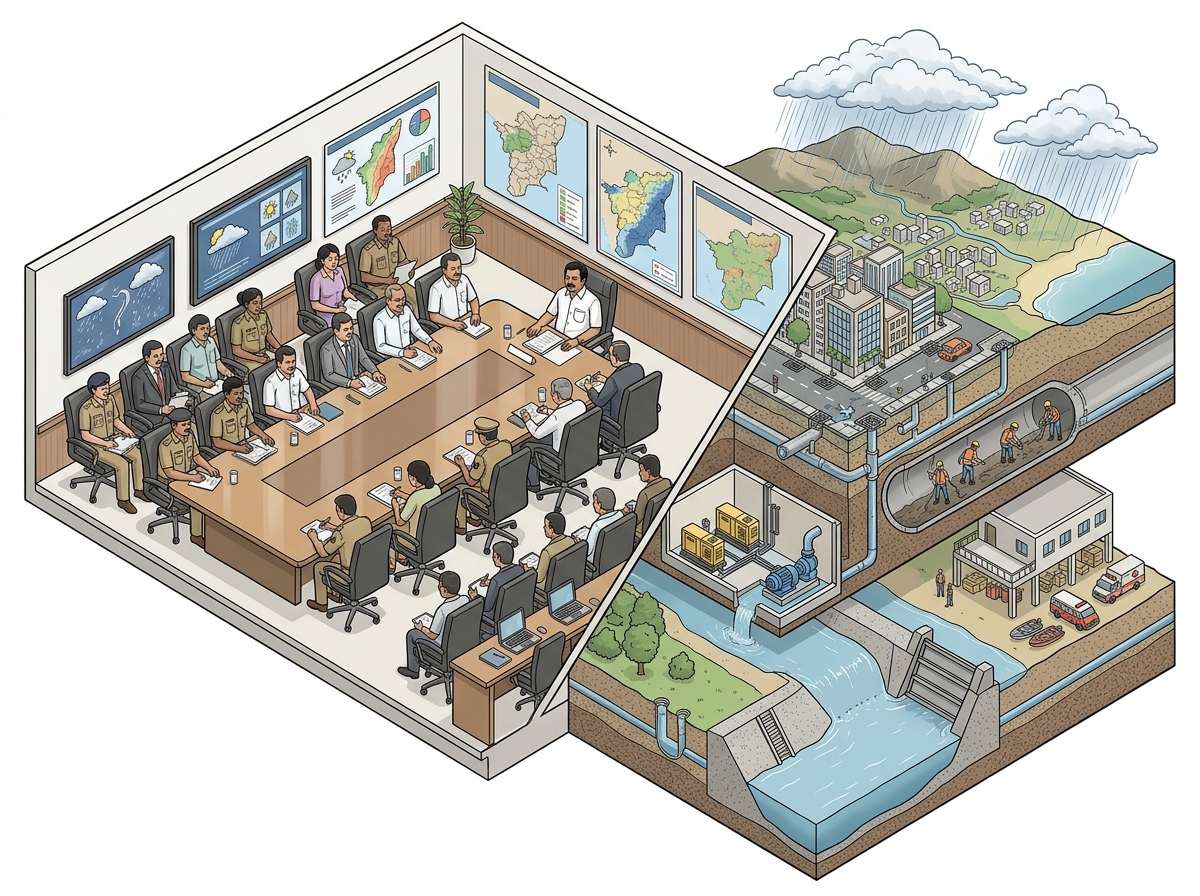
The Chief Minister of Tamil Nadu chaired a high-level meeting to review the preparedness for the Northeast Monsoon, highlighting the institutional protocols for inter-departmental coordination, infrastructure maintenance, and community-level contingency planning. This initiative underscores the state’s proactive approach to mitigating urban flooding risks, particularly in vulnerable districts such as Chennai, Kancheepuram, and Tiruvallur, and aligns with national disaster management frameworks.
Background
- The Northeast Monsoon, primarily affecting Tamil Nadu, Puducherry, coastal Andhra Pradesh, and Kerala, contributes 48% of the annual rainfall in Tamil Nadu, with peak precipitation occurring between October and December.
- Tamil Nadu has historically faced severe urban flooding events, notably in 2015 and 2020, which exposed systemic vulnerabilities in drainage infrastructure, water body encroachments, and emergency response mechanisms.
- The Disaster Management Act 2005 mandates the establishment of State Disaster Management Authorities (SDMAs) and District Disaster Management Authorities (DDMAs) to coordinate preparedness, mitigation, and response activities.
- Urban flooding in Chennai is exacerbated by factors such as unplanned urbanisation, encroachment of water bodies, inadequate maintenance of stormwater drains, and the proliferation of invasive aquatic weeds like water hyacinth.
- The Tamil Nadu State Disaster Management Plan (2023) prioritises flood risk reduction through structural measures (desilting, drainage restoration) and non-structural measures (early warning systems, community awareness).
- The National Disaster Response Force (NDRF) and State agencies conduct joint mock drills and capacity-building exercises to enhance response readiness for monsoon-related disasters.
What is Northeast Monsoon Preparedness in the Context of Urban Flood Management?
- Northeast Monsoon preparedness refers to the systematic planning and execution of measures to mitigate the adverse impacts of heavy rainfall during the October–December period, particularly in urban areas prone to waterlogging and flooding.
- Key structural interventions include desilting of canals and stormwater drains, removal of water hyacinth from water bodies, and reinforcement of drainage networks to ensure rapid runoff of excess water.
- Non-structural measures encompass inter-departmental coordination, real-time monitoring of vulnerable zones, and the establishment of relief infrastructure such as community kitchens, temporary shelters, and evacuation protocols.
- The Disaster Management Act 2005 empowers state governments to designate nodal agencies (e.g., Tamil Nadu State Disaster Management Authority) to oversee preparedness, response, and recovery operations during monsoon seasons.
- Urban local bodies, such as the Greater Chennai Corporation, play a critical role in coordinating with agencies like the Chennai Metropolitan Water Supply and Sewerage Board (CMWSSB) and the Police to execute flood mitigation strategies.
- Community-level preparedness involves the identification of low-lying areas, pre-positioning of rescue equipment (boats, pumps), and conducting awareness campaigns to ensure public participation in evacuation and safety protocols.
- The integration of technology, such as GIS-based flood mapping and early warning systems, enhances the precision of risk assessment and resource allocation during monsoon preparedness phases.
- Preparedness also includes the repair of critical infrastructure, such as electric poles and wires, to prevent power disruptions and fire hazards during flooding events.
Key Features
| Feature | Significance |
|---|---|
| Inter-departmental coordination meetings | Ensures integrated preparedness across all agencies, avoiding siloed responses to monsoon risks. |
| Weekly inspection of flood-prone and vulnerable areas | Facilitates real-time assessment of infrastructure gaps and preemptive corrective action. |
| Desilting of canals, drains, and removal of water hyacinth | Enhances drainage capacity, reducing urban flooding risk by improving hydrological flow. |
| Pre-monsoon completion of critical infrastructure works | Mitigates delays during monsoon by ensuring drinking water, sewage, and road networks are monsoon-ready. |
| Pre-positioning of emergency equipment (pumps, saws, boats) | Enables rapid response to waterlogging, fallen trees, and evacuation needs during extreme weather events. |
Why it Matters
Urban Flood Management
- Chennai’s vulnerability to urban flooding stems from rapid unplanned urbanisation, encroachment of water bodies, and inadequate drainage infrastructure.
- Northeast monsoon preparedness in Chennai exemplifies State-led disaster risk reduction (DRR) in high-density urban centres.
- Proactive measures such as desilting and water hyacinth removal address structural bottlenecks that exacerbate flooding.
Institutional Coordination
- Multi-departmental coordination (Greater Chennai Corporation, CMWSSB, Police, Fire Services) demonstrates the Integrated Disaster Management (IDM) approach mandated under the Disaster Management Act, 2005.
- District-level coordination meetings align with the District Disaster Management Plans (DDMPs) under the National Disaster Management Authority (NDMA) guidelines.
Public Health and Safety
- Preparation of community halls and schools as relief shelters ensures adherence to the Sendai Framework for Disaster Risk Reduction’s priority on protecting lives and livelihoods.
- Pre-positioning of community kitchens and safe drinking water aligns with the National Disaster Response Framework’s emphasis on humanitarian assistance.
Climate Resilience
- Urban flood preparedness in Chennai reflects adaptation strategies to climate change, particularly intensified rainfall patterns in peninsular India.
- Removal of invasive species like water hyacinth improves ecological resilience of water bodies, aiding long-term drainage efficiency.
Challenges
1. URBAN DRAINAGE INFRASTRUCTURE DEFICITS
- Rapid urbanisation has outpaced the upgradation of stormwater drainage systems, leading to recurrent waterlogging.
- Encroachment of natural water channels and lakes reduces the city’s flood absorption capacity.
- Siltation and debris accumulation in drains and canals exacerbate drainage inefficiency.
UPSC Link: GS3: Disaster Management
2. CLIMATE CHANGE-INDUCED RAINFALL INTENSITY
- Increased frequency of extreme rainfall events in peninsular India, as projected by the India Meteorological Department (IMD), strains existing drainage systems.
- Urban heat island effect and reduced green cover amplify localised flooding risks.
UPSC Link: GS3: Climate Change
3. COORDINATION GAPS AMONG STAKEHOLDERS
- Historical silos between municipal bodies, water utilities, and emergency services hinder seamless disaster response.
- Lack of standardised protocols for inter-departmental communication during crises delays decision-making.
UPSC Link: GS2: Centre-State Relations
4. PRE-MONSOON INFRASTRUCTURE BACKLOGS
- Pending civic works (drinking water, sewage, roads) often remain incomplete due to resource constraints or bureaucratic delays.
- Inadequate maintenance of electric infrastructure (poles, wires) poses electrocution and fire hazards during monsoons.
UPSC Link: GS2: Governance
5. RESOURCE MOBILISATION FOR EMERGENCY RESPONSE
- Ensuring adequate stockpiles of pumps, boats, and emergency equipment requires pre-season budgetary allocations and logistical planning.
- Community-level preparedness, including training in evacuation drills, remains inconsistent.
UPSC Link: GS3: Disaster Management
Challenges — UPSC Perspective
| Issue | Concern |
|---|---|
| Encroachment of water bodies | Reduces flood absorption capacity and disrupts natural drainage systems. |
| Siltation in canals and drains | Diminishes flow capacity, increasing urban flooding risk. |
| Inadequate maintenance of electric infrastructure | Poses electrocution and fire hazards during heavy rainfall. |
| Delayed completion of civic works | Leaves critical infrastructure vulnerable during monsoon season. |
| Limited community-level preparedness | Hampers effective evacuation and relief operations in flood-prone areas. |
Way Forward
- Constitute a multidisciplinary task force comprising engineers, urban planners, and meteorologists to audit and upgrade Chennai’s stormwater drainage network.
- Accelerate pre-monsoon completion of pending civic infrastructure projects through time-bound tendering and monitoring mechanisms.
- Implement GIS-based mapping of flood-prone zones and drainage bottlenecks for data-driven decision-making.
- Strengthen inter-departmental coordination protocols under the Disaster Management Act, 2005, with clear accountability matrices.
- Launch public awareness campaigns on flood preparedness, including evacuation drills and community-level emergency response training.
- Enhance real-time monitoring of water bodies and drains using IoT sensors to predict and mitigate flooding risks.
- Establish a dedicated fund for rapid deployment of emergency equipment (pumps, boats) in high-risk districts.
- Integrate climate resilience into urban planning by restoring natural water bodies and expanding green cover.
UPSC Value Addition
Keywords for Mains Answer-Writing
Northeast Monsoon preparedness · Disaster Management in India · Urban Flood Mitigation · Stormwater Drainage Systems · Water Hyacinth Management · Inter-Departmental Coordination · District-Level Disaster Preparedness · Flood Risk Reduction Strategies · Climate Resilience in Urban Planning · Tamil Nadu State Disaster Management Authority · National Disaster Management Authority (NDMA) · Community-Based Disaster Preparedness · Integrated Water Resource Management · Urban Drainage Infrastructure · Climate Change and Monsoon Variability
Concept Flow
Rapid urbanisation and climate change → Increased intensity and frequency of Northeast monsoon rainfall → Inadequate drainage infrastructure and encroachment of water bodies → Urban flooding and waterlogging → Disruption of civic services (water supply, electricity, transport) → Public health risks and economic losses → State-led disaster preparedness measures (desilting, coordination, equipment pre-positioning) → Mitigation of immediate impacts and long-term resilience building
Prelims Practice Questions
Q1. Consider the following statements regarding the Northeast Monsoon in India:
1. The Northeast Monsoon primarily affects the eastern coast of India, including Tamil Nadu.
2. It is responsible for the majority of the annual rainfall in Tamil Nadu.
3. The Northeast Monsoon season is from October to December.
4. The India Meteorological Department (IMD) does not issue forecasts for the Northeast Monsoon.
How many of the above statements are correct?
- Only one
- Only two
- Only three
- All
Answer: Only three — Statements 1, 2, and 3 are correct. The Northeast Monsoon affects the eastern coast of India, including Tamil Nadu, and contributes significantly to its annual rainfall. The season is from October to December. Statement 4 is incorrect as the IMD issues forecasts for the Northeast Monsoon.
Q2. Assertion (A): Urban flood mitigation requires a multi-departmental approach involving coordination between water supply, drainage, health, and emergency services.
Reason (R): Urban flooding is primarily caused by inadequate drainage infrastructure and not by meteorological factors.
Options:
A. Both A and R are true, and R is the correct explanation of A.
B. Both A and R are true, but R is not the correct explanation of A.
C. A is true, but R is false.
D. A is false, but R is true.
- A
- B
- C
- D
Answer: C — Assertion (A) is true as urban flood mitigation indeed requires coordination among multiple departments. Reason (R) is false because urban flooding is influenced by both inadequate drainage infrastructure and meteorological factors such as heavy rainfall.
Q3. Match the following pairs related to disaster management in India:
Column I
1. National Disaster Management Authority (NDMA)
2. State Disaster Management Authority (SDMA)
3. District Disaster Management Authority (DDMA)
4. National Disaster Response Force (NDRF)
Column II
A. Implements disaster management policies at the district level
B. Coordinates disaster response at the national level
C. Implements disaster management policies at the state level
D. Specialized force for disaster response under the NDMA
Choose the correct match:
- 1-B, 2-C, 3-A, 4-D
- 1-A, 2-B, 3-C, 4-D
- 1-D, 2-A, 3-B, 3-C
- 1-C, 2-D, 3-A, 4-B
Answer: 1-B, 2-C, 3-A, 4-D — 1-B: NDMA coordinates disaster response at the national level. 2-C: SDMA implements disaster management policies at the state level. 3-A: DDMA implements disaster management policies at the district level. 4-D: NDRF is a specialized force for disaster response under the NDMA.
Mains Practice Question
✍ The preparedness for the Northeast Monsoon in urban areas necessitates a multi-dimensional approach integrating infrastructure, inter-departmental coordination, and community resilience. Critically examine the challenges and strategies involved in this process with reference to recent initiatives in Tamil Nadu. (15 Marks)
Approach: MODEL-ANSWER SKELETON:
1. **Introduction (2 Marks)**
– Define the Northeast Monsoon and its significance for Tamil Nadu (e.g., 50-60% of annual rainfall).
– State the context: Urban flooding in Chennai and other coastal districts due to inadequate drainage, waterlogging, and climate variability.
2. **Challenges in Urban Monsoon Preparedness (5 Marks)**
– **Infrastructure Deficits**: Aging stormwater drains, siltation, and encroachments (cite Comptroller and Auditor General (CAG) reports or NDMA guidelines).
– **Water Hyacinth Infestation**: Blockage of water bodies and drains (reference National Green Tribunal (NGT) directives or Tamil Nadu Pollution Control Board (TNPCB) actions).
– **Inter-Departmental Coordination Gaps**: Lack of synchronization between agencies like Greater Chennai Corporation, CMWSSB, and Fire and Rescue Services.
– **Climate Change Impact**: Increased frequency of extreme rainfall events (IPCC AR6 findings or IMD data).
– **Community Vulnerabilities**: Informal settlements in low-lying areas and lack of awareness.
3. **Strategies and Recent Initiatives (5 Marks)**
– **Infrastructure Upgrades**: Desilting of drains, construction of new stormwater networks, and removal of water hyacinth (reference Tamil Nadu’s ‘Namma Chennai’ project or Smart City Mission components).
– **Institutional Mechanisms**: Formation of District Disaster Management Authorities (DDMAs) and weekly inspections by senior officials (reference NDMA guidelines).
– **Technology Integration**: Use of GIS mapping for flood-prone areas and real-time monitoring systems (cite examples from Ahmedabad’s flood management or NDMA’s initiatives).
– **Community Preparedness**: Pre-positioning of relief materials, community kitchens, and evacuation plans (reference Tamil Nadu State Disaster Management Plan 2023-2028).
– **Legal and Policy Frameworks**: Compliance with the Disaster Management Act, 2005, and National Disaster Management Policy.
4. **Critical Analysis and Way Forward (3 Marks)**
– **Strengths**: Highlight Tamil Nadu’s proactive measures (e.g., weekly inspections, multi-departmental coordination).
– **Limitations**: Persistent challenges like encroachments, funding gaps, and climate adaptation lag.
– **Sustainable Solutions**: Emphasize nature-based solutions (e.g., restoration of wetlands), decentralized governance, and public-private partnerships.
– **Conclusion**: Stress the need for a holistic, climate-resilient approach to urban monsoon preparedness.
Source: The Hindu
Generated by AanyaAi for educational purpose.
Related guides on our sites
- Best geography optional coaching
- Best geography optional coaching
- Best geography optional teacher
- Best geography optional teacher

- हिमाचल में पर्यटन निवेश: मुख्यमंत्री सुक्खू का 15,000 करोड़ रुपये का बड़ा प्लान - October 26, 2026
- NLCL achieves key targets under Special Campaign 6: Polity & Governance insights - October 26, 2026
- सर्दियों से पहले दिल्ली में वाहनों से प्रदूषण कम करने के लिए NCR पुलिस की मदद - October 26, 2026

No Comments