


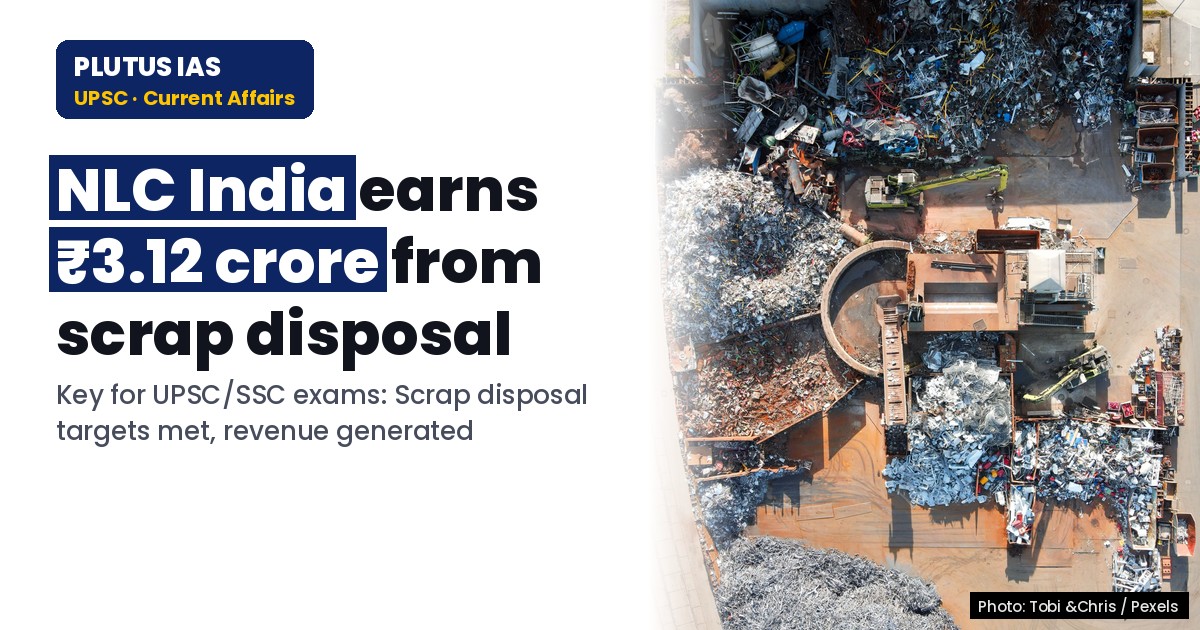
26 Oct NLCL achieves key targets under Special Campaign 6: Polity & Governance insights
✎ Special Campaign 6 is a DARPG-led governance initiative promoting operational excellence, environmental compliance, and administrative efficiency in PSUs, with measurable outcomes in waste management, record digitization, and…
Subject Relevance — Where This Topic Fits
- GS Paper II — Governance, Transparency and Accountability | GS Paper III — Environment and Sustainable Development, Resource Efficiency
- Prelims: Special Campaign 6, E-Waste (Management) Rules, 2022, Public Sector Undertakings (PSUs), Scrap disposal revenue, Administrative Reforms and Public Grievances Department (DARPG), Circular economy, Resource efficiency, E-governance
- Essay: Sustainable resource management as a governance imperative, The role of PSUs in advancing environmental compliance and administrative efficiency
Quick Revision: Special Campaign 6 is a DARPG-led governance initiative promoting operational excellence, environmental compliance, and administrative efficiency in PSUs, with measurable outcomes in waste management, record digitization, and process simplification.
Why is this in the news?
NLC India Limited (NLCIL), a Navratna Central Public Sector Enterprise under the Ministry of Coal, has achieved significant milestones under Special Campaign 6, a nationwide initiative led by the Department of Administrative Reforms and Public Grievances (DARPG). The campaign, conducted from 2–31 October 2026, focused on institutional waste management, scrap disposal, and administrative streamlining, resulting in measurable outcomes such as revenue generation from scrap disposal, environmental compliance, and improved record management.
Background
- Special Campaign 6 is a pan-India governance initiative launched by the Department of Administrative Reforms and Public Grievances (DARPG) to promote operational excellence, transparency, and sustainability across all Central Ministries and Public Sector Undertakings (PSUs).
- The campaign builds on the framework of previous editions, particularly Special Campaign 5.0, which emphasized governance reforms and cleanliness drives in PSUs.
- E-Waste (Management) Rules, 2022, mandate systematic collection, segregation, and environmentally sound disposal of electronic waste, aligning with India’s commitment to the Sustainable Development Goals (SDGs).
- NLC India Limited, a major coal and lignite mining PSU, operates multiple units across India and has integrated sustainability and resource efficiency into its operational strategy.
- The campaign period (15–30 September 2026: preparation phase; 2–31 October 2026: implementation phase) was designed to align with DARPG’s directives and ensure measurable outcomes within a fixed timeframe.
What is Special Campaign 6?
- Special Campaign 6 is a time-bound, outcome-focused governance initiative mandated by the Department of Administrative Reforms and Public Grievances (DARPG) to drive administrative efficiency, transparency, and sustainability across all Central Ministries and Public Sector Undertakings (PSUs).
- The campaign operates on a two-phase model: a preparation phase (15–30 September 2026) for target setting and planning, followed by an implementation phase (2–31 October 2026) for execution and monitoring.
- Key thematic areas include: (i) waste management and scrap disposal, (ii) record management and digitization, (iii) process simplification, and (iv) citizen grievance redressal.
- The campaign emphasizes compliance with environmental regulations, particularly the E-Waste (Management) Rules, 2022, to ensure environmentally sound management of electronic waste.
- Administrative reforms under the campaign aim to reduce bureaucratic bottlenecks, streamline procedures, and enhance service delivery through digital tools and process reengineering.
- Special Campaign 6 is part of a broader national effort to institutionalize good governance practices, reduce carbon footprints, and promote circular economy principles in public sector operations.
- The initiative is aligned with India’s commitment to the Sustainable Development Goals (SDGs), particularly SDG 12 (Responsible Consumption and Production) and SDG 13 (Climate Action).
- Monitoring and evaluation are conducted through real-time dashboards, field inspections, and third-party audits to ensure accountability and transparency.
Key Features
| Feature | Significance |
|---|---|
| Swachhata Abhiyan Sites | Identification of 180 sites for cleanliness drives, exceeding the target of 145, ensuring systematic waste management across operational units. |
| Scrap Disposal | Disposal of 1,272 metric tonnes of scrap, surpassing the target of 1,266.22 metric tonnes, generating ₹3.12 crore in revenue. |
| E-Waste Management | Processing of 2,042 e-waste items across three categories, aligning with E-Waste Management Rules, 2022 for environmentally sound disposal. |
| Record Management | Review of 1,378 physical and 320 e-files, disposal of 506 physical and 122 e-files, enhancing administrative efficiency. |
| Citizen Grievance Redressal | Zero pending complaints, demonstrating commitment to responsive governance and public service delivery. |
Why it Matters
Economic
- Revenue generation of ₹3.12 crore from scrap disposal, contributing to financial sustainability of public sector enterprises.
- Efficient resource utilisation through circular economy principles, reducing costs associated with waste management.
- Enhanced operational efficiency by streamlining administrative processes and record-keeping.
Environmental
- Compliance with E-Waste Management Rules, 2022, ensuring safe disposal and recycling of electronic waste.
- Promotion of environmentally sound scrap disposal practices, reducing landfill burden and pollution.
- Adoption of sustainable resource management in industrial operations, aligning with national climate goals.
Administrative
- Demonstration of commitment to governance reforms under Special Campaign 6, enhancing transparency and accountability.
- Improved record management through digitisation and file disposal, reducing bureaucratic inefficiencies.
- Strengthening of institutional capacity for waste management and operational excellence.
Strategic
- Alignment with national initiatives for cleanliness and waste management, reinforcing public sector leadership.
- Integration of sustainability principles into core business operations, enhancing corporate social responsibility.
- Setting benchmarks for other PSUs in efficient resource utilisation and environmental compliance.
Challenges
1. Compliance with E-Waste Regulations
- Ensuring strict adherence to E-Waste Management Rules, 2022 across all operational units and supply chains.
- Addressing challenges in sourcing certified e-waste recyclers and disposal facilities.
- Training workforce in safe handling and disposal of hazardous electronic components.
UPSC Link: GS3: Environmental Pollution
2. Operational Efficiency in Waste Management
- Balancing scrap disposal targets with logistical constraints in large-scale industrial operations.
- Managing costs associated with environmentally compliant waste processing and recycling.
- Integrating digital tools for real-time tracking of waste generation and disposal.
UPSC Link: GS3: Resource Mobilisation
3. Administrative Bottlenecks in Record Management
- Overcoming resistance to digitisation and file disposal in traditional bureaucratic setups.
- Ensuring seamless transition from physical to digital records without data loss.
- Maintaining transparency while disposing of redundant administrative records.
UPSC Link: GS2: Governance
4. Public Awareness and Stakeholder Engagement
- Educating employees and local communities on responsible waste disposal practices.
- Collaborating with government agencies, NGOs, and private recyclers for effective e-waste management.
- Addressing misconceptions about scrap disposal and its economic-environmental trade-offs.
UPSC Link: GS3: Environmental Conservation
Challenges — UPSC Perspective
| Issue | Concern |
|---|---|
| E-Waste Certification | Lack of certified recyclers in all regions, leading to potential non-compliance risks. |
| Logistical Constraints | High transportation costs and delays in scrap disposal from remote industrial units. |
| Digital Divide | Limited adoption of digital record-keeping in certain operational units, hindering efficiency. |
| Cost of Compliance | Investments required for environmentally compliant waste processing infrastructure. |
| Workforce Training | Need for continuous upskilling of staff in hazardous waste handling protocols. |
Government Initiatives — Must-Memorise for Prelims
- E-Waste Management Rules, 2022
- Special Campaign 6 (Department of Administrative Reforms and Public Grievances)
Way Forward
- Scale up certified e-waste recycling partnerships to ensure full regulatory compliance.
- Invest in digital infrastructure for real-time monitoring of waste generation and disposal.
- Expand workforce training programs on hazardous waste handling and environmental safety.
- Enhance public-private collaborations for cost-effective and sustainable waste management solutions.
- Integrate sustainability metrics into performance appraisals of operational units.
- Publish annual sustainability reports to track progress and maintain transparency.
- Leverage social media and digital platforms for continuous awareness campaigns on waste reduction.
UPSC Value Addition
Keywords for Mains Answer-Writing
Special Campaign 6 · NLC India Limited · E-waste Management Rules 2022 · Scrap disposal · Resource efficiency · Administrative Reforms and Public Grievances Department (DARPG) · Circular economy · Sustainable resource management · Public Sector Undertakings (PSUs) · E-governance · Waste-to-wealth · Corporate sustainability · Government waste management initiatives · Environmental compliance
Concept Flow
Initiation of Special Campaign 6 by DARPG → Establishment of operational targets for PSUs → Identification of 180 Swachhata sites and 2,042 e-waste items for disposal → Implementation of waste management protocols under E-Waste Management Rules, 2022 → Revenue generation (₹3.12 crore) and environmental compliance through scrap disposal → Digitisation of records and disposal of redundant files for administrative efficiency → Zero pending grievances, demonstrating responsive governance → Reinforcement of circular economy principles in industrial operations
Prelims Practice Questions
Q1. Consider the following statements regarding Special Campaign 6:
1. It is an initiative led by the Department of Administrative Reforms and Public Grievances (DARPG).
2. The campaign focuses on institutional e-waste management under the E-waste Management Rules, 2022.
3. It mandates the disposal of all types of waste, including hazardous and non-hazardous, without any focus on resource recovery.
How many of the above statements are correct?
- Only one
- Only two
- All
- None
Answer: Only two — Statement 1 is correct as Special Campaign 6 is indeed led by DARPG. Statement 2 is correct as the campaign emphasizes institutional e-waste management under the E-waste Management Rules, 2022. Statement 3 is incorrect because the campaign promotes resource recovery and circular economy principles, not indiscriminate disposal.
Q2. Assertion (A): The E-waste Management Rules, 2022, mandate the environmentally sound management of e-waste in India.
Reason (R): These rules were notified under the provisions of the Environment (Protection) Act, 1986, to ensure sustainable resource management.
Options:
A. Both A and R are true, and R is the correct explanation of A.
B. Both A and R are true, but R is not the correct explanation of A.
C. A is true, but R is false.
D. A is false, but R is true.
Answer: ? — Assertion (A) is true as the E-waste Management Rules, 2022, do mandate environmentally sound management of e-waste. Reason (R) is also true as these rules were notified under the Environment (Protection) Act, 1986, and the campaign aligns with sustainable resource management principles. However, R is not the correct explanation of A as the assertion is a direct provision of the rules, while the reason provides the legal basis.
Mains Practice Question
✍ Examine the significance of Special Campaign 6 in promoting sustainable resource management and circular economy principles within Public Sector Undertakings (PSUs). Substantiate your answer with reference to the initiatives undertaken by NLC India Limited (NLCIL) under this campaign. (15 Marks)
Approach: MODEL-ANSWER SKELETON:
1. **Introduction (2 Marks)**
– Define Special Campaign 6 and its objectives as a nationwide initiative led by DARPG.
– Highlight the focus on administrative reforms, waste management, and resource efficiency.
2. **Sustainable Resource Management and Circular Economy (4 Marks)**
– Explain the principles of sustainable resource management and circular economy.
– Link these principles to the E-waste Management Rules, 2022, and their role in promoting environmentally sound management.
– Discuss how Special Campaign 6 aligns with these principles through institutional waste management.
3. **NLC India Limited’s Initiatives (5 Marks)**
– Detail the specific actions taken by NLCIL under Special Campaign 6:
– Scrap disposal (1,272 metric tonnes) and revenue generation (₹3.12 crore).
– Cleanliness drives (180 sites identified and cleaned).
– Record management improvements (1,378 physical files and 320 e-files reviewed).
– E-waste management (2,042 items processed across three categories).
– Highlight the integration of digital tools (e.g., social media outreach, 352 tweets, 8 videos).
4. **Broader Implications (3 Marks)**
– Discuss the role of PSUs in promoting sustainability and circular economy.
– Evaluate the potential for scaling such initiatives across other PSUs.
– Comment on the long-term benefits for environmental compliance and resource efficiency.
5. **Conclusion (1 Mark)**
– Summarize the importance of Special Campaign 6 in driving administrative and environmental reforms in PSUs.
Source: PIB (Press Information Bureau)
Generated by AanyaAi for educational purpose.
Related guides on our sites
- Anthropology VS PSIR
- Best PSIR optional coaching
- Best PSIR optional coaching online
- Best PSIR optional teacher


No Comments