


09 Aug Vikram-1 Launch: How India’s PPP Model Boosts Space Sector for UPSC
✎ Vikram-1’s successful launch by Skyroot Aerospace under India’s space sector reforms marks a transformational shift from ISRO-centric to collaborative space missions, enabling private innovation while leveraging ISRO’s technical…
Subject Relevance — Where This Topic Fits
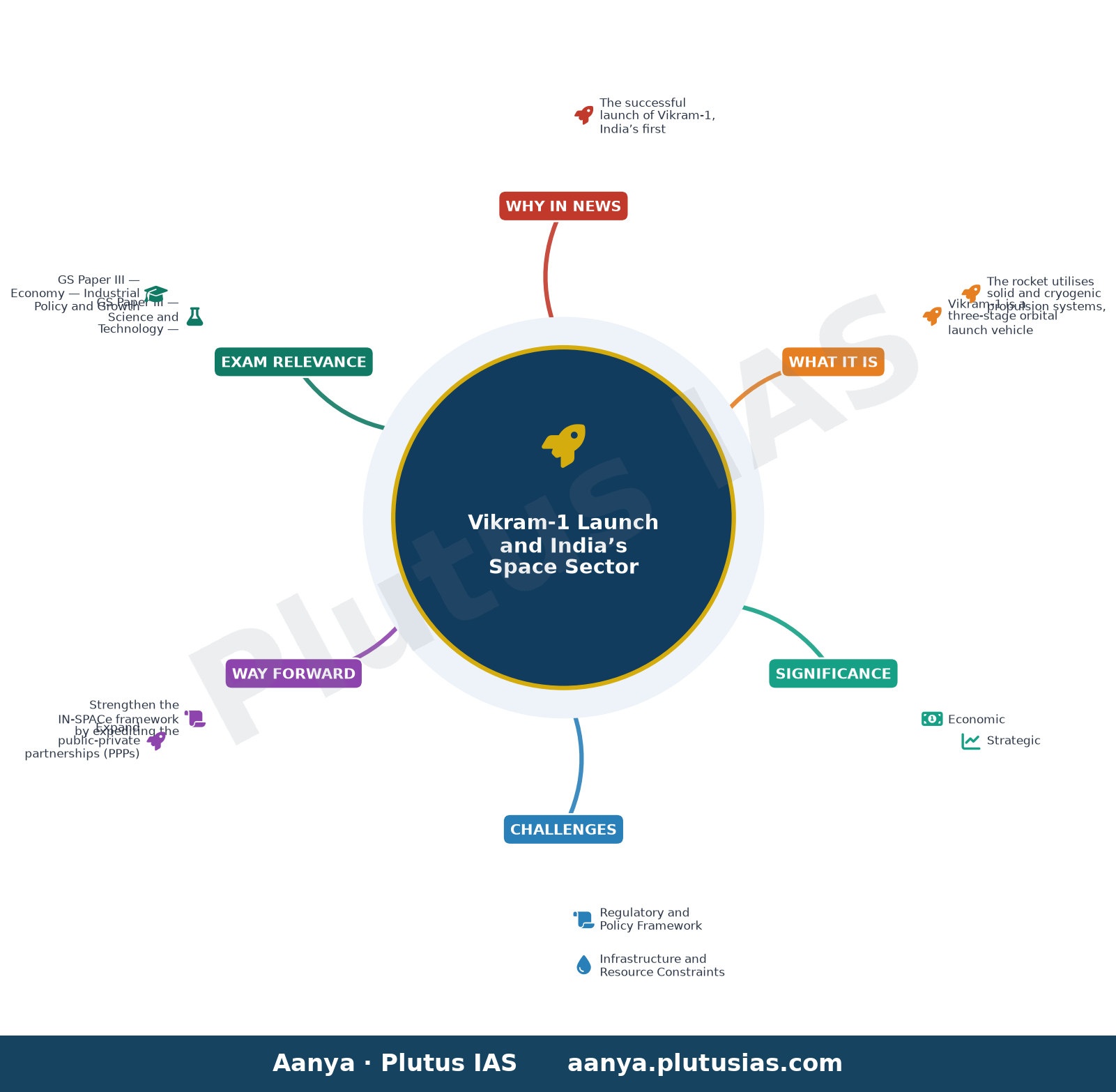
- GS Paper III — Science and Technology — Developments and their Applications and Effects in Everyday Life | GS Paper III — Economy — Industrial Policy and Growth | GS Paper III — Disaster and Disaster Management
- Prelims: Vikram-1 launch, ISRO, Skyroot Aerospace, Space Sector Reforms, IN-SPACe, FDI in space sector, Chandrayaan missions, IIST
- Essay: The role of public-private partnerships in India’s technological self-reliance, India’s emergence as a global space power: opportunities and challenges
Quick Revision: Vikram-1’s successful launch by Skyroot Aerospace under India’s space sector reforms marks a transformational shift from ISRO-centric to collaborative space missions, enabling private innovation while leveraging ISRO’s technical and infrastructural support.
Why is this in the news?
The successful launch of Vikram-1, India’s first privately developed orbital rocket, by Skyroot Aerospace marks a seminal moment in the country’s space sector. ISRO Chairperson V. Narayanan highlighted this achievement as a testament to the efficacy of India’s space sector reforms, which have fostered unprecedented collaboration between public institutions and private enterprises. The event underscores the transformative potential of these reforms in positioning India as a global leader in space technology while enhancing commercial viability and innovation.
Background
- India’s space programme, historically led by ISRO, has evolved from a state-centric model to one that actively encourages private sector participation through policy reforms.
- Prior to reforms, private participation was limited to manufacturing components or providing ancillary services; post-reforms, entities like Skyroot Aerospace are developing and launching full-fledged orbital rockets.
- The Vikram-1 launch follows the suborbital flight of Skyroot’s Vikram-S in November 2022, demonstrating the rapid maturation of India’s private space industry.
- ISRO’s role has transitioned from sole operator to enabler, providing technical expertise, infrastructure, and mentorship to private players while focusing on high-end missions.
What is Vikram-1 and India’s Space Sector Reforms?
- Vikram-1 is a three-stage orbital launch vehicle developed by Skyroot Aerospace, designed to place payloads of up to 300 kg into Low Earth Orbit (LEO). It represents India’s first privately built orbital rocket, signifying a shift from government-led to industry-driven space missions.
- The rocket utilises solid and cryogenic propulsion systems, incorporating advanced materials like carbon composites to enhance payload efficiency and reduce costs.
- India’s space sector reforms dismantled the monopoly of ISRO by allowing private entities to engage in end-to-end space activities, including satellite manufacturing, launch services, and space-based applications.
- Key reforms include the creation of IN-SPACe as a regulatory and promotional body and the liberalisation of FDI norms.
- The reforms aim to enhance India’s share in the global space economy, which is projected to reach $1 trillion by 2040, while fostering innovation, job creation, and indigenous technological development.
- Private participation has extended beyond launch services to include satellite constellations, ground stations, and data analytics, creating a diversified ecosystem.
- ISRO’s support to private players includes sharing technical know-how, providing launch infrastructure, and mentoring startups through initiatives like the ISRO Startup Initiative.
- The Vikram-1 launch exemplifies the synergy between ISRO’s legacy expertise and the agility of private enterprises, enabling rapid iteration and cost-effective solutions.
Key Features
| Feature | Significance |
|---|---|
| Vikram-1 launch by Skyroot Aerospace | Demonstrates operational validation of India’s space sector reforms, particularly the liberalisation of launch services under the IN-SPACe framework. |
| ISRO’s continued support to private sector | Facilitates technology transfer, mentorship, and infrastructure access, ensuring sustainable growth of the commercial space ecosystem. |
| IIST convocation address by ISRO Chairperson | Highlights the integration of academic excellence with industry-relevant space technologies, reinforcing the need for self-reliance in critical domains. |
| Governor’s emphasis on Viksit Bharat | Reinforces the national aspiration of leveraging space science for socio-economic development and global leadership. |
| Degrees awarded at IIST convocation | Reflects the expanding human capital pipeline in space science and technology, essential for sustaining innovation in the sector. |
Why it Matters
Economic
- Enhances India’s share in the global space economy, projected to reach USD 40 billion by 2040, through cost-effective and innovative private sector participation.
- Stimulates job creation in high-technology sectors, including manufacturing, R&D, and allied industries, particularly in aerospace engineering and satellite applications.
- Attracts foreign direct investment (FDI) and fosters international collaborations, positioning India as a competitive hub for commercial space missions.
Strategic
- Reduces dependency on foreign launch services for small satellite deployments, ensuring sovereign access to space for national security and developmental priorities.
- Strengthens India’s position in the global space race, particularly in the context of lunar exploration and deep-space missions, as evidenced by Chandrayaan achievements.
- Enhances strategic autonomy by diversifying capabilities across public and private entities, mitigating risks associated with single-point failures.
Technological
- Accelerates indigenous development of launch vehicles, satellite systems, and propulsion technologies, reducing reliance on imported components.
- Promotes innovation in reusable launch systems and modular satellite designs, aligning with global trends in sustainable space exploration.
- Facilitates the integration of emerging technologies such as AI, IoT, and quantum computing in space missions, enhancing mission efficiency and data utilisation.
Educational
- Reinforces the role of premier institutions like IIST in nurturing a skilled workforce capable of driving the space sector’s growth and innovation.
- Encourages interdisciplinary research, bridging gaps between theoretical knowledge and practical applications in aerospace engineering.
- Fosters a culture of entrepreneurship among graduates, enabling the creation of startups that contribute to the commercialisation of space technologies.
Challenges
1. Regulatory and Policy Framework
- Ensuring consistency and clarity in the implementation of space sector policies, particularly in licensing, liability, and export controls.
- Balancing rapid commercialisation with stringent safety and environmental standards to prevent long-term orbital debris accumulation.
- Harmonising domestic regulations with international frameworks (e.g., Outer Space Treaty, Artemis Accords) to facilitate global collaborations.
UPSC Link: GS3: Space Technology
2. Infrastructure and Resource Constraints
- Addressing the limited availability of launch pads, testing facilities, and tracking stations to accommodate the growing demand for commercial launches.
- Mitigating the shortage of skilled professionals in niche areas such as propulsion engineering, satellite systems, and space law.
- Ensuring equitable access to ISRO’s legacy infrastructure (e.g., launch vehicles, ground stations) for private entities without compromising mission integrity.
UPSC Link: GS3: Infrastructure
3. Financial Viability and Market Competition
- Securing sustainable funding models for private space enterprises, including venture capital, government grants, and public-private partnerships.
- Competing with established global players (e.g., SpaceX, Arianespace) in cost efficiency, reliability, and payload capacity.
- Developing a robust domestic supply chain for critical components to reduce dependency on imports and mitigate geopolitical risks.
UPSC Link: GS3: Investment Models
4. Technological Risks and Failures
- Managing the high failure rates associated with maiden launches and experimental missions, which can deter investor confidence.
- Investing in redundancy and fail-safe mechanisms to ensure mission success, particularly for high-value payloads.
- Adopting agile development methodologies to iterate and improve designs rapidly, reducing time-to-market for new technologies.
UPSC Link: GS3: Science & Technology
5. International Collaboration and Geopolitics
- Navigating the complexities of technology transfer restrictions imposed by foreign governments, particularly in dual-use technologies.
- Aligning with global space governance frameworks while safeguarding national security interests and strategic autonomy.
- Competing for limited orbital slots and spectrum allocations in an increasingly congested space environment.
UPSC Link: GS2: International Relations
Challenges — UPSC Perspective
| Issue | Concern |
|---|---|
| Policy ambiguity | Inconsistent interpretation of space sector reforms may deter private investment. |
| Infrastructure bottlenecks | Limited launch capacity and testing facilities constrain commercial operations. |
| High capital requirements | Private entities struggle to secure funding for R&D and scaling up. |
| Global competition | Established players dominate the market, making it difficult for newcomers to compete. |
| Technology transfer barriers | Restrictions on critical imports hinder innovation and self-reliance. |
| Regulatory compliance | Complex licensing processes delay project timelines and increase costs. |
Way Forward
- Strengthen the IN-SPACe framework by expediting the finalisation of standard operating procedures for licensing, safety, and liability.
- Expand public-private partnerships (PPPs) to co-develop critical infrastructure, such as launch pads and satellite integration facilities.
- Enhance funding mechanisms for startups through dedicated space-focused venture capital funds and government-backed guarantees.
- Accelerate technology transfer from ISRO to private entities, particularly in propulsion systems, avionics, and satellite subsystems.
- Invest in human capital development by expanding IIST’s curriculum to include commercial space operations, entrepreneurship, and space law.
- Establish a national space debris mitigation programme to ensure sustainable long-term operations in low Earth orbit.
- Promote international collaborations through the Artemis Accords and other multilateral frameworks to access advanced technologies and markets.
- Develop a national space industrial policy to provide a clear roadmap for private sector participation and foreign investment.
UPSC Value Addition
Keywords for Mains Answer-Writing
Space sector reforms in India · Vikram-1 launch by Skyroot Aerospace · Public-Private Partnership in space sector · ISRO’s role in fostering private participation · Indian Space Policy 2023 · IN-SPACe regulatory framework · Chandrayaan missions and lunar exploration · Viksit Bharat vision and space capabilities · IIST and space science education · Space sector commercialization and innovation
Concept Flow
Space sector liberalisation (IN-SPACe framework) → Private sector participation (Skyroot Aerospace) → Operational validation (Vikram-1 launch) → Economic growth (job creation, FDI) → Strategic autonomy (sovereign launch capacity) → Educational reinforcement (IIST curriculum) → National aspiration (Viksit Bharat). → ISRO’s mentorship and infrastructure support → Private sector innovation → Commercial launch services → Global market competition → Policy refinement → Sustainable space economy. → Chandrayaan missions → Lunar exploration leadership → Space diplomacy → International collaborations → Technology transfer → Indigenous innovation. → IIST convocation address → Academic excellence → Human capital pipeline → Startup ecosystem → Commercialisation of space technologies → Economic diversification. → Governor’s emphasis on Viksit Bharat → National development agenda → Space science integration → Socio-economic impact → Global leadership assertion. → Skyroot Aerospace’s Vikram-1 launch → Private sector capability demonstration → ISRO’s support → Policy momentum → Sectoral transformation.
Prelims Practice Questions
Q1. Consider the following statements regarding the Vikram-1 launch and India’s space sector reforms:
1. Vikram-1 is India’s first privately developed orbital rocket launched by Skyroot Aerospace.
2. The Indian Space Policy 2023 mandates 100% Foreign Direct Investment (FDI) in the space sector without any restrictions.
3. IN-SPACe is an autonomous nodal agency under the Department of Space to promote and regulate private sector participation in space activities.
How many of the above statements are correct?
- Only one
- Only two
- All three
- None
Answer: All three — Statement 1 is correct as Vikram-1 is indeed India’s first privately developed orbital rocket. Statement 2 is incorrect as the Indian Space Policy 2023 allows up to 74% FDI under the automatic route and beyond that with government approval. Statement 3 is correct as IN-SPACe functions as the nodal agency for private sector participation.
Q2. Assertion (A): The Vikram-1 launch by Skyroot Aerospace demonstrates the success of India’s public-private partnership model in the space sector.
Reason (R): ISRO’s continued support and the space sector reforms have created an enabling ecosystem for private players to innovate and contribute to India’s space ambitions.
Options:
A. Both A and R are true, and R is the correct explanation of A.
B. Both A and R are true, but R is not the correct explanation of A.
C. A is true, but R is false.
D. A is false, but R is true.
Answer: ? — Assertion (A) is true as the Vikram-1 launch reflects the strength of public-private partnerships. Reason (R) is also true and correctly explains (A) as ISRO’s support and reforms have enabled private participation.
Q3. Match the following entities with their correct descriptions:
Column I
1. Vikram-1
2. IN-SPACe
3. Chandrayaan missions
4. IIST
Column II
A. Autonomous nodal agency under the Department of Space for promoting private sector participation in space activities.
B. India’s first privately developed orbital rocket launched by Skyroot Aerospace.
C. Premier institution for space science and technology education in India.
D. Series of lunar exploration missions by ISRO, including the discovery of water-related evidence on the Moon.
- 1-B, 2-A, 3-D, 4-C
- 1-A, 2-B, 3-C, 4-D
- 1-D, 2-C, 3-B, 4-A
- 1-C, 2-D, 3-A, 4-B
Answer: 1-B, 2-A, 3-D, 4-C — Vikram-1 (1) is matched with B (first privately developed orbital rocket). IN-SPACe (2) is matched with A (nodal agency for private sector participation). Chandrayaan missions (3) are matched with D (lunar exploration missions). IIST (4) is matched with C (premier institution for space science education).
Mains Practice Question
✍ Critically examine the role of public-private partnerships (PPPs) in transforming India’s space sector, with reference to the Vikram-1 launch and the broader policy framework. Also, assess the challenges and future prospects for sustaining this model in achieving the vision of Viksit Bharat. (15 Marks)
Approach: MODEL-ANSWER SKELETON:
1. **Introduction**: Define PPPs in the context of the space sector and state the transformational impact of India’s space reforms (Indian Space Policy 2023, IN-SPACe framework).
2. **Policy Framework**:
– Indian Space Policy 2023: Key provisions enabling private participation, FDI norms, and role of IN-SPACe.
– ISRO’s support: Technology transfer, mentorship, and infrastructure sharing (e.g., Vikram Sarabhai Space Centre, Liquid Propulsion Systems Centre).
– Vikram-1 launch: A case study of private innovation (Skyroot Aerospace) and ISRO’s collaboration.
3. **Achievements**:
– Commercialization of space activities (e.g., satellite launches, suborbital flights).
– Global recognition: India’s leadership in lunar exploration (Chandrayaan missions) and cost-effective space missions.
– Educational impact: Role of IIST in fostering talent for the space sector.
4. **Challenges**:
– Regulatory hurdles: Complex approval processes, compliance requirements.
– Funding constraints: High capital requirements for R&D and infrastructure.
– Competition: Global players (e.g., SpaceX, Blue Origin) and India’s positioning.
– Skill gaps: Need for specialized talent in emerging domains (e.g., reusable launch vehicles, satellite servicing).
5. **Future Prospects**:
– Expansion of private sector roles: Manufacturing, satellite deployment, and space tourism.
– International collaborations: Joint missions, technology sharing agreements.
– Policy evolution: Need for clearer guidelines on liability, intellectual property, and dispute resolution.
6. **Conclusion**: Weigh the transformative potential of PPPs against the challenges, emphasizing the need for sustained policy support, investment, and innovation to realize Viksit Bharat.
Source: The Hindu
Generated by AanyaAi for educational purpose.

- KWML’s Feasibility Reports for Water Metro in 18 Cities: UPSC & PCS Insights - October 3, 2026
- ओडिशा में वन्यजीव अनुसंधान अनुदान कार्यक्रम शुरू, सिमिलिपाल में 300 कैमरे और बढ़ेंगे - October 3, 2026
- India Summons Pakistan High Commission Official Over Violation - October 3, 2026

No Comments