


08 Aug Vikram-1 Launch: How India’s PPP Model Boosts Space Sector for UPSC
✎ The Vikram-1 launch by Skyroot Aerospace exemplifies the transformational impact of India’s space sector reforms, particularly IN-SPACe, on fostering public-private partnerships and accelerating innovation in orbital launch…
Subject Relevance — Where This Topic Fits
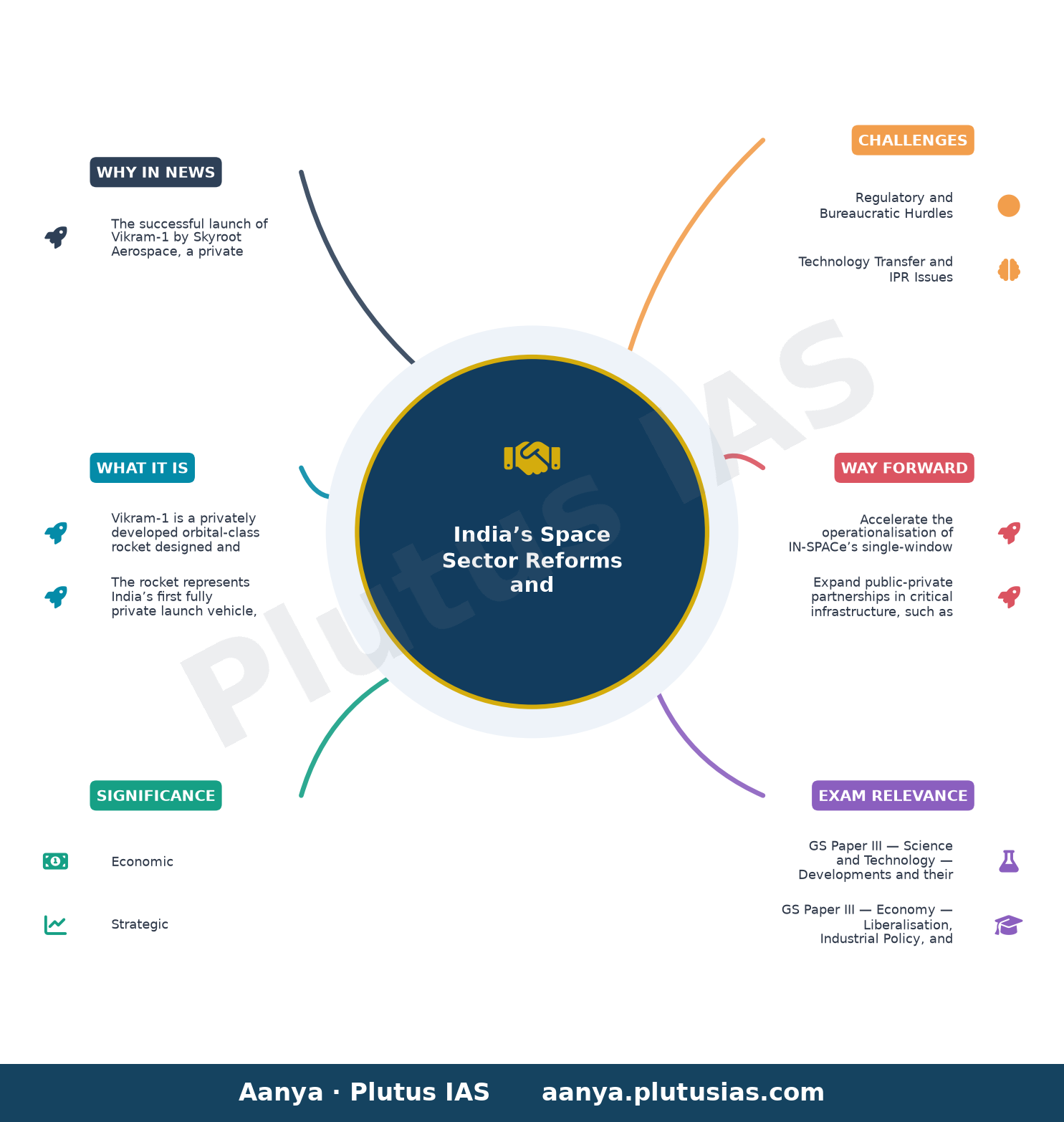
- GS Paper III — Science and Technology — Developments and their Applications and Effects in Everyday Life | GS Paper III — Economy — Liberalisation, Industrial Policy, and Role of Public and Private Sectors
- Prelims: IN-SPACe, Vikram-1, Chandrayaan-3, Space Sector Reforms 2020, FDI in Space Sector, ISRO, IIST, Skyroot Aerospace
- Essay: The Role of Public-Private Partnerships in India’s Technological Ascendancy, Viksit Bharat: From Space Missions to Societal Transformation
Quick Revision: The Vikram-1 launch by Skyroot Aerospace exemplifies the transformational impact of India’s space sector reforms, particularly IN-SPACe, on fostering public-private partnerships and accelerating innovation in orbital launch capabilities.
Why is this in the news?
The successful launch of Vikram-1 by Skyroot Aerospace, a private entity, marks a significant milestone in India’s space sector. ISRO Chairperson V. Narayanan highlighted this achievement as a testament to the transformational impact of space sector reforms, particularly the enhanced role of public-private partnerships (PPP) in fostering innovation, commercialisation, and global competitiveness in India’s space endeavours.
Background
- The Indian Space Research Organisation (ISRO) has historically dominated India’s space activities, operating under a state-centric model with limited private sector participation.
- The creation of the Indian National Space Promotion and Authorisation Centre (IN-SPACe) in 2020 marked a paradigm shift by liberalising the space sector and enabling private entities to engage in end-to-end space activities, including satellite launches and manufacturing.
- Prior to these reforms, private participation was restricted to supplying components or providing services under ISRO’s supervision, with no independent capability for launch or satellite deployment.
- The Vikram-1 launch by Skyroot Aerospace, a Hyderabad-based startup, represents the first private orbital-class rocket developed in India, demonstrating the efficacy of the reformed regulatory and institutional framework.
- India’s space sector reforms align with global trends, where countries like the USA and Europe have increasingly leveraged PPP models to accelerate innovation and reduce costs in space exploration.
- The reforms are part of a broader national strategy to position India as a global leader in space technology, complementing missions like Chandrayaan-3 and the Gaganyaan programme.
What is the Vikram-1 Launch and Its Significance in India’s Space Sector?
- Vikram-1 is a privately developed orbital-class rocket designed and manufactured by Skyroot Aerospace, a start-up incubated at the Indian Institute of Space Science and Technology (IIST).
- The rocket represents India’s first fully private launch vehicle, capable of deploying small satellites into Low Earth Orbit (LEO), with a payload capacity of up to 300 kg.
- The launch underscores the success of India’s space sector reforms, particularly the establishment of IN-SPACe, which streamlined regulatory approvals and facilitated private sector participation.
- Skyroot Aerospace’s achievement demonstrates the viability of PPP models in space technology, where ISRO provides technical expertise, infrastructure, and mentorship, while private entities drive innovation and commercialisation.
- The launch aligns with India’s broader goal of achieving self-reliance (Atmanirbhar Bharat) in space technology, reducing dependence on foreign launch services, and positioning India as a cost-competitive alternative for global satellite deployment.
- The event highlights the growing role of start-ups in India’s space ecosystem, with over 100 private entities now registered under IN-SPACe, spanning satellite manufacturing, launch services, and ground infrastructure.
- The Vikram-1 launch is a precursor to future missions, including Vikram-2 and Vikram-3, which aim to expand payload capacity and commercial viability, further integrating India’s space sector into the global market.
Key Features
| Feature | Significance |
|---|---|
| Vikram-1 launch by Skyroot Aerospace | Demonstrates operational capability of India’s private space sector, validating the ‘transformational milestone’ of space sector reforms under IN-SPACe and liberalised FDI norms. |
| ISRO’s continued support to private sector | Institutional mentorship, technology transfer, and shared infrastructure (e.g., launch pads, testing facilities) enable private players to achieve cost-efficient space missions. |
| IIST convocation address by ISRO Chairperson | Highlights the integration of academic excellence with industrial application, reinforcing the need for self-reliance in space technology and leadership in STEM education. |
| Governor’s emphasis on Viksit Bharat | Links space achievements to national development goals, urging graduates to contribute to India’s technological sovereignty and global standing. |
| Awards of 332 degrees at IIST | Reflects the growing talent pipeline in space sciences and engineering, essential for sustaining India’s space ecosystem and innovation pipeline. |
Why it Matters
Economic
- Enhances India’s share in the global space economy, projected at $40 billion by 2040, by fostering commercial launch services and satellite deployment.
- Attracts private investment in space startups, reducing reliance on public funding for space missions and promoting job creation in high-tech sectors.
Strategic
- Strengthens India’s position as a space-faring nation with indigenous capabilities in launch vehicles, satellite systems, and deep-space exploration.
- Supports national security objectives by enabling rapid deployment of communication and reconnaissance satellites through private-sector agility.
Technological
- Validates India’s transition from a government-led space programme to a collaborative model, leveraging private sector innovation in propulsion, materials, and avionics.
- Demonstrates cost-effective space missions, reducing per-kg launch costs and improving competitiveness in the global space market.
Educational
- Highlights the role of premier institutions like IIST in producing a skilled workforce aligned with industry and research needs in space sciences.
- Encourages interdisciplinary research, integrating engineering, physics, and computer science to address complex space challenges.
Challenges
1. Regulatory and Bureaucratic Hurdles
- Delays in approvals and licensing under the new space policy framework may impede private sector agility and innovation.
- Need for harmonised regulations across state and central agencies to streamline clearances for launch sites and satellite operations.
UPSC Link: GS3: Science and Tech
2. Technology Transfer and IPR Issues
- Balancing ISRO’s proprietary technologies with private sector access to ensure innovation without compromising national security.
- Potential disputes over intellectual property rights in joint ventures and technology-sharing agreements.
UPSC Link: GS3: IPR
3. Infrastructure Bottlenecks
- Limited launch pads and testing facilities constrain the frequency and scale of private sector launches.
- Dependence on foreign launch sites for certain missions due to gaps in domestic infrastructure.
UPSC Link: GS3: Infrastructure
4. Talent Retention and Skill Gaps
- Competition from multinational corporations and foreign firms may lead to brain drain in critical space technology domains.
- Need for continuous upskilling to keep pace with advancements in AI, robotics, and propulsion systems.
UPSC Link: GS3: Human Resource Development
5. Global Competition and Market Access
- Facing stiff competition from established players like SpaceX and emerging giants such as China’s commercial space sector.
- Ensuring market access for Indian private players in international satellite launch contracts and space-based services.
UPSC Link: GS2: International Relations
Challenges — UPSC Perspective
| Issue | Concern |
|---|---|
| Regulatory delays | Impedes private sector’s ability to scale operations and meet global launch timelines. |
| Technology access restrictions | May limit private sector innovation in critical areas like cryogenic engines and re-entry systems. |
| Infrastructure constraints | Reduces launch frequency and increases costs for private players due to shared ISRO resources. |
| Talent migration | Undermines long-term capacity building in niche space technology domains. |
| Global market competition | Threatens India’s share in the $1 trillion global space economy by 2040. |
Way Forward
- Accelerate the operationalisation of IN-SPACe’s single-window clearance system to reduce regulatory delays for private launches.
- Expand public-private partnerships in critical infrastructure, such as additional launch pads at Sriharikota and Thumba, with shared usage models.
- Enhance technology transfer mechanisms under the Space Activities Bill to balance innovation with national security constraints.
- Invest in upskilling programmes at IIST and other institutions to address skill gaps in AI-driven satellite operations and propulsion technologies.
- Promote international collaborations for technology sharing while safeguarding strategic interests, particularly with Quad partners and like-minded nations.
- Strengthen domestic demand for space-based services through government-led initiatives in agriculture, disaster management, and urban planning.
- Establish a dedicated venture fund for space startups to de-risk private investments and foster R&D in cutting-edge technologies.
- Develop a national space data policy to standardise data-sharing protocols, enabling private players to build commercial applications on ISRO’s satellite data.
UPSC Value Addition
Keywords for Mains Answer-Writing
Vikram-1 launch by Skyroot Aerospace · Public-Private Partnership (PPP) in space sector · Space sector reforms in India · ISRO’s role in fostering private participation · Skyroot Aerospace and Vikram-1 · Indian Institute of Space Science and Technology (IIST) · Chandrayaan missions and lunar exploration · Transformational milestones in space sector · Viksit Bharat vision and space capabilities · Governor Rajendra Vishwanath Arlekar’s address at IIST
Concept Flow
Space sector reforms (IN-SPACe, liberalised FDI) → Enabled private participation (Skyroot Aerospace) → Vikram-1 launch success → Demonstrates operational capability → Attracts investment and talent → Strengthens India’s space economy → Supports Viksit Bharat vision → Drives educational and institutional excellence (IIST) → Fuels further reforms and innovation.
Prelims Practice Questions
Q1. Consider the following statements regarding the Vikram-1 launch and India’s space sector reforms:
1. Vikram-1 is India’s first privately developed orbital rocket.
2. The launch reflects the strength of India’s public-private partnership in the space sector.
3. The reforms have been described as a ‘transformational milestone’ by ISRO Chairperson V. Narayanan.
4. The Indian Institute of Space Science and Technology (IIST) is exclusively focused on theoretical research and does not engage in practical space missions.
How many of the above statements are correct?
- Only one
- Only two
- Only three
- All
Answer: Only three — Statements 1, 2, and 3 are correct. Statement 4 is incorrect as IIST engages in both theoretical and practical aspects of space science and technology, including collaborations with ISRO and private entities.
Q2. Assertion (A): The Vikram-1 launch by Skyroot Aerospace signifies a shift towards greater private sector participation in India’s space activities.
Reason (R): The space sector reforms in India have opened unprecedented opportunities for private entities to contribute to space missions.
Codes:
A. Both A and R are true, and R is the correct explanation of A.
B. Both A and R are true, but R is not the correct explanation of A.
C. A is true, but R is false.
D. A is false, but R is true.
- A
- B
- C
- D
Answer: A — Both Assertion (A) and Reason (R) are true, and Reason (R) correctly explains Assertion (A). The reforms have explicitly enabled private participation, as evidenced by the Vikram-1 launch.
Q3. Match the following entities with their respective roles in India’s space sector:
Column I
1. ISRO
2. Skyroot Aerospace
3. IIST
4. Vikram-1
Column II
A. First privately developed orbital rocket in India
B. Premier institution for space science and technology education
C. National space agency leading space missions
D. Private aerospace company developing launch vehicles
Select the correct match:
- 1-C, 2-D, 3-B, 4-A
- 1-D, 2-C, 3-A, 4-B
- 1-B, 2-A, 3-D, 4-C
- 1-A, 2-B, 3-C, 4-D
Answer: 1-C, 2-D, 3-B, 4-A — The correct matches are: 1-C (ISRO is the national space agency), 2-D (Skyroot Aerospace is a private company), 3-B (IIST is the premier institution), and 4-A (Vikram-1 is the first privately developed orbital rocket).
Mains Practice Question
✍ Critically examine the role of public-private partnerships (PPPs) in transforming India’s space sector, with reference to the Vikram-1 launch by Skyroot Aerospace and the broader space sector reforms. Also, discuss the implications of these reforms for India’s global standing in space exploration. (15 Marks)
Approach: MODEL-ANSWER SKELETON:
1. **Introduction**: Define PPPs in the context of space sector and state the transformational nature of reforms (citing ISRO Chairperson V. Narayanan’s remarks).
2. **Key Reforms**: Outline the enabling policy framework (e.g., Space Activities Act, 2019; IN-SPACe) and institutional mechanisms (e.g., Indian National Space Promotion and Authorisation Centre).
3. **Case Study – Vikram-1**: Highlight Skyroot Aerospace’s achievement, its significance as India’s first privately developed orbital rocket, and ISRO’s role in supporting private entities (e.g., technical mentorship, infrastructure access).
4. **Broader Impact**: Discuss how PPPs have accelerated innovation, reduced costs, and enhanced India’s space capabilities (e.g., Chandrayaan missions, Gaganyaan program).
5. **Global Standing**: Analyze India’s position as a leader in cost-effective space missions and its potential to compete with global players like SpaceX and ESA.
6. **Challenges**: Address regulatory hurdles, funding constraints, and competition from established players.
7. **Conclusion**: Summarize the transformative potential of PPPs and the need for sustained policy support to consolidate gains.
Source: The Hindu
Generated by AanyaAi for educational purpose.

- यूपी में पहली बार तेंदुओं का बधियाकरण: मानव-वन्यजीव संघर्ष रोकेगा अभियान - September 24, 2026
- UP’s Groundbreaking Leopard Sterilization Plan to Curb Human-Wildlife Conflict - September 24, 2026
- महाराष्ट्र में त्योहार जुलूसों पर बॉम्बे हाईकोर्ट का बड़ा फैसला: पटाखे, लेजर और संगीत पर रोक - September 24, 2026

No Comments