


08 Aug Vikram-1 Launch: How India’s Space Sector Reforms Boosted Private Participation
✎ India’s space sector reforms, institutionalised through IN-SPACe and supported by 100% FDI, have catalysed private innovation, transforming ISRO’s role from sole provider to facilitator of a competitive space ecosystem.
Subject Relevance — Where This Topic Fits
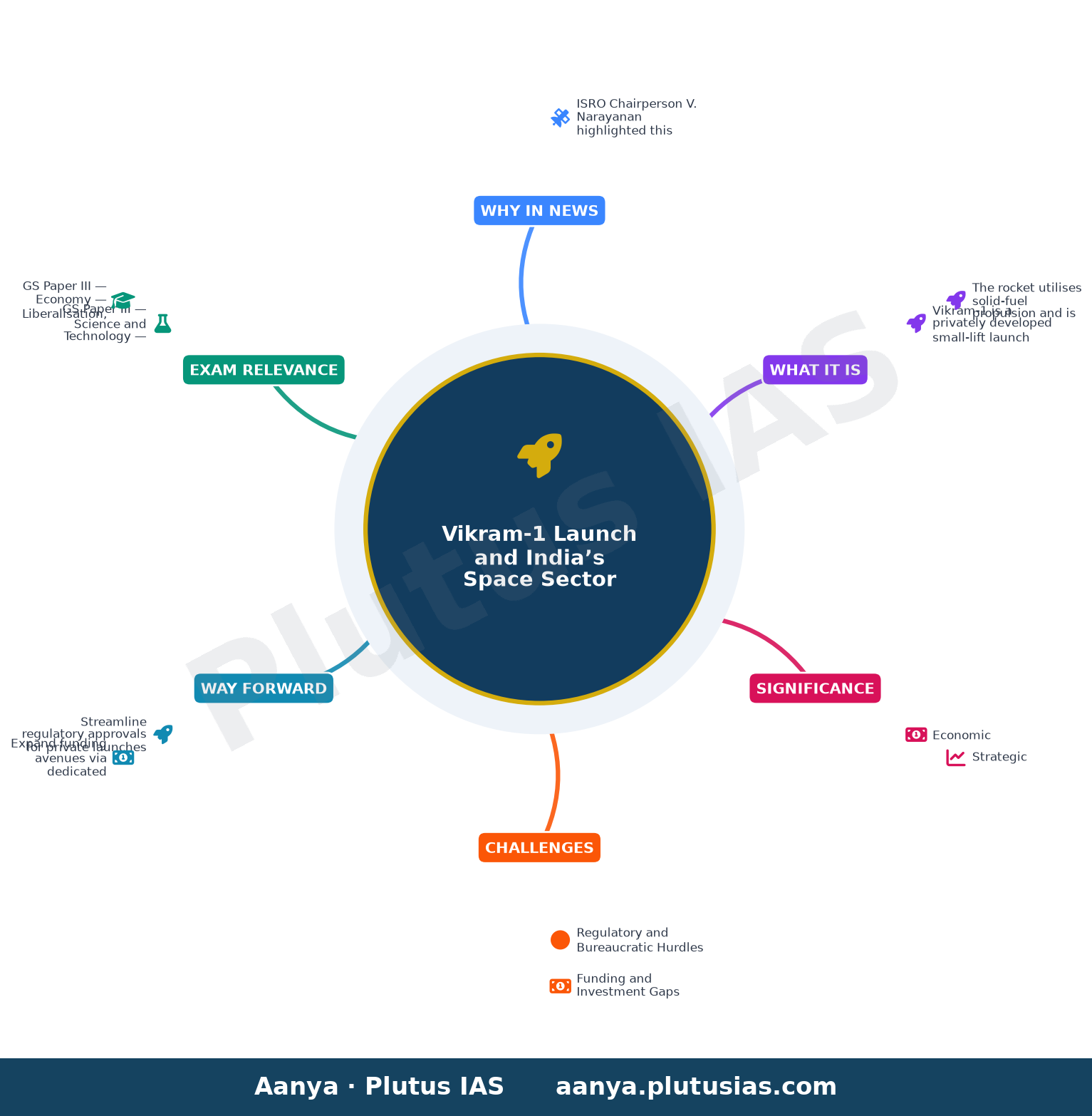
- GS Paper III — Science and Technology — Developments and their Applications and Effects in Everyday Life | GS Paper III — Economy — Liberalisation, Privatisation and Globalisation
- Prelims: IN-SPACe, Vikram-1, Skyroot Aerospace, ISRO, NewSpace India Limited (NSIL), FDI in space sector, Space Activities Bill 2019, Chandrayaan-3, Gaganyaan mission
- Essay: The role of public-private partnerships in national development: A case study of India’s space sector reforms, Technological sovereignty and its strategic implications for emerging economies
Quick Revision: India’s space sector reforms, institutionalised through IN-SPACe and supported by 100% FDI, have catalysed private innovation, transforming ISRO’s role from sole provider to facilitator of a competitive space ecosystem.
Why is this in the news?
ISRO Chairperson V. Narayanan highlighted this achievement as a testament to the efficacy of India’s space sector reforms, which have fostered unprecedented collaboration between public institutions and private enterprises. The event, marked by the convocation address at the Indian Institute of Space Science and Technology (IIST), underscores the transformational shift in India’s space ecosystem, blending indigenous innovation with global competitiveness.
Background
- India’s space programme, historically led by ISRO, has evolved from a state-centric model to a more inclusive ecosystem under the ‘New Space’ paradigm, enabling private sector participation.
- The Space Activities Bill 2019 and subsequent reforms, including the establishment of IN-SPACe (Indian National Space Promotion and Authorisation Centre) in 2020, have created a regulatory framework for private entities to engage in space activities.
- The Union Budget 2021-22 allocated ₹10,000 crore for the space sector, signalling government commitment to fostering private innovation and commercialisation.
- Skyroot Aerospace, a Hyderabad-based startup, became the first Indian private entity to launch a rocket (Vikram-S) in November 2022, paving the way for Vikram-1, a more advanced launch vehicle.
- India’s space sector reforms align with global trends, where countries like the USA (NASA’s Commercial Orbital Transportation Services) and Europe (ESA’s commercial partnerships) have leveraged private sector capabilities for cost efficiency and innovation.
- The Chandrayaan-3 mission (2023) demonstrated India’s technological prowess in lunar exploration, reinforcing the strategic importance of space capabilities for national security and scientific advancement.
What is Vikram-1 and India’s Space Sector Reforms?
- Vikram-1 is a privately developed small-lift launch vehicle designed by Skyroot Aerospace, capable of placing payloads up to 300 kg into Low Earth Orbit (LEO).
- The rocket utilises solid-fuel propulsion and is part of Skyroot’s Vikram series, named after Dr. Vikram Sarabhai, the father of India’s space programme.
- India’s space sector reforms, initiated in 2020, dismantled the state monopoly in space activities, allowing private entities to conduct end-to-end space missions, including satellite launches and rocket development.
- IN-SPACe acts as a single-window agency for private sector approvals, technical guidance, and regulatory oversight, ensuring streamlined processes for commercial space activities.
- The reforms enable 100% Foreign Direct Investment (FDI) in the space sector, attracting global investors and fostering technological collaboration.
- Private participation has diversified India’s space capabilities, reducing ISRO’s burden and accelerating innovation through competition and cost-efficiency.
- The Vikram-1 launch exemplifies the ‘Make in India’ initiative in space technology, promoting indigenous manufacturing and reducing reliance on foreign launch services.
- India’s space sector now contributes to both domestic needs (e.g., communication, navigation) and global commercial markets, positioning itself as a cost-effective alternative to established players like SpaceX or Arianespace.
Key Features
| Feature | Significance |
|---|---|
| Vikram-1 launch by Skyroot Aerospace | Demonstrates operational viability of private sector in satellite launch services, validating India’s space sector reforms. |
| ISRO’s mentorship and technical support to private entities | Enhances capacity-building in the commercial space ecosystem while maintaining ISRO’s core research focus. |
| IIST convocation address by ISRO Chairperson | Highlights the integration of academic excellence with industry-ready innovation in space sciences. |
| Governor’s emphasis on Viksit Bharat vision | Reinforces the alignment of scientific achievement with national development goals. |
| Award of 332 degrees across BTech, MTech, PhD programs | Indicates sustained human resource development in critical STEM fields for the space sector. |
Why it Matters
Economic
- Expands India’s share in the global space economy by fostering a competitive private launch industry.
- Reduces dependency on foreign launch services, thereby saving foreign exchange and enhancing strategic autonomy.
- Creates high-skilled employment opportunities in aerospace engineering, manufacturing, and allied sectors.
Strategic
- Strengthens India’s position as a leading spacefaring nation with demonstrated capabilities in both public and private domains.
- Enhances national security by diversifying launch capabilities and reducing single-point vulnerabilities.
- Supports dual-use technologies (e.g., satellite launches) that have implications for defense and communication.
Technological
- Accelerates innovation through public-private collaboration, bridging the gap between research and commercial deployment.
- Validates indigenous propulsion and launch vehicle technologies, reducing reliance on imported systems.
- Demonstrates end-to-end capability in small satellite launch vehicles, a growing market segment.
Institutional
- Showcases the role of IIST as a talent pipeline for ISRO and private space enterprises.
- Reinforces the efficacy of India’s space sector reforms, particularly the liberalization under IN-SPACe.
- Highlights the importance of convocation addresses in shaping aspirational narratives for STEM graduates.
Challenges
1. Regulatory and Bureaucratic Hurdles
- Complexity in obtaining clearances for private launch activities despite reforms.
- Delays in standardizing protocols for private entities interfacing with ISRO’s infrastructure.
UPSC Link: GS3: Science & Tech, Ease of Doing Business
2. Funding and Investment Gaps
- High capital requirements for R&D and infrastructure in the space sector deter private investment.
- Need for venture capital and angel funding ecosystems tailored to high-risk, long-gestation space projects.
UPSC Link: GS3: Startup India, FDI Policy
3. Talent Retention and Brain Drain
- Competition from global space firms (e.g., SpaceX, Blue Origin) for Indian aerospace talent.
- Inadequate post-graduate research opportunities in niche areas like propulsion and orbital mechanics.
UPSC Link: GS3: Human Resource Development
4. Infrastructure Bottlenecks
- Limited launchpad capacity at ISRO’s primary centers (e.g., Sriharikota) for accommodating private launches.
- Underdeveloped downstream facilities (e.g., satellite integration, testing) for private sector use.
UPSC Link: GS3: Infrastructure Development
5. International Competition and IP Challenges
- Pressure from established spacefaring nations to comply with non-tariff barriers (e.g., ITAR-like regimes).
- Risk of intellectual property theft in collaborative projects with foreign entities.
UPSC Link: GS2: International Relations, IPR Regimes
Challenges — UPSC Perspective
| Issue | Concern |
|---|---|
| Regulatory delays | Hampers timely execution of private launch missions. |
| High R&D costs | Limits participation of startups and MSMEs in the space sector. |
| Talent migration | Undermines long-term competitiveness of India’s space industry. |
| Launchpad scarcity | Restricts frequency and diversity of private launches. |
| IPR vulnerabilities | Exposes indigenous technologies to unauthorized replication. |
Way Forward
- Streamline regulatory approvals for private launches through a single-window clearance mechanism under IN-SPACe.
- Expand funding avenues via dedicated space-sector funds (e.g., Indian Space Fund) and public-private partnerships.
- Enhance IIST and other institutions’ research facilities to retain talent and foster innovation.
- Develop auxiliary infrastructure (e.g., satellite integration hubs, testing labs) at secondary launch sites.
- Strengthen IPR protections for space technologies to encourage indigenous R&D and deter infringement.
- Promote international collaborations under balanced frameworks to access advanced technologies without compromising sovereignty.
- Introduce specialized incubation programs for space startups to bridge the funding gap in early stages.
- Mandate ISRO to allocate a fixed percentage of its budget for mentoring private entities in critical domains.
UPSC Value Addition
Keywords for Mains Answer-Writing
Space sector reforms in India · Vikram-1 launch by Skyroot Aerospace · Public-Private Partnership (PPP) in space sector · Indian Space Research Organisation (ISRO) support to private sector · IN-SPACe regulatory framework · FDI in space sector · Space commercialisation · Indian Institute of Space Science and Technology (IIST) · Chandrayaan mission achievements · Viksit Bharat vision · Space sector liberalisation · Role of Governor in space sector development
Constitutional & Policy Linkages
- [‘Article 51A(h): Duty to develop scientific temper’, ‘Space sector reforms align with constitutional duty of citizens.’]
Concept Flow
Space Sector Reforms (2020-2026) → Liberalization under IN-SPACe → Private Sector Participation (e.g., Skyroot Aerospace) → Vikram-1 Launch → Validation of PPP Model → Expansion of India’s Space Economy → Strategic Autonomy & Global Competitiveness
Prelims Practice Questions
Q1. Consider the following statements regarding the Vikram-1 launch by Skyroot Aerospace:
1. Vikram-1 is India’s first privately developed orbital rocket.
2. The launch was supported by ISRO under the IN-SPACe framework.
3. The rocket is designed for sub-orbital missions only.
4. The launch reflects the success of India’s space sector liberalisation.
How many of the above statements are correct?
- Only one
- Only two
- Only three
- All four
Answer: Only three — Statements 1, 2, and 4 are correct. Statement 3 is incorrect as Vikram-1 is designed for orbital missions.
Q2. Assertion (A): The IN-SPACe framework was established to promote private participation in India’s space sector.
Reason (R): The framework provides regulatory and policy support to private entities engaged in space activities.
Options:
A. Both A and R are true, and R is the correct explanation of A.
B. Both A and R are true, but R is not the correct explanation of A.
C. A is true but R is false.
D. A is false but R is true.
Answer: ? — Both the assertion and reason are true, and the reason correctly explains the assertion as IN-SPACe was created to facilitate private sector involvement in space activities.
Q3. Match the following space missions with their respective achievements:
Column I (Mission) | Column II (Achievement)
1. Chandrayaan-3 | A. Discovery of water-related evidence on the Moon
2. Vikram-1 | B. Historic soft landing near the lunar south pole
3. Chandrayaan-1 | C. First privately developed orbital rocket launch in India
4. Gaganyaan | D. India’s first human spaceflight mission (under development)
Options:
A. 1-B, 2-C, 3-A, 4-D
B. 1-A, 2-C, 3-B, 4-D
C. 1-B, 2-A, 3-D, 4-C
D. 1-C, 2-B, 3-A, 4-D
- A
- B
- C
- D
Answer: A — 1-B (Chandrayaan-3 achieved soft landing near lunar south pole), 2-C (Vikram-1 is India’s first privately developed orbital rocket), 3-A (Chandrayaan-1 discovered water-related evidence on the Moon), 4-D (Gaganyaan is India’s first human spaceflight mission under development).
Mains Practice Question
✍ Critically analyse the transformational impact of India’s space sector reforms on public-private partnerships in the space domain. How far have these reforms succeeded in fostering innovation, commercialisation, and global competitiveness? (15 Marks)
Approach: MODEL-ANSWER SKELETON:
1. **Introduction (2 marks)**
– Define space sector reforms in India: Key milestones such as the creation of IN-SPACe (2020), liberalisation of FDI norms (up to 100% in satellite manufacturing), and the role of the Space Activities Act, 2023.
– Contextualise with the Vikram-1 launch by Skyroot Aerospace as a case study of successful PPP.
2. **Transformational Impact on PPP (5 marks)**
– **Regulatory Framework**: Role of IN-SPACe in providing single-window clearance, technology transfer, and resource allocation (e.g., ISRO’s facilities like SDSC SHAR for private launches).
– **Financial Incentives**: FDI liberalisation, tax benefits, and government funding schemes (e.g., Seed Fund Scheme for space startups).
– **Infrastructure Sharing**: ISRO’s support in terms of testing facilities, launch pads, and mentorship (e.g., Vikram-1’s development leveraged ISRO’s propulsion systems).
– **Global Competitiveness**: Comparison with global models (e.g., NASA’s Commercial Orbital Transportation Services, SpaceX) and India’s emergence as a cost-effective alternative.
3. **Successes and Achievements (4 marks)**
– **Innovation**: Highlight private sector contributions such as Skyroot’s solid propulsion systems, Agnikul’s semi-cryogenic engines, and Pixxel’s hyperspectral imaging satellites.
– **Commercialisation**: Growth in satellite launches (e.g., PSLV-C58 mission deploying 36 OneWeb satellites), space-based services (e.g., remote sensing, communication), and startups (over 150 space-tech startups registered post-reforms).
– **Global Recognition**: India’s ranking in global space economy (from 0.5% in 2016 to ~2% in 2026) and participation in international collaborations (e.g., Artemis Accords).
4. **Challenges and Criticisms (3 marks)**
– **Regulatory Bottlenecks**: Delays in approvals, bureaucratic hurdles, and lack of clarity in liability frameworks for private launches.
– **Infrastructure Gaps**: Limited launch pads (only two operational: SDSC SHAR and Sriharikota), and dependence on ISRO for critical technologies.
– **Market Competition**: Dominance of established players (e.g., ISRO, Antrix) and competition from global giants (e.g., SpaceX, Blue Origin).
5. **Conclusion (1 mark)**
– Summarise the transformational impact while acknowledging the need for further reforms to address challenges.
– Emphasise the role of PPP in achieving India’s vision of Viksit Bharat and global leadership in space.
Source: The Hindu
Generated by AanyaAi for educational purpose.

- पेट्रोलियम (संशोधन) विधेयक 2026: हितधारकों से सुझाव आमंत्रित - September 30, 2026
- UERC imposes 67 paise/unit surcharge on open access power in Uttarakhand - September 30, 2026
- एलपीयू हिंसा मामले में हाईकोर्ट ने सरकार से पूछा- अब तक क्या किया? - September 30, 2026

No Comments