


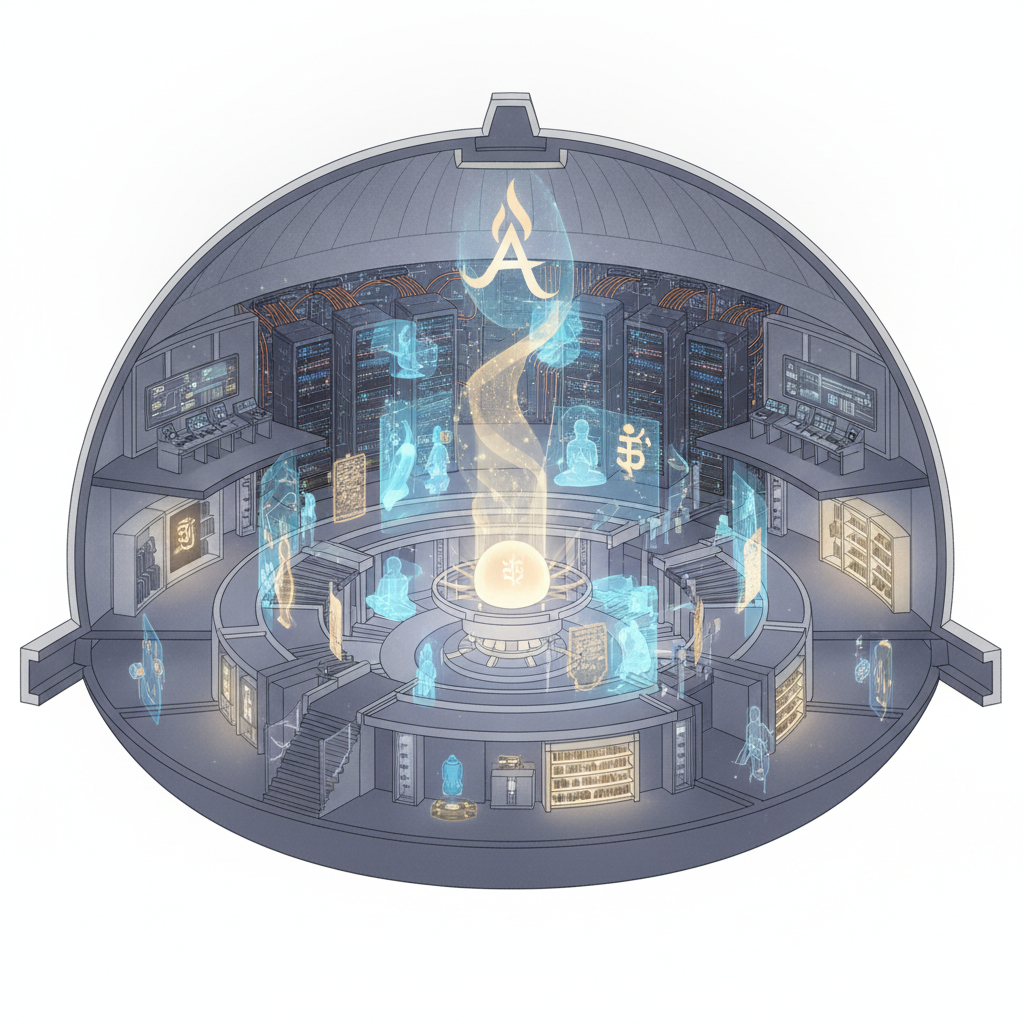
04 Sep Virtual Museum on Sri Aurobindo Inaugurated at Auroville for 150th Birth Anniversary
✎ The Virtual Museum on Sri Aurobindo at Auroville exemplifies the convergence of cultural heritage preservation and digital innovation, leveraging technology to disseminate India’s spiritual traditions globally.
Subject Relevance — Where This Topic Fits
- GS Paper I — Indian Heritage and Culture | GS Paper I — Modern Indian History
- Prelims: Sri Aurobindo, Integral Yoga, Auroville, Bharat Nivas, virtual museum, cultural heritage, Puducherry, Auroville Foundation
- Essay: The role of cultural institutions in preserving and propagating philosophical and spiritual heritage
Quick Revision: The Virtual Museum on Sri Aurobindo at Auroville exemplifies the convergence of cultural heritage preservation and digital innovation, leveraging technology to disseminate India’s spiritual traditions globally.
Why is this in the news?
A state-of-the-art virtual museum dedicated to Sri Aurobindo has been inaugurated at Bharat Nivas in Auroville, Puducherry, as part of the nationwide observance of his 150th birth anniversary. The facility, a collaborative initiative between the Auroville Foundation, the Puducherry government, and the Union Ministry of Culture, represents a significant advancement in the digital preservation and dissemination of India’s spiritual and philosophical traditions.
Background
- Sri Aurobindo (1872–1950) was a philosopher, yogi, poet, and nationalist leader whose works laid the foundation for Integral Yoga, a spiritual practice integrating physical, mental, and supramental evolution.
- Auroville, an experimental township in Tamil Nadu, was founded as a universal city dedicated to human unity, inspired by the teachings of Sri Aurobindo and The Mother (Mirra Alfassa).
- The Auroville Foundation is a joint initiative responsible for the governance and development of Auroville.
- Virtual museums leverage digital technology to create immersive, interactive, and accessible platforms for cultural and educational engagement, particularly relevant in the context of India’s push for digital transformation in heritage preservation.
- The Union Ministry of Culture plays a pivotal role in promoting and preserving India’s cultural heritage through initiatives such as the National Mission on Cultural Mapping and Virtual Museums of India.
- The Central Public Works Department (CPWD) is the premier construction agency of the Government of India, responsible for executing infrastructure projects across the country, including those of national cultural significance.
What is the Virtual Museum on Sri Aurobindo at Auroville?
- The virtual museum is a digitally immersive facility located at Bharat Nivas in Auroville, designed to showcase the life, philosophy, and literary contributions of Sri Aurobindo through advanced digital touchpoints and intuitive learning interfaces.
- The museum employs cutting-edge technology, including advanced digital touchpoints and intuitive learning interfaces, and a dedicated olfactory installation, to create an experiential learning environment for visitors of all ages.
- The narrative and curatorial framework of the museum are rooted in the authentic spiritual ethos of Sri Aurobindo and The Mother, ensuring fidelity to their teachings on Integral Yoga, human evolution, and spiritual unity.
- A dedicated olfactory installation features the subtle essences and aromas of 12 spiritually significant flowers.
- The project is a tripartite collaboration between the Auroville Foundation (a statutory body under the Government of India), the Puducherry government, and the Union Ministry of Culture, with execution undertaken by the Central Public Works Department.
- The museum is part of a broader national initiative to commemorate Sri Aurobindo’s 150th birth anniversary, aligning with the government’s efforts to promote cultural heritage through digital innovation.
- Upon its public opening, the museum is poised to serve as a key cultural, educational, and spiritual destination, attracting researchers, devotees, and tourists to Auroville and Puducherry.
- The project underscores the potential of digital museums in democratising access to India’s philosophical and spiritual heritage, particularly for global audiences.
Key Features
| Feature | Significance |
|---|---|
| Virtual museum infrastructure | Leverages advanced digital touchpoints and intuitive learning interfaces to facilitate immersive, age-agnostic exploration of Sri Aurobindo’s life, works, and philosophy. |
| Olfactory installation | Integrates the spiritual significance of 12 flowers as per Sri Aurobindo and The Mother’s teachings, creating a multisensory educational experience. |
| Collaborative governance model | Joint initiative by the Auroville Foundation, Puducherry government, and Union Ministry of Culture, executed by the Central Public Works Department, demonstrating inter-institutional coordination. |
| Curatorial authenticity | Narrative script conceptualised by a long-term Aurovilian (Manoj Pavithran), ensuring alignment with Sri Aurobindo’s authentic spiritual ethos and The Mother’s legacy. |
| Public accessibility | Designed as an essential cultural, educational, and spiritual destination for visitors, researchers, and devotees, enhancing Auroville and Puducherry’s cultural tourism ecosystem. |
Why it Matters
Cultural and Educational
- Preserves and disseminates the intellectual and spiritual heritage of Sri Aurobindo, a pivotal figure in India’s socio-spiritual renaissance, through modern digital pedagogy.
- Serves as a model for integrating traditional knowledge systems with contemporary technology in cultural preservation and public education.
- Enhances Auroville’s global reputation as a hub for spiritual and philosophical discourse, attracting researchers, scholars, and spiritual seekers.
Governance and Institutional
- Demonstrates the efficacy of multi-stakeholder governance in executing high-impact cultural projects, involving central, state, and autonomous institutions.
- Highlights the role of the Auroville Foundation, a statutory body under the Auroville Foundation Act, 1988, in fostering cultural and educational initiatives.
- Showcases the Central Public Works Department’s capacity in delivering state-of-the-art infrastructure for national cultural projects.
Tourism and Local Economy
- Strengthens cultural tourism in Puducherry and Auroville, contributing to socio-economic development through increased footfall and ancillary services.
- Positions Auroville as a destination for spiritual and intellectual tourism, diversifying the region’s economic base beyond conventional sectors.
Philosophical and Spiritual
- Reinforces the teachings of Sri Aurobindo and The Mother on integral yoga, spirituality, and the significance of sensory experiences in spiritual practice.
- Provides a tangible platform for the dissemination of Sri Aurobindo’s literary and philosophical works, including ‘The Life Divine’ and ‘Savitri’.
Challenges
1. Digital Divide and Accessibility
- Ensuring equitable access to the virtual museum for diverse demographic groups, including those with limited digital literacy or infrastructure.
- Maintaining the balance between technological sophistication and the preservation of the spiritual and philosophical essence of Sri Aurobindo’s teachings.
UPSC Link: GS Paper 2: E-governance and Digital Infrastructure
2. Cultural Authenticity vs. Modernisation
- Preserving the authenticity of Sri Aurobindo’s teachings while adapting them to modern digital formats for broader dissemination.
- Avoiding commercialisation or dilution of the philosophical and spiritual content in the pursuit of mass appeal.
UPSC Link: GS Paper 1: Indian Culture and Heritage
3. Sustainability and Maintenance
- Ensuring the long-term operational sustainability of the virtual museum, including funding, technical upkeep, and content updates.
- Mitigating risks of obsolescence in digital infrastructure and ensuring compatibility with evolving technological standards.
UPSC Link: GS Paper 3: Science and Technology
4. Stakeholder Coordination
- Sustaining inter-institutional collaboration among the Auroville Foundation, Puducherry government, and Union Ministry of Culture for future expansions or modifications.
- Addressing potential conflicts in vision or priorities among stakeholders with diverse mandates.
UPSC Link: GS Paper 2: Federalism and Centre-State Relations
Challenges — UPSC Perspective
| Issue | Concern |
|---|---|
| Digital literacy gaps | Limited access to digital infrastructure among certain visitor demographics may restrict the museum’s reach. |
| Content authenticity | Risk of misinterpretation or oversimplification of Sri Aurobindo’s complex philosophical works in digital formats. |
| Technological obsolescence | Rapid advancements in digital technology may render the museum’s infrastructure outdated without regular upgrades. |
| Funding sustainability | Dependence on government and institutional funding may pose challenges for long-term maintenance and expansion. |
| Cultural commercialisation | Potential for the museum to be perceived as a commercial venture, diluting its spiritual and educational objectives. |
Way Forward
- Develop multilingual digital interfaces to enhance accessibility for non-English-speaking visitors and researchers.
- Establish a dedicated fund for the museum’s upkeep, sourced from public-private partnerships and cultural tourism revenues.
- Organise periodic workshops and seminars for educators, scholars, and spiritual practitioners to deepen engagement with Sri Aurobindo’s teachings.
- Integrate the virtual museum with academic curricula in Indian universities, particularly in philosophy, history, and cultural studies departments.
- Collaborate with international cultural institutions to create exchange programs and joint research initiatives on Sri Aurobindo’s legacy.
- Implement a feedback mechanism to assess visitor experiences and refine digital content based on user insights.
- Explore augmented reality (AR) and virtual reality (VR) enhancements to provide immersive, experiential learning opportunities.
- Strengthen ties with local artisans and cultural practitioners to integrate traditional crafts and art forms into the museum’s narrative.
UPSC Value Addition
Keywords for Mains Answer-Writing
Cultural Heritage Preservation · Virtual Museums · Auroville Foundation · Sri Aurobindo · Integral Yoga · Digital Heritage · Ministry of Culture · Puducherry Government · Central Public Works Department · Intangible Cultural Heritage · Digital Archiving · Spiritual Tourism · Cultural Institutions in India · Heritage Conservation Policies · Public-Private Partnerships in Culture · National Cultural Policy
Constitutional & Policy Linkages
- [‘Article 51A (Fundamental Duties): Promoting the spirit of inquiry and scientific temper.’]
- [‘Article 49 (DPSP): Protection of monuments and places of national importance.’]
Concept Flow
Sri Aurobindo’s 150th birth anniversary commemoration → Identification of cultural preservation as a national priority. → Collaborative proposal by Auroville Foundation, Puducherry government, and Union Ministry of Culture → Formation of a multi-stakeholder governance model. → Execution by Central Public Works Department → Development of state-of-the-art virtual museum infrastructure. → Curatorial design rooted in Sri Aurobindo’s teachings → Integration of digital and sensory elements (e.g., olfactory installation). → Public launch and phased accessibility → Establishment as a cultural, educational, and spiritual destination. → Long-term sustainability and impact assessment → Expansion of digital and physical engagement strategies.
Prelims Practice Questions
Q1. Consider the following statements regarding the Auroville Foundation:
1. It is a statutory body established under the Auroville Foundation Act, 1988.
2. The Union Ministry of Culture is the nodal ministry for its administration.
3. The Foundation is governed by a Board of Governors appointed by the President of India.
4. Auroville is recognized as a UNESCO World Heritage Site.
How many of the above statements are correct?
- Only one
- Only two
- Only three
- All four
Answer: Only three — Statements 1, 2, and 3 are correct. Statement 4 is incorrect as Auroville is not a UNESCO World Heritage Site.
Q2. Assertion (A): The Central Public Works Department (CPWD) is responsible for the execution of projects under the Ministry of Culture.
Reason (R): The CPWD is the premier construction agency of the Government of India, mandated to build and maintain infrastructure for various ministries, including culture.
- Both A and R are true, and R is the correct explanation of A
- Both A and R are true, but R is NOT the correct explanation of A
- A is true, but R is false
- A is false, but R is true
Answer: Both A and R are true, and R is the correct explanation of A — Both A and R are true, and R correctly explains A as CPWD is the executing agency for projects under the Ministry of Culture.
Q3. Match the following pairs related to cultural institutions in India:
Column I (Institution) Column II (Parent Ministry)
A. Nehru Memorial Museum & Library 1. Ministry of Culture
B. National Museum, New Delhi 2. Ministry of Tourism
C. Auroville Foundation 3. Ministry of Education
D. Indian National Trust for Art and Cultural Heritage (INTACH) 4. Autonomous Body under Ministry of Culture
Choose the correct match:
- A-1, B-1, C-4, D-2
- A-1, B-1, C-4, D-3
- A-3, B-1, C-4, D-2
- A-1, B-2, C-4, D-3
Answer: A-1, B-1, C-4, D-3 — A-1 (Nehru Memorial Museum & Library is under Ministry of Culture), B-1 (National Museum is under Ministry of Culture), C-4 (Auroville Foundation is an autonomous body under Ministry of Culture), D-3 (INTACH is under Ministry of Education).
Mains Practice Question
✍ The inauguration of a state-of-the-art virtual museum dedicated to Sri Aurobindo at Auroville underscores the evolving paradigms in cultural heritage preservation in India. Critically examine the significance of digital museums in safeguarding intangible cultural heritage and their role in promoting spiritual and educational tourism. (15 Marks)
Approach: MODEL-ANSWER SKELETON:
1. **Definition and Context**: Define intangible cultural heritage (ICH) as per UNESCO’s 2003 Convention and explain its relevance to Sri Aurobindo’s teachings (Integral Yoga, literary works, and spiritual philosophy).
2. **Digital Museums as Tools for Preservation**:
– Discuss how digital museums (e.g., virtual reality, olfactory installations, interactive interfaces) can preserve and disseminate ICH beyond physical constraints.
– Cite examples like the Virtual Museum of the Indian Freedom Struggle or the Digital Archiving of Indian Classical Music.
3. **Role in Spiritual and Educational Tourism**:
– Explain how such museums enhance tourist experience (e.g., immersive learning, accessibility for global audiences).
– Highlight the economic and socio-cultural benefits for Auroville and Puducherry (e.g., employment, cultural exchange).
4. **Challenges and Limitations**:
– Address issues like digital divide, authenticity of digital representations, and sustainability of such projects.
5. **Policy and Institutional Framework**:
– Reference the National Culture Policy (2022) and the role of the Ministry of Culture in promoting digital heritage.
6. **Conclusion**: Balance the transformative potential of digital museums with the need for ethical and inclusive practices in cultural preservation.
Source: The Hindu
Generated by AanyaAi for educational purpose.
Related guides on our sites
- UPSC History optional
- Is history a good optional for upsc exam
- Best history optional teacher for UPSC
- How to prepare for GS paper 1 for UPSC CSE mains exam

- UNEP Report 2026 Warns: Paris 1.5°C Target Slipping Away - October 23, 2026
- पूर्व आईएएस अधिकारी हत्या मामले में आईएएस एसोसिएशन की मुख्यमंत्री से मुलाकात - October 23, 2026
- UPSC Exam: Rare Glimpse of Ritwik Ghatak’s Cinematic Legacy at 4-Day Festival - October 23, 2026

No Comments