


26 Sep Wayanad Wildlife Sanctuary Launches Vulture Survey for Conservation
✎ Vultures are keystone species in ecosystems, and their conservation is critical for disease control and nutrient cycling; systematic surveys like the one in Wayanad are essential for assessing population health and guiding policy…
Subject Relevance — Where This Topic Fits
- GS Paper III — Environment, Ecology, Biodiversity and Climate Change | GS Paper II — Government Policies and Interventions for Development in various sectors
- Prelims: Vulture Conservation, Wildlife Sanctuary, Nilgiri Biosphere Reserve, Scavenger Ecology, Carcass Management, Endangered Species, Habitat Fragmentation, Nutrient Cycling
- Essay: The Interconnectedness of Species: Lessons from Vulture Conservation, Biodiversity as a Pillar of Sustainable Ecosystems
Quick Revision: Vultures are keystone species in ecosystems, and their conservation is critical for disease control and nutrient cycling; systematic surveys like the one in Wayanad are essential for assessing population health and guiding policy interventions.
Why is this in the news?
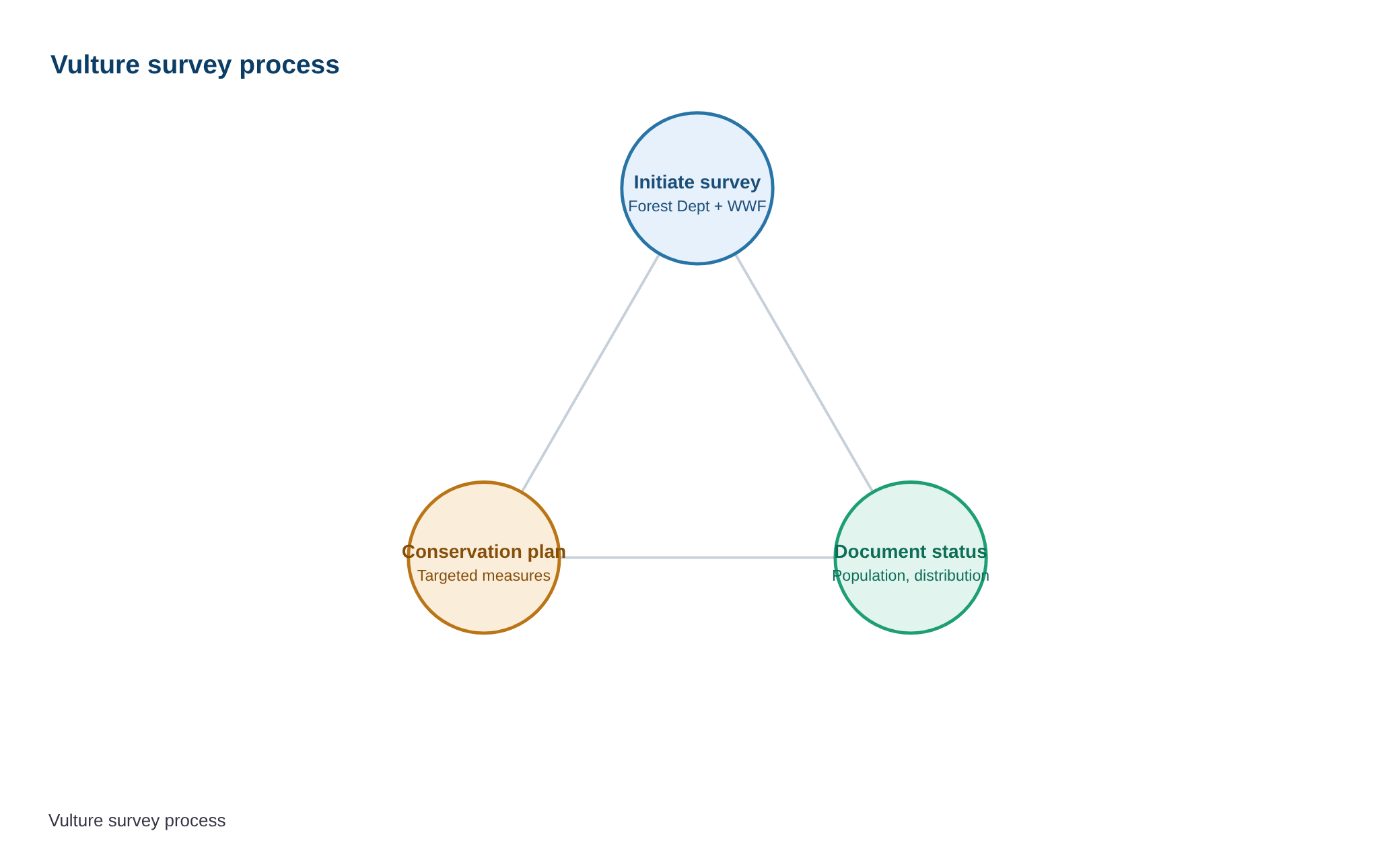
A two-day vulture survey has been initiated in the Wayanad Wildlife Sanctuary, Kerala, marking a proactive step in documenting the status and distribution of vulture populations. This survey, conducted jointly by the Forest Department and WWF-India, underscores the ecological significance of vultures and their role in maintaining ecosystem health, particularly in the context of the upcoming Wildlife Week celebrations. The initiative is critical given the region’s role as a habitat for three resident vulture species and occasional migratory species, highlighting the need for targeted conservation measures.
Background
- Vultures are obligate scavengers, playing a pivotal role in ecosystem services by efficiently consuming animal carcasses, thereby preventing the spread of diseases and facilitating nutrient cycling.
- The Wayanad Wildlife Sanctuary, part of the Nilgiri Biosphere Reserve, is a critical habitat for vultures in Kerala, supporting three resident species: the White-rumped Vulture (*Gyps bengalensis*), Red-headed Vulture (*Sarcogyps calvus*), and Indian Vulture (*Gyps indicus*).
- The region also serves as a transient habitat for migratory vulture species such as the Himalayan Griffon (*Gyps himalayensis*) and Cinereous Vulture (*Aegypius monachus*), emphasizing its ecological significance in a larger landscape.
- Historically, vulture populations in India have declined sharply due to factors such as poisoning from veterinary drugs (e.g., diclofenac), habitat loss, and food scarcity, leading to their classification as critically endangered or endangered by the IUCN.
- The survey aligns with broader conservation efforts under the Wildlife (Protection) Act, 1972, and India’s commitments to international biodiversity frameworks such as the Convention on Biological Diversity (CBD).
- Wildlife Week, celebrated annually in October, serves as a platform to raise awareness about the conservation of wildlife and their habitats, with this year’s survey preceding the event.
What are Vultures and Why are They Ecologically Significant?
- Vultures belong to the family Accipitridae and are obligate scavengers, relying exclusively on carrion for sustenance, which distinguishes them from other raptors.
- Their ecological role includes rapid carcass consumption, which minimizes the spread of pathogens by reducing the proliferation of disease vectors such as flies and rodents.
- Vultures contribute to nutrient cycling by breaking down organic matter, returning essential nutrients like nitrogen and phosphorus to the soil through their excreta, thereby enhancing soil fertility.
- The decline of vulture populations has been linked to secondary poisoning from the veterinary drug diclofenac, which is toxic to vultures even in small doses, leading to kidney failure and death.
- India is home to nine species of vultures, of which three—White-rumped Vulture, Red-headed Vulture, and Indian Vulture—are critically endangered, while others are endangered or near threatened.
- Conservation strategies for vultures include banning veterinary drugs like diclofenac, establishing Vulture Safe Zones (VSZs), and promoting community-based carcass disposal mechanisms to ensure safe food sources.
- The Nilgiri Biosphere Reserve, of which Wayanad Wildlife Sanctuary is a part, is recognized as a UNESCO Biosphere Reserve and is a biodiversity hotspot, providing critical habitats for numerous species, including vultures.
- Monitoring vulture populations through systematic surveys helps in assessing the effectiveness of conservation policies and identifying emerging threats such as habitat fragmentation and climate change.
UPSC Value Addition
Keywords for Mains Answer-Writing
Vulture conservation in India · Wayanad Wildlife Sanctuary · Nilgiri Biosphere Reserve · Obligate scavengers · Carcass nutrient cycling · Ecological role of vultures · Threatened vulture species in India · Community-based conservation · Wildlife Week celebrations · Kerala forest administration
Prelims Practice Questions
Q1. Consider the following statements regarding vultures in India:
1. Vultures are obligate scavengers that play a crucial role in nutrient cycling by rapidly consuming animal carcasses.
2. The White-rumped Vulture, Red-headed Vulture, and Indian Vulture are resident species in Wayanad Wildlife Sanctuary.
3. The Nilgiri Biosphere Reserve is not a significant habitat for vultures in peninsular India.
4. Vultures contribute to reducing the spread of pathogens by removing decaying animal matter from the ecosystem.
How many of the above statements are correct?
- Only one
- Only two
- Only three
- All four
Answer: Only three — Statements 1, 2, and 4 are correct as vultures are obligate scavengers, the three species are resident in Wayanad, and they reduce pathogen spread. Statement 3 is incorrect because the Nilgiri Biosphere Reserve is a significant habitat for vultures in peninsular India.
Q2. Assertion (A): Vultures are ecologically important scavengers that prevent the accumulation of decaying animal matter in ecosystems.
Reason (R): By consuming animal carcasses, vultures contribute to nutrient cycling and reduce the risk of pathogen spread.
Options:
A. Both A and R are true, and R is the correct explanation of A.
B. Both A and R are true, but R is not the correct explanation of A.
C. A is true, but R is false.
D. A is false, but R is true.
- A
- B
- C
- D
Answer: A — Both the assertion and reason are true, and the reason correctly explains the assertion. Vultures’ role in consuming carcasses directly contributes to nutrient cycling and pathogen control.
Q3. Match the following pairs of vulture species with their conservation status as per the IUCN Red List (2026):
Column I (Vulture Species) | Column II (IUCN Status)
1. White-rumped Vulture | A. Critically Endangered
2. Red-headed Vulture | B. Endangered
3. Indian Vulture | C. Vulnerable
4. Himalayan Griffon | D. Near Threatened
Options:
1. A, 2. B, 3. A, 4. D
2. 1. B, 2. A, 3. C, 4. D
3. 1. A, 2. A, 3. B, 4. C
4. 1. C, 2. B, 3. A, 4. D
- 1
- 2
- 3
- 4
Answer: 1 — The correct match is: 1. White-rumped Vulture – Critically Endangered, 2. Red-headed Vulture – Critically Endangered, 3. Indian Vulture – Critically Endangered, 4. Himalayan Griffon – Near Threatened.
Mains Practice Question
✍ Critically examine the ecological significance of vultures in India, with particular reference to their role in nutrient cycling and disease control. Also, discuss the conservation challenges faced by vulture populations in the country. (15 Marks)
Approach: MODEL-ANSWER SKELETON:
1. **Ecological Role of Vultures (4 Marks)**
– Define obligate scavengers and their dependence on carcasses.
– Explain nutrient cycling: how vultures accelerate decomposition and return nutrients (e.g., nitrogen, phosphorus) to the soil.
– Discuss disease control: reduction of pathogen spread (e.g., anthrax, rabies) by removing decaying matter.
– Cite examples: Wayanad Wildlife Sanctuary, Nilgiri Biosphere Reserve.
2. **Conservation Status and Threats (5 Marks)**
– IUCN Red List status of resident vulture species in India (White-rumped, Red-headed, Indian Vultures: Critically Endangered).
– Major threats: diclofenac toxicity, habitat loss, food scarcity, and electrocution from power lines.
– Reference the decline in vulture populations post-1990s due to veterinary use of non-steroidal anti-inflammatory drugs (NSAIDs).
– Mention the role of the Vulture Action Plan 2020-2025 by the Ministry of Environment, Forest and Climate Change.
3. **Conservation Efforts and Challenges (6 Marks)**
– Government initiatives: Vulture Conservation Breeding Centres (e.g., Pinjore, Rajabhatkhawa), banning of diclofenac for veterinary use.
– Community-based conservation: involvement of local communities, NGOs (e.g., WWF-India, Bombay Natural History Society).
– Challenges: lack of awareness, enforcement gaps, funding constraints, and need for transboundary cooperation (e.g., South Asia Vulture Recovery Programme).
– Suggest measures: stricter implementation of bans, habitat restoration, and research on alternative NSAIDs.
Source: The Hindu
Kerala PCS (Kerala PSC (KAS)) — State PCS Practice
Prelims: Which of the following is the primary objective of the recent vulture survey initiated in the Wayanad Wildlife Sanctuary?
- A. To assess the population decline of vultures in the sanctuary
- B. To study the impact of climate change on vulture habitats
- C. To identify new species of vultures in the Western Ghats
- D. To promote eco-tourism involving vultures
Answer: A. To assess the population decline of vultures in the sanctuary — The survey aims to evaluate the current population status and health of vultures in the sanctuary, which is crucial for conservation efforts.
Mains: Discuss the ecological significance of vultures in the Western Ghats and the challenges faced by their declining populations. Suggest measures for their conservation, with a focus on Kerala’s initiatives.
Generated by AanyaAi for educational purpose.
Related guides on our sites
- Best PSIR optional coaching for upsc
- Best economics optional coaching for upsc
- Best PSIR optional teacher for upsc
- Best teacher of PSIR optional for upsc

- यूक्रेन का रोबोट सेना अभियान: युद्ध में मानव हानि कम करने की रणनीति - September 27, 2026
- Ukraine’s ‘Army of Robots’: A Game-Changer for UPSC Mains 2026 Polity & Governance - September 27, 2026
- रूस ने भारत-ब्राजील को दिया UNSC स्थायी सदस्यता का समर्थन, जर्मनी-जापान विरोध में - September 27, 2026

No Comments