


10 Sep West Bengal’s ‘One State, One Education’ Bill: Key Provisions & Controversies
✎ The West Bengal Universities & Colleges Administration & Regulation (Amendment) Bill 2026 aims to implement the 'one state, one education' policy by regulating staff transfers and bringing Aliah University under the Higher…
Subject Relevance — Where This Topic Fits
- GS Paper II — Functions and Responsibilities of the Union and the States, Issues and Challenges Pertaining to the Federal Structure | GS Paper II — Government Policies and Interventions for Development in Various Sectors | GS Paper IV — Ethics and Human Interface: Accountability and Ethical Governance
- Prelims: West Bengal Higher Education Department, Aliah University Act, 2007, Governor’s assent to state bills, State legislature’s special session, Transfer of university staff
- Essay: Federalism and cooperative governance in education policy, Autonomy vs. accountability in higher education institutions
Quick Revision: The West Bengal Universities & Colleges Administration & Regulation (Amendment) Bill 2026 aims to implement the ‘one state, one education’ policy by regulating staff transfers and bringing Aliah University under the Higher Education Department, raising debates on institutional autonomy.
Why is this in the news?
The West Bengal Assembly is set to introduce and pass the West Bengal Universities & Colleges Administration & Regulation (Amendment) Bill 2026 during a special session, aiming to implement the ‘one state, one education’ policy. The Bill seeks to regulate the transfer of teaching and non-teaching staff across state-run universities, including the transfer of experienced faculty from older institutions to newer ones, and to bring Aliah University under the purview of the Higher Education Department. The move has sparked debates on institutional autonomy and the legal framework governing state-run universities.
Background
- The Bill is an amendment to the West Bengal Universities & Colleges Administration & Regulation Act, which governs the functioning of state-run higher education institutions in West Bengal.
- The ‘one state, one education’ policy aims to streamline educational governance by ensuring uniformity in administrative and academic practices across all state-run universities.
- Aliah University, established under the Aliah University Act, 2007, was previously under the jurisdiction of the Minority Affairs & Madrasah Education Department, reflecting its historical and religious education focus.
- The Bill follows the state cabinet’s approval and is expected to be passed in a single-day special session of the West Bengal Assembly.
- The Governor’s assent is required for the Bill to become law, after which it will be enacted as the West Bengal Universities & Colleges Administration & Regulation (Amendment) Act, 2026.
- The policy aligns with the state government’s objective to utilise the expertise of experienced faculty in newer institutions to enhance teaching, research, and administrative quality.
What is the West Bengal Universities & Colleges Administration & Regulation (Amendment) Bill 2026?
- The Bill seeks to amend the existing West Bengal Universities & Colleges Administration & Regulation Act to implement the ‘one state, one education’ policy, ensuring uniformity in higher education governance across the state.
- Key provision: The Bill proposes guidelines for the transfer of teaching and non-teaching staff between state-run universities, particularly targeting experienced faculty from older institutions (e.g., Calcutta University, Jadavpur University) to newer ones to balance human resource distribution.
- The Bill includes provisions to bring Aliah University under the administrative control of the West Bengal Higher Education Department, shifting it from the Minority Affairs & Madrasah Education Department.
- The rationale cited for the transfer policy is to utilise the expertise of experienced faculty in newer institutions, thereby improving teaching quality, research output, and administrative efficiency.
- The Bill raises questions about the autonomy of state-run universities, as universities in West Bengal operate as autonomous bodies under their respective Acts, and their staff are not directly state government employees.
- The legal framework governing the transfer of staff will be clarified only after the Bill is passed and enacted, leaving room for interpretation and potential controversies.
- The Bill is part of a broader effort to standardise higher education governance in West Bengal, aligning with the state’s vision for equitable and quality education across institutions.
- The Bill will require the Governor’s assent before it becomes law, following the state legislature’s passage.
Key Features
| Feature | Significance |
|---|---|
| Transfer of teaching and non-teaching staff | Proposes systematic redistribution of experienced faculty and administrative staff from older universities to newer institutions to enhance teaching quality and administrative efficiency across the state’s higher education system. |
| Inclusion of Aliah University under Higher Education Department | Shifts administrative jurisdiction of Aliah University from the Minority Affairs & Madrasah Education Department to the Higher Education Department, aiming for uniform governance and resource distribution in higher education. |
| Autonomy of state-run universities | Highlights the constitutional and statutory autonomy of state-run universities in matters of faculty management, raising questions about the extent of government control over transfers and administrative decisions. |
| Balanced distribution of human resources | Seeks to utilise the expertise of long-serving faculty and staff in newer universities to improve teaching, research, and administrative infrastructure, thereby addressing regional disparities in educational quality. |
| Legislative process and gubernatorial assent | The bill’s passage through the Assembly and subsequent assent by the Governor will formalise the policy into law, ensuring its legal enforceability and institutional legitimacy. |
Why it Matters
Higher Education Governance
- Demonstrates state-level intervention in higher education administration to achieve uniformity and efficiency, reflecting a trend of policy-driven reforms in state-run educational institutions.
- Raises critical questions about the balance between governmental oversight and institutional autonomy in the governance of universities.
- Highlights the role of legislative action in shaping educational policy, particularly in states with diverse educational institutions and historical administrative structures.
Resource Allocation and Equity
- Aims to address disparities in educational quality by redistributing experienced faculty and administrative staff from older, established universities to newer institutions.
- Seeks to improve teaching, research, and administrative capabilities in under-resourced universities, thereby promoting equitable access to quality education across the state.
- Reflects a policy approach to utilise existing human resources effectively, rather than solely focusing on new recruitment or infrastructure development.
Administrative and Legal Implications
- The inclusion of Aliah University under the Higher Education Department signifies a consolidation of administrative control, which may streamline governance but could also raise concerns about minority educational rights.
- The legislative process underscores the importance of constitutional provisions related to education, particularly in states with diverse institutional frameworks.
- The requirement for gubernatorial assent introduces a layer of constitutional oversight, ensuring that the bill aligns with broader legal and policy frameworks.
Challenges
1. Faculty Autonomy vs. Government Control
- The proposed transfer of faculty and staff from older to newer universities may be perceived as infringing upon the autonomy of state-run universities, which are constitutionally autonomous bodies.
- Questions arise about whether transfers will be voluntary or mandatory, and whether such decisions will be taken unilaterally by the government or through mutual consent.
- Potential resistance from faculty associations and university administrations could lead to legal challenges or administrative bottlenecks.
UPSC Link: 7th Schedule, State List (Education)
2. Minority Educational Rights
- The transfer of Aliah University from the Minority Affairs Department to the Higher Education Department may raise concerns about the protection of minority educational rights under constitutional provisions.
- Ensuring that the policy does not dilute the special status or administrative autonomy of minority institutions will be critical to avoid legal and social controversies.
UPSC Link: Article 30 (Rights of Minorities)
3. Implementation and Enforcement
- The success of the policy depends on effective implementation, which requires clear guidelines, stakeholder consultations, and robust administrative mechanisms.
- Potential delays in the transfer process, resistance from affected faculty, or lack of consensus on transfer criteria could undermine the policy’s objectives.
UPSC Link: Administrative Reforms Commission Recommendations
4. Equity in Resource Distribution
- Ensuring that the redistribution of faculty and staff does not create new disparities or neglect the needs of older universities is a significant challenge.
- Balancing the interests of older, established universities with those of newer institutions will require careful planning and continuous monitoring.
UPSC Link: NITI Aayog’s Higher Education Strategy
5. Legal and Constitutional Validity
- The policy must align with constitutional provisions, including those related to education, autonomy, and minority rights, to avoid legal challenges.
- Ensuring that the legislative process adheres to constitutional norms and does not infringe upon fundamental rights will be essential.
UPSC Link: Basic Structure Doctrine
Challenges — UPSC Perspective
| Issue | Concern |
|---|---|
| Faculty autonomy | Risk of government overreach in faculty transfers, potentially violating institutional autonomy. |
| Minority educational rights | Potential dilution of administrative control over minority institutions like Aliah University. |
| Implementation delays | Possible resistance from faculty, administrative bottlenecks, or lack of consensus on transfer criteria. |
| Equity in resource distribution | Ensuring that older universities do not suffer from the redistribution of experienced faculty and staff. |
| Legal validity | Risk of legal challenges if the policy is perceived to infringe upon constitutional rights or provisions. |
Way Forward
- Conduct stakeholder consultations with faculty associations, university administrations, and student bodies to address concerns and build consensus on the transfer policy.
- Develop clear, transparent guidelines for faculty and staff transfers, including criteria for selection, timelines, and grievance redressal mechanisms.
- Ensure that the transfer process respects the autonomy of state-run universities while aligning with state-level educational goals.
- Monitor the implementation of the policy to assess its impact on teaching quality, research output, and administrative efficiency in both older and newer universities.
- Strengthen mechanisms for continuous evaluation and feedback to address emerging challenges and make necessary adjustments to the policy.
- Clarify the administrative and legal implications of shifting Aliah University to the Higher Education Department to address concerns about minority educational rights.
- Collaborate with the Governor’s office to ensure timely assent and formalisation of the bill into law, while addressing any constitutional or legal concerns.
- Promote public awareness campaigns to explain the objectives and benefits of the policy, fostering broader support and reducing resistance.
UPSC Value Addition
Keywords for Mains Answer-Writing
One State One Education Policy · Autonomy of State Universities · Transfer of University Teachers · Aliah University Jurisdiction · Higher Education Administration · West Bengal Higher Education Department · Governor’s Assent · State Legislature’s Legislative Competence · Academic Autonomy vs State Control · Constitutional Framework of Education
Constitutional & Policy Linkages
- Article 29 (Protection of Minority Rights)
- Article 30 (Rights of Minorities to Establish and Administer Educational Institutions)
- 7th Schedule, State List (Education)
- Basic Structure Doctrine (Judicial Review)
Concept Flow
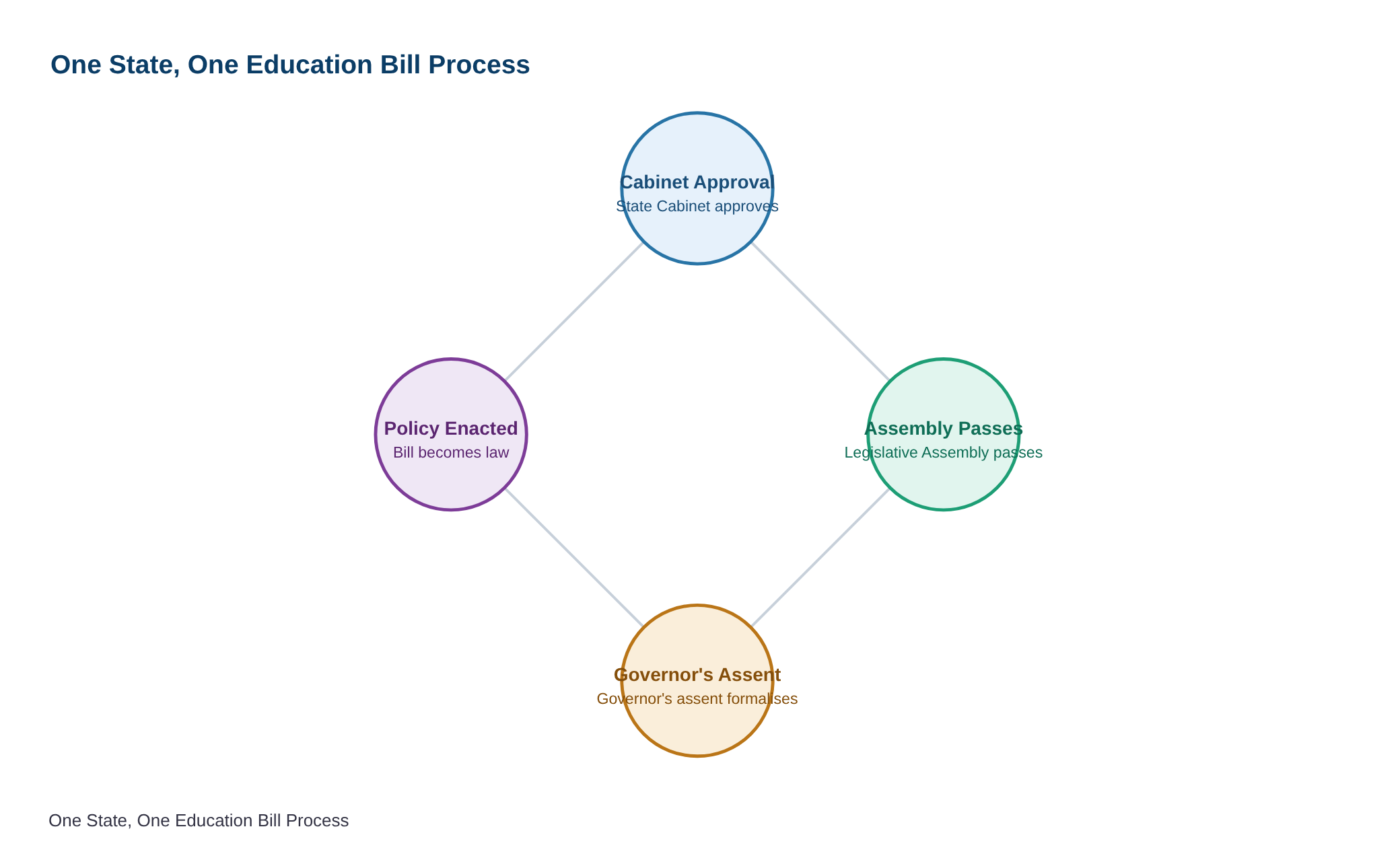
State Cabinet approves the bill → Legislative Assembly passes the bill → Governor’s assent formalises the policy → Administrative guidelines for faculty transfers are issued → Transfers of experienced faculty and staff are implemented → Impact on teaching quality and administrative efficiency is assessed → Policy is reviewed and adjusted based on feedback.
Prelims Practice Questions
Q1. Consider the following statements regarding the West Bengal Universities & Colleges Administration & Regulation (Amendment) Bill 2026:
1. The bill proposes to transfer teachers from older state-run universities to newer ones.
2. Aliah University is proposed to be brought under the jurisdiction of the West Bengal Minority Affairs & Madrasah Education Department.
3. The bill was cleared by the state cabinet before being introduced in the Assembly.
How many of the above statements are correct?
- Only one
- Only two
- All three
- None
Answer: Only two — Statement 1 is correct as the bill proposes transfers to utilise experienced teachers in new universities. Statement 2 is incorrect as the bill seeks to bring Aliah University under the West Bengal Higher Education Department. Statement 3 is correct as the bill was cleared by the state cabinet.
Q2. Assertion (A): The autonomy of state-run universities is constitutionally protected under the Seventh Schedule of the Indian Constitution.
Reason (R): The West Bengal Universities & Colleges Administration & Regulation (Amendment) Bill 2026 seeks to regulate transfers of teachers, which may impinge on this autonomy.
Options:
A. Both A and R are true, and R is the correct explanation of A.
B. Both A and R are true, but R is not the correct explanation of A.
C. A is true, but R is false.
D. A is false, but R is true.
Answer: ? — Assertion (A) is true as university autonomy is constitutionally protected under Entry 66 of the Union List and Entry 32 of the State List in the Seventh Schedule. Reason (R) is also true but does not directly explain the assertion, as the bill pertains to state legislative competence over higher education administration.
Mains Practice Question
✍ Critically examine the constitutional and administrative implications of the ‘one state, one education’ policy as envisaged in the West Bengal Universities & Colleges Administration & Regulation (Amendment) Bill 2026. (15 Marks)
Approach: MODEL-ANSWER SKELETON:
1. **Constitutional Framework**:
– Entry 66 (Union List) and Entry 32 (State List) of the Seventh Schedule: Higher education as a concurrent subject.
– Article 246: Distribution of legislative powers between Parliament and State Legislatures.
– Article 248: Residuary powers of Parliament.
– Doctrine of pith and substance: Whether the bill falls within the state’s legislative competence.
2. **Autonomy of State Universities**:
– Constitutional status of universities under Article 29 and 30 (cultural and educational rights).
– Judicial precedents: T.M.A. Pai Foundation v. State of Karnataka (2002) and P.A. Inamdar v. State of Maharashtra (2005) on university autonomy.
– Conflict between state control and institutional autonomy.
3. **Administrative Implications**:
– Provisions for teacher transfers: Whether this undermines academic freedom or ensures equitable distribution of resources.
– Bringing Aliah University under the Higher Education Department: Implications for minority educational institutions under Article 30.
– Role of the Governor in granting assent under Article 200: Whether the bill is likely to face constitutional challenges.
4. **Balancing State Interests and Academic Freedom**:
– Arguments for state intervention: Ensuring quality, equitable distribution of faculty, and reducing regional disparities.
– Counter-arguments: Potential misuse of power, erosion of institutional autonomy, and threats to academic independence.
5. **Conclusion**:
– The policy reflects a legitimate state objective but must be balanced with constitutional safeguards for autonomy.
– Recommendations: Clear statutory safeguards, consultation with stakeholders, and judicial review mechanisms.
Source: orissapost.com
West Bengal PCS (WBPSC / WBCS) — State PCS Practice
Prelims: Which of the following is the primary objective of the West Bengal Assembly’s ‘one state, one education’ bill?
- To unify the school education system under a single board for the entire state
- To introduce a common curriculum for all higher education institutions
- To merge all universities in West Bengal into a single administrative body
- To establish a uniform teacher recruitment policy across all districts
Answer: To unify the school education system under a single board for the entire state — The bill aims to create a single education board for West Bengal to standardize school education across the state.
Mains: Critically analyze the potential benefits and challenges of implementing the ‘one state, one education’ policy in West Bengal. How might this policy impact the existing diversity in educational practices across different regions of the state?
Generated by AanyaAi for educational purpose.
Related guides on our sites
- Current affairs for upsc 2026
- Best PSIR optional coaching for upsc
- Best PSIR optional teacher for upsc
- Best teacher of PSIR optional for upsc

- West Bengal’s ‘One State, One Education’ Bill: Key Provisions & Controversies - September 10, 2026
- UPSC Civil Services (Main) Examination 2026 — Kannada Literature Paper II: Question Paper | Plutus IAS - September 10, 2026
- UPSC Civil Services (Main) Examination 2026 — Kannada Literature Paper I: Question Paper | Plutus IAS - September 10, 2026

No Comments