


02 Aug WHO-Netherlands Pact: €500K Boost for Climate-Health Action in 2024
✎ The WHO-Netherlands partnership exemplifies the integration of climate action into global health governance, with the Netherlands’ financial and strategic support enabling the WHO to operationalise climate-resilient health…
Subject Relevance — Where This Topic Fits
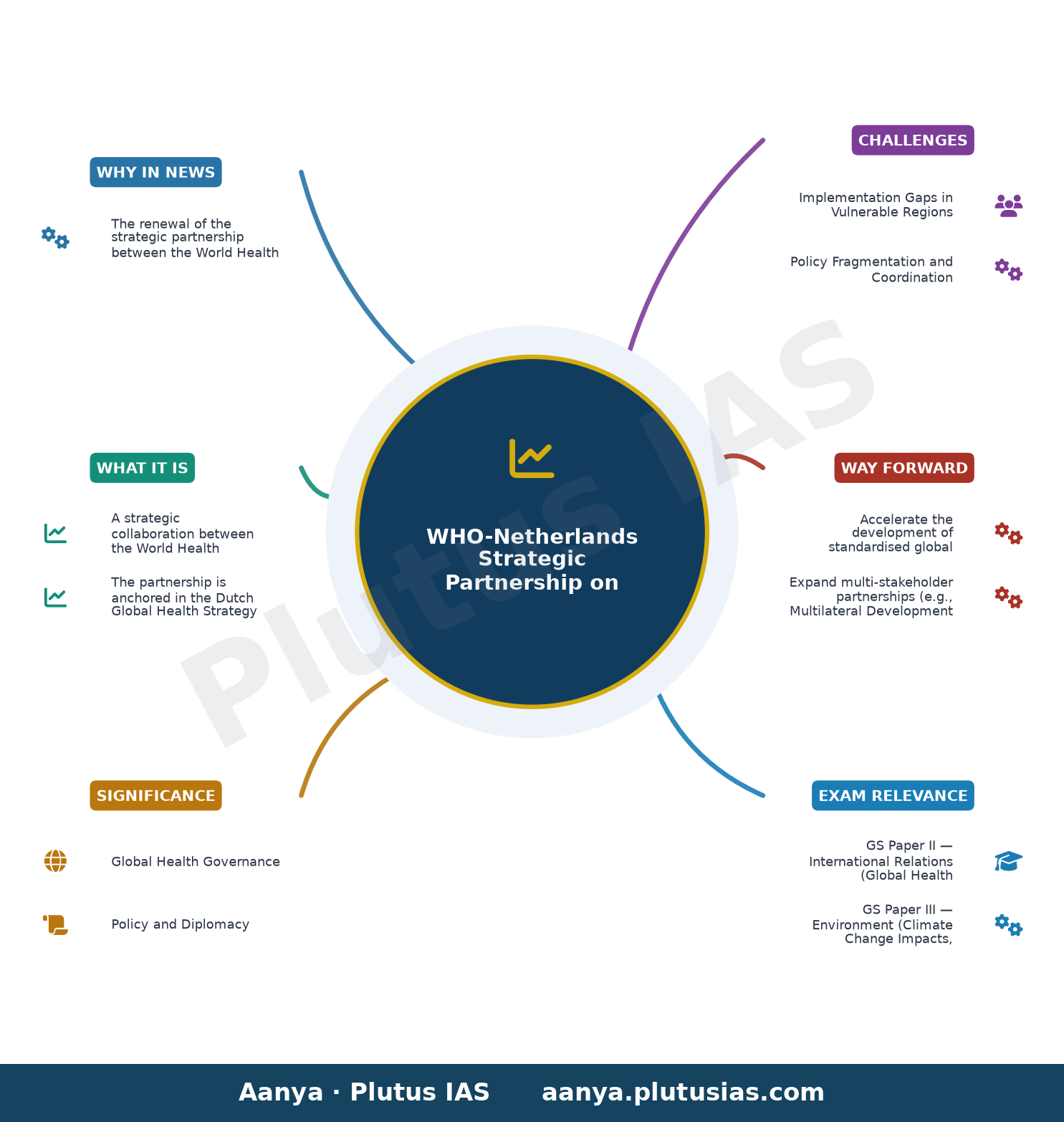
- GS Paper II — International Relations (Global Health Governance, Multilateral Partnerships) | GS Paper III — Environment (Climate Change Impacts, Sustainable Development Goals, Health Systems Resilience) | GS Paper III — Science and Technology (Health Surveillance Systems, Early Warning Mechanisms)
- Prelims: WHO, Netherlands, Climate Change and Health, Alliance for Transformative Action on Climate and Health (ATACH), COP26 health commitments, World Health Assembly Resolution 77.3 (2024), Dutch Global Health Strategy 2023-2030, Climate-resilient health systems, Low-carbon healthcare, Health surveillance systems
- Essay: Climate change as the defining challenge of the 21st century: Interlinkages between environmental degradation and public health, Multilateralism in crisis: The role of international partnerships in addressing global health inequities
Quick Revision: The WHO-Netherlands partnership exemplifies the integration of climate action into global health governance, with the Netherlands’ financial and strategic support enabling the WHO to operationalise climate-resilient health systems and early warning mechanisms, thereby aligning with the WHO’s GPW 14 and the WHA 77 Resolution.
Why is this in the news?
The renewal of the strategic partnership between the World Health Organization (WHO) and the Kingdom of the Netherlands on 10 October 2024, with an additional €500,000 allocation for 2024, underscores the escalating urgency of integrating climate action with global health governance. This development is significant as it aligns with the WHO’s Fourteenth General Programme of Work (GPW 14) and precedes critical climate negotiations at COP29, highlighting the Netherlands’ leadership in embedding health considerations within climate policy frameworks.
Background
- The WHO-Netherlands partnership on climate change and health was initiated in 2023, marking a pivotal shift in global health diplomacy by explicitly linking climate action to health outcomes.
- The Netherlands has been a vocal advocate for climate-health integration, as evidenced by its Dutch Global Health Strategy 2023–2030, which prioritises the nexus between environmental sustainability and public health.
- The World Health Assembly (WHA) Resolution on Climate Change and Health (2024), co-led by the Netherlands and Peru, formalised the global consensus on the need for a WHO global action plan to address climate-related health risks, superseding the 2008 WHA Resolution on Climate Change and Health.
- The Alliance for Transformative Action on Climate and Health (ATACH) Secretariat, supported by the Netherlands’ funding, serves as a critical platform for harmonising climate-health strategies across Member States.
- Climate change exacerbates health vulnerabilities, with projections indicating that by 2030, climate-related events could cause an additional 250,000 deaths annually from malnutrition, malaria, diarrhoea, and heat stress (WHO estimates).
- The partnership’s cumulative support of over €1.1 million since 2023 reflects a growing recognition of health systems’ role in climate adaptation and mitigation, particularly in vulnerable regions such as Africa, Asia, and the Eastern Mediterranean.
What is the WHO-Netherlands Partnership on Climate Change and Health?
- A strategic collaboration between the World Health Organization (WHO) and the Kingdom of the Netherlands, renewed annually since 2023, to address the intersection of climate change and global health outcomes.
- The partnership is anchored in the Dutch Global Health Strategy 2023–2030, which frames climate change as a cross-cutting determinant of health equity and resilience.
- Core objectives include strengthening climate-resilient health systems, enhancing early warning systems for health-related climate risks, and mainstreaming climate considerations into national health policies.
- The Netherlands’ financial commitment of €500,000 for 2024 (cumulative €1.1 million since 2023) is channelled through the Alliance for Transformative Action on Climate and Health (ATACH) Secretariat, supporting global and regional health initiatives.
- The partnership prioritises vulnerable regions (Africa, Asia, Eastern Mediterranean) by assisting Member States in implementing integrated climate-health surveillance, early warning systems, and capacity-building for health professionals.
- It aligns with the WHO’s Fourteenth General Programme of Work (GPW 14), which targets the prevention of 7.5 million deaths over four years through climate-resilient health interventions.
- The collaboration is instrumental in operationalising the World Health Assembly Resolution on Climate Change and Health (2024), which calls for a WHO global action plan on climate change and health, integrating health into climate negotiations ahead of COP29.
- The partnership emphasises multi-stakeholder engagement, including civil society, Multilateral Development Banks, UN agencies, and health professionals, to foster a unified global response to climate-induced health challenges.
Key Features
| Feature | Significance |
|---|---|
| Strategic Partnership Renewal (2024) | Reinforces long-term collaboration between WHO and the Netherlands on climate-health nexus, ensuring sustained funding and policy alignment. |
| Financial Allocation (€500,000 for 2024) | Direct funding to WHO’s Alliance for Transformative Action on Climate and Health Secretariat, enabling operational continuity and programme expansion. |
| Integrated Surveillance Systems | Supports development of early warning systems for climate-related health risks in vulnerable regions (Africa, Asia, Eastern Mediterranean). |
| COP26 Health Commitments | Facilitates implementation of climate-resilient health systems, aligning with global climate agreements and health sector priorities. |
| Global Action Plan (WHA 77 Resolution, 2024) | Advocates for mainstreaming climate-health linkages in WHO’s Fourteenth General Programme of Work (GPW 14). |
Why it Matters
Global Health Governance
- Demonstrates multilateral cooperation in addressing climate-induced health crises, reinforcing WHO’s role as a coordinating authority.
- Aligns with WHO’s GPW 14, which prioritises climate-resilient health systems and health equity in climate action.
- Sets a precedent for high-income countries to financially support low- and middle-income countries in climate adaptation.
Policy and Diplomacy
- Underscores the Netherlands’ leadership in global health diplomacy, particularly in climate-health integration (Dutch Global Health Strategy 2023-2030).
- Highlights the adoption of WHA 77 Resolution (2024), which mandates a global action plan for climate change and health.
- Positions health as a central pillar in climate negotiations, particularly ahead of COP29 (Azerbaijan, 2024).
Health System Resilience
- Strengthens early warning systems for climate-related health risks (e.g., vector-borne diseases, heat stress, extreme weather events).
- Enhances capacity of Member States to deliver on COP26 health commitments, particularly in vulnerable regions.
- Supports transition to low-carbon healthcare systems, reducing the carbon footprint of health services.
Financial and Operational Impact
- Total Dutch contribution since 2023 exceeds €1.1 million, enabling scalable interventions in climate-vulnerable regions.
- Funding reinforces WHO’s Investment Case, which estimates 7.5 million lives saved over four years through targeted climate-health programmes.
Challenges
1. Implementation Gaps in Vulnerable Regions
- Limited institutional capacity in low-income countries to integrate climate-health surveillance systems.
- Inadequate funding and technical expertise for early warning systems in regions prone to extreme weather events.
- Slow mainstreaming of climate-resilient health policies due to competing health priorities and resource constraints.
UPSC Link: GS II: International Organisations (WHO)
2. Policy Fragmentation and Coordination
- Lack of harmonised global standards for climate-health surveillance and response mechanisms.
- Divergent national priorities among Member States, hindering unified action on climate-health integration.
- Weak enforcement mechanisms for WHA resolutions and COP health commitments.
UPSC Link: GS II: Global Groupings
3. Financial Sustainability
- Dependence on voluntary contributions from high-income countries (e.g., Netherlands) may lead to funding volatility.
- Limited private-sector engagement in climate-health financing, despite potential for innovation and scalability.
- Competing demands for climate finance across sectors (e.g., agriculture, infrastructure) may dilute health-specific allocations.
UPSC Link: GS III: Environmental Pollution
4. Technological and Data Constraints
- Insufficient granular data on climate-health linkages, particularly in remote or conflict-affected regions.
- Gaps in interoperability between national health information systems and climate monitoring tools.
- Limited access to advanced technologies (e.g., AI, remote sensing) for predictive modelling of climate-health risks.
UPSC Link: GS III: Science and Technology
Challenges — UPSC Perspective
| Issue | Concern |
|---|---|
| Institutional Capacity | Inability of low-income countries to operationalise climate-health surveillance systems. |
| Funding Volatility | Over-reliance on ad-hoc contributions from high-income countries for sustained programmes. |
| Policy Coherence | Fragmented global frameworks leading to inconsistent implementation of climate-health commitments. |
| Data Gaps | Lack of real-time, granular data on climate-induced health risks in vulnerable regions. |
| Technological Barriers | Limited access to advanced tools for predictive analysis and early warning in climate-vulnerable areas. |
Way Forward
- Accelerate the development of standardised global frameworks for climate-health surveillance and response, aligned with WHA 77 Resolution.
- Expand multi-stakeholder partnerships (e.g., Multilateral Development Banks, UN Agencies, civil society) to mobilise additional funding for climate-resilient health systems.
- Invest in capacity-building programmes for national health authorities to integrate climate-risk assessments into health planning.
- Enhance data-sharing mechanisms between climate science institutions and health ministries to improve predictive modelling.
- Promote public-private partnerships to incentivise innovation in low-carbon healthcare technologies and financing models.
- Strengthen regional cooperation (e.g., through WHO Regional Offices) to harmonise early warning systems and share best practices.
- Advocate for climate-health mainstreaming in national health policies and budgets, ensuring alignment with COP commitments.
- Establish a dedicated fund under WHO’s GPW 14 to channel resources directly to climate-vulnerable Member States.
UPSC Value Addition
Keywords for Mains Answer-Writing
WHO’s Fourteenth General Programme of Work (GPW 14) · Climate change and health nexus · Alliance for Transformative Action on Climate and Health (ATACH) · WHO Global Action Plan on Climate Change and Health · Dutch Global Health Strategy 2023-2030 · World Health Assembly Resolution on Climate Change and Health (WHA77, 2024) · COP29 climate negotiations (Azerbaijan, 2024) · Climate-resilient health systems · Multilateral partnerships for health and climate · Low-carbon healthcare systems · Integrated climate-health surveillance systems · WHO Investment Case 2024 (7.5 million lives saved)
Concept Flow
Climate change exacerbates health risks → Increased burden of diseases (e.g., vector-borne, heat stress) → Need for resilient health systems → Multilateral partnerships (WHO-Netherlands) → Financial and technical support → Implementation of surveillance systems → Early warning and response → Reduced mortality and morbidity → Alignment with global health commitments (COP26, WHA 77) → Mainstreaming in GPW 14.
Prelims Practice Questions
Q1. Consider the following statements regarding the WHO-Netherlands partnership on climate change and health:
1. The Netherlands has allocated €500,000 in 2024 to support WHO’s climate and health programmes.
2. The partnership aims to establish integrated climate-health surveillance systems in African, Asian, and Eastern Mediterranean countries.
3. The Netherlands led the adoption of the World Health Assembly Resolution on Climate Change and Health in 2024.
4. The partnership’s total support to WHO since 2023 exceeds €1.1 million.
How many of the above statements are correct?
- Only one
- Only two
- Only three
- All
Answer: All — Statements 1, 2, and 4 are correct. Statement 3 is incorrect as the Netherlands co-led the adoption with Peru, not alone.
Q2. Assertion (A): The WHO’s Fourteenth General Programme of Work (GPW 14) prioritizes climate change as a key health priority.
Reason (R): The WHO Investment Case 2024 estimates that WHO’s work on climate change and health will save 7.5 million lives in the next four years.
Options:
A. Both A and R are true, and R is the correct explanation of A.
B. Both A and R are true, but R is not the correct explanation of A.
C. A is true, but R is false.
D. A is false, but R is true.
- A
- B
- C
- D
Answer: C — Assertion (A) is true as GPW 14 indeed prioritizes climate change. Reason (R) is also true but does not directly explain the assertion, as the GPW 14’s priority is independent of the life-saving estimate.
Q3. Match the following initiatives with their respective descriptions:
Column I
1. Alliance for Transformative Action on Climate and Health (ATACH)
2. Dutch Global Health Strategy 2023-2030
3. WHO Global Action Plan on Climate Change and Health
4. World Health Assembly Resolution on Climate Change and Health (WHA77, 2024)
Column II
A. A strategic framework adopted by the Netherlands to integrate climate change and health.
B. A WHO-led initiative to strengthen climate-resilient health systems globally.
C. A resolution adopted at WHA77 calling for accelerated national and global efforts.
D. A partnership secretariat supported by the Netherlands to advance climate and health programmes.
Options:
1. 1-D, 2-A, 3-B, 4-C
2. 1-A, 2-B, 3-C, 4-D
3. 1-B, 2-A, 3-D, 4-C
4. 1-C, 2-D, 3-A, 4-B
- 1
- 2
- 3
- 4
Answer: 1 — Correct matches: 1-D (ATACH secretariat), 2-A (Dutch Global Health Strategy), 3-B (WHO Global Action Plan), 4-C (WHA77 Resolution).
Mains Practice Question
✍ The World Health Organization (WHO) and the Kingdom of the Netherlands have renewed their strategic partnership to address the nexus between climate change and health. Critically examine the significance of this partnership in the context of WHO’s Fourteenth General Programme of Work (GPW 14) and the global health architecture. (15 Marks)
Approach: MODEL-ANSWER SKELETON:
1. **Introduction (2 marks)**: Define the climate change and health nexus and its urgency as per WHO’s GPW 14. Mention the renewed Netherlands-WHO partnership (€500,000 in 2024, total support >€1.1 million since 2023) and its alignment with the Dutch Global Health Strategy 2023-2030.
2. **Key Components of the Partnership (4 marks)**:
– **ATACH Secretariat**: Role in advancing climate-resilient health systems and integrated surveillance systems.
– **WHA77 Resolution (2024)**: Co-led by Netherlands and Peru; calls for a WHO global action plan and mainstreaming climate-health in national policies.
– **Capacity Building**: Support to African, Asian, and Eastern Mediterranean countries for early warning systems and COP26 health commitments.
– **Low-carbon Healthcare Systems**: Focus on sustainable, climate-resilient healthcare infrastructure.
3. **Significance in GPW 14 (4 marks)**:
– **Priority Area**: Climate change as a key focus in GPW 14, with an estimated 7.5 million lives saved over four years (WHO Investment Case 2024).
– **Global Action Plan**: Partnership aligns with the WHO’s call for a global action plan to address climate-health risks.
– **Multilateral Collaboration**: Engages civil society, Multilateral Development Banks, UN agencies, and health professionals for concerted action.
– **COP29 Preparedness**: Ensures health remains central to climate negotiations ahead of COP29 (Azerbaijan, 2024).
4. **Challenges and Limitations (3 marks)**:
– **Resource Gaps**: Despite contributions, funding remains insufficient for the scale of the challenge.
– **Implementation Barriers**: Varied capacity among countries to adopt integrated climate-health systems.
– **Policy Coherence**: Need for stronger alignment between national health strategies and climate policies.
5. **Conclusion (2 marks)**: Summarize the partnership’s role in advancing climate-resilient health systems and the need for sustained multilateral cooperation. Highlight the urgency as climate impacts intensify.
Source: who.int
Generated by AanyaAi for educational purpose.


No Comments