


13 Aug WHO warns against Trump’s vaccine policy shift: UPSC & State PCS exam analysis
✎ Vaccination schedules are designed to provide optimal protection against diseases, and deviations from recommended schedules can undermine public health outcomes and increase the risk of outbreaks.
Subject Relevance — Where This Topic Fits
- GS Paper II — International Organisations (WHO, UN) | GS Paper III — Science and Technology (Public Health, Vaccination Policy) | GS Paper III — Environment and Health (Infectious Diseases, Immunisation)
- Prelims: Vaccine hesitancy, Measles-Mumps-Rubella (MMR) vaccine, Executive Order (US), WHO recommendations, Infectious disease control, Parental rights vs public health, Immunisation schedule, Vaccine safety
- Essay: The tension between individual liberty and collective public health in governance, The role of international organisations in shaping national health policies
Quick Revision: Vaccination schedules are designed to provide optimal protection against diseases, and deviations from recommended schedules can undermine public health outcomes and increase the risk of outbreaks.
Why is this in the news?
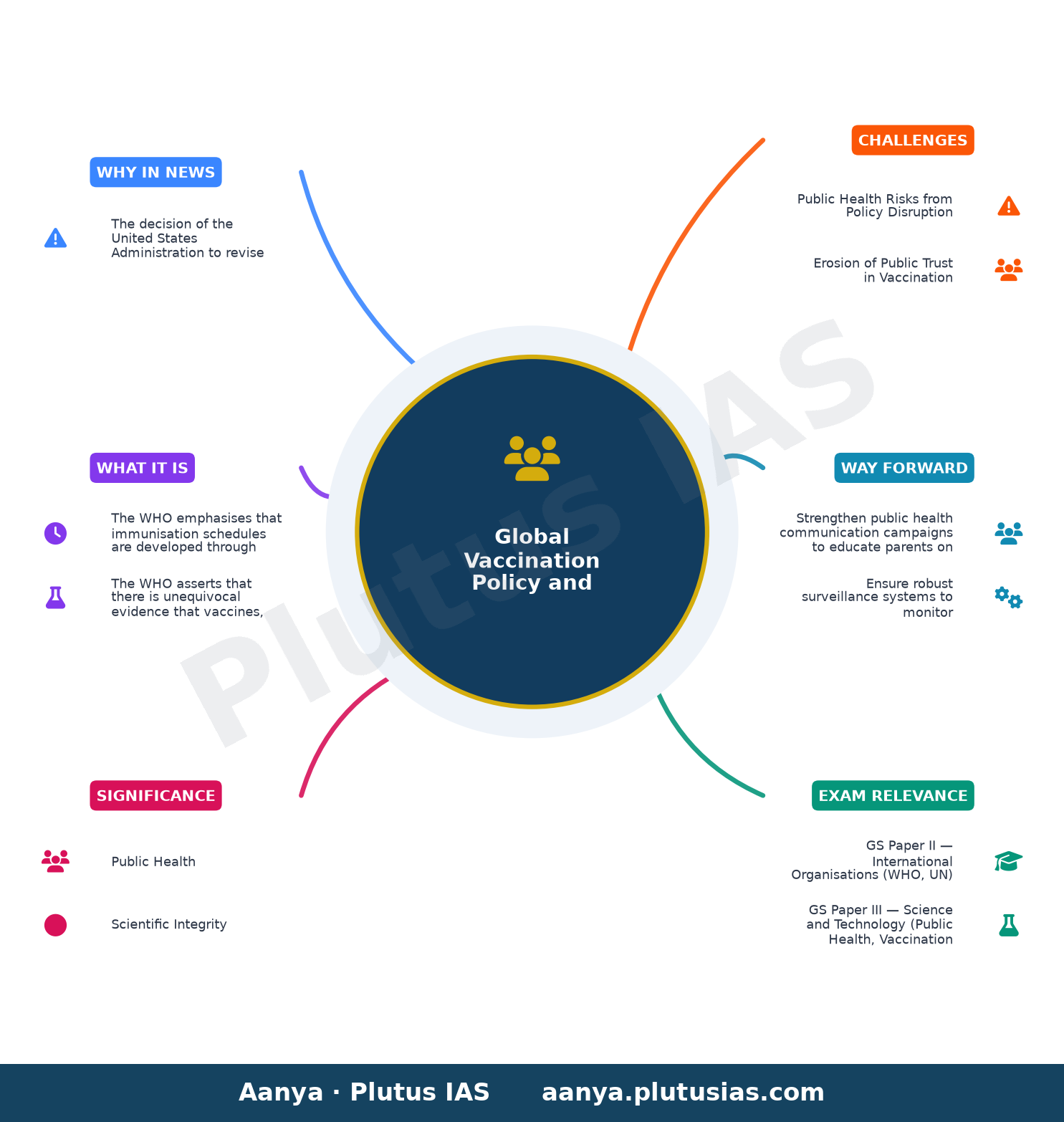
The decision of the United States Administration to revise the recommended childhood immunisation schedule has triggered a global response from the World Health Organization (WHO). The WHO’s statement underscores the scientific consensus on vaccine safety and efficacy, highlighting concerns that policy changes not aligned with established evidence could undermine public health outcomes and global immunisation efforts.
Background
- Vaccination is a cornerstone of public health, preventing an estimated 2-3 million deaths annually from vaccine-preventable diseases such as measles, polio, and diphtheria.
- The WHO’s Expanded Programme on Immunisation (EPI), launched in 1974, provides a framework for national immunisation schedules, aiming to achieve universal immunisation coverage.
- The MMR vaccine, introduced in the 1970s, combines protection against measles, mumps, and rubella in a single dose, reducing the number of injections required and improving compliance.
- Vaccine hesitancy, driven by misinformation or concerns about safety, has been identified by the WHO as one of the top ten global health threats, complicating efforts to achieve herd immunity.
- The US immunisation schedule, developed by the Centers for Disease Control and Prevention (CDC) in collaboration with the Advisory Committee on Immunization Practices (ACIP), is periodically updated based on the latest scientific evidence.
- The WHO’s Strategic Advisory Group of Experts on Immunisation (SAGE) provides global recommendations on vaccine use, which are used by countries to inform their national policies.
What is the WHO’s stance on vaccination schedules and the US executive order?
- The WHO emphasises that immunisation schedules are developed through rigorous, independent, and transparent review of scientific evidence, ensuring that vaccines are administered at the optimal time and in the most effective combinations to maximise protection.
- The WHO asserts that there is unequivocal evidence that vaccines, including the MMR vaccine, do not cause autism, a claim that has been repeatedly debunked by extensive scientific research.
- The WHO’s Global Vaccine Action Plan (GVAP) 2011–2020 and its successor, the Immunisation Agenda 2030, advocate for equitable access to vaccines and the maintenance of high immunisation coverage to prevent outbreaks.
- The WHO’s stance is grounded in the principle that vaccination policies must prioritise public health outcomes over individual preferences, as herd immunity relies on high and sustained immunisation coverage.
- The WHO’s concerns reflect broader global trends, where deviations from recommended schedules—whether due to policy changes or vaccine hesitancy—have led to resurgences of vaccine-preventable diseases, such as measles outbreaks in Europe and the Americas.
- The WHO’s response underscores the importance of multilateral cooperation in public health, as national policies that deviate from global recommendations can have cross-border implications for disease control.
- The WHO advocates for policies that are evidence-based, transparent, and aligned with international standards to ensure consistency and effectiveness in immunisation programmes.
Key Features
| Feature | Significance |
|---|---|
| Executive Order on Vaccine Schedule | Introduces a policy directive to reduce the number of routine childhood immunizations from 18 to 11 and separate the MMR vaccine into three single-disease shots. |
| Parental Choice and Religious Freedom | Emphasizes state compliance with constitutional and federal statutory obligations regarding parental authority, religious accommodations, and equal protection under law. |
| Vaccine Safety and Efficacy | Underscores the critical role of vaccination in public health and the established evidence base supporting the safety and efficacy of childhood vaccines. |
| Global Health Governance | Highlights the role of WHO in providing evidence-based recommendations for national immunization policies. |
| Scientific Rigor in Policy | Stresses that vaccination policy should be guided by independent, transparent, and rigorous review of scientific evidence rather than political influence. |
Why it Matters
Public Health
- Childhood immunization is a cornerstone of public health policy, reducing morbidity and mortality from vaccine-preventable diseases such as measles, mumps, and rubella.
- The policy shift could disrupt herd immunity, increasing the risk of outbreaks of diseases that were previously under control.
- Separating the MMR vaccine into three doses may reduce compliance rates due to the increased number of medical visits required.
Scientific Integrity
- The WHO’s stance reinforces the importance of evidence-based policymaking in public health, aligning with global best practices.
- Political interference in vaccine schedules risks undermining public trust in immunization programs, which is critical for their success.
- The policy challenges the consensus on vaccine dosing and scheduling, which is built on decades of clinical research and real-world data.
Legal and Constitutional
- The policy invokes constitutional and federal statutory obligations regarding parental rights, religious freedom, and equal protection, raising questions about the balance between individual liberties and public health imperatives.
- State compliance with federal directives may conflict with local public health regulations or judicial interpretations of public health law.
Challenges
1. Public Health Risks from Policy Disruption
- Reduction in the number of vaccines may leave children vulnerable to preventable diseases, particularly in communities with low vaccination rates.
- Separating the MMR vaccine could lead to delays in immunization, increasing the window of susceptibility to infection.
- Potential for resurgence of vaccine-preventable diseases, as seen in outbreaks linked to reduced vaccination coverage in other contexts.
UPSC Link: GS2: Health; GS3: Science & Tech
2. Erosion of Public Trust in Vaccination
- Political influence over vaccine schedules may erode confidence in immunization programs, leading to lower uptake even among those previously compliant.
- Misinformation and skepticism about vaccine safety could spread, further undermining public health efforts.
UPSC Link: GS2: Health; GS4: Ethics
3. Legal and Ethical Dilemmas
- Balancing parental rights with the collective good of herd immunity presents a complex ethical challenge for policymakers.
- Courts may be called upon to adjudicate conflicts between federal directives and state public health laws.
UPSC Link: GS2: Polity; GS4: Ethics
4. Global Health Governance Strain
- The policy could strain international cooperation on health, particularly if it contradicts WHO recommendations and global consensus.
- Other countries may question the reliability of the U.S. as a partner in global health initiatives, including pandemic preparedness.
UPSC Link: GS2: International Relations
5. Scientific Consensus vs. Political Expediency
- The policy challenges the integrity of scientific consensus, which is built on peer-reviewed research and global data.
- It raises questions about the role of expert bodies like the WHO in informing national health policies.
UPSC Link: GS3: Science & Tech
Challenges — UPSC Perspective
| Issue | Concern |
|---|---|
| Reduced Vaccine Coverage | Increased risk of outbreaks of vaccine-preventable diseases due to lower immunization rates. |
| Compliance Challenges | Parents may face logistical and financial barriers to completing multiple separate vaccine doses. |
| Public Health Messaging | Difficulty in communicating the rationale for policy changes without undermining trust in vaccines. |
| Legal Precedents | Potential for litigation challenging the policy on grounds of public health necessity or constitutional rights. |
| Global Health Diplomacy | Risk of reputational damage to the U.S. in global health governance forums. |
| Data and Surveillance Gaps | Lack of robust monitoring systems to track the impact of policy changes on disease incidence. |
Way Forward
- Strengthen public health communication campaigns to educate parents on the importance of timely and complete vaccination schedules.
- Ensure robust surveillance systems to monitor vaccine-preventable disease incidence and vaccination coverage post-policy implementation.
- Conduct independent, peer-reviewed studies to evaluate the safety and efficacy of the proposed vaccine schedule changes.
- Engage with state governments to align local public health policies with federal directives while addressing compliance challenges.
- Promote inter-agency coordination between health ministries, legal experts, and civil society to address ethical and legal dilemmas.
- Leverage global health partnerships to reinforce the importance of evidence-based vaccination policies and mitigate reputational risks.
- Develop contingency plans to address potential outbreaks resulting from reduced vaccination coverage.
- Establish transparent mechanisms for public consultation and stakeholder engagement in health policy formulation.
UPSC Value Addition
Keywords for Mains Answer-Writing
Vaccination policy · Public health governance · Executive orders and public health · WHO guidelines on immunisation · Scientific evidence in policymaking · Parental choice in healthcare · Vaccine safety and efficacy · Global health standards · Evidence-based policymaking · Constitutional provisions on health · Public health ethics · Childhood immunisation schedule
Concept Flow
Executive Order issued by the U.S. administration → Policy directive to reduce and separate childhood vaccines → WHO raises concerns over alignment with global evidence → Potential disruption to herd immunity → Increased risk of vaccine-preventable disease outbreaks → Erosion of public trust in immunization programs → Legal and ethical challenges in balancing individual rights and public health → Strain on global health governance and cooperation → Need for evidence-based policy review and public health safeguards.
Prelims Practice Questions
Q1. Consider the following statements regarding childhood vaccination policies in the United States:
1. The WHO recommends a combined measles, mumps and rubella (MMR) vaccine administered in a single dose.
2. The WHO asserts that vaccines, including the MMR vaccine, do not cause autism.
3. The WHO advocates for the separation of combined vaccines into single-disease shots to enhance safety.
How many of the above statements are correct?
- Only one
- Only two
- All three
- None
Answer: Only two — Statement 1 is correct as the WHO recommends the MMR vaccine in a combined form. Statement 2 is correct as the WHO unequivocally states that vaccines do not cause autism. Statement 3 is incorrect as the WHO does not advocate separating combined vaccines unnecessarily, as it can leave children unprotected.
Q2. Assertion (A): The WHO chief has expressed concern over the Trump Administration’s executive order reducing the number of routine childhood immunizations.
Reason (R): The WHO chief’s concern stems from the lack of alignment between the executive order and decades of scientific evidence on vaccination schedules and safety.
Options:
A. Both A and R are true, and R is the correct explanation of A.
B. Both A and R are true, but R is NOT the correct explanation of A.
C. A is true, but R is false.
D. A is false, but R is true.
Answer: ? — Both the assertion and reason are factually accurate. The WHO chief’s concern is directly tied to the executive order’s deviation from established scientific evidence on vaccination schedules and safety.
Q3. Match the following terms with their correct descriptions:
Column I
1. MMR Vaccine
2. WHO Guidelines on Immunisation
3. Executive Order on Vaccines
4. Evidence-Based Policymaking
Column II
A. A directive issued by the executive branch to modify public health policies
B. A framework that synthesises global scientific consensus on vaccination schedules
C. A combined vaccine protecting against three diseases: measles, mumps, and rubella
D. A policy approach that prioritises scientific evidence and rigorous review in decision-making
- 1-C, 2-B, 3-A, 4-D
- 1-B, 2-A, 3-D, 4-C
- 1-D, 2-C, 3-B, 4-A
- 1-A, 2-D, 3-C, 4-B
Answer: 1-C, 2-B, 3-A, 4-D — The MMR vaccine is a combined vaccine (1-C). WHO guidelines on immunisation are based on global scientific consensus (2-B). An executive order is a directive from the executive branch (3-A). Evidence-based policymaking prioritises scientific evidence (4-D).
Mains Practice Question
✍ The WHO has expressed reservations regarding the United States’ executive order on childhood vaccination schedules, citing a departure from established scientific evidence. Critically examine the implications of such policy shifts for public health governance, with reference to the principles of evidence-based policymaking and constitutional obligations. (15 Marks)
Approach: MODEL-ANSWER SKELETON:
1. **Introduction (2 marks)**: Define public health governance and evidence-based policymaking. Briefly introduce the WHO’s role in setting global health standards and its concerns regarding the executive order.
2. **Evidence-Based Policymaking (4 marks)**:
– Explain the principle of evidence-based policymaking, citing frameworks such as the WHO’s Immunisation Agenda 2030.
– Highlight the importance of continuous review of scientific data and global consensus in shaping vaccination policies.
– Discuss the risks of policy shifts that deviate from scientific evidence, including potential public health consequences (e.g., resurgence of vaccine-preventable diseases).
3. **Constitutional and Legal Obligations (4 marks)**:
– Examine the constitutional provisions and statutory obligations (e.g., parental rights, religious freedom, equal protection) that may influence vaccination policies.
– Discuss the balance between individual liberties and public health imperatives, referencing judicial precedents (e.g., Jacobson v. Massachusetts, 1905).
– Analyse how executive orders interact with these obligations and the role of judicial review in ensuring policy alignment with constitutional principles.
4. **Global Health Governance (3 marks)**:
– Discuss the role of international organisations like the WHO in harmonising health policies and addressing vaccine hesitancy.
– Highlight the potential for policy divergence to undermine global health security and cooperation (e.g., WHO’s Global Vaccine Action Plan).
5. **Conclusion (2 marks)**:
– Summarise the need for policies that balance scientific rigour, constitutional obligations, and public health outcomes.
– Emphasise the role of transparent, independent review processes in maintaining public trust and health security.
Source: news.un.org
Generated by AanyaAi for educational purpose.

- मद्रास उच्च न्यायालय में ‘वेट्ट्री पयणम’ योजना को असंवैधानिक घोषित करने की मांग - October 4, 2026
- Gurugram’s groundwater extraction exceeds limit by 212%; HC seeks ban - October 4, 2026
- स्वतंत्रता सेनानी श्यामजी कृष्ण वर्मा की जन्म जयंती पर पीएम का श्रद्धांजलि - October 4, 2026

No Comments