


06 Aug Why UPSC Aspirants Must Focus on AI-Resistant Skills in 2026
✎ UPSC aspirants must internalise that while AI can process data, only human-centric competencies—critical thinking, creativity, empathy, and ethical judgement—can address the 'wicked problems' of the 21st century.
 Critical thinkingCreativityCommunicationEmpathy
Subject Relevance — Where This Topic Fits
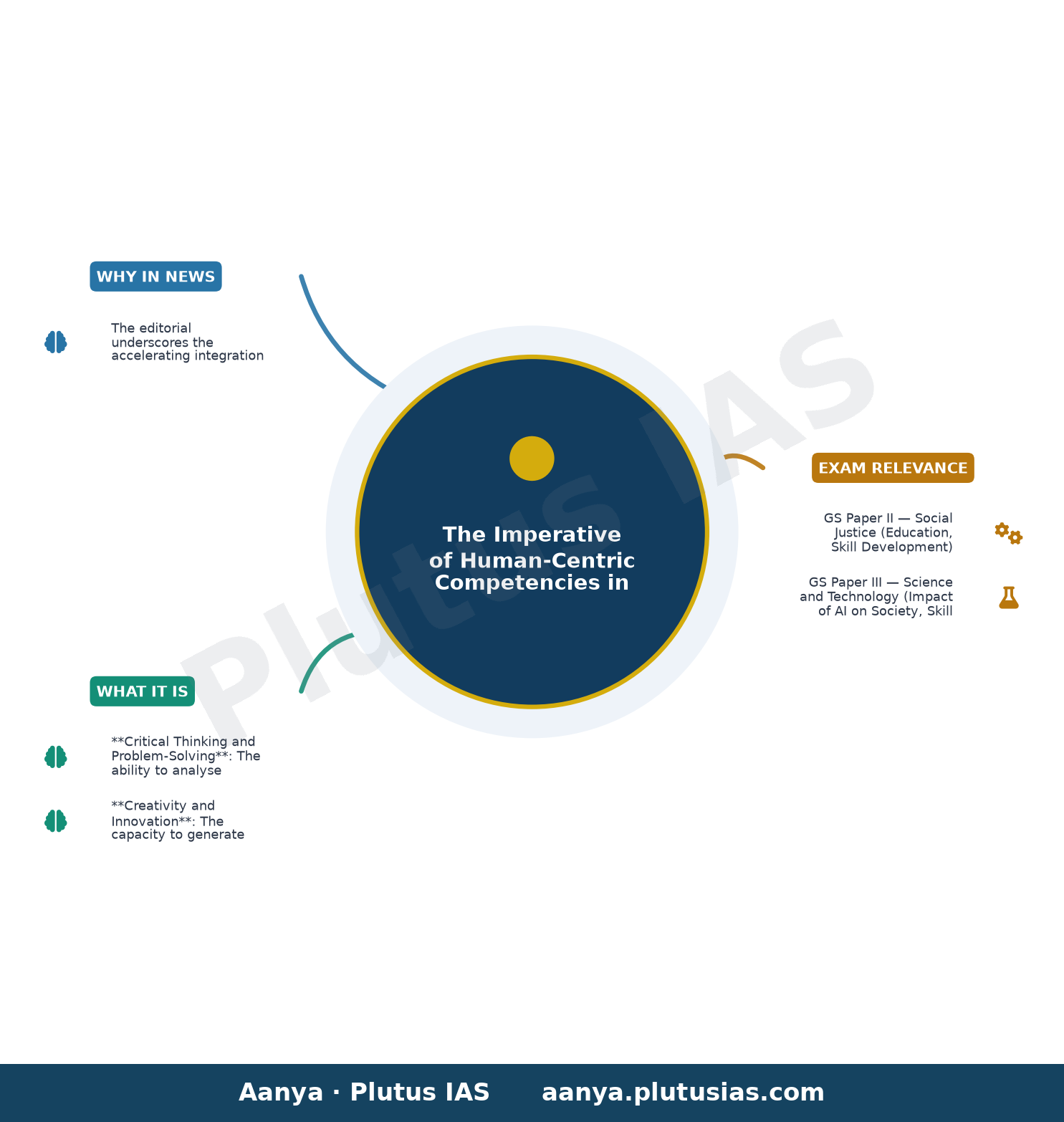
- GS Paper II — Social Justice (Education, Skill Development) | GS Paper III — Science and Technology (Impact of AI on Society, Skill Gaps)
- Prelims: Bloom’s Taxonomy, 21st Century Skills, AI Literacy, Human-AI Complementarity, Pedagogical Shift, NEP 2020 (Skill Development), UNESCO ICT-CFT Framework
- Essay: The Role of Education in the Age of Artificial Intelligence: Balancing Innovation and Human Development, Reimagining Pedagogy: From Content Mastery to Competency Cultivation in the 21st Century
Quick Revision: UPSC aspirants must internalise that while AI can process data, only human-centric competencies—critical thinking, creativity, empathy, and ethical judgement—can address the ‘wicked problems’ of the 21st century.
Why is this in the news?
The editorial underscores the accelerating integration of AI in education and the urgent need to prioritise human-centric skills—critical thinking, creativity, communication, and empathy—that remain beyond AI’s current capabilities. This discourse aligns with global policy shifts, and India’s evolving education framework under the National Education Policy (NEP) 2020, which emphasises holistic development and skill-based learning.
Background
- The National Education Policy (NEP) 2020 mandates a shift from rote learning to competency-based education, emphasising critical thinking, creativity, and socio-emotional skills.
- The UNESCO ICT Competency Framework for Teachers (ICT-CFT) 2018 highlights the need for educators to integrate technology while preserving human-centric pedagogical approaches.
- The World Economic Forum’s Future of Jobs Report (2023) identifies cognitive skills (critical thinking, creativity) and socio-behavioural skills (leadership, resilience) as the top competencies for future employability.
- India’s Skill India Mission (2015) and the National Skill Development Corporation (NSDC) have long advocated for vocational and soft-skill training to bridge the employability gap.
- The COVID-19 pandemic accelerated the adoption of AI-driven ed-tech tools, raising concerns about over-reliance on technology at the expense of foundational human skills.
What are ‘Human-Centric Skills’ in the Context of AI-Augmented Education?
- **Critical Thinking and Problem-Solving**: The ability to analyse information, evaluate arguments, and devise solutions without algorithmic bias. This aligns with Bloom’s Taxonomy’s higher-order cognitive skills (analysing, evaluating, creating).
- **Creativity and Innovation**: The capacity to generate original ideas, adapt to novel situations, and approach problems with curiosity—traits AI lacks due to its reliance on pre-existing data patterns.
- **Communication and Collaboration**: Proficiency in articulating ideas clearly, negotiating, and working in diverse teams, which are essential for leadership and civic engagement.
- **Emotional Intelligence (EQ)**: The ability to recognise, understand, and manage emotions in oneself and others, fostering empathy, resilience, and interpersonal trust.
- **Ethical Judgement and Digital Citizenship**: The capacity to navigate ethical dilemmas in AI use, including data privacy, misinformation, and algorithmic accountability, as outlined in UNESCO’s AI Ethics guidelines.
- **Adaptability and Lifelong Learning**: The willingness to upskill continuously in response to technological and societal changes, a cornerstone of the NEP 2020’s vision for education.
- **Cultural and Social Awareness**: The ability to engage with diverse perspectives, fostering inclusivity and global citizenship, which are increasingly valued in a hyper-connected world.
- **Judgement and Decision-Making**: The capacity to weigh pros and cons, assess risks, and make contextually appropriate choices—a distinctly human trait that AI cannot replicate without human input.
UPSC Value Addition
Keywords for Mains Answer-Writing
Artificial Intelligence in education · Human-AI complementarity · Critical thinking in pedagogy · Emotional intelligence and leadership · AI literacy in school curricula · 21st-century skills framework · Human-centric education model · AI governance in educational institutions · Cognitive apprenticeship · Ethics of AI integration in schools
Prelims Practice Questions
Q1. Consider the following statements regarding the integration of Artificial Intelligence (AI) in education:
1. AI can automate routine tasks such as grading and content generation, thereby freeing educators to focus on pedagogical innovation.
2. AI tools are capable of replacing human judgment, empathy, and leadership in educational settings.
3. Norway has restricted the use of generative AI tools for primary school students to ensure foundational skill development.
How many of the above statements are correct?
- Only one
- Only two
- All
- None
Answer: Only two — Statement 1 is correct as AI can automate administrative and repetitive tasks. Statement 2 is incorrect because AI cannot replace human judgment, empathy, or leadership. Statement 3 is correct as Norway has indeed imposed restrictions on generative AI for primary students.
Q2. Assertion (A): The primary goal of integrating AI in education should be to substitute human thinking rather than complement it.
Reason (R): AI tools can process information at speeds far exceeding human capabilities, making them superior for knowledge dissemination.
- Both A and R are true, and R is the correct explanation of A
- Both A and R are true, but R is not the correct explanation of A
- A is true, but R is false
- A is false, but R is true
Answer: A is false, but R is true — Assertion (A) is false because the goal of AI integration should be to complement human thinking, not substitute it. Reason (R) is true as AI excels in processing information rapidly, but it does not justify the assertion.
Q3. Match the following educational skills with their corresponding AI limitations:
Column I (Educational Skill) | Column II (AI Limitation)
— | —
A. Critical thinking | 1. AI lacks contextual understanding and nuanced reasoning
2. AI cannot replicate human empathy and emotional intelligence
3. AI struggles with creative problem-solving and innovation
4. AI cannot engage in meaningful interpersonal communication
- A-1, B-2, C-3, D-4
- A-3, B-1, C-2, D-4
- A-2, B-3, C-1, D-4
- A-4, B-2, C-3, D-1
Answer: A-1, B-2, C-3, D-4 — Critical thinking (A) is matched with AI’s limitation in contextual understanding (1). Emotional intelligence (B) aligns with AI’s inability to replicate empathy (2). Creativity (C) is linked to AI’s struggle with innovation (3). Interpersonal communication (D) corresponds to AI’s limitation in meaningful engagement (4).
Mains Practice Question
✍ Artificial Intelligence is increasingly being integrated into educational systems, raising concerns about the erosion of foundational human skills. Critically examine the proposition that AI should complement, rather than substitute, human cognitive and socio-emotional development in education. Substantiate your arguments with reference to contemporary global practices and India’s policy landscape. (15 Marks)
Approach: MODEL-ANSWER SKELETON:
1. **Introduction (2 marks)**: Define AI in education and its dual role as a tool for enhancement and potential threat to foundational skills. Mention the global shift toward human-centric education frameworks (e.g., UNESCO’s ‘Education 2030’ agenda).
2. **AI as a Complementary Tool (4 marks)**:
– Discuss AI’s role in automating administrative tasks (e.g., grading, content generation) to free educators for mentorship.
– Reference global practices: Norway’s phased AI integration in schools; Singapore’s ‘Smart Nation’ initiative promoting AI literacy.
– Highlight India’s NEP 2020 emphasis on ’21st-century skills’ and AI literacy in curricula.
3. **Human Skills AI Cannot Replace (4 marks)**:
– **Critical Thinking**: AI lacks contextual reasoning; cite Bloom’s Taxonomy to argue for higher-order thinking.
– **Creativity and Innovation**: Reference Sir Ken Robinson’s arguments on creativity in education.
– **Emotional Intelligence and Leadership**: Discuss Daniel Goleman’s framework on EQ in educational leadership.
– **Ethical Judgment**: Reference the need for human oversight in AI-driven decisions (e.g., bias mitigation).
4. **Challenges and Risks (3 marks)**:
– Over-reliance on AI may erode independent thinking; cite examples of ‘Google Maps effect’ in navigation.
– Digital divide and accessibility issues in India’s education system.
– Ethical concerns: data privacy, algorithmic bias, and accountability in AI tools.
5. **Way Forward (2 marks)**:
– Policy recommendations: age-appropriate AI integration (e.g., Norway’s model for primary vs. secondary schools).
– Teacher training programs to foster human-AI collaboration.
– Emphasize experiential learning and project-based assessments to nurture human-centric skills.
Source: Hindustan Times
Generated by AanyaAi for educational purpose.

- तमिलनाडु के लिए क्या है ‘एल नीनो’ और उत्तर-पूर्वी मानसून का खतरा? - September 23, 2026
- El Nino & Northeast Monsoon: Impact on Tamil Nadu for UPSC 2026 - September 23, 2026
- हिमाचल में डिजिटल भुगतान क्रांति: बिलासपुर अव्वल, महिलाओं की भागीदारी 93% तक पहुंची - September 23, 2026

No Comments