


06 Aug Why UPSC Aspirants Must Master Skills AI Can Never Replace in 2026
✎ UPSC aspirants must internalise that while AI can process data, it cannot replace human competencies such as critical thinking, emotional intelligence, and ethical reasoning—these remain the bedrock of effective governance and…
Subject Relevance — Where This Topic Fits
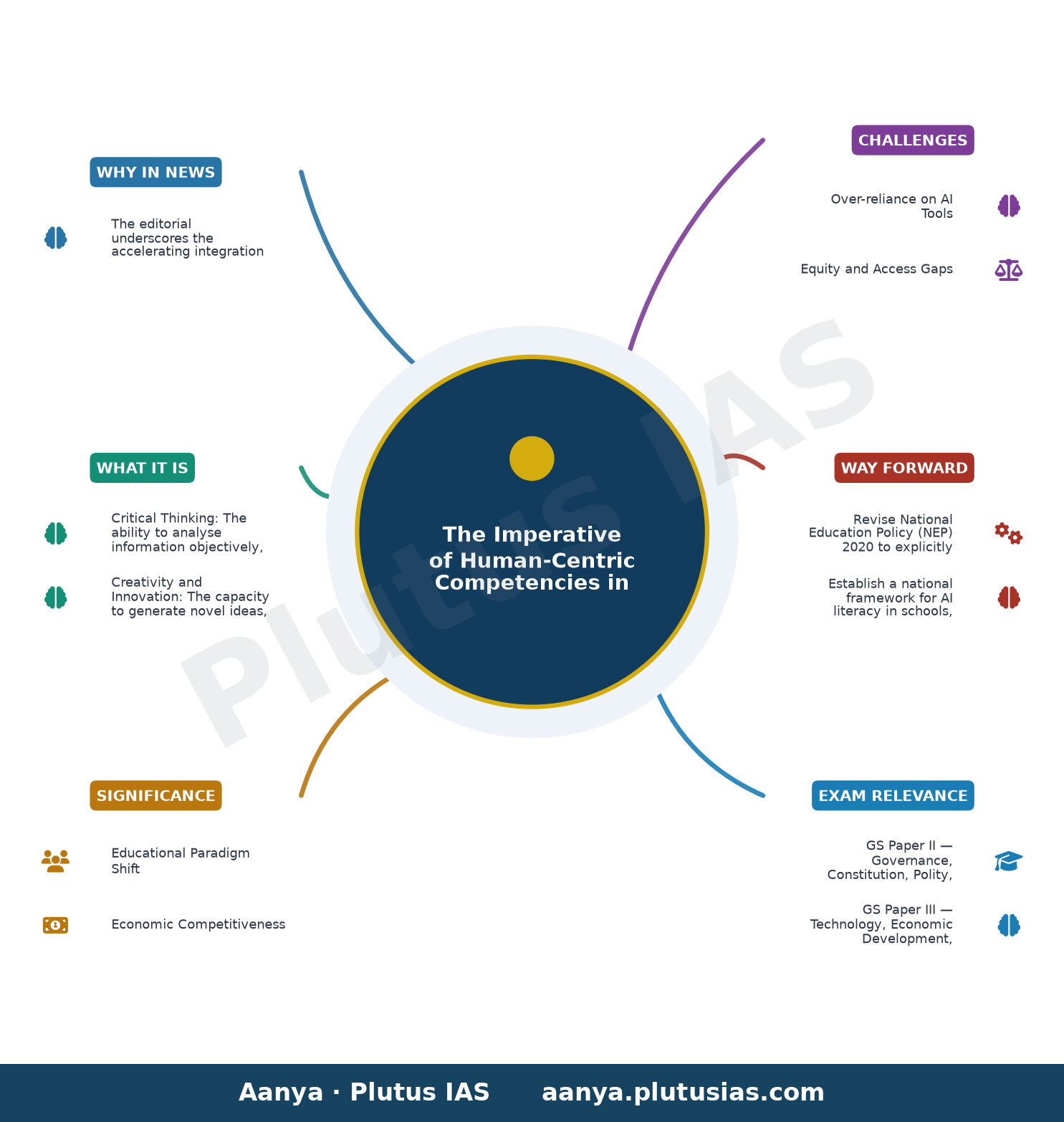
- GS Paper II — Governance, Constitution, Polity, Social Justice and International Relations | GS Paper III — Technology, Economic Development, Biodiversity, Environment, Security and Disaster Management
- Prelims: Artificial Intelligence (AI), Critical Thinking, Creativity, Emotional Intelligence, NEP 2020, National Curriculum Framework (NCF) 2023, Human-Machine Collaboration, AI Literacy, 21st Century Skills, Bloom’s Taxonomy
- Essay: The Paradox of Progress: Balancing Technological Advancement with Human Agency in Education, Reimagining Pedagogy: From Algorithmic Learning to Holistic Human Development
Quick Revision: UPSC aspirants must internalise that while AI can process data, it cannot replace human competencies such as critical thinking, emotional intelligence, and ethical reasoning—these remain the bedrock of effective governance and leadership.
Why is this in the news?
The editorial underscores the accelerating integration of Artificial Intelligence (AI) in educational ecosystems, particularly in India, where its adoption in classrooms is reshaping pedagogical approaches. The discourse highlights a critical paradox: while AI enhances efficiency and accessibility in learning, it risks eroding foundational human competencies such as critical thinking, creativity, and emotional intelligence—skills that remain indispensable for UPSC aspirants navigating complex socio-economic and political landscapes. The piece further contextualises global responses, including Norway’s stance on generative AI, to argue for a calibrated, human-centric approach to AI integration in education.
Background
- The National Education Policy (NEP) 2020 explicitly advocates for a shift from rote learning to competency-based education, aligning with global trends in 21st-century skill development.
What are Human-Centric Competencies in the Context of AI-Augmented Education?
- Critical Thinking: The ability to analyse information objectively, identify biases, and evaluate arguments—skills that AI lacks due to its reliance on pre-programmed algorithms and data patterns.
- Creativity and Innovation: The capacity to generate novel ideas, solve open-ended problems, and adapt to dynamic environments, which AI cannot replicate as it operates within defined parameters.
- Emotional Intelligence (EQ): The competence to recognise, understand, and manage emotions—both in oneself and others—essential for leadership, teamwork, and conflict resolution in diverse settings.
- Communication Skills: The art of articulating ideas clearly, persuasively, and empathetically, whether in written, oral, or digital formats, remains a uniquely human domain.
- Ethical Reasoning: The ability to discern right from wrong, navigate moral dilemmas, and uphold ethical standards in decision-making, particularly in AI-driven decision systems.
- Adaptability and Resilience: The agility to thrive in uncertain environments, pivot strategies, and embrace lifelong learning—qualities that AI cannot inherently possess.
- Collaboration and Leadership: The skill to work effectively in teams, inspire others, and lead with empathy and vision, which AI tools cannot substitute.
- Curiosity and Lifelong Learning: The intrinsic motivation to explore, question, and seek knowledge beyond structured curricula, fostering intellectual autonomy in an AI-saturated world.
Key Features
| Feature | Significance |
|---|---|
| Critical Thinking | Enables students to evaluate information, identify biases, and make reasoned decisions, forming the bedrock of independent learning and problem-solving. |
| Creativity | Fosters innovation and originality, allowing students to generate novel solutions and ideas that AI cannot autonomously produce. |
| Emotional Intelligence | Develops empathy, self-awareness, and interpersonal skills, which are essential for leadership, collaboration, and ethical decision-making. |
| Communication Skills | Enhances the ability to articulate ideas clearly, negotiate, and persuade, which are irreplaceable in human interactions and professional settings. |
| Adaptability | Cultivates resilience and flexibility to navigate uncertainty and rapid technological change, ensuring lifelong learning and relevance in dynamic environments. |
Why it Matters
Educational Paradigm Shift
- AI integration necessitates a reorientation from rote memorisation to skill-based learning, aligning education with the demands of the 21st-century workforce.
- Traditional metrics of academic success (e.g., grades) must be supplemented with assessments of higher-order cognitive and socio-emotional skills.
- Curriculum design should prioritise interdisciplinary approaches to foster holistic development, integrating arts, sciences, and humanities.
Economic Competitiveness
- Nations that prioritise human-centric skills gain a comparative advantage in innovation-driven economies, where creativity and critical thinking are premium assets.
- A workforce equipped with non-cognitive skills is better positioned to adapt to automation, reducing structural unemployment risks.
- Investment in human capital through skill development enhances productivity and economic resilience in the face of technological disruption.
Social Cohesion
- Empathy and communication skills strengthen social bonds, reducing polarisation and fostering inclusive communities.
- Leadership and ethical reasoning are critical for addressing global challenges such as climate change, inequality, and geopolitical instability.
- Civic engagement and democratic participation rely on citizens’ ability to analyse information critically and communicate effectively.
Challenges
1. Over-reliance on AI Tools
- Students may develop dependency on AI for problem-solving, undermining their ability to think independently and develop foundational skills.
- AI-generated content can propagate misinformation or biased perspectives if not critically evaluated by learners.
- Excessive use of AI in early education may hinder the development of fine motor skills, handwriting, and spatial reasoning.
UPSC Link: GS2: Education Policy
2. Equity and Access Gaps
- Digital divide exacerbates disparities in access to AI tools, leaving marginalised students at a disadvantage in skill development.
- Rural and low-income schools often lack infrastructure to integrate AI responsibly, widening the urban-rural skill divide.
- Language barriers and cultural differences may limit the effectiveness of AI tools in diverse educational settings.
UPSC Link: GS1: Social Justice
3. Teacher Preparedness
- Many educators lack training to integrate AI tools effectively while maintaining focus on human-centric skills.
- Curriculum frameworks may not adequately address the pedagogical shifts required to teach non-cognitive skills.
- Resistance to change among teachers and institutions can impede the adoption of innovative educational practices.
UPSC Link: GS2: Human Resource Development
4. Assessment and Evaluation
- Traditional examination systems are ill-equipped to measure skills like creativity, emotional intelligence, and adaptability.
- AI-driven assessments may inadvertently favour students with access to premium tools, distorting meritocracy.
- Ethical concerns arise regarding data privacy and the use of AI in grading or profiling students.
UPSC Link: GS2: Educational Governance
5. Ethical and Psychological Concerns
- Over-exposure to AI may erode human agency, leading to a decline in intrinsic motivation and self-efficacy.
- Students may experience anxiety or alienation if AI tools are introduced without adequate human support or guidance.
- The commercialisation of AI in education raises concerns about exploitation, data privacy, and the commodification of learning.
UPSC Link: GS4: Ethics
Challenges — UPSC Perspective
| Issue | Concern |
|---|---|
| AI Dependency in Early Education | Risk of stunting cognitive development and independent thinking in formative years. |
| Lack of Standardised AI Integration Guidelines | Leads to inconsistent implementation across schools and regions, exacerbating inequalities. |
| Teacher Training Deficits | Inadequate preparation to balance AI tools with human-centric pedagogy. |
| Assessment Misalignment | Traditional metrics fail to capture the value of non-cognitive skills in student evaluation. |
| Ethical Dilemmas in AI Use | Privacy concerns, data security, and potential misuse of student information. |
| Cultural and Linguistic Barriers | AI tools may not be inclusive, marginalising non-English speakers or culturally diverse learners. |
Way Forward
- Revise National Education Policy (NEP) 2020 to explicitly integrate human-centric skills (e.g., critical thinking, creativity) into curriculum frameworks and assessment systems.
- Establish a national framework for AI literacy in schools, delineating age-appropriate guidelines for AI tool usage, with strict restrictions for primary students.
- Launch a dedicated teacher training programme focused on pedagogical strategies to foster non-cognitive skills alongside AI integration.
- Develop a multi-stakeholder task force (educators, technologists, policymakers) to design ethical guidelines for AI use in education, including data privacy protocols.
- Incentivise schools to adopt project-based and experiential learning models that prioritise real-world problem-solving over rote learning.
- Expand digital infrastructure in government schools, ensuring equitable access to AI tools while maintaining offline learning options for resilience.
- Introduce skill-based assessments (e.g., portfolios, peer evaluations) to measure creativity, communication, and adaptability alongside traditional metrics.
- Promote public-private partnerships to develop open-source AI tools tailored for Indian educational contexts, ensuring cultural and linguistic inclusivity.
UPSC Value Addition
Keywords for Mains Answer-Writing
Artificial Intelligence in Education · Human-centric skills · Critical thinking · Creativity and innovation · Emotional intelligence · AI literacy · 21st-century competencies · Pedagogical reforms · Human-AI collaboration · Policy frameworks for AI in schools
Concept Flow
Technological Advancement (AI Integration in Education) → Over-reliance on AI Tools → Risk of Atrophy in Human Skills → Need for Human-Centric Learning → Curriculum Reform → Teacher Training → Equitable Access → Ethical Governance → Skill-Based Assessment → Workforce Readiness
Prelims Practice Questions
Q1. Consider the following statements regarding the integration of Artificial Intelligence (AI) in education:
1. AI can analyse data and generate presentations but cannot replace human judgement.
2. The Norwegian government has mandated that primary school students must use generative AI tools to enhance learning.
3. Skills such as critical thinking, creativity, and communication are considered irreplaceable by AI in the educational context.
How many of the above statements are correct?
- Only one
- Only two
- All three
- None
Answer: Only two — Statement 1 is correct as AI lacks human judgement. Statement 2 is incorrect because Norway has restricted primary school students from using generative AI tools. Statement 3 is correct as these skills are identified as uniquely human capabilities.
Q2. Assertion (A): The primary objective of integrating AI in education should be to complement and enhance human thinking rather than substitute it.
Reason (R): AI tools can process information at remarkable speeds but lack the ability to exercise empathy, leadership, or build trust, which are essential human traits.
- Both A and R are true, and R is the correct explanation of A.
- Both A and R are true, but R is not the correct explanation of A.
- A is true, but R is false.
- A is false, but R is true.
Answer: Both A and R are true, and R is the correct explanation of A. — Both the assertion and reason are true. AI’s inability to replace human traits like empathy and leadership makes it essential for AI to complement human thinking in education.
Mains Practice Question
✍ Artificial Intelligence is transforming education by automating routine tasks, personalising learning, and enhancing efficiency. However, the future of education lies not in replacing human capabilities but in nurturing skills that AI cannot replicate. Critically examine this proposition with reference to the evolving role of AI in education and the imperative to develop human-centric competencies. (15 Marks)
Approach: MODEL-ANSWER SKELETON:
1. **Introduction (2 Marks)**: Define AI in education and its current applications (e.g., adaptive learning platforms, automated grading). State the proposition that AI should complement, not replace, human skills.
2. **AI’s Limitations in Education (3 Marks)**:
– AI excels in data processing, pattern recognition, and task automation but lacks human traits such as empathy, ethical reasoning, and creativity.
– Cite examples: AI cannot mentor students emotionally or foster social learning.
3. **Human-Centric Skills and Their Importance (4 Marks)**:
– **Critical Thinking**: Ability to question, analyse, and synthesise information (e.g., evaluating AI-generated content).
– **Creativity and Innovation**: Developing original ideas and solutions beyond algorithmic outputs.
– **Communication and Collaboration**: Interpersonal skills essential for teamwork and leadership.
– **Emotional Intelligence**: Understanding and managing emotions in oneself and others.
4. **Policy and Pedagogical Reforms (3 Marks)**:
– **AI Literacy**: Integrating AI education to ensure students understand its capabilities and limitations (e.g., Norway’s policy for primary schools).
– **Teacher Training**: Equipping educators to leverage AI as a tool while prioritising human interaction.
– **Curriculum Design**: Emphasising experiential learning, interdisciplinary projects, and ethical discussions.
5. **Challenges and Way Forward (3 Marks)**:
– **Over-reliance on AI**: Risk of deskilling students in critical areas.
– **Equity Concerns**: Ensuring AI tools are accessible and do not exacerbate digital divides.
– **Balanced Approach**: Recommend a phased integration of AI with a focus on foundational human skills.
**Conclusion (2 Marks)**: Reiterate that AI is a tool to augment education, not replace it, and stress the need for a human-centred educational paradigm.
Source: Hindustan Times
Generated by AanyaAi for educational purpose.

- तमिलनाडु के लिए क्या है ‘एल नीनो’ और उत्तर-पूर्वी मानसून का खतरा? - September 23, 2026
- El Nino & Northeast Monsoon: Impact on Tamil Nadu for UPSC 2026 - September 23, 2026
- हिमाचल में डिजिटल भुगतान क्रांति: बिलासपुर अव्वल, महिलाओं की भागीदारी 93% तक पहुंची - September 23, 2026

No Comments