


06 Aug Why UPSC aspirants must master skills AI cannot replace in 2026 exams
✎ In the AI era, education must prioritise cultivating human-centric competencies—critical thinking, creativity, communication, and ethical reasoning—over algorithmic dependence, ensuring students retain agency over their cognitive…
 Human-centric skillsCreativityEducational systemsHolistic skill development
Subject Relevance — Where This Topic Fits
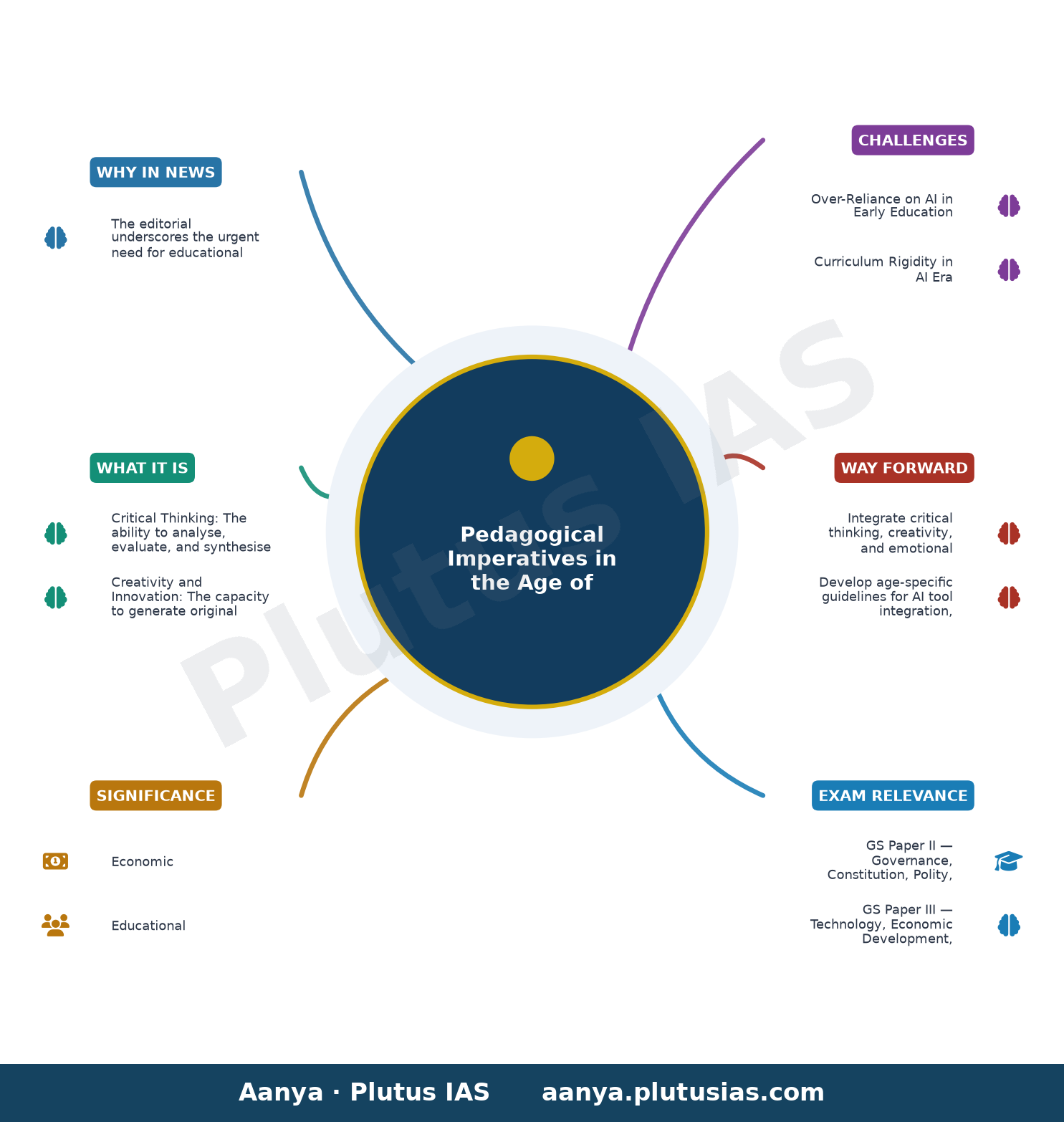
- GS Paper II — Governance, Constitution, Polity, Social Justice and International Relations (Subtheme: Education Policy and Digital Governance) | GS Paper III — Technology, Economic Development, Bio-diversity, Environment, Security and Disaster Management (Subtheme: Impact of AI on Labour Markets and Skill Development)
- Prelims: Artificial Intelligence (AI), Generative AI, NEP 2020, National Curriculum Framework (NCF) 2023, National Education Policy (NEP), 21st Century Skills, Bloom’s Taxonomy, Human-AI Collaboration, Digital Literacy, Critical Thinking, Creativity, Emotional Intelligence
- Essay: The Role of Human Agency in an AI-Augmented World, Education for the Future: Balancing Technological Advancement and Human Development
Quick Revision: In the AI era, education must prioritise cultivating human-centric competencies—critical thinking, creativity, communication, and ethical reasoning—over algorithmic dependence, ensuring students retain agency over their cognitive development.
Why is this in the news?
The editorial underscores the urgent need for educational systems to pivot from algorithmic dependence to fostering human-centric skills as AI integration accelerates in classrooms. It highlights the paradox where AI tools, while enhancing efficiency, risk eroding foundational cognitive skills such as critical thinking, creativity, and independent reasoning—capabilities that remain uniquely human and irreplaceable in an evolving socio-economic landscape. The discussion is particularly salient for India, where the National Education Policy (NEP) 2020 and the National Curriculum Framework (NCF) 2023 are being operationalised, and where the challenge of balancing technological adoption with holistic skill development is acute.
Background
- The National Education Policy (NEP) 2020 explicitly emphasizes the development of 21st-century skills, including critical thinking, creativity, communication, collaboration, and ethical reasoning, as core educational outcomes.
- The National Curriculum Framework (NCF) 2023, aligned with NEP 2020, introduces competency-based learning and pedagogical shifts that prioritise experiential and inquiry-based education over rote memorisation.
- The rapid proliferation of AI tools in classrooms—from generative AI for content creation to adaptive learning platforms—has raised concerns about over-reliance on technology at the expense of foundational cognitive development.
- India’s Digital India initiative aims to bridge the digital divide, but the focus on hardware and connectivity must be complemented by a robust framework for AI literacy and ethical use.
- The World Economic Forum’s Future of Jobs Report (2023) identifies critical thinking, resilience, and adaptability as the top skills for the future workforce, underscoring the need for educational systems to adapt accordingly.
What are human-centric competencies in the context of AI-driven education?
- Critical Thinking: The ability to analyse, evaluate, and synthesise information independently, rather than passively consuming algorithmically generated content. This aligns with higher-order cognitive skills in Bloom’s Taxonomy (evaluate, create).
- Creativity and Innovation: The capacity to generate original ideas, solve problems through novel approaches, and adapt to ambiguous or unstructured scenarios—areas where AI, despite its generative capabilities, lacks true originality or contextual understanding.
- Communication and Collaboration: Proficiency in articulating ideas clearly, negotiating meaning, and working effectively in diverse teams, which are underpinned by empathy, emotional intelligence, and cultural competence—qualities beyond AI’s current capabilities.
- Ethical Reasoning and Judgement: The ability to navigate moral dilemmas, assess the societal impact of technology, and make decisions aligned with ethical principles, including digital ethics and data privacy.
- Adaptability and Resilience: The mental flexibility to learn, unlearn, and relearn in response to technological and societal changes, coupled with the emotional resilience to cope with uncertainty and failure.
- Leadership and Social Intelligence: The capability to inspire, motivate, and influence others, build trust, and navigate complex social dynamics—skills that require emotional and social intelligence, which AI cannot replicate.
- Curiosity and Lifelong Learning: A disposition towards continuous learning, intellectual curiosity, and self-directed inquiry, which are essential for navigating an AI-augmented world where knowledge becomes obsolete rapidly.
- Human-AI Collaboration: The skill to effectively utilise AI tools as aids while retaining agency over decision-making, ensuring that technology augments rather than replaces human judgement.
Key Features
| Feature | Significance |
|---|---|
| Critical Thinking | Enables students to analyse, evaluate, and synthesise information independently, reducing over-reliance on AI-generated outputs. |
| Creativity | Fosters innovation and original problem-solving, areas where AI can only assist but not originate. |
| Emotional Intelligence | Develops empathy, self-awareness, and social skills essential for leadership and collaboration. |
| Ethical Reasoning | Equips students to navigate moral dilemmas in technology use, ensuring responsible AI integration. |
| Adaptability | Cultivates resilience and flexibility to thrive in dynamic, AI-driven environments. |
| Communication | Enhances clarity, persuasion, and negotiation skills critical for professional and personal interactions. |
Why it Matters
Economic
- AI-driven automation threatens routine cognitive tasks, making human-centric skills (e.g., creativity, emotional intelligence) economically irreplaceable.
- Workforce adaptability to AI integration will determine India’s global competitiveness in high-value sectors like healthcare, education, and services.
- Investment in human skill development reduces long-term unemployment risks by preparing students for evolving job markets.
Educational
- Traditional rote-learning models are inadequate for AI-era demands, necessitating a shift toward experiential and inquiry-based learning.
- AI tools should augment, not replace, teacher-student interactions to preserve mentorship and cognitive scaffolding.
- Curriculum redesign must prioritise interdisciplinary learning to bridge gaps between technical and humanistic disciplines.
Societal
- Over-reliance on AI for education risks eroding foundational skills like reading, writing, and numeracy in early learners.
- Digital divide exacerbates inequality; underserved communities require equitable access to AI literacy and human skill development.
- Ethical AI use in education demands transparency, accountability, and safeguards against algorithmic bias in assessment and content.
Challenges
1. Over-Reliance on AI in Early Education
- Primary school students risk underdeveloped independent thinking if AI tools replace foundational learning activities.
- Lack of age-appropriate guidelines for AI integration may lead to premature exposure without cognitive benefits.
- Teachers may struggle to balance AI-assisted teaching with traditional pedagogical methods.
UPSC Link: NCF 2005 – Foundational Learning
2. Curriculum Rigidity in AI Era
- Static syllabi fail to incorporate rapid advancements in AI, leaving students unprepared for future skill demands.
- Resistance to curriculum reform from institutional inertia and bureaucratic delays.
- Inadequate teacher training on integrating AI tools without compromising human skill development.
UPSC Link: NEP 2020 – Curriculum Flexibility
3. Digital Divide and Equity Gaps
- Socioeconomic disparities limit access to AI tools and high-speed internet, widening educational inequalities.
- Rural and tribal schools lack infrastructure for AI literacy, exacerbating urban-rural skill disparities.
- Policy frameworks must ensure inclusive AI adoption in education to prevent marginalisation of vulnerable groups.
UPSC Link: SDG 4.5 – Inclusive Education
4. Ethical and Psychological Risks
- Overuse of AI in education may reduce human interaction, impacting emotional and social development.
- Students may develop dependency on AI for problem-solving, undermining intrinsic motivation and resilience.
- Privacy concerns arise from data collection in AI-driven learning platforms, raising safeguarding issues.
UPSC Link: Article 21 – Right to Privacy
5. Teacher Preparedness and Resistance
- Insufficient training on AI tools and their pedagogical applications limits effective integration in classrooms.
- Skepticism among educators about AI’s role in education may hinder adoption and innovation.
- High workloads and lack of incentives discourage teachers from upskilling in AI literacy.
UPSC Link: NEP 2020 – Teacher Training
Challenges — UPSC Perspective
| Issue | Concern |
|---|---|
| AI Dependency in Early Years | Erosion of foundational cognitive skills due to premature AI integration. |
| Curriculum Obsolescence | Static syllabi failing to address AI-driven skill demands. |
| Infrastructure Gaps | Unequal access to AI tools and digital resources across socio-economic strata. |
| Ethical Dilemmas | Privacy risks and psychological impacts of AI in education. |
| Teacher Capacity | Lack of training and support for educators to leverage AI effectively. |
| Policy Lag | Slow adaptation of regulatory frameworks to AI advancements in education. |
Way Forward
- Integrate critical thinking, creativity, and emotional intelligence into school curricula through project-based and experiential learning modules.
- Develop age-specific guidelines for AI tool integration, prioritising foundational skill development in primary education.
- Launch nationwide teacher training programmes on AI literacy and pedagogical innovation to bridge digital skill gaps.
- Establish a national AI education task force to monitor trends, assess risks, and recommend policy updates.
- Strengthen digital infrastructure in rural and tribal schools to ensure equitable access to AI tools and resources.
- Encourage public-private partnerships to fund AI literacy initiatives and subsidise tool access for underserved communities.
- Promote interdisciplinary research on AI’s impact on education to inform evidence-based policy decisions.
- Mandate ethical AI use in educational institutions through transparent data policies and student safeguarding protocols.
UPSC Value Addition
Keywords for Mains Answer-Writing
Artificial Intelligence in education · Human-centric skills · Critical thinking · Creativity in learning · AI literacy · 21st-century competencies · Soft skills vs technical skills · Ethical use of AI · Human-AI complementarity · Pedagogical approaches for AI integration
Constitutional & Policy Linkages
- Article 21A – Right to Education
- Article 45 – Early Childhood Care and Education
- Article 51A(h) – Duty to develop scientific temper
Concept Flow
AI integration in education → Over-reliance on algorithms → Erosion of foundational human skills → Curriculum stagnation → Digital divide widens → Policy lag in regulation → Societal inequality persists → Need for human-centric skill prioritisation → Curriculum reform and teacher training → Equitable AI adoption in education.
Prelims Practice Questions
Q1. Consider the following statements regarding the role of Artificial Intelligence (AI) in education:
1. AI can analyse data, generate presentations, and assist with coding tasks.
2. AI tools are designed to replace human judgement, empathy, and leadership in educational settings.
3. Norway has announced that generative AI should not be used by primary school students to ensure foundational skill development.
4. AI can effectively replace the need for independent thinking and problem-solving in students.
How many of the above statements are correct?
- Only one
- Only two
- Only three
- All four
Answer: Only three — Statements 1 and 3 are correct. Statement 2 is incorrect because AI cannot replace human judgement, empathy, or leadership. Statement 4 is incorrect as AI cannot substitute independent thinking and problem-solving.
Q2. Assertion (A): The integration of AI in education should prioritise complementing student thinking rather than substituting it.
Reason (R): AI lacks the capacity for human judgement, empathy, and leadership, which are essential for holistic development.
Options:
A. Both A and R are true, and R is the correct explanation of A.
B. Both A and R are true, but R is not the correct explanation of A.
C. A is true, but R is false.
D. A is false, but R is true.
Answer: ? — Both A and R are true, and R correctly explains why AI should complement rather than substitute human thinking in education.
Q3. Match the following countries with their respective approaches to AI integration in education:
Column I (Country) | Column II (Approach)
1. Norway | A. Gradual introduction of AI tools under teacher supervision for older students
2. India | B. Prioritising AI literacy and foundational skill development
3. United States | C. Emphasising critical thinking and creativity over AI reliance
4. Singapore | D. Focusing on AI-driven personalised learning for all age groups
Options:
A. 1-A, 2-B, 3-D, 4-C
B. 1-A, 2-C, 3-B, 4-D
C. 1-B, 2-A, 3-D, 4-C
D. 1-C, 2-D, 3-A, 4-B
Answer: ? — 1-A (Norway restricts AI for primary students and introduces it gradually for older students), 2-B (India is prioritising AI literacy), 3-D (United States focuses on AI-driven personalised learning), 4-C (Singapore emphasises critical thinking and creativity).
Mains Practice Question
✍ Critically examine the assertion that Artificial Intelligence (AI) in education should be leveraged to complement human thinking rather than replace it. In your answer, discuss the role of AI in modern pedagogy, the essential human-centric skills that AI cannot replicate, and the measures required to ensure ethical and balanced integration of AI in educational systems. (15 Marks)
Approach: MODEL-ANSWER SKELETON:
1. **Introduction (2 marks)**
– Define AI in education and its growing role in pedagogy.
– State the central thesis: AI should complement, not replace, human thinking.
2. **AI’s Role in Modern Pedagogy (3 marks)**
– AI as a tool for personalised learning, data analysis, and administrative efficiency.
– Examples: adaptive learning platforms (e.g., Khan Academy, BYJU’S), AI-driven assessment tools.
– Reference to Norway’s policy on restricting AI for primary students to preserve foundational skills.
3. **Human-Centric Skills AI Cannot Replicate (4 marks)**
– Critical thinking: AI processes information but lacks contextual reasoning.
– Creativity: AI generates outputs but cannot innovate or conceptualise independently.
– Empathy and emotional intelligence: Essential for teaching, mentoring, and social learning.
– Leadership and ethical decision-making: Human judgement in moral dilemmas and value-based education.
– Cite Howard Gardner’s theory of multiple intelligences to underscore the diversity of human skills.
4. **Measures for Ethical and Balanced AI Integration (3 marks)**
– Age-wise rules for AI usage (e.g., Norway’s policy for primary vs. older students).
– Teacher training to integrate AI tools without compromising human interaction.
– Curriculum reforms to prioritise 21st-century competencies (critical thinking, creativity, communication).
– Regulatory frameworks to prevent over-reliance on AI and ensure data privacy.
5. **Conclusion (3 marks)**
– Reiterate the need for a human-AI partnership in education.
– Emphasise that AI should enhance, not erode, the teacher-student relationship.
– Call for a balanced approach that leverages AI’s strengths while preserving human-centric values in education.
Source: Hindustan Times
Generated by AanyaAi for educational purpose.

- हिमाचल में डिजिटल भुगतान क्रांति: बिलासपुर अव्वल, महिलाओं की भागीदारी 93% तक पहुंची - September 23, 2026
- Himachal Pradesh Leads in Digital Payments: Bilaspur Tops, Women’s Role Rises - September 23, 2026
- केरल लोक सेवा आयोग ने उच्च न्यायालय में दायर किया मामला, सदस्यों के खिलाफ मामला रद्द करने की मांग - September 23, 2026

No Comments