


06 Aug Why UPSC Aspirants Must Prioritize Non-AI Skills Beyond Algorithms
✎ The Indian education system must institutionalise human-centric competencies—critical thinking, creativity, empathy, and ethical reasoning—through structured pedagogical reforms, as AI tools increasingly mediate but cannot…
Subject Relevance — Where This Topic Fits
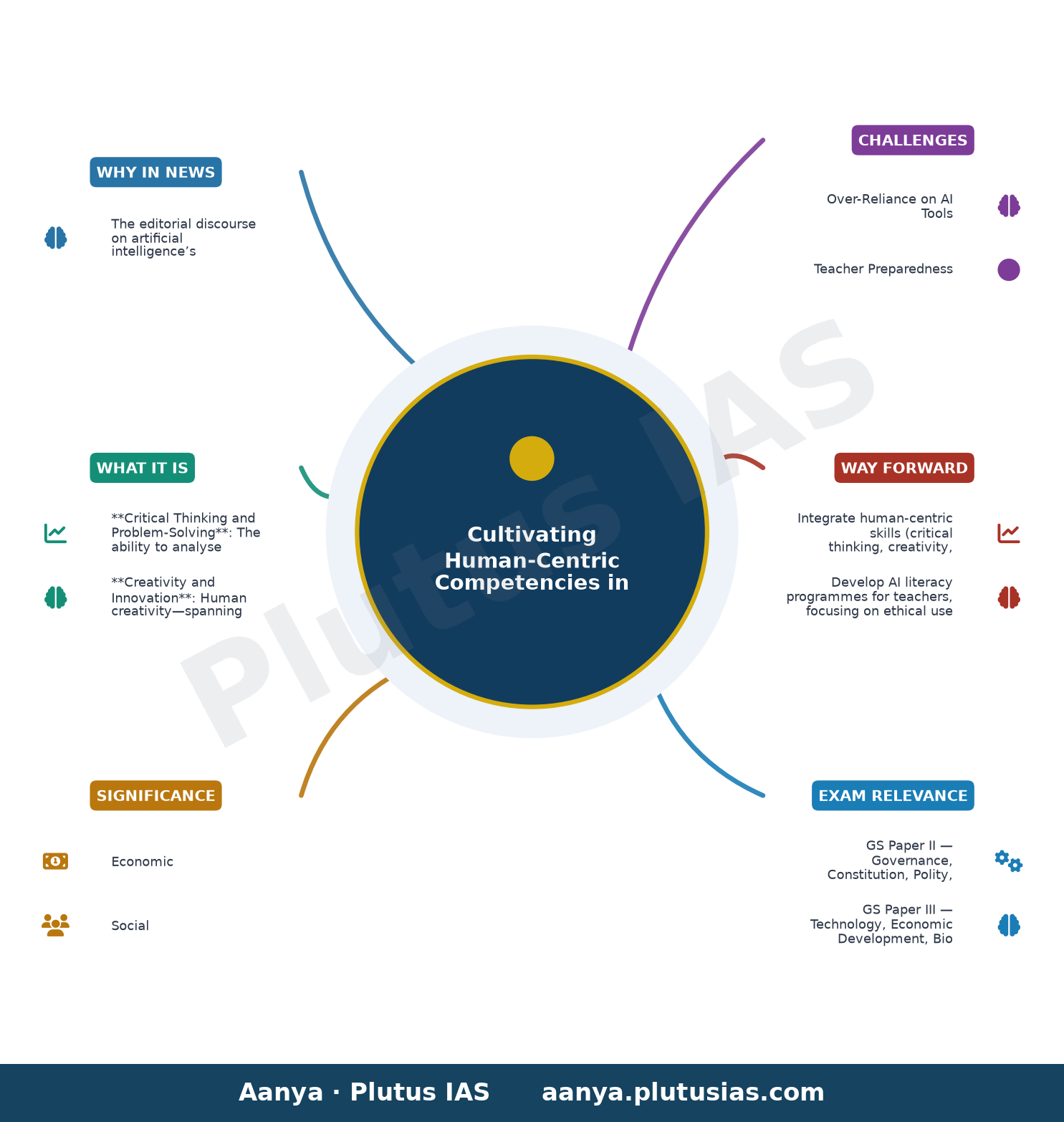
- GS Paper II — Governance, Constitution, Polity, Social Justice and International Relations (Education as a determinant of social equity and human development) | GS Paper III — Technology, Economic Development, Bio diversity, Environment, Security and Disaster Management (Impact of AI on employment and skill ecosystems)
- Prelims: NEP 2020, National Curriculum Framework (NCF) 2023, AI literacy, 21st Century Skills, Bloom’s Taxonomy, Constructivist Learning Theory, UNESCO Global Education Monitoring Report, National Education Policy (NEP) 2020’s emphasis on experiential learning
- Essay: The fusion of tradition and technology: Reimagining education for a post-AI world, Human capital in the age of automation: The enduring value of non-cognitive competencies
Quick Revision: The Indian education system must institutionalise human-centric competencies—critical thinking, creativity, empathy, and ethical reasoning—through structured pedagogical reforms, as AI tools increasingly mediate but cannot replace foundational cognitive and socio-emotional development.
Why is this in the news?
The editorial discourse on artificial intelligence’s integration into education has intensified, with global and domestic stakeholders questioning the long-term implications for foundational cognitive development. The article underscores the urgency for Indian educational institutions to recalibrate pedagogical strategies to prioritise uniquely human competencies—critical thinking, creativity, empathy, and ethical reasoning—over algorithmic proficiency, as AI tools increasingly mediate learning processes. This shift is particularly salient given India’s demographic dividend and the NEP 2020’s mandate to foster holistic, multidisciplinary education.
Background
- The National Education Policy (NEP) 2020 explicitly advocates for a transition from rote learning to competency-based education, emphasising critical thinking, problem-solving, and socio-emotional learning as core outcomes.
- The National Curriculum Framework (NCF) 2023, aligned with NEP 2020, introduces ‘21st Century Skills’ as a foundational pillar, including creativity, collaboration, communication, and digital literacy.
- Global initiatives such as UNESCO’s *Global Education Monitoring Report* (2023) highlight the risks of over-reliance on AI in education, particularly in early childhood and foundational learning stages.
- The proliferation of generative AI tools (e.g., large language models, coding assistants) has democratised access to information but simultaneously eroded opportunities for independent inquiry and reflective learning.
What are uniquely human competencies in an AI-augmented educational ecosystem?
- **Critical Thinking and Problem-Solving**: The ability to analyse information, identify biases, and synthesise knowledge without algorithmic intermediation, ensuring intellectual autonomy in an era of AI-generated content.
- **Creativity and Innovation**: Human creativity—spanning artistic expression, scientific inquiry, and entrepreneurial ideation—remains irreducible to AI’s pattern-recognition capabilities, as it thrives on ambiguity, emotion, and contextual nuance.
- **Empathy and Emotional Intelligence**: AI lacks intrinsic emotional awareness; thus, competencies like active listening, conflict resolution, and mentorship are irreplaceable for fostering inclusive and cohesive learning environments.
- **Ethical Reasoning and Judgement**: The capacity to evaluate the moral implications of AI-driven decisions, including data privacy, algorithmic bias, and societal equity, is a distinctly human domain.
- **Collaboration and Leadership**: Team-based problem-solving, consensus-building, and adaptive leadership—skills honed through human interaction—are essential for navigating complex, interdisciplinary challenges.
- **Metacognition**: The ability to reflect on one’s own learning processes, recognise cognitive biases, and regulate learning strategies is inherently human and critical for lifelong adaptability.
- **Cultural and Contextual Adaptability**: AI struggles with nuanced cultural contexts; thus, competencies in cross-cultural communication and localised problem-solving remain human strengths.
- **Curiosity and Lifelong Learning**: The intrinsic motivation to explore, question, and pursue knowledge beyond immediate utility is a uniquely human trait that AI cannot replicate or incentivise.
Key Features
| Feature | Significance |
|---|---|
| Critical Thinking | Enables students to evaluate information, identify biases, and solve problems without relying solely on algorithmic outputs. |
| Creativity | Fosters innovation and original thought, which AI cannot replicate due to its dependency on existing data patterns. |
| Communication Skills | Essential for articulating ideas, collaborating, and building trust—capabilities beyond AI’s current linguistic fluency. |
| Emotional Intelligence | Involves empathy, leadership, and interpersonal understanding, which are inherently human traits. |
| Adaptability | Prepares students to navigate uncertainty and rapidly changing environments where AI may not provide context-specific solutions. |
Why it Matters
Economic
- AI-driven automation displaces routine tasks, increasing demand for uniquely human skills in the workforce.
- Countries prioritising human-centric education gain a competitive edge in innovation and service sectors.
- India’s demographic dividend can be leveraged by equipping youth with skills AI cannot replicate, ensuring employability in a tech-dominated economy.
Social
- Reduces over-reliance on technology, fostering a balanced and holistic development of learners.
- Promotes inclusivity by ensuring marginalised groups are not left behind in an AI-centric education system.
- Encourages societal resilience by cultivating citizens capable of ethical decision-making in complex scenarios.
Educational
- Shifts focus from rote learning to experiential and inquiry-based learning models.
- Aligns with NEP 2020’s emphasis on multidisciplinary education and skill development.
- Encourages pedagogical innovation, such as project-based learning and collaborative problem-solving.
Challenges
1. Over-Reliance on AI Tools
- Students may develop dependency on AI for problem-solving, undermining independent thinking.
- Teachers may prioritise AI-assisted teaching over human-centred pedagogy, reducing student engagement.
- Risk of homogenisation in learning outcomes due to algorithmic bias in AI-generated content.
UPSC Link: GS Paper 2: Education and Human Resource Development
2. Teacher Preparedness
- Lack of training for educators on integrating AI tools without compromising critical thinking.
- Inadequate resources to adopt AI literacy programmes in government schools.
- Resistance to change among teachers accustomed to traditional teaching methods.
UPSC Link: GS Paper 2: Role of Teachers in Education
3. Equity and Access
- Digital divide exacerbates inequalities, with AI tools inaccessible to students in rural or underprivileged areas.
- Private schools may adopt AI tools more rapidly, widening the gap with public education systems.
- Language barriers limit the effectiveness of AI tools for non-English-speaking students.
UPSC Link: GS Paper 1: Social Issues and Regional Disparities
4. Curriculum Design
- Curricula may lag in incorporating human-centric skills due to rapid technological advancements.
- Examination systems may not evaluate skills like creativity and emotional intelligence effectively.
- Lack of standardised frameworks to measure progress in non-cognitive domains.
UPSC Link: GS Paper 2: Education Policy and Curriculum Development
5. Ethical Concerns
- AI tools may inadvertently reinforce biases present in training data, affecting student perceptions.
- Privacy issues arise from the use of student data in AI-driven educational platforms.
- Accountability gaps in case of errors or misinformation generated by AI tools.
UPSC Link: GS Paper 4: Ethics and Governance
Challenges — UPSC Perspective
| Issue | Concern |
|---|---|
| Curriculum Rigidity | Traditional syllabi may not accommodate the dynamic needs of an AI-integrated education system. |
| Assessment Limitations | Standardised tests often fail to evaluate skills like creativity, empathy, and adaptability. |
| Teacher Shortages | Insufficient number of trained educators to guide students in balancing AI use with human-centric learning. |
| Digital Divide | Unequal access to AI tools and internet connectivity perpetuates educational inequalities. |
| Ethical Dilemmas | Unclear guidelines on data privacy, bias mitigation, and accountability in AI-driven education. |
| Policy Lag | Government policies may not keep pace with technological advancements, leaving gaps in regulation. |
Way Forward
- Integrate human-centric skills (critical thinking, creativity, communication) into school curricula from foundational stages.
- Develop AI literacy programmes for teachers, focusing on ethical use and integration without substitution.
- Establish public-private partnerships to provide equitable access to AI tools in government schools.
- Revise assessment frameworks to include evaluations of non-cognitive skills, such as project-based assessments.
- Encourage experiential learning through internships, community projects, and interdisciplinary studies.
- Promote research on AI’s impact on education to inform evidence-based policy-making.
- Strengthen teacher training institutes to include modules on AI pedagogy and human-centric teaching.
- Foster collaborations between schools, industries, and civil society to co-design AI-integrated learning models.
UPSC Value Addition
Keywords for Mains Answer-Writing
Artificial Intelligence in education · Human-centric skills · Critical thinking · Creativity and innovation · Communication and collaboration · AI literacy · 21st-century competencies · Ethical use of AI in schools · Teacher supervision of AI tools · Pedagogical transformation
Concept Flow
Technological Advancements (AI Integration in Education) → Shift in Skill Demands (Increased Need for Human-Centric Skills) → Educational System Challenges (Curriculum, Teacher Training, Equity) → Policy Responses (Curriculum Reform, Teacher Upskilling) → Societal Impact (Workforce Readiness, Inclusivity)
Prelims Practice Questions
Q1. Consider the following statements regarding the role of Artificial Intelligence (AI) in education:
1. AI can process information and generate presentations but cannot replace human judgement.
2. Norway has banned the use of generative AI for primary school students to prioritise foundational skills.
3. AI tools are universally permitted in all educational stages across the world without age-wise restrictions.
How many of the above statements are correct?
- Only one
- Only two
- All three
- None
Answer: Only two — Statements 1 and 2 are correct. Statement 3 is incorrect as countries like Norway enforce age-wise rules for AI tool usage in education.
Q2. Assertion (A): The ability to think critically and communicate effectively are skills that Artificial Intelligence cannot replicate.
Reason (R): AI processes data and performs tasks based on algorithms but lacks human empathy and ethical reasoning.
Options:
A. Both A and R are true, and R is the correct explanation of A.
B. Both A and R are true, but R is not the correct explanation of A.
C. A is true, but R is false.
D. A is false, but R is true.
Answer: ? — Both A and R are true, and R correctly explains why AI cannot replicate critical thinking, communication, or empathy.
Q3. Match the following educational objectives with the skills they primarily develop:
Column I (Objective)
1. Analysing data to identify patterns
2. Building trust and empathy in interactions
3. Generating creative solutions to problems
4. Collaborating effectively in teams
Column II (Skill)
A. Critical thinking
B. Communication
C. Creativity
D. Emotional intelligence
Options:
A. 1-A, 2-D, 3-C, 4-B
B. 1-B, 2-A, 3-D, 4-C
C. 1-C, 2-B, 3-A, 4-D
D. 1-D, 2-C, 3-B, 4-A
Answer: ? — 1-A (Analysing data requires critical thinking), 2-D (Building trust involves emotional intelligence), 3-C (Generating solutions requires creativity), 4-B (Collaboration requires communication).
Mains Practice Question
✍ Critically examine the proposition that ‘the integration of Artificial Intelligence in education necessitates a reorientation of pedagogical practices towards human-centric skills rather than technical competence alone’. Substantiate your argument with reference to contemporary educational policies and the evolving demands of the 21st-century workforce. (15 Marks)
Approach: MODEL-ANSWER SKELETON:
1. **Introduction** (2 marks): Define AI in education and state the shift from rote learning to skill-based learning.
2. **Human-centric skills** (4 marks): Discuss critical thinking, creativity, communication, collaboration, and emotional intelligence as irreplaceable by AI, citing frameworks like OECD’s PISA 2022 or NEP 2020.
3. **Pedagogical reorientation** (4 marks): Highlight the need for experiential learning, project-based assessments, and teacher supervision of AI tools, referencing Norway’s policy on age-wise AI restrictions.
4. **Workforce demands** (3 marks): Link these skills to the Fourth Industrial Revolution, citing the World Economic Forum’s Future of Jobs Report 2023 or India’s Skill India Mission.
5. **Challenges and balance** (2 marks): Address ethical concerns (data privacy, algorithmic bias) and the role of teachers as facilitators, not replacements.
Source: Hindustan Times
Generated by AanyaAi for educational purpose.

- तमिलनाडु के लिए क्या है ‘एल नीनो’ और उत्तर-पूर्वी मानसून का खतरा? - September 23, 2026
- El Nino & Northeast Monsoon: Impact on Tamil Nadu for UPSC 2026 - September 23, 2026
- हिमाचल में डिजिटल भुगतान क्रांति: बिलासपुर अव्वल, महिलाओं की भागीदारी 93% तक पहुंची - September 23, 2026

No Comments