


09 Aug Women Reservation Bill: SAD Demands Immediate Implementation from BJP
✎ The Women’s Reservation Bill (106th Amendment Act, 2023) mandates 33% reservation for women in legislatures but requires delimitation of constituencies post-2026 Census for implementation.
Subject Relevance — Where This Topic Fits
- GS Paper II — Polity and Governance (Constitutional Provisions, Reservation Policies, Delimitation)
- Prelims: Women’s Reservation Bill 2023, Delimitation Commission, Article 334A, 106th Constitutional Amendment Act, Punjab Reorganisation Act 1966
Quick Revision: The Women’s Reservation Bill (106th Amendment Act, 2023) mandates 33% reservation for women in legislatures but requires delimitation of constituencies post-2026 Census for implementation.
Why is this in the news?
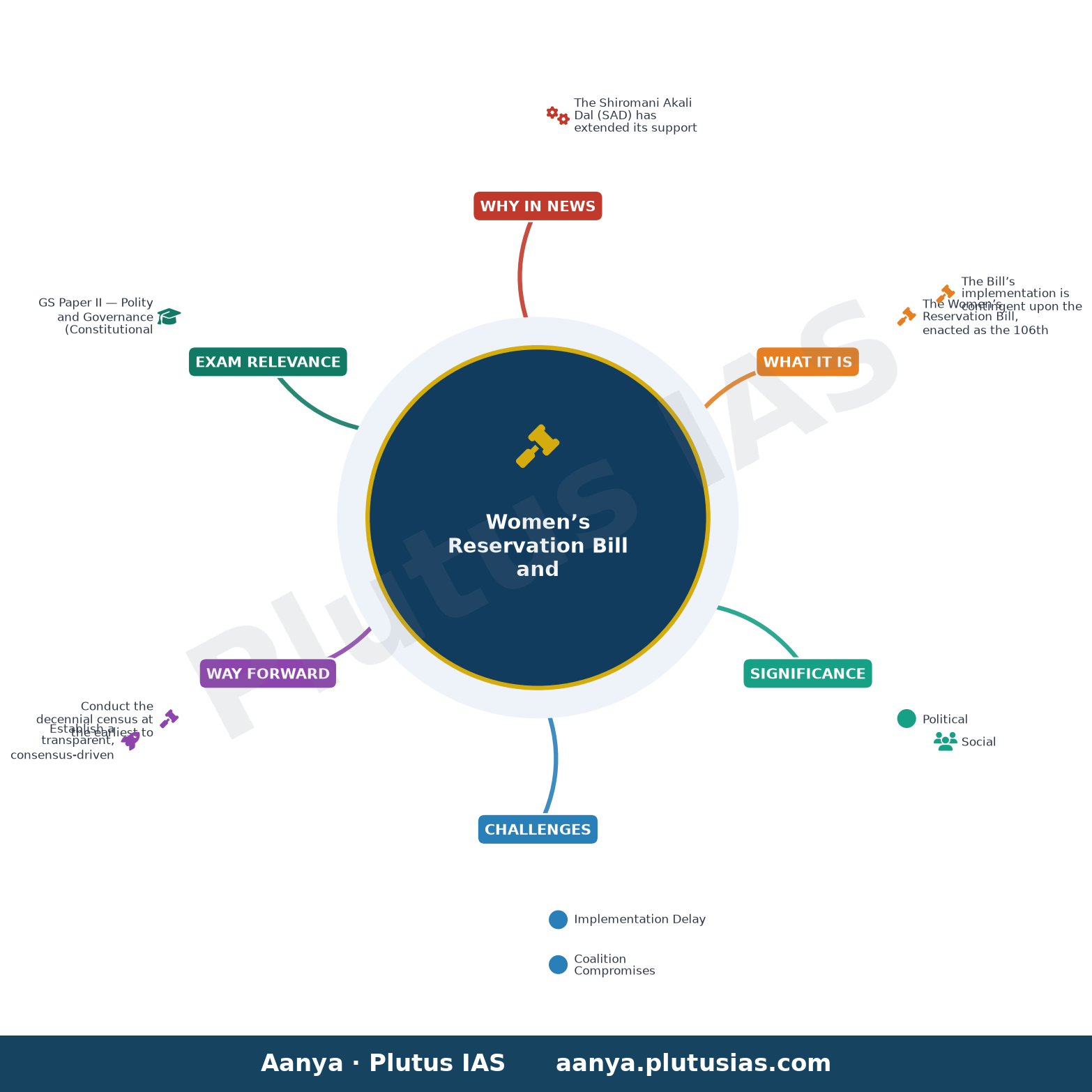
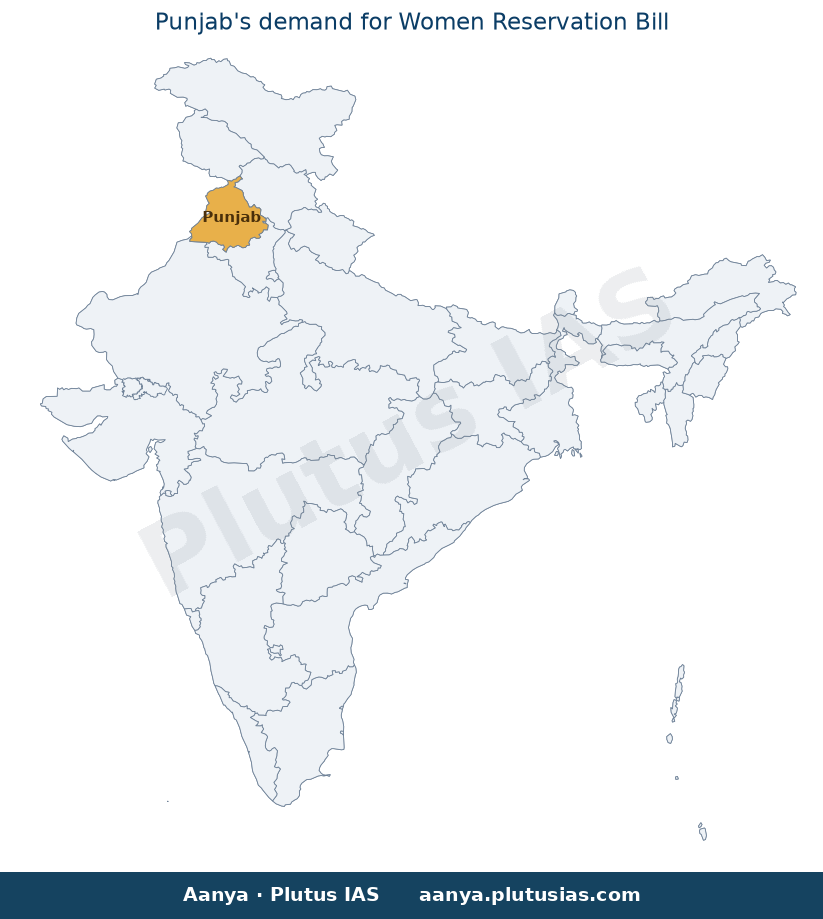
The Shiromani Akali Dal (SAD) has extended its support to the Women’s Reservation Bill and the delimitation process, aligning with the Centre’s stance. This development assumes significance as it reflects a rare bipartisan consensus on a contentious issue, particularly in the context of Punjab’s political landscape and the SAD-BJP alliance dynamics. The party’s emphasis on timely implementation and transparency in the delimitation process underscores the broader constitutional and administrative challenges associated with these reforms.
Background
- The Women’s Reservation Bill, officially the Constitution (106th Amendment) Act, 2023, provides for 33% reservation for women in the Lok Sabha and State Legislative Assemblies. It was passed by Parliament in September 2023 but requires delimitation of constituencies before implementation.
- Delimitation refers to the process of redrawing the boundaries of parliamentary and assembly constituencies to reflect changes in population. The last delimitation exercise was conducted in 2002–2008, and the next is scheduled post-2026 after the first Census.
- The Shiromani Akali Dal (SAD), a regional party in Punjab, has historically been a key ally of the BJP in national politics but has maintained a distinct identity on issues of regional autonomy and social justice.
- Punjab’s political landscape has been shaped by the Sikh community’s aspirations, as reflected in the party’s invocation of Sikh Gurus’ teachings on gender equality and social justice.
- The SAD’s support for the Bill and delimitation comes amid broader debates on federalism, with states expressing concerns over the Centre’s role in determining their electoral representation.
What is the Women’s Reservation Bill and the Delimitation Process?
- The Women’s Reservation Bill, enacted as the 106th Constitutional Amendment Act, 2023, mandates 33% reservation for women in the Lok Sabha and State Legislative Assemblies. This reservation is horizontal and applies across all categories, including SCs, STs, and OBCs.
- The Bill’s implementation is contingent upon the delimitation of constituencies, as the current reservation is based on pre-existing constituency boundaries. Delimitation ensures that the reservation is applied to newly demarcated constituencies.
- Delimitation is a statutory process conducted by the Delimitation Commission, which redraws constituency boundaries to reflect population changes. The Commission’s recommendations are final and binding, though Parliament can modify them.
- The SAD’s support for the Bill and delimitation aligns with its long-standing advocacy for gender equality, as articulated in Sikh Gurus’ teachings. The party cited the SGPC’s decision to reserve seats for women in its management committees as an example of its commitment.
- The delimitation process has been a point of contention in Indian federalism, with states like Tamil Nadu and West Bengal historically opposing Centre-led exercises, citing concerns over regional autonomy and representation.
- The SAD’s conditional support—emphasising transparency and fairness—highlights the need for a consultative approach to delimitation, particularly in states with distinct demographic and cultural identities like Punjab.
- The Bill’s implementation is expected to enhance women’s political participation, addressing the underrepresentation of women in legislatures, which currently stands at less than 15% in Parliament and 9% in State Assemblies.
Key Features
| Feature | Significance |
|---|---|
| Women Reservation Bill (128th Constitutional Amendment Act, 2023) | Aims to reserve one-third of seats in the Lok Sabha, State Legislative Assemblies, and the Delhi Assembly for women, promoting gender parity in political representation. |
| Delimitation Process | The constitutional mandate to redraw electoral boundaries based on the latest census data, ensuring equitable representation of all regions and communities. |
| Shiromani Akali Dal (SAD) Stance | Explicit support for both the Women Reservation Bill and delimitation, aligning with its historical advocacy for women’s rights and Sikh principles of equality. |
| Punjab’s Political Dynamics | SAD’s strategic positioning within the NDA framework, balancing coalition compulsions with ideological commitments to women’s empowerment. |
Why it Matters
Political
- Reinforces the constitutional commitment to gender justice by accelerating the implementation of the Women Reservation Bill, pending since 2023.
- Demonstrates SAD’s ability to influence national policy while maintaining its regional identity, particularly in Punjab.
- Highlights the intersection of electoral reforms (delimitation) and social justice (gender reservation), a critical debate in Indian democracy.
Social
- Advances the cause of women’s political participation, aligning with the constitutional vision of equality enshrined in Articles 14, 15, and 46.
- Reflects Sikh principles of gender equality, as emphasized by the SAD leadership, reinforcing cultural and religious underpinnings of social justice.
Institutional
- Underscores the role of delimitation in ensuring fair representation, a process mandated by the Constitution but often delayed due to political sensitivities.
- Illustrates the functioning of coalition politics, where regional parties like SAD can shape national agendas while safeguarding regional interests.
Challenges
1. Implementation Delay
- The Women Reservation Bill, passed in 2023, remains unimplemented due to unresolved delimitation and census-related delays.
- Political consensus on delimitation is fragile, with states like Punjab demanding equitable representation to avoid perceived injustices.
UPSC Link: GS-II: Constitutional Provisions
2. Coalition Compromises
- SAD’s support for the Bill is contingent on its broader coalition strategy with the BJP, risking dilution of its ideological stance.
- Balancing regional aspirations (e.g., Punjab’s demands) with national priorities (e.g., women’s reservation) poses a strategic challenge.
UPSC Link: GS-II: Centre-State Relations
3. Delimitation Controversies
- Delimitation requires updated census data, which has not been conducted since 2011, leading to disputes over fair representation.
- States with declining populations (e.g., Punjab) may face reduced seats, triggering political resistance.
UPSC Link: GS-II: Election Commission
4. Gender Representation Gaps
- Despite constitutional guarantees, women’s representation in Indian legislatures remains below 15%, necessitating proactive measures.
- Cultural and societal barriers persist, requiring sustained political and social interventions beyond legislative quotas.
UPSC Link: GS-I: Social Empowerment
Challenges — UPSC Perspective
| Issue | Concern |
|---|---|
| Delayed Census Data | Hinders delimitation, delaying Women Reservation Bill implementation. |
| State-Level Resistance | States fear loss of seats due to population shifts, complicating consensus. |
| Coalition Politics | Regional parties must balance ideological commitments with electoral alliances. |
| Cultural Sensitivities | Deep-rooted gender biases may undermine the effectiveness of reservation policies. |
Way Forward
- Conduct the decennial census at the earliest to enable timely delimitation and implementation of the Women Reservation Bill.
- Establish a transparent, consensus-driven delimitation commission with representation from all states to address regional concerns.
- Strengthen mechanisms for women’s political participation, including capacity-building programs for aspiring female leaders.
- Leverage SAD’s ideological alignment with Sikh principles to mobilize broader societal support for gender justice.
- Engage in multi-party dialogues to resolve coalition-related conflicts and ensure sustained political will for reform.
- Monitor and evaluate the impact of reservation policies to identify gaps and propose corrective measures.
- Promote awareness campaigns to sensitize stakeholders on the constitutional and social imperatives of gender equality.
UPSC Value Addition
Keywords for Mains Answer-Writing
Women’s Reservation Bill 2023 · Constitution (106th Amendment) Act · Delimitation Commission · Political reservation for women · Parliamentary representation · Shiromani Akali Dal (SAD) · BJP-SAD alliance · Sikh Gurus’ teachings on gender equality · 50% increase in parliamentary seats · Constitutional provisions on reservation
Constitutional & Policy Linkages
- Article 14 (Right to Equality)
- Article 15 (Prohibition of Discrimination)
- Article 46 (Promotion of Educational and Economic Interests of Weaker Sections)
- Article 324 (Election Commission)
- Article 82 (Readjustment of Representation in Parliament)
- Seventh Schedule (State List: Elections)
Concept Flow
Constitutional Mandate for Gender Justice (Articles 14, 15, 46) → Enactment of Women Reservation Bill (2023) → Delay in Implementation due to Delimitation and Census Issues → Political Mobilization by SAD for Timely Execution → Coalition Dynamics and Regional Demands (Punjab) → Challenges in Consensus Building → Way Forward: Census, Delimitation, and Social Empowerment
Prelims Practice Questions
Q1. Consider the following statements regarding the Women’s Reservation Bill 2023:
1. The Bill seeks to reserve one-third of the seats in the Lok Sabha and State Legislative Assemblies for women.
2. The reservation will be implemented immediately after the Bill receives Presidential assent.
3. The Bill also proposes a 50% increase in the total number of parliamentary seats across all states.
4. The reservation will be rotated among different constituencies every five years.
How many of the above statements are correct?
- Only one
- Only two
- Only three
- All four
Answer: Only three — Statements 1 and 3 are correct. Statement 1 aligns with the Bill’s objective. Statement 3 reflects the provision for increasing parliamentary seats. Statements 2 and 4 are incorrect as the Bill mandates reservation post-delimitation and does not specify rotation.
Q2. Assertion (A): The Women’s Reservation Bill 2023 aims to enhance women’s political representation by reserving seats in Parliament and State Legislatures.
Reason (R): The Bill mandates a 50% increase in the total number of parliamentary seats across all states to accommodate the reservation.
Options:
A. Both A and R are true, and R is the correct explanation of A.
B. Both A and R are true, but R is not the correct explanation of A.
C. A is true, but R is false.
D. A is false, but R is true.
- A
- B
- C
- D
Answer: C — Assertion (A) is true as the Bill seeks to reserve seats for women. Reason (R) is also true but does not directly explain the assertion, as the 50% increase in seats is a separate provision to ensure adequate representation.
Q3. Match the following provisions of the Women’s Reservation Bill 2023 with their correct descriptions:
Column I (Provision)
A. Reservation for women
B. Delimitation process
C. 50% increase in parliamentary seats
D. Rotation of reserved seats
Column II (Description)
1. To be implemented after the next census
2. One-third of seats in Lok Sabha and State Legislatures
3. Not specified in the Bill
4. Across all states to accommodate reservation
Options:
A-2, B-1, C-4, D-3
- A-2, B-1, C-4, D-3
- A-1, B-2, C-3, D-4
- A-3, B-4, C-2, D-1
- A-4, B-3, C-1, D-2
Answer: A-2, B-1, C-4, D-3 — A-2 (Reservation for women is one-third of seats), B-1 (Delimitation is to be implemented post-census), C-4 (50% increase in seats is across all states), D-3 (Rotation of reserved seats is not specified in the Bill).
Mains Practice Question
✍ The Women’s Reservation Bill 2023 represents a significant step toward gender parity in Indian politics. Critically examine the constitutional, political, and social dimensions of this legislation. Also, analyze how the Bill addresses the concerns raised by regional parties like the Shiromani Akali Dal regarding its implementation. (15 Marks)
Approach: MODEL-ANSWER SKELETON:
1. **Constitutional Dimensions**:
– Reference to Article 15(3) and Article 243D (reservation for women in Panchayats and Municipalities).
– Constitutional (106th Amendment) Act, 2023: Insertion of Article 330A and 332A for reservation in Lok Sabha and State Legislative Assemblies.
– Role of the Delimitation Commission (Article 82 and 170) and its linkage to the census (Article 324).
2. **Political Dimensions**:
– Objective: Enhance women’s political participation and representation.
– Challenges: Implementation post-delimitation (next census), potential delays, and political consensus.
– Regional party perspectives: Shiromani Akali Dal’s support for the Bill but demand for immediate implementation and fair delimitation (as seen in the news).
– BJP-SAD alliance dynamics: How coalition politics influences policy implementation.
3. **Social Dimensions**:
– Gender equality and empowerment: Aligns with the teachings of Sikh Gurus on women’s dignity and equality (as cited by SAD leader Gulzar Singh).
– Impact on women’s leadership and policy outcomes.
– Criticisms: Reservation as a temporary measure vs. structural change; potential tokenism.
4. **Concerns Raised by Regional Parties**:
– Demand for immediate implementation without waiting for delimitation.
– Ensuring fair and transparent delimitation to avoid injustice to any state.
– 50% increase in parliamentary seats to accommodate reservation without reducing general seats.
5. **Conclusion**:
– Balance between constitutional mandates and political feasibility.
– Need for timely implementation to realize the Bill’s objectives.
Source: amarujala.com
Generated by AanyaAi for educational purpose.


No Comments