


10 Aug World Adivasi Day 2026: Tribal Crafts Exhibition & Cultural Significance for UPSC
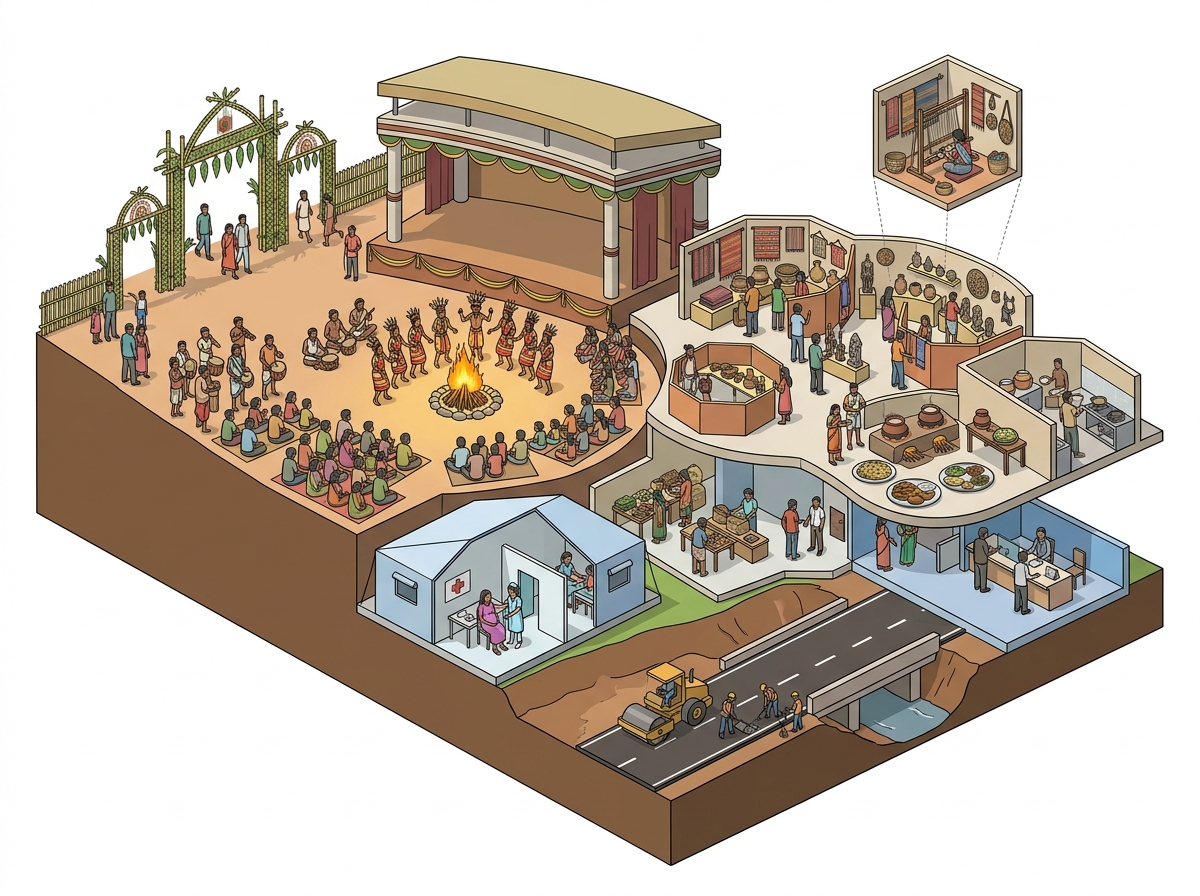
Tribal craftsSelf-help groupsWelfare schemesCultural exhibitionRoad connectivityFood distribution✎ World Adivasi Day underscores India’s constitutional commitment to tribal welfare, operationalised through schemes like ZMMR, Adavi Thalli Bata, and GCC, while balancing cultural preservation with socio-economic development under…
Subject Relevance — Where This Topic Fits
- GS Paper II — Governance, Welfare Schemes for Vulnerable Sections | GS Paper III — Rural Development, Tribal Sub-Plan, Employment Generation | GS Paper IV — Ethics in Governance: Inclusive Development and Cultural Preservation
- Prelims: Scheduled Tribes and Other Traditional Forest Dwellers (Recognition of Forest Rights) Act, 2006, Van Mitra Scheme, Tribal Cooperative Marketing Development Federation of India (TRIFED), Zero Maternal Mortality Rate (ZMMR) initiative, Self-Help Groups (SHGs), Integrated Tribal Development Agency (ITDA), Girijan Cooperative Corporation, Food in PGRS Scheme
- Essay: Cultural pluralism and national integration: The role of indigenous traditions in modern India, Inclusive growth: Balancing economic development with cultural preservation
Quick Revision: World Adivasi Day underscores India’s constitutional commitment to tribal welfare, operationalised through schemes like ZMMR, Adavi Thalli Bata, and GCC, while balancing cultural preservation with socio-economic development under the Tribal Sub-Plan framework.
Why is this in the news?
World Adivasi Day 2026 was observed with significant cultural and administrative participation in Araku Valley, Andhra Pradesh, highlighting the intersection of tribal heritage preservation, welfare governance, and inclusive development initiatives. The event underscored the Indian state’s constitutional obligations toward Scheduled Tribes (STs) under Articles 46 and 275(1) of the Constitution, as well as the operationalisation of welfare schemes such as the Zero Maternal Mortality Rate (ZMMR) initiative, the Adavi Thalli Bata road connectivity programme, and the Food in PGRS Scheme. The celebration also served as a platform to showcase tribal handicrafts, cuisine, and socio-economic progress through self-help groups and cooperative enterprises.
Background
- India’s tribal population constitutes approximately 8.6% of the total population (Census 2011), with significant concentrations in states such as Madhya Pradesh, Maharashtra, Odisha, Rajasthan, and Andhra Pradesh.
- The Constitution of India provides for special provisions for STs under Articles 46 and 275(1) of the Constitution, mandating protective discrimination and affirmative action.
- The Scheduled Tribes and Other Traditional Forest Dwellers (Recognition of Forest Rights) Act, 2006, recognises individual and community forest rights, empowering tribal communities in forest governance.
- The Tribal Sub-Plan (TSP) framework, introduced in the Fifth Five-Year Plan (1974–79), aims to channelise resources for the socio-economic development of tribal areas.
- Institutions such as the Tribal Cooperative Marketing Development Federation of India (TRIFED) and Girijan Cooperative Corporation (GCC) play a pivotal role in marketing tribal produce, handicrafts, and forest products.
Tribal Welfare and Cultural Preservation: Governance Mechanisms and Key Initiatives
- The **Zero Maternal Mortality Rate (ZMMR) initiative** is a pilot programme operational in 11 primary health centres in Araku Valley, integrating maternal health services with community-based monitoring to eliminate preventable maternal deaths.
- The **Adavi Thalli Bata** programme, with an outlay of ₹1,000 crore, focuses on improving road connectivity in tribal areas, facilitating access to markets, healthcare, and educational institutions, thereby reducing isolation and enhancing socio-economic mobility.
- The **Girijan Cooperative Corporation (GCC)** is a state-level apex cooperative body under the Andhra Pradesh government, mandated to procure, process, and market tribal produce, handicrafts, and forest products, ensuring fair remuneration and market linkages.
- Tribal self-help groups (SHGs) have emerged as a critical instrument for financial inclusion and women’s empowerment, with over 1.47 lakh women members in Araku Valley receiving financial assistance totalling ₹24.23 crore, fostering entrepreneurship and collective bargaining.
Key Features
| Feature | Significance |
|---|---|
| Cultural exhibitions of tribal crafts | Preservation and promotion of indigenous art forms, fostering cultural identity and economic opportunities for tribal artisans. |
| Traditional attire and performances | Reinforcement of tribal heritage, intergenerational transmission of cultural practices, and community bonding. |
| Food in PGRS scheme | Ensures food security for tribal communities through Public Distribution System reforms tailored to local dietary needs. |
| Khet Bachao Abhiyan loan melas | Provides financial access to tribal farmers for agricultural resilience, addressing credit gaps in remote areas. |
| Zero Maternal Mortality Rate initiative | Targets reduction of maternal mortality in tribal regions through targeted healthcare interventions and monitoring. |
| Adavi Thalli Bata road connectivity programme | Enhances accessibility to markets, healthcare, and education for tribal populations in remote areas. |
| Girijan Cooperative Corporation stalls | Supports tribal cooperatives, ensuring fair trade and sustainable livelihoods for artisans and farmers. |
Why it Matters
Cultural Preservation
- Tribal communities in India represent over 8% of the population and possess distinct cultural practices, languages, and art forms that require systematic preservation.
- Cultural exhibitions and festivals serve as platforms for intergenerational knowledge transfer, ensuring continuity of traditional knowledge systems.
- Recognition of tribal art forms under intellectual property frameworks (e.g., Geographical Indications) enhances economic value and prevents exploitation.
Economic Empowerment
- Tribal handicrafts and agricultural products represent significant economic assets, with potential for value addition and export-led growth.
- Self-help groups (SHGs) and cooperatives provide institutional mechanisms for collective bargaining and market access for tribal producers.
- Financial inclusion initiatives, such as loan melas, address structural barriers in credit access for tribal farmers and entrepreneurs.
Healthcare Access
- Tribal regions often face disparities in healthcare infrastructure, necessitating targeted interventions like feeder ambulance services and maternal health programmes.
- Zero Maternal Mortality Rate initiatives demonstrate the effectiveness of localized healthcare strategies in reducing preventable deaths.
- Community-based health monitoring systems, such as those in pilot primary health centres, improve early detection and intervention.
Infrastructure Development
- Road connectivity programmes in tribal areas mitigate geographical isolation, enabling socio-economic integration and reducing vulnerability to exploitation.
- Improved transport infrastructure facilitates access to education, healthcare, and markets, thereby enhancing quality of life.
Policy Coherence
- The integration of cultural preservation with economic and social development reflects a holistic approach to tribal welfare, aligning with constitutional directives.
- Inter-departmental coordination in initiatives such as the Zero Maternal Mortality Rate programme highlights the importance of multi-stakeholder governance.
Challenges
1. Geographical Isolation
- Tribal communities in remote areas face limited access to markets, healthcare, and educational institutions due to difficult terrain and poor infrastructure.
- Low population density and dispersed settlements increase the cost of service delivery, particularly for healthcare and transport.
UPSC Link: GS1: Tribal communities in India
2. Economic Marginalization
- Tribal populations often lack access to formal credit systems, limiting their ability to invest in agriculture, entrepreneurship, or skill development.
- Dependence on subsistence agriculture and informal economies exposes them to market volatility and exploitation by middlemen.
UPSC Link: GS3: Economic empowerment of vulnerable sections
3. Cultural Erosion
- Globalization and urbanization threaten the transmission of traditional knowledge, languages, and art forms among younger generations.
- Lack of documentation and archival systems for tribal knowledge systems risks permanent loss of cultural heritage.
UPSC Link: GS1: Cultural heritage preservation
4. Healthcare Disparities
- Tribal regions report higher incidences of malnutrition, communicable diseases, and maternal mortality compared to national averages.
- Shortage of healthcare professionals and facilities in tribal areas exacerbates health outcomes, necessitating targeted interventions.
UPSC Link: GS2: Health infrastructure and services
5. Policy Implementation Gaps
- Despite numerous welfare schemes, ground-level delivery faces challenges such as bureaucratic delays, lack of awareness, and inadequate monitoring.
- Fragmented governance structures and overlapping jurisdictions hinder effective implementation of tribal welfare programmes.
UPSC Link: GS2: Governance and public service delivery
6. Market Access Barriers
- Tribal artisans and farmers often lack market linkages, branding, and certification, limiting their ability to command fair prices.
- Exploitation by intermediaries and lack of value addition reduce the economic returns from tribal products.
UPSC Link: GS3: Agricultural and rural development
Challenges — UPSC Perspective
| Issue | Concern |
|---|---|
| Geographical isolation | Limited access to essential services and markets due to terrain and infrastructure deficits. |
| Economic marginalization | Dependence on informal economies and lack of credit access hinder sustainable livelihoods. |
| Cultural erosion | Globalization and urbanization threaten the preservation of tribal languages and art forms. |
| Healthcare disparities | Higher maternal mortality and malnutrition rates in tribal regions require targeted interventions. |
| Policy implementation gaps | Bureaucratic delays and lack of awareness impede effective delivery of welfare schemes. |
| Market access barriers | Exploitation by intermediaries and lack of branding reduce economic returns for tribal producers. |
Government Initiatives — Must-Memorise for Prelims
- Zero Maternal Mortality Rate initiative
- Adavi Thalli Bata road connectivity programme
- ASR Lakshyam employment cell for tribal youth
Way Forward
- Strengthen inter-departmental coordination to ensure seamless implementation of tribal welfare schemes, with regular monitoring and evaluation.
- Expand financial inclusion initiatives, such as loan melas and SHG linkages, to enhance credit access for tribal farmers and entrepreneurs.
- Develop localized healthcare models, including mobile clinics and community health workers, to improve service delivery in remote tribal areas.
- Promote tribal art forms through Geographical Indication (GI) tagging, branding, and e-commerce platforms to enhance market access and economic returns.
- Invest in rural infrastructure, particularly roads and digital connectivity, to reduce geographical isolation and improve socio-economic integration.
- Document and archive tribal knowledge systems, languages, and art forms to prevent cultural erosion and enable future generations to access heritage.
- Enhance awareness campaigns to ensure tribal communities are informed about their rights, entitlements, and available welfare schemes.
- Foster public-private partnerships to support tribal cooperatives and enterprises, ensuring sustainable livelihoods and economic empowerment.
UPSC Value Addition
Keywords for Mains Answer-Writing
Tribal Sub-Plan · Scheduled Tribes and Other Traditional Forest Dwellers (Recognition of Forest Rights) Act, 2006 · Zero Maternal Mortality Rate initiative · Food Security Act and tribal nutrition · Girijan Cooperative Corporation · Tribal self-help groups and financial inclusion · Adavi Thalli Bata road connectivity programme · Constitutional provisions for tribal welfare (Article 46, Fifth and Sixth Schedules) · Inclusive development and cultural preservation · Tribal entrepreneurship and traditional crafts
Constitutional & Policy Linkages
- Fifth Schedule: Administration and control of Scheduled Areas and Scheduled Tribes
- Sixth Schedule: Autonomous District Councils in tribal areas
- Article 46: Promotion of educational and economic interests of Scheduled Castes and Scheduled Tribes
Concept Flow
Observance of World Adivasi Day → Recognition of tribal cultural heritage → Promotion of tribal art forms and crafts → Economic empowerment through market access and cooperatives → → Tribal communities face geographical isolation and economic marginalization → Implementation of welfare schemes (e.g., road connectivity, healthcare, financial inclusion) → → Cultural preservation initiatives → Documentation and archival of tribal knowledge systems → Intergenerational transmission of heritage → → Healthcare disparities in tribal regions → Targeted interventions (e.g., Zero Maternal Mortality Rate) → Improved health outcomes → → Policy implementation gaps → Strengthened governance and monitoring → Enhanced delivery of tribal welfare programmes → → Market access barriers → Promotion of tribal enterprises and GI tagging → Increased economic returns → Sustainable livelihoods
Prelims Practice Questions
Q1. Consider the following statements regarding the Scheduled Tribes and Other Traditional Forest Dwellers (Recognition of Forest Rights) Act, 2006:
1. The Act recognises the rights of forest-dwelling tribal communities and other traditional forest dwellers to forest resources.
2. The Act mandates the establishment of Forest Rights Committees at the village level.
3. The Act provides for the diversion of forest land for non-forest purposes without the consent of the Gram Sabha.
How many of the above statements are correct?
- Only one
- Only two
- All three
- None
Answer: Only two — Statement 1 is correct as the Act recognises individual and community forest rights. Statement 2 is correct as the Act requires the formation of Forest Rights Committees. Statement 3 is incorrect as the Act does not allow diversion of forest land without the consent of the Gram Sabha.
Q2. Assertion (A): The Girijan Cooperative Corporation (GCC) plays a pivotal role in the marketing and promotion of tribal handicrafts and forest produce.
Reason (R): The GCC operates under the provisions of the Andhra Pradesh Scheduled Tribes (Planning and Development) Cooperative Societies Act, 1974.
Options:
A. Both A and R are true, and R is the correct explanation of A.
B. Both A and R are true, but R is not the correct explanation of A.
C. A is true, but R is false.
D. A is false, but R is true.
Answer: ? — Assertion (A) is true as the GCC is indeed a key institution for tribal artisans. Reason (R) is also true as the GCC operates under the Andhra Pradesh Scheduled Tribes (Planning and Development) Cooperative Societies Act, 1974, which provides the legal framework for its functioning. R correctly explains A.
Q3. Match the following tribal welfare schemes with their respective objectives:
Column I
1. Zero Maternal Mortality Rate initiative
2. Khet Bachao Abhiyan
3. ASR Lakshyam employment cell
4. Food in PGRS scheme
Column II
A. Ensuring food security for tribal communities
B. Providing employment opportunities for tribal youth
C. Preventing maternal deaths in primary health centres
D. Supporting tribal farmers in agricultural distress
Options:
1. 1-C, 2-D, 3-B, 4-A
2. 1-A, 2-B, 3-C, 4-D
3. 1-D, 2-C, 3-A, 4-B
4. 1-B, 2-A, 3-D, 4-C
- 1
- 2
- 3
- 4
Answer: 1 — 1-C: Zero Maternal Mortality Rate initiative focuses on reducing maternal deaths. 2-D: Khet Bachao Abhiyan supports tribal farmers in agricultural distress. 3-B: ASR Lakshyam employment cell provides employment opportunities for tribal youth. 4-A: Food in PGRS scheme ensures food security for tribal communities.
Mains Practice Question
✍ The preservation of tribal identity and culture must coexist with inclusive development and economic empowerment. Critically analyse the constitutional and statutory framework for tribal welfare in India, citing recent initiatives and judicial pronouncements. (15 Marks)
Approach: MODEL-ANSWER SKELETON:
1. Constitutional Provisions: Article 46 (Directive Principles of State Policy), Fifth and Sixth Schedules, Article 275 (grants-in-aid for tribal welfare), and Article 342 (Scheduled Tribes).
2. Statutory Framework: Scheduled Tribes and Other Traditional Forest Dwellers (Recognition of Forest Rights) Act, 2006 (FRA), Panchayats (Extension to Scheduled Areas) Act, 1996 (PESA), and Forest Conservation Act, 1980.
3. Recent Initiatives: Zero Maternal Mortality Rate initiative, Khet Bachao Abhiyan, Adavi Thalli Bata road connectivity programme, and ASR Lakshyam employment cell.
4. Judicial Pronouncements: Recent Supreme Court judgments on FRA (e.g., 2023 judgment on eviction of tribals from forest lands) and PESA implementation.
5. Challenges: Land alienation, forest rights violations, lack of awareness, and implementation gaps.
6. Balanced View: While constitutional and statutory frameworks are robust, ground-level implementation remains uneven. Suggest measures for effective convergence of welfare and cultural preservation.
Source: The Hindu
Generated by AanyaAi for educational purpose.

- संसदीय कार्य मंत्री ने 2026 में ‘स्वच्छता ही सेवा’ अभियान के तहत श्रमदान किया - October 1, 2026
- TDB halts Research Innovation Scheme invitations: Key reasons explained - October 1, 2026
- कर्नाटक में 1971 के बाद सबसे खराब मानसून: 35% बारिश की कमी, जानें पूरा मामला - October 1, 2026

No Comments