


10 Aug World Adivasi Day 2026: Tribal Crafts & Welfare Schemes Highlighted in Araku
Tribal craftsSelf-help groupsMaternal healthInfrastructure developmentCultural identity✎ World Adivasi Day underscores the need for a multi-dimensional approach to tribal welfare, integrating cultural preservation, economic empowerment, and inclusive governance.
Subject Relevance — Where This Topic Fits
- GS Paper II — Governance, Administration and People’s Empowerment (Tribal Welfare Policies) | GS Paper III — Rural Development, Agriculture and Social Sector Initiatives (Tribal Livelihoods and Employment)
- Prelims: Scheduled Tribes and Other Traditional Forest Dwellers (Recognition of Forest Rights) Act, 2006, Van Mitra Scheme, Zero Maternal Mortality Rate (ZMMR) initiative, Food in PGRS scheme, Khet Bachao Abhiyan, Adavi Thalli Bata road connectivity programme, Girijan Cooperative Corporation, Tribal Sub-Plan (TSP)
- Essay: Cultural preservation as a pillar of inclusive development, The interface between tradition and modernity in tribal welfare
Quick Revision: World Adivasi Day underscores the need for a multi-dimensional approach to tribal welfare, integrating cultural preservation, economic empowerment, and inclusive governance.
Why is this in the news?
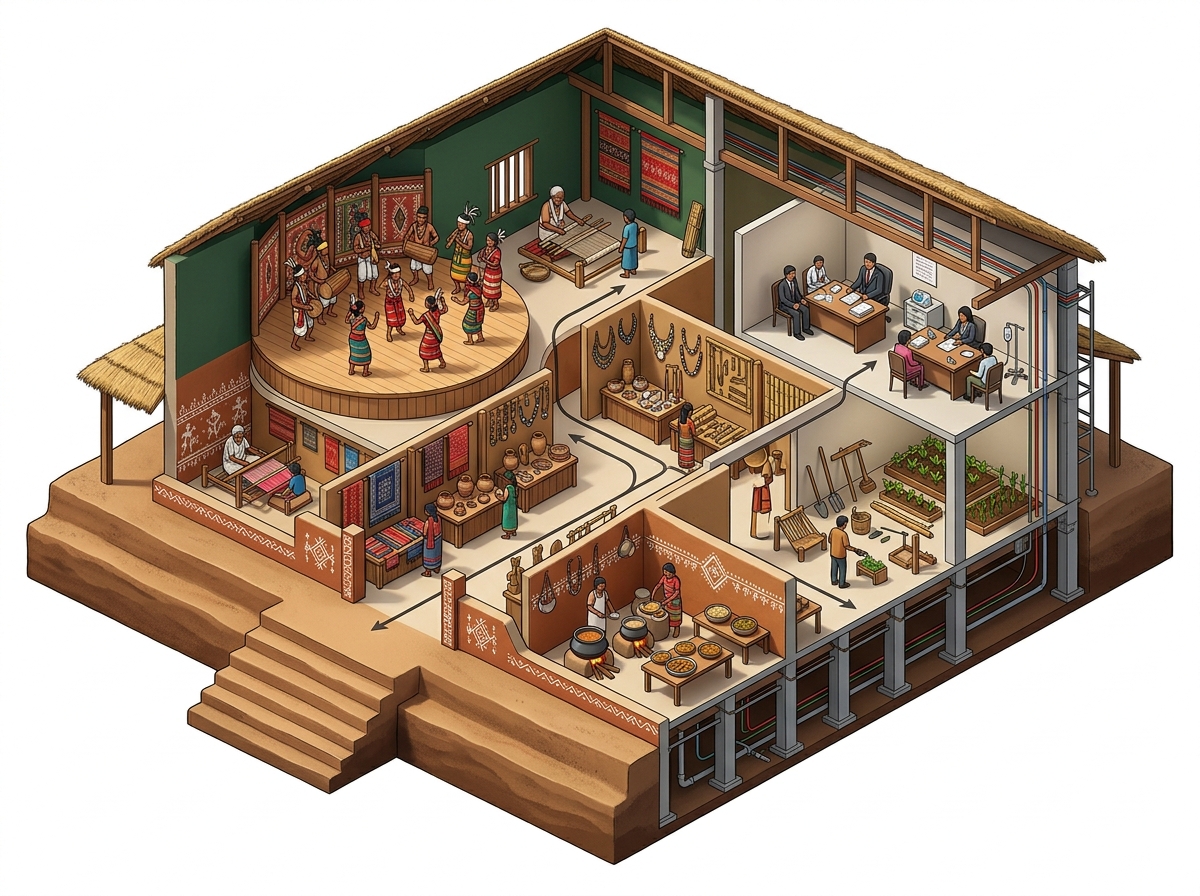
World Adivasi Day 2026 was marked in Araku Valley, Andhra Pradesh, with a focus on cultural preservation, economic empowerment, and administrative outreach. The event highlighted state-led initiatives in tribal welfare, including financial assistance to self-help groups, maternal health improvements, and infrastructure development, while showcasing tribal crafts and cuisine. The celebrations underscored the intersection of cultural identity, governance, and sustainable development in tribal regions.
Background
- The United Nations declared 9 August as the International Day of the World’s Indigenous Peoples in 1994, later adopted in India as World Adivasi Day to recognise the cultural, social, and economic contributions of tribal communities.
- India’s tribal population constitutes approximately 8.6% of the total population, as per the 2011 Census, with significant concentrations in central and eastern states.
- The Constitution of India provides for special provisions under Articles 15(4), 16(4), 29, 46, and 342, along with the Fifth and Sixth Schedules, to protect tribal rights, culture, and livelihoods.
- The Scheduled Tribes and Other Traditional Forest Dwellers (Recognition of Forest Rights) Act, 2006, aims to secure land tenure and access to forest resources for tribal and forest-dwelling communities.
- Government schemes such as the Tribal Sub-Plan (TSP) and Van Mitra Scheme are designed to address the developmental gaps between tribal and non-tribal populations.
- Andhra Pradesh has a substantial tribal population, with the Integrated Tribal Development Agency (ITDA) playing a key role in implementing welfare programmes in tribal areas.
What are the key dimensions of tribal welfare and cultural preservation in India?
- Cultural Preservation: Tribal communities possess distinct languages, art forms, and traditional knowledge systems that require protection and promotion. Events like World Adivasi Day serve as platforms for showcasing tribal heritage, including handicrafts, music, dance, and cuisine.
- Economic Empowerment: Financial assistance to self-help groups (SHGs) and livelihood programmes such as the Food in PGRS scheme aim to enhance income-generating activities for tribal populations, particularly women.
- Health and Nutrition: Initiatives like the Zero Maternal Mortality Rate (ZMMR) programme focus on reducing maternal and infant mortality in tribal regions through improved healthcare access and infrastructure.
- Infrastructure Development: Road connectivity programmes such as Adavi Thalli Bata and feeder ambulance services address geographical isolation, improving access to markets, education, and healthcare.
- Education and Skill Development: Schools of Excellence for tribal students and employment cells like ASR Lakshyam provide targeted educational and vocational training to enhance employability.
- Institutional Mechanisms: Organisations such as the ITDA play pivotal roles in implementing welfare schemes, ensuring that benefits reach tribal communities effectively.
- Legal and Policy Framework: Constitutional provisions and legislative acts, including the Forest Rights Act, provide the legal basis for protecting tribal rights and ensuring inclusive development.
- Community Participation: Tribal elders, local leaders, and self-help groups are integral to the design and implementation of welfare programmes, ensuring cultural relevance and sustainability.
Key Features
| Feature | Significance |
|---|---|
| Observance of World Adivasi Day | Acknowledges the cultural and social identity of Scheduled Tribes (STs), aligning with constitutional provisions for tribal welfare and recognition. |
| Exhibition of tribal crafts and cuisine | Showcases indigenous knowledge systems, artisanal skills, and traditional livelihood practices, fostering cultural preservation and economic empowerment. |
| Government Degree College Grounds, Araku Valley | Serves as a symbolic venue for inclusive development initiatives, reflecting administrative commitment to tribal-centric governance. |
| Participation of tribal elders and students | Ensures intergenerational transmission of tribal knowledge and reinforces community-led development approaches. |
| Address by Women and Child Welfare Minister | Highlights the integration of tribal welfare within broader social development frameworks, particularly for women and children. |
| Zero Maternal Mortality Rate initiative | Demonstrates targeted public health interventions in tribal areas, addressing critical gaps in maternal healthcare access. |
| Food in PGRS scheme | Addresses food security and nutrition among tribal communities through Public Distribution System reforms tailored to local dietary needs. |
| Khet Bachao Abhiyan loan melas | Provides financial inclusion and credit access to tribal farmers, mitigating agrarian distress and enhancing livelihood resilience. |
| Adavi Thalli Bata road connectivity programme | Improves access to markets, healthcare, and education for remote tribal settlements, reducing socio-economic isolation. |
| Girijan Cooperative Corporation stalls | Facilitates market linkages for tribal artisans, ensuring fair remuneration and sustainable income generation. |
Why it Matters
Cultural and Social Significance
- Reinforces the constitutional mandate under Article 29(1) and Article 30(1) to protect the cultural and educational rights of Scheduled Tribes, ensuring their distinct identity is preserved and promoted.
- Fosters inter-community dialogue and national integration by celebrating tribal heritage in a public forum, aligning with the ethos of pluralism enshrined in the Preamble of the Constitution.
- Highlights the role of tribal knowledge systems in sustainable development, particularly in areas such as traditional medicine, agriculture, and handicrafts, which are increasingly recognized in global frameworks like the Convention on Biological Diversity (CBD).
- Encourages the documentation and dissemination of intangible cultural heritage, contributing to the objectives of the UNESCO 2003 Convention for the Safeguarding of the Intangible Cultural Heritage.
Economic Significance
- Demonstrates the potential of tribal handicrafts and agro-based products as avenues for economic empowerment, particularly for women-led self-help groups (SHGs).
- Showcases the Girijan Cooperative Corporation’s role in aggregating tribal produce and crafts, reducing intermediaries and enhancing market access for tribal artisans.
- Illustrates the integration of tribal livelihoods with mainstream economic systems through schemes like Khet Bachao Abhiyan, which provides credit and agricultural support to tribal farmers.
- Highlights the multiplier effect of financial assistance to SHGs, which not only improves household incomes but also strengthens local economies through increased consumption and investment.
Administrative and Governance Significance
- Reflects the implementation of district-level initiatives under the Integrated Tribal Development Agencies (ITDAs), which are mandated by the Scheduled Tribes and Other Traditional Forest Dwellers (Recognition of Forest Rights) Act, 2006 (FRA), for holistic tribal welfare.
- Demonstrates the use of participatory governance models, where tribal elders, women, and youth are actively engaged in planning and implementation processes, ensuring cultural relevance and community ownership.
- Showcases the role of district administrations in translating national and state-level tribal welfare schemes into ground-level action, such as the Zero Maternal Mortality Rate initiative and road connectivity programmes.
- Highlights the importance of inter-departmental coordination in addressing multi-dimensional challenges faced by tribal communities, such as healthcare, education, and infrastructure.
Challenges
1. Socio-Economic Marginalisation
- Persistent disparities in access to education, healthcare, and economic opportunities between tribal and non-tribal populations, despite constitutional safeguards.
- Limited market access for tribal artisans and farmers, leading to exploitation by middlemen and inadequate remuneration for traditional crafts and agricultural produce.
- High levels of poverty and indebtedness among tribal communities, exacerbated by climate vulnerabilities and lack of formal credit mechanisms.
UPSC Link: GS-II: Vulnerable Sections
2. Cultural Erosion and Identity Loss
- Gradual erosion of traditional knowledge systems, languages, and cultural practices due to urbanisation, migration, and lack of formal documentation.
- Inadequate representation of tribal narratives in mainstream media and educational curricula, leading to misrepresentation or stereotyping.
- Challenges in balancing cultural preservation with economic development, particularly in sectors like tourism and industrialisation.
UPSC Link: GS-I: Indian Culture
3. Infrastructure and Service Delivery Gaps
- Inadequate road connectivity and transportation networks in tribal regions, impeding access to essential services such as healthcare, education, and markets.
- Shortage of healthcare facilities, particularly in remote areas, leading to high maternal and infant mortality rates and limited access to specialised care.
- Insufficient digital infrastructure, limiting the reach of government welfare schemes and financial inclusion initiatives.
UPSC Link: GS-II: Governance
4. Implementation Bottlenecks in Welfare Schemes
- Delays in disbursement of financial assistance to SHGs and tribal farmers, undermining the intended benefits of schemes like Food in PGRS and Khet Bachao Abhiyan.
- Lack of awareness among tribal communities about their entitlements under various welfare programmes, leading to underutilisation of available resources.
- Bureaucratic hurdles and complex eligibility criteria in schemes like Adavi Thalli Bata, which may exclude eligible beneficiaries.
UPSC Link: GS-II: Government Policies
5. Environmental Degradation and Land Rights
- Encroachment on tribal lands for industrial, mining, or infrastructure projects, leading to displacement and loss of livelihoods, in violation of the Forest Rights Act, 2006.
- Climate change impacts, such as erratic rainfall and deforestation, threatening traditional agricultural practices and food security among tribal communities.
- Inadequate recognition of community forest rights under the FRA, which limits tribal communities’ ability to manage and conserve forest resources sustainably.
UPSC Link: GS-III: Environment
Challenges — UPSC Perspective
| Issue | Concern |
|---|---|
| Access to Education | Low enrolment and high dropout rates among tribal children, particularly girls, due to distance to schools, lack of hostel facilities, and cultural barriers. |
| Healthcare Disparities | High maternal and infant mortality rates, malnutrition, and lack of specialised healthcare services in tribal areas. |
| Land and Forest Rights | Inadequate implementation of the Forest Rights Act, 2006, leading to conflicts over land use and displacement of tribal communities. |
| Economic Exclusion | Limited access to formal credit, markets, and skill development programmes for tribal artisans and farmers. |
| Cultural Preservation | Erosion of traditional knowledge systems, languages, and cultural practices due to external influences and lack of documentation. |
| Infrastructure Deficits | Poor road connectivity, unreliable electricity, and limited digital access in tribal regions, hindering development and service delivery. |
Government Initiatives — Must-Memorise for Prelims
- Food in PGRS scheme
- Zero Maternal Mortality Rate initiative
- Adavi Thalli Bata road connectivity programme
- ASR Lakshyam employment cell
Way Forward
- Strengthen the implementation of the Forest Rights Act, 2006, by expediting the recognition of individual and community forest rights to ensure tenure security and sustainable resource management.
- Expand the coverage of the Zero Maternal Mortality Rate initiative to all tribal-dominated districts, with a focus on training local health workers and improving referral systems.
- Enhance market linkages for tribal artisans through the Girijan Cooperative Corporation by establishing more exhibition stalls, e-commerce platforms, and direct procurement from SHGs.
- Improve road connectivity in tribal regions under the Adavi Thalli Bata programme by leveraging funds from the Pradhan Mantri Gram Sadak Yojana and state-specific schemes.
- Launch targeted awareness campaigns to educate tribal communities about their entitlements under welfare schemes, using local languages and community leaders as facilitators.
- Integrate traditional knowledge systems into formal education curricula to preserve tribal languages, arts, and agricultural practices while fostering pride in cultural heritage.
- Promote climate-resilient agriculture among tribal farmers by providing training in sustainable farming techniques, water conservation, and crop diversification.
- Establish a dedicated tribal entrepreneurship fund to support startups in tribal crafts, agro-processing, and eco-tourism, with simplified loan approval processes.
UPSC Value Addition
Keywords for Mains Answer-Writing
Scheduled Tribes · Tribal welfare schemes · Inclusive development · Tribal identity preservation · Government initiatives for tribal communities · Zero Maternal Mortality Rate initiative · Food in PGRS scheme · Khet Bachao Abhiyan · Adavi Thalli Bata road connectivity programme · Girijan Cooperative Corporation · Tribal self-help groups · Constitutional provisions for tribal welfare · Tribal cultural preservation
Constitutional & Policy Linkages
- Article 29(1): Protection of interests of minority communities (including Scheduled Tribes) in matters of culture, script, and language.
- Fifth Schedule: Provisions for the administration and control of Scheduled Areas and Scheduled Tribes.
- Sixth Schedule: Autonomous district councils in tribal areas for self-governance and cultural preservation.
Concept Flow
Observance of World Adivasi Day → Recognition of tribal cultural identity and constitutional safeguards → Showcasing tribal crafts and livelihoods → Highlighting gaps in socio-economic inclusion → Implementation of tribal welfare schemes (e.g., Food in PGRS, Khet Bachao Abhiyan) → Addressing challenges in healthcare, education, and infrastructure → Strengthening governance through participatory models → Ensuring sustainable development and cultural preservation → Long-term integration of tribal communities into mainstream development while safeguarding their distinct identity.
Prelims Practice Questions
Q1. Consider the following statements regarding tribal welfare schemes in India:
1. The Food in PGRS scheme is aimed at providing food security to tribal communities.
2. The Khet Bachao Abhiyan is a loan melas initiative for tribal farmers.
3. The Zero Maternal Mortality Rate initiative has been implemented across all primary health centres in India.
How many of the above statements are correct?
- Only one
- Only two
- All three
- None
Answer: All three — Statements 1 and 2 are correct as per the report. Statement 3 is incorrect because the initiative is implemented only in 11 pilot primary health centres, not all.
Q2. Assertion (A): The Girijan Cooperative Corporation plays a pivotal role in promoting tribal handicrafts and economic empowerment.
Reason (R): The Girijan Cooperative Corporation operates under the Ministry of Tribal Affairs to ensure inclusive development of tribal communities.
Options:
A. Both A and R are true, and R is the correct explanation of A.
B. Both A and R are true, but R is not the correct explanation of A.
C. A is true, but R is false.
D. A is false, but R is true.
- A
- B
- C
- D
Answer: B — Both the assertion and reason are correct. The Girijan Cooperative Corporation is indeed a key institution for tribal economic empowerment, and it functions under the Ministry of Tribal Affairs.
Mains Practice Question
✍ The preservation of tribal identity and culture is often juxtaposed with the imperatives of inclusive development. Critically examine the balance between these two objectives in the context of contemporary tribal welfare policies in India. (15 Marks)
Approach: MODEL-ANSWER SKELETON:
1. Define tribal identity and inclusive development in the Indian context (Constitutional provisions: Article 275, 339, 342; National Tribal Policy 2006).
2. Analyse the dual objectives: preservation of tribal identity (cultural practices, traditional knowledge, land rights) vs. development (economic empowerment, healthcare, education).
3. Examine recent schemes: Food in PGRS, Khet Bachao Abhiyan, Adavi Thalli Bata, Zero Maternal Mortality Rate, and self-help groups (data: 13,267 SHGs, 1.47 lakh women, ₹24.23 crore).
4. Discuss challenges: land alienation, forest rights (FRA 2006), displacement, and policy implementation gaps.
5. Balance of views: Arguments for cultural preservation (UN Declaration on Indigenous Peoples, NITI Aayog reports) vs. arguments for economic integration (World Bank studies on tribal poverty).
6. Conclude with a reasoned stance on achieving synergy between the two objectives, citing examples like the Girijan Cooperative Corporation and tribal craft exhibitions.
Source: The Hindu
Generated by AanyaAi for educational purpose.


No Comments