


23 Sep Xi-Trump Summit 2026: Key Agenda for UPSC & State PCS Aspirants
✎ The Xi-Trump summit highlights the interplay between economic interdependence, technological competition, and military posturing, underscoring the need for multilateral frameworks to govern global challenges such as AI, space…
Subject Relevance — Where This Topic Fits
- GS Paper II — International Relations: Bilateral, Regional and Global Groupings and Agreements involving India and/or affecting India’s interests | GS Paper II — International Relations: Effect of Policies and Politics of Developed and Developing Countries on India’s interests | GS Paper III — Economy: Effects of Liberalisation on the Economy, Changes in Industrial Policy and their Effects on Industrial Growth | GS Paper III — Science and Technology: Awareness in the fields of IT, Space, Computers, Robotics, Nano-technology, Bio-technology and issues relating to Intellectual Property Rights
- Prelims: US-China trade war, Artificial Intelligence (AI) regulation, Space militarisation, Sanctions under US law (e.g., CAATSA-like provisions), Tariff barriers and reciprocal trade agreements, UN Security Council mandate for sanctions, Taiwan Strait dynamics, Russia-Ukraine War and its global economic impact
- Essay: The rise of multipolarity in a unipolar world: Challenges and opportunities, Technology as a double-edged sword: Balancing innovation with national security
Quick Revision: The Xi-Trump summit highlights the interplay between economic interdependence, technological competition, and military posturing, underscoring the need for multilateral frameworks to govern global challenges such as AI, space militarisation, and trade disputes.
Why is this in the news?
The upcoming Xi-Trump summit in Washington marks a rare high-level diplomatic engagement between the leaders of the world’s two largest economies, occurring within six months of their previous meeting. The summit assumes significance amid escalating geopolitical tensions, including trade disputes, technological rivalry, and military posturing in space, which have direct implications for global economic stability, technological governance, and India’s strategic positioning.
Background
- The US-China relationship has been characterised by strategic competition across economic, technological, and military domains since the early 21st century, with periodic attempts at dialogue and crisis management.
- The imposition of tariffs by the US on Chinese goods under Section 301 of the Trade Act of 1974 and China’s retaliatory measures have been a persistent feature of bilateral trade relations since 2018.
- The Russia-Ukraine War has intensified geopolitical alignments, with both the US and China adopting distinct stances on sanctions, energy trade, and military support, influencing global supply chains and commodity prices.
- The rapid advancement of artificial intelligence (AI) has emerged as a critical domain of competition, with both nations investing heavily in AI-driven technologies while grappling with ethical, security, and regulatory challenges.
- The militarisation of space has gained traction, with the US confirming the deployment of offensive space capabilities in 2026, prompting concerns over an arms race in outer space.
- India’s strategic autonomy is increasingly tested by the US-China rivalry, particularly in areas such as energy imports, technology transfers, and geopolitical alignments.
Key Dimensions of the Xi-Trump Summit: Governance, Technology, and Security
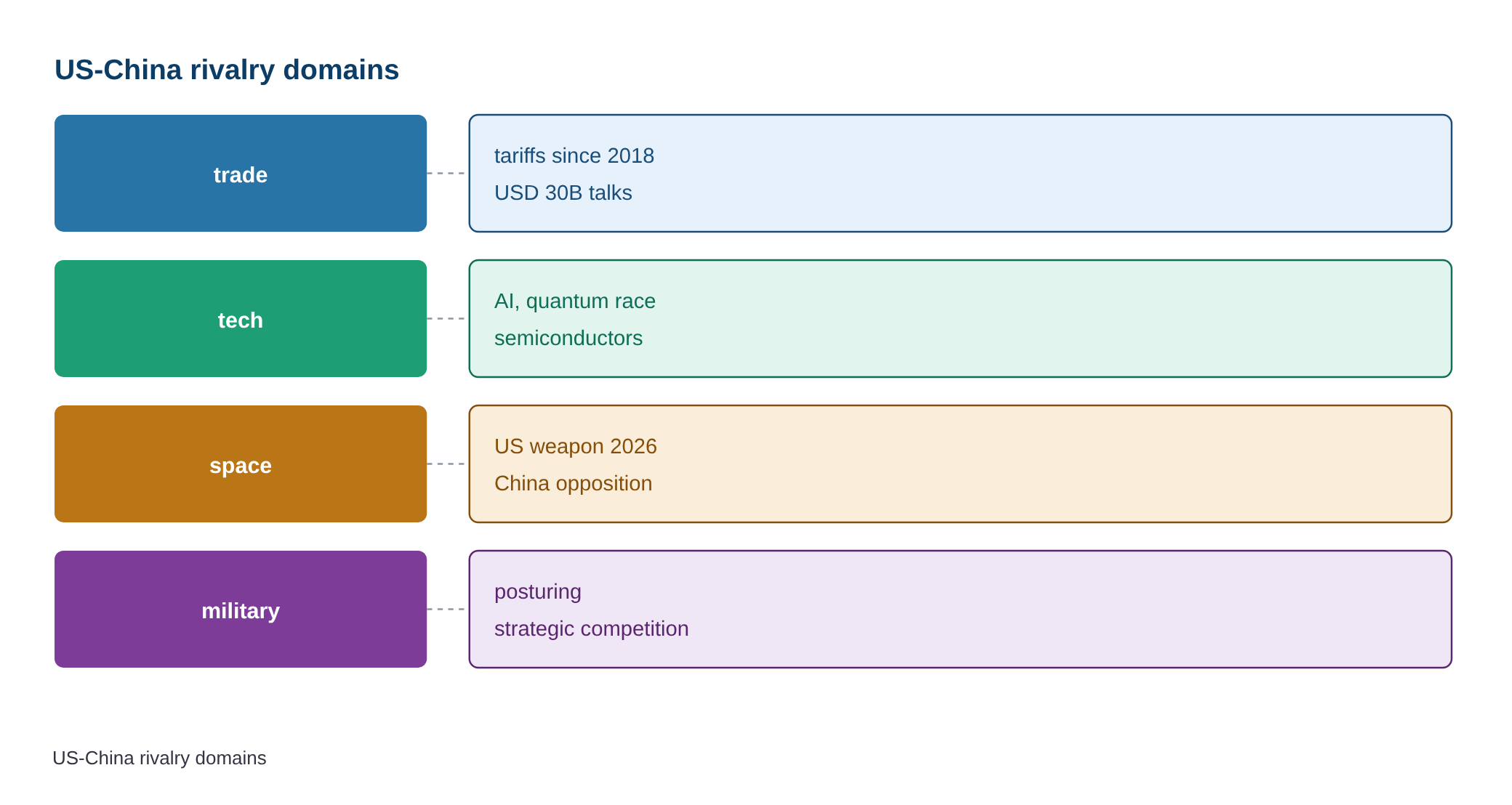
- Bilateral Trade and Tariffs: The summit is expected to address ongoing trade disputes, including the US proposal for a reciprocal tariff reduction framework covering goods worth USD 30 billion from each side, aimed at easing trade tensions.
- Artificial Intelligence (AI) Governance: The US has proposed a notification mechanism for AI incidents that could affect national security, reflecting growing concerns over the dual-use nature of AI technologies and their geopolitical implications.
- Military and Space Security: The summit will likely discuss the US confirmation of offensive space capabilities and China’s opposition to unilateral sanctions, highlighting the militarisation of space and its implications for global stability.
- Energy and Sanctions: The ‘Lindsey O. Graham Sanctioning Russia and Iran Act of 2026’ authorises steep tariffs on major importers of Russian oil and gas, including China and India, raising questions about the extraterritorial application of sanctions and long-arm jurisdiction.
- Geopolitical Alignments: The summit will address the Russia-Ukraine War, US arms sales to Taiwan, and conflicts in the Middle East, reflecting the broader strategic competition between the US and China in shaping global governance.
- Reciprocal Engagement: The summit follows Trump’s invitation to Xi during his visit to China in May 2026, signalling an attempt to institutionalise high-level exchanges despite underlying tensions.
Key Features
| Feature | Significance |
|---|---|
| High-level diplomatic engagement | The Xi-Trump summit represents a rare high-level diplomatic engagement between the two largest economies, aimed at stabilising bilateral relations amid escalating trade and technology tensions. |
| AI governance and regulation | The proposed US-China notification mechanism for AI incidents underscores the global imperative to establish norms for emerging technologies, particularly in national security contexts. |
| Trade tariff dynamics | The reciprocal tariff reduction framework under negotiation reflects efforts to mitigate protectionist measures that could disrupt global supply chains and economic stability. |
| Space militarisation | The US confirmation of deploying a space weapon in Earth’s orbit highlights the growing militarisation of outer space, a domain increasingly critical to national security and technological supremacy. |
| Energy geopolitics | The Lindsey O. Graham Sanctioning Russia and Iran Act of 2026 introduces tariff threats on major oil and gas importers, including China and India, reshaping global energy trade dynamics and geopolitical alliances. |
Why it Matters
Economic and Trade Relations
- The summit is pivotal in addressing trade imbalances, tariff disputes, and reciprocal market access issues that have strained US-China economic ties since 2018.
- Negotiations on a USD 30 billion reciprocal tariff reduction framework signal a potential easing of protectionist measures, benefiting global trade flows.
- The US proposal for an AI incident notification mechanism reflects a shared interest in mitigating risks from AI-driven disruptions, particularly in critical infrastructure and defence.
Technological and Strategic Competition
- The summit occurs against the backdrop of intensified competition in artificial intelligence, quantum computing, and semiconductor technologies, with both nations seeking to establish dominance in these sectors.
- The US deployment of a space weapon and China’s opposition to unilateral sanctions highlight the militarisation of space and the erosion of multilateral norms in technology governance.
- Discussions on AI regulation and military ties underscore the need for bilateral and multilateral frameworks to prevent technological escalation and ensure strategic stability.
Geopolitical Implications
- The summit’s timing, following the Lindsey O. Graham Act, suggests a linkage between trade policies and geopolitical objectives, particularly concerning energy imports from Russia and Iran.
- China’s rejection of US tariffs over Russian oil purchases reflects its stance on non-interference in sovereign trade relations, a principle central to its foreign policy doctrine.
- The summit’s focus on conflicts in the Middle East and the Russia-Ukraine war indicates efforts to coordinate or at least align positions on global security challenges, despite deep strategic divergences.
Institutional and Diplomatic Processes
- The inclusion of high-ranking officials, such as the US Treasury Secretary and Chinese Foreign Minister, demonstrates the institutionalisation of dialogue mechanisms to manage bilateral tensions.
- The summit’s scheduling within six months of the previous meeting reflects an attempt to institutionalise high-level exchanges, reducing the risk of miscalculation or unintended escalation.
- The proposed notification mechanism for AI incidents represents a potential model for future technological governance, requiring robust institutional frameworks for implementation and compliance.
Challenges
1. Unilateral Sanctions and Long-Arm Jurisdiction
- The Lindsey O. Graham Act authorises tariffs on major oil and gas importers, including China and India, raising concerns over the extraterritorial application of US laws.
- China’s opposition to such measures highlights the tension between unilateral sanctions and the principles of sovereignty and non-interference enshrined in international law.
- The lack of a UN Security Council mandate for these sanctions weakens their legitimacy and risks undermining multilateral institutions.
UPSC Link: GS-II: International Institutions
2. Technological Escalation and AI Governance
- The absence of globally accepted norms for AI governance creates risks of unintended escalation, particularly in military applications and critical infrastructure.
- The proposed US-China notification mechanism, while a step forward, lacks binding enforcement mechanisms, leaving room for ambiguity and non-compliance.
- The militarisation of space and the development of AI-driven autonomous weapons systems pose existential risks to global stability, necessitating urgent international frameworks.
UPSC Link: GS-III: Science & Technology
3. Trade Protectionism and Supply Chain Disruptions
- Escalating trade tariffs and protectionist measures threaten to fragment global supply chains, particularly in sectors like semiconductors, pharmaceuticals, and renewable energy.
- The reciprocal tariff reduction framework, though under negotiation, faces domestic political hurdles in both countries, delaying its implementation.
- The imposition of tariffs on energy imports could destabilise global energy markets, with cascading effects on economic growth and inflation in importing nations.
UPSC Link: GS-III: Economy
4. Geopolitical Realignment and Energy Security
- The Lindsey O. Graham Act’s tariff threats on Russian oil and gas importers, including China and India, risk reshaping global energy alliances and supply routes.
- China’s continued reliance on Russian energy sources, despite US pressure, underscores the complexity of decoupling from geopolitically entrenched trade relationships.
- The summit’s discussions on the Middle East and Russia-Ukraine conflicts highlight the challenge of balancing strategic interests with economic dependencies.
UPSC Link: GS-II: International Relations
5. Space Militarisation and Strategic Stability
- The US confirmation of deploying a space weapon in Earth’s orbit marks a significant escalation in the militarisation of outer space, a domain governed by the Outer Space Treaty (1967).
- The absence of binding international treaties to regulate space weapons increases the risk of an arms race in space, with potential catastrophic consequences for global security.
- China’s opposition to US space militarisation efforts reflects its own investments in space capabilities, necessitating dialogue to prevent a destabilising arms race.
UPSC Link: GS-III: Science & Technology
Challenges — UPSC Perspective
| Issue | Concern |
|---|---|
| Extraterritorial application of US laws | Erosion of sovereignty and non-interference principles in international trade and energy relations. |
| Absence of AI governance norms | Risks of unintended escalation in AI-driven technologies, particularly in military and critical infrastructure applications. |
| Fragmentation of global supply chains | Threat to economic stability due to protectionist trade policies and tariff disputes. |
| Geopolitical realignment in energy markets | Potential destabilisation of global energy trade routes and alliances due to tariff threats and sanctions. |
| Militarisation of outer space | Increased risk of an arms race in space, undermining strategic stability and global security. |
| Lack of binding enforcement mechanisms | Ambiguity and non-compliance in proposed frameworks, such as the AI incident notification mechanism. |
Way Forward
- Establish a bilateral US-China working group on AI governance to develop binding norms for incident reporting and risk mitigation, in alignment with existing multilateral frameworks.
- Revive negotiations on the reciprocal tariff reduction framework to reduce trade barriers and stabilise global supply chains, with a focus on sectors critical to both economies.
- Convene a UN-led initiative to negotiate a treaty on the prevention of an arms race in outer space, incorporating provisions for transparency and verification.
- Develop a joint mechanism with the EU and other major economies to address the extraterritorial application of sanctions, ensuring compliance with international law.
- Strengthen multilateral institutions, such as the WTO and UN Security Council, to address trade disputes and geopolitical tensions through dialogue rather than unilateral measures.
- Promote Track-II diplomacy involving think tanks, academia, and industry to build trust and explore cooperative solutions in technology and trade.
- Enhance transparency in energy trade policies to reduce geopolitical risks and ensure energy security for all nations, particularly in the context of the Russia-Ukraine war.
UPSC Value Addition
Keywords for Mains Answer-Writing
Great Power Competition · US-China bilateral relations · Trade tariffs and sanctions · Artificial Intelligence governance · Long-arm jurisdiction · Unilateral sanctions · Space militarisation · Technology race · Reciprocal tariff reduction frameworks · International law and multilateralism · Bilateral summits and diplomatic engagements · National security and economic statecraft
Concept Flow
Escalation of US-China trade and technology tensions (2018–present) → Imposition of unilateral tariffs and sanctions (e.g., Lindsey O. Graham Act of 2026) → Militarisation of space and AI-driven strategic competition → High-level diplomatic engagement (Xi-Trump summit) → Negotiation of reciprocal frameworks (tariff reduction, AI governance) → Potential stabilisation or continued fragmentation of global order.
Prelims Practice Questions
Q1. Consider the following statements regarding the recent Xi-Trump summit in Washington (2026):
1. The summit focused exclusively on trade tariffs between the US and China.
2. The US proposed a new notification mechanism for artificial intelligence (AI) incidents affecting national security.
3. The summit was the first time the US acknowledged the deployment of a space weapon in Earth’s orbit.
4. The US imposed a 100% tariff on all crude oil and gas imports from Russia, including those from China and India.
How many of the above statements are correct?
- Only one
- Only two
- Only three
- All four
Answer: Only three — Statement 1 is incorrect as the summit covered a broad range of issues including trade, technology, AI, military ties, and conflicts. Statement 2 is correct as reported by US Treasury Secretary Scott Bessent. Statement 3 is correct as the US confirmed the deployment of a space weapon in Earth’s orbit. Statement 4 is incorrect as the tariff was authorised but not imposed on all imports; it targeted the top five importers.
Q2. Assertion (A): China has consistently opposed unilateral sanctions imposed by the US, terming them as violations of international law.
Reason (R): The US has imposed unilateral sanctions on China for its purchases of Russian oil and gas, citing national security concerns.
Options:
A. Both A and R are true, and R is the correct explanation of A.
B. Both A and R are true, but R is NOT the correct explanation of A.
C. A is true, but R is false.
D. A is false, but R is true.
Answer: ? — Assertion (A) is true as China has repeatedly criticised unilateral sanctions imposed by the US, arguing they lack a basis in international law. Reason (R) is also true and directly explains A, as the US sanctions on Chinese purchases of Russian oil and gas are a cited example of such unilateral measures.
Q3. Match the following bilateral initiatives between the US and China with their respective domains:
Column I (Initiative) | Column II (Domain)
1. Reciprocal tariff reduction framework | A. Artificial Intelligence governance
2. Lindsey O. Graham Sanctioning Russia and Iran Act of 2026 | B. Trade and economic cooperation
3. New notification mechanism for AI incidents | C. Sanctions and geopolitical coercion
4. Deployment of a space weapon | D. Space militarisation
Options:
A. 1-B, 2-C, 3-A, 4-D
B. 1-A, 2-B, 3-C, 4-D
C. 1-D, 2-C, 3-B, 4-A
D. 1-C, 2-A, 3-D, 4-B
Answer: ? — 1-B: The reciprocal tariff reduction framework pertains to trade and economic cooperation. 2-C: The Lindsey O. Graham Act authorises sanctions against Russia and Iran, a geopolitical coercion tool. 3-A: The AI notification mechanism is related to AI governance. 4-D: The deployment of a space weapon falls under space militarisation.
Mains Practice Question
✍ The contemporary US-China bilateral summit reflects the intensification of geopolitical competition across multiple domains, including trade, technology, and space. Critically analyse the implications of this competition for the rules-based international order and the principle of multilateralism. (15 Marks)
Approach: MODEL-ANSWER SKELETON:
1. **Introduction (2 marks):** Define geopolitical competition between the US and China, highlighting the domains of trade, technology (AI), and space militarisation as per the summit context.
2. **Trade and Economic Statecraft (4 marks):**
– Discuss the imposition of unilateral tariffs and sanctions (e.g., Lindsey O. Graham Act) and their impact on the WTO rules-based order.
– Explain the concept of ‘long-arm jurisdiction’ and its conflict with the principle of non-interference in domestic trade.
– Mention the proposed reciprocal tariff reduction framework as a counter-example to unilateralism.
3. **Technology Race and AI Governance (4 marks):**
– Analyse the US proposal for a notification mechanism for AI incidents affecting national security as an attempt to regulate emerging technologies.
– Discuss the broader implications for global AI governance frameworks, including the role of multilateral institutions like the UN.
– Reference the need for international norms to prevent technological decoupling.
4. **Space Militarisation and Security Dilemmas (3 marks):**
– Examine the US confirmation of deploying a space weapon and China’s likely responses, framing it within the Outer Space Treaty (1967) and the Prevention of an Arms Race in Outer Space (PAROS) discussions.
– Discuss how this escalation challenges the principle of peaceful uses of outer space.
5. **Impact on Multilateralism and International Law (2 marks):**
– Critically assess how unilateral actions by the US and China undermine multilateral institutions (e.g., WTO, UNSC) and the principle of collective security.
– Highlight the role of middle powers (e.g., India, EU) in preserving multilateral norms amidst great power competition.
6. **Conclusion (1 mark):** Summarise the findings and suggest the need for renewed diplomatic efforts to reinstate multilateral frameworks.
Source: orissapost.com
Generated by AanyaAi for educational purpose.
Related guides on our sites
- Current affairs for upsc 2026
- Best PSIR optional coaching for upsc
- Best PSIR optional teacher for upsc
- Best teacher of PSIR optional for upsc

- Xi-Trump Summit 2026: Key Agenda for UPSC & State PCS Aspirants - September 23, 2026
- ओडिशा सरकार और केंद्र की मिलीभगत से डीजीपी नियुक्ति में हस्तक्षेप: सुप्रीम कोर्ट - September 23, 2026
- Supreme Court Slams Odisha-Centre Collusion in DGP Appointment Case - September 23, 2026

No Comments